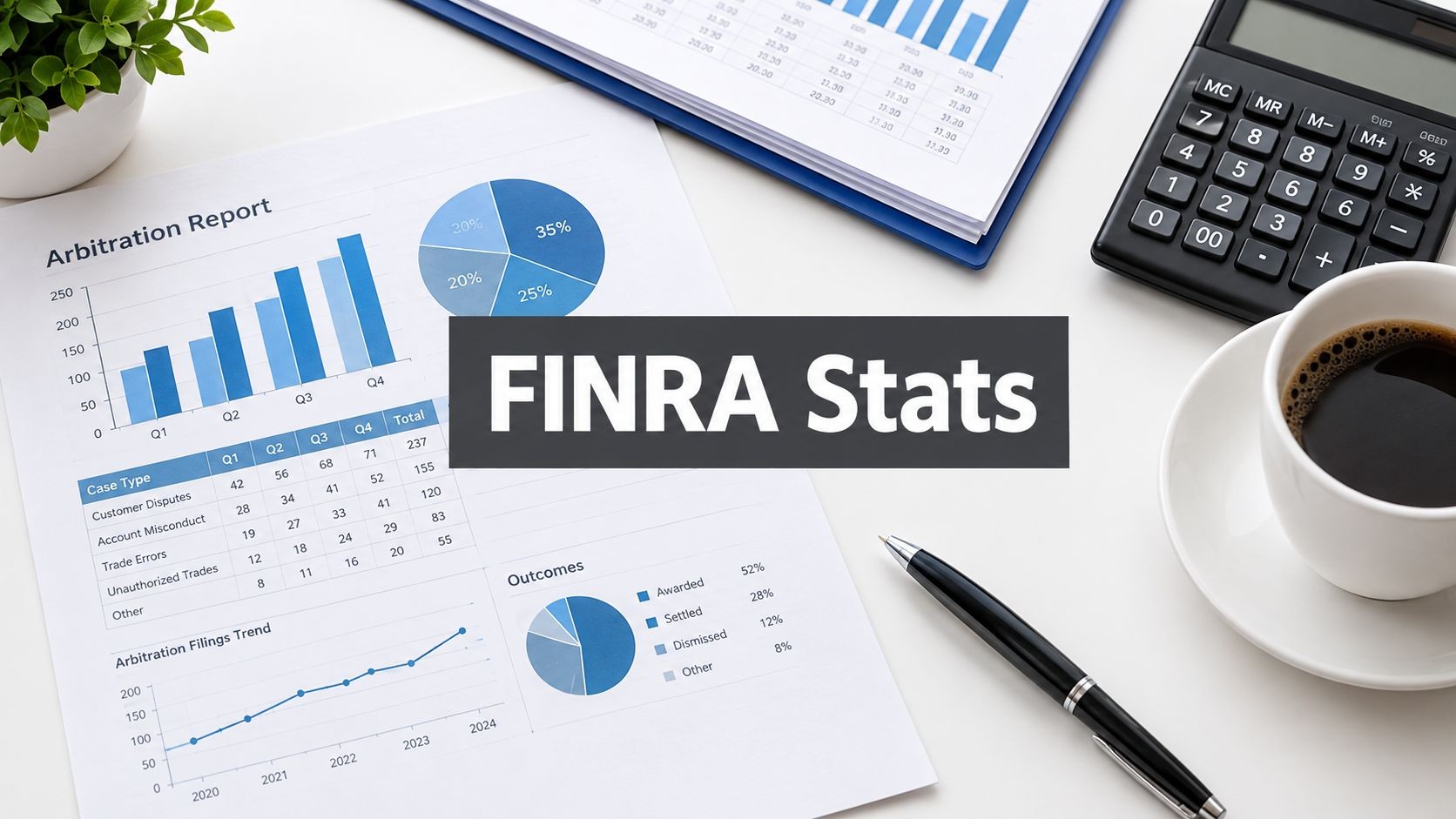
In 2024, 70% of customer FINRA arbitration cases settled directly between the parties, and approximately 84% closed through settlement or paid damages, with an average overall duration of 12.5 months. Those figures show that recovery usually depends less on winning a public hearing than on preparing a claim that can resolve effectively before or during the arbitration process.
Investors often search FINRA arbitration statistics for a simple answer: What are my chances of getting my money back? The statistics can't answer that question by themselves. They can show how cases move through the forum, but your recovery depends on proof of misconduct, documented losses, causation, available assets, and the respondent's ability to pay.
The most useful approach is to separate four outcomes: settlement, arbitration award, payment, and actual recovery. Treating those outcomes as interchangeable creates bad expectations and can lead investors to accept weak advice about the value of a claim.
Understanding FINRA Arbitration Statistics and What They Mean for Your Claim
70% of customer cases settled directly between the parties, 13% went to an award, and 1% ended with an unpaid award. Those outcome categories matter more than raw filing counts because they answer different questions about risk, timing, and the realistic path to recovery. FINRA's published customer-case data also shows that many cases close without a merits hearing and that average duration still runs long enough to make early case evaluation important.
For investors, the practical mistake is treating settlement, arbitration award, payment, and actual recovery as if they were interchangeable. They are not. A settlement may resolve the dispute without any public decision. An award reflects what arbitrators ordered after hearing the case. Payment asks whether the respondent satisfied that obligation. Actual recovery is what the investor received after timing, offsets, and collectability issues are sorted out.
That distinction changes how I assess a case. A high settlement rate does not show what claimants recovered, whether the amount matched the losses, or whether nonmonetary terms affected the result. An award rate does not measure the value of settled claims, and an unpaid-award figure does not capture every collection problem that can arise after a claimant technically wins.
Use the numbers as a screening tool.
I evaluate FINRA arbitration statistics in three steps:
- Identify the outcome category. Confirm whether the figure refers to filings, closed cases, settlements, awards, paid damages, or unpaid awards.
- Match the category to the question. If the issue is likely recovery, filing volume has limited value. If the issue is hearing risk, award data may help, but it still leaves out the many claims that resolve before a final decision.
- Test the claim with documents. Review account statements, trade confirmations, emails, notes of calls, and other communications alongside the theory of liability and damages. Those records usually do more to value a case than any headline percentage.
Practical rule: A settlement is not the same as an award, an award is not the same as payment, and payment is not necessarily full recovery.
Investors also need a clear view of the forum itself. A short explanation of what FINRA does helps separate FINRA's regulatory role from its job administering customer arbitrations.
Where the record spans years of statements and trading activity, organization matters. Tools for analysis methods and visualization can help sort concentration, timing, withdrawals, and loss periods. They help present the facts clearly, but the claim still turns on admissible records and a defensible damages model.
Historical Trends in FINRA Arbitration Filing Volume
Raw filing volume matters because it shows whether FINRA arbitration remains a recurring forum for investor disputes. It doesn't, however, establish that claims are becoming stronger, weaker, easier, or harder to win.
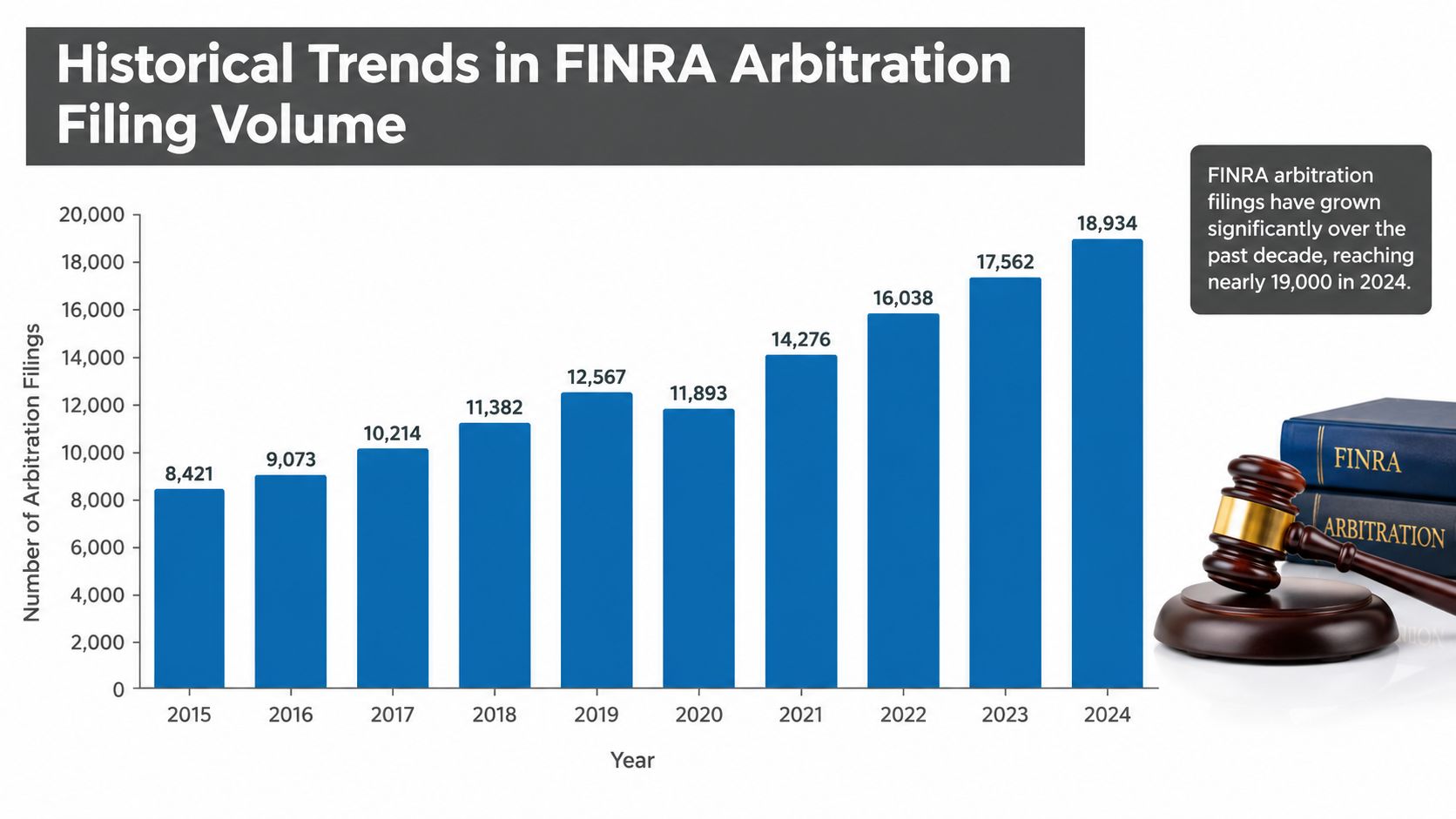
FINRA recorded 3,822 total arbitration filings in 2014, including 2,662 customer cases, which represented 70% of all filings, as reported in FINRA's historical dispute-resolution data. By 2016, total filings had declined to 3,681, consisting of 2,519 customer cases, or 68%, and 1,162 intra-industry cases, or 32%.
The later data shows why a single annual number can mislead. Filings fell to 2,671 in 2022, then rose sharply to 3,382 in 2023, a 27% year-over-year increase. In 2024, total filings dropped 27% to 2,469.
What the trend does and doesn't show
Customer disputes remained the majority in the reported years, but their share varied from 56% to 70%. In 2023, customer filings totaled 1,891, or 56%, while intra-industry filings totaled 1,491, or 44%. In 2024, customer filings declined to approximately 1,595, or 65% of the total, while intra-industry filings accounted for approximately 35%.
| Period or year | Total filings | Customer-case context |
|---|---|---|
| 2014 | 3,822 | 2,662 customer cases, 70% |
| 2016 | 3,681 | 2,519 customer cases, 68% |
| 2022 | 2,671 | Customer cases remained part of the national forum |
| 2023 | 3,382 | 27% increase from 2022, 1,891 customer cases |
| 2024 | 2,469 | 27% decline from 2023, approximately 1,595 customer cases |
The practical conclusion is restrained but important. FINRA arbitration has handled thousands of new cases in most reported years, so it isn't an occasional remedy used only in unusual disputes. At the same time, annual fluctuations reflect changing market conditions and dispute volume. Investors shouldn't interpret a rise as proof that recovery is more likely or a decline as proof that arbitration has lost relevance.
Resolution Outcomes and Time-to-Resolution Data
Among 232 customer claimant cases decided in 2024 through hearings, special procedures, or paper submissions, customers received damages in 61 cases, or 26%. That is the narrower outcome investors usually want, because it isolates decided cases instead of blending them with settlements, withdrawals, dismissals, and other closures.
That number still needs context. A hearing decision is not the same thing as an overall case result, and it is definitely not the same thing as money collected. In practice, investors need to separate four different questions: did the case settle, did the panel issue an award, did the respondent pay, and is the award realistically collectible. Those are related, but they are not interchangeable. A published award can look favorable on paper and still leave a collection problem.
Time-to-resolution matters for the same reason. FINRA reported an average overall case duration of 12.5 months. By procedure, regular hearing decisions averaged 16.4 months, special-proceeding decisions averaged 7.3 months, and paper decisions averaged 5.4 months.
Those averages are useful, but only to a point.
A paper case can close faster, yet speed often comes with trade-offs. If the dispute turns on witness credibility, suitability explanations, sales practice conversations, or a complicated trading record, a shorter process may limit how fully the evidence can be developed. A regular hearing usually gives counsel more room to build the record, test testimony, and present damages, but it also requires more preparation and patience.
The calendar in a real case is rarely just the published average. Document collection, statement-of-claim amendments, discovery fights, hearing scheduling, mediation efforts, and settlement negotiations can all affect the path from filing to closure. I tell investors to treat forum averages as planning tools, not promises.
The same caution applies to awards. A formal award is one endpoint, not the whole recovery analysis. Investors reviewing FINRA arbitration awards should focus on what the panel ordered, whether any claims were denied, whether interest or fees were included, and whether the respondent has the ability to pay. Outcome statistics help frame expectations. They do not replace a case-by-case review of liability, damages, and collectability.
Five-Year Customer Case Analysis and Award Patterns
A longer period provides more context than one year's outcome data. FINRA's 2021-2025 forum data recorded 14,023 newly filed cases, of which 8,707 were customer disputes, approximately 62.1%, as shown in FINRA's forum data notice.
During the same period, 10,393 customer cases closed. Of those, 7,385, or 71%, settled before an award, while 1,391, or 13%, closed by award. Among the cases closed by award, customers received damages in 409 cases, or 29%.
Those figures describe the overall closed-case mix. They don't answer the narrower question of what happened when a customer case reached a merits hearing and received an award decision.
The merits-hearing comparison
FINRA separately identified 734 customer cases decided by award after a merits hearing. Customers received damages in 313 of those cases, or 43%.
That figure is not a general claimant win rate. It excludes cases that settled, withdrew, were dismissed before a merits hearing, or ended through another resolution. The comparison is still valuable because it shows how dramatically the denominator changes the apparent result.
| Measurement | What it describes | Customer outcome |
|---|---|---|
| All newly filed cases | Customer share of 2021-2025 filings | 8,707 of 14,023, approximately 62.1% |
| Closed customer cases | Settled before an award | 7,385, or 71% |
| Closed customer cases | Closed by award | 1,391, or 13% |
| Award-closed cases | Customers received damages | 409, or 29% |
| Award decisions after merits hearings | Customers received damages | 313 of 734, or 43% |
The professional lesson is simple: always ask what cases are included in the denominator. A percentage based on all closed cases answers a different question from a percentage based only on award decisions after a merits hearing.
For an individual investor, the relevant inquiry is more specific. Does the claim involve unsuitable recommendations, unauthorized trading, churning, concentration, misrepresentations, omission of material risks, breach of fiduciary duty, or another recognized theory? Can the records show what the broker knew, what the investor needed, what was recommended, and how the conduct caused the loss? Statistics help calibrate expectations, but those facts drive the evaluation.
Common Misinterpretations of Arbitration Award Statistics
The most common error is to treat the award percentage as the probability that a new claimant will recover money. Approximately 18% of all customer cases proceed to an award, according to FINRA's customer resolution information. That means most customer matters don't produce a public arbitrator decision.
A second error runs in the opposite direction. Some investors see high settlement levels and assume that settlement means full reimbursement. Settlement data generally doesn't disclose the demanded amount, the percentage recovered, confidential terms, nonmonetary concessions, or the timing of payment. Without those details, the statistic can't establish the quality of the result.
Four outcomes require four questions
Settlement means the parties reached an agreement. Ask whether the amount reflects the provable loss, whether the release covers related claims, and whether payment terms are realistic.
Award means arbitrators issued a decision. Ask whether the award includes compensatory damages, interest, fees, costs, or other relief, and whether the decision resolves every material issue.
Payment means the respondent paid an amount due. An award can be legally favorable without producing immediate funds.
Recovery means money reached the investor and should be evaluated against the loss, expenses, taxes, and the broader financial harm. It may be partial rather than complete.
Collectability matters as much as liability when the respondent has limited assets, insolvency concerns, or a history of unpaid obligations.
FINRA separately tracks unpaid customer awards. That tracking demonstrates why obtaining an award doesn't always equal receiving money. A strong liability case may still require an enforcement plan, respondent-asset investigation, or a realistic settlement strategy.
The issue is especially serious for retirees, victims of broker theft, and investors in illiquid private placements. In those disputes, the claimant may need to establish not only how the conduct violated an obligation, but also what assets remain available and whether the respondent or brokerage firm can satisfy a judgment or award.
Investors should resist any advertisement that presents one percentage as a guaranteed outcome. A responsible evaluation identifies the data set, explains its exclusions, and then turns to the evidence in the individual account.
FINRA Arbitration Filing Fees and Cost Structure
FINRA Rule 12900 bases the claimant's filing fee on the amount claimed, excluding interest, attorneys' fees, and expenses. The applicable FINRA arbitration fee schedule sets fees across claim ranges, so accurate claim valuation matters before filing.
| Amount claimed | Filing fee |
|---|---|
| $0.01 to $1,000 | $50 |
| $1,000.01 to $2,500 | $75 |
| $2,500.01 to $5,000 | $175 |
| $5,000.01 to $10,000 | $325 |
| $10,000.01 to $25,000 | $425 |
| $25,000.01 to $50,000 | $600 |
| Above $50,000 through $100,000 | $975 |
| Above $100,000 through $500,000 | $1,425 |
| Above $500,000 through $1 million | $1,740 |
| Above $1 million through $5 million | $2,025 |
| Exceeding $5 million | $2,300 |
| Nonmonetary or unspecified claim | $1,600 |
The filing fee is only one part of the cost structure. A case may also involve legal fees, expert analysis, document review, hearing preparation, travel, and other expenses. The fee schedule doesn't determine whether a claim is economically sensible. That decision requires comparing the likely provable recovery with the evidence burden, procedural demands, and collectability.
For a plain-language discussion of FINRA arbitration fees, investors should also ask how the representation agreement handles filing fees and case expenses. Depending on the agreement and outcome, some costs may be recoverable, but no investor should assume reimbursement is automatic.
Evaluating Your Claim Using Arbitration Statistics
Use the statistics to set expectations, then evaluate the claim on its own evidence. The most reliable process separates forum data from case proof.
Start with the account history. Collect monthly statements, trade confirmations, tax records, emails, text messages, account-opening documents, risk questionnaires, investment proposals, private-placement materials, and communications about withdrawals or losses. Missing records don't automatically defeat a claim, but gaps can make causation and damages harder to prove.
Next, identify the theory of liability. A concentrated portfolio may raise different issues from unauthorized trading. An unsuitable annuity presents different questions from a private placement or a broker-theft claim. The label matters less than the evidence showing the recommendation, the investor's circumstances, the risks disclosed, and the resulting loss.
Four tests for practical case value
Liability evidence: Can the records show what the broker or firm recommended, authorized, represented, or failed to disclose?
Loss calculation: Can an expert or attorney separate market movement from losses caused by the alleged misconduct? A statement showing a decline isn't automatically a damages model.
Causation: Can the claim connect the conduct to the financial harm? The respondent will often argue that market conditions, investor decisions, or unrelated events caused the loss.
Collectability: If the claim succeeds, can the respondent or responsible firm pay? This question becomes central when the alleged wrongdoer is an individual, an insolvent entity, or a promoter of an illiquid investment.
The statistical benchmarks should inform, not replace, this analysis. Settlement is the dominant resolution path, but settlement value depends on negotiating power and proof. Award statistics provide context, but an award-focused percentage excludes many claims that resolve differently. Filing volume confirms that the forum is active, but it says nothing conclusive about your claim's merits.
A practical evaluation should end with a decision, not a percentage. File, investigate further, negotiate, pursue another legal forum, or decline the claim if the evidence and economics don't support it. That decision should account for deadlines and possible statute-of-limitations issues, which can affect rights even when the underlying misconduct appears clear.
Next Steps for Investors Pursuing Arbitration Recovery
Investors who suspect broker or advisor misconduct should preserve records before contacting the firm or deleting communications. Gather account statements, transaction confirmations, tax documents, emails, text messages, investment agreements, promotional materials, and a written timeline of conversations and losses.
A focused consultation should address five questions:
- What happened: Identify the recommendation, trade, omission, unauthorized act, or theft.
- Who was involved: List the broker, advisor, brokerage firm, issuer, promoter, and any related entity.
- What was lost: Separate account losses, fees, withdrawals, tax effects, and other claimed damages.
- What proves it: Match each allegation to a document, communication, witness, or account record.
- What can be recovered: Consider settlement, award, payment, enforcement, and respondent assets separately.
Investors comparing lawyers should ask who will handle the case, how experts and expenses are treated, whether the firm has experience with the specific investment product, and whether representation is offered on a contingency-fee basis. Firms serving legal practices also explain how Helbling Digital Media's legal expertise supports professional legal communications, but marketing materials shouldn't substitute for a detailed claim review.
Kons Law represents investors in FINRA arbitration and court actions involving broker misconduct, investment fraud, unsuitable recommendations, unauthorized trading, private placements, alternative investments, and financial elder abuse. The firm reports more than $50 million recovered across 700+ matters, offers free consultations, and typically structures representation on a contingency-fee basis. Investors can review the firm's approach to selecting a FINRA arbitration attorney and prepare records before the consultation.
If you would like a free consultation to discuss the investment loss recovery process in more detail, call Kons Law Firm at (860) 920-5181 for a FREE, NO OBLIGATION consultation. Visit Kons Law to discuss how settlement strategy, award analysis, payment risk, and collectability apply to your potential FINRA claim.
