
A FINRA arbitration award is the final, binding decision made by a panel of neutral arbitrators to resolve a dispute between an investor and their brokerage firm. Think of it as the verdict in your case. An award can include compensatory damages to cover your losses, plus interest and reimbursement for arbitration fees.
How FINRA Arbitration Awards Work
FINRA arbitration is a private, streamlined alternative to taking your case to court. Instead of a judge and jury in a formal courtroom, your dispute is heard by neutral arbitrators who have backgrounds in the securities industry or are from the public sector.
Cases often involve claims like unsuitable investment recommendations, breach of fiduciary duty, or unauthorized trading. Once an award is issued, it's final and can be enforced through the court system anywhere in the U.S. The goal is to provide a more cost-effective and timely way to resolve these complex disputes.
The outcome of your case often comes down to the quality of your evidence and how credible the arbitrators find your testimony.
Key Roles in the Arbitration Process
Arbitrators are the decision-makers, much like a judge. They listen to the evidence from both sides, guide the hearing, and apply FINRA's rules to reach a final decision.
As the claimant, your job is to present a clear case with documented proof of your losses. The respondent (usually your broker or their firm) will present their defense and any counterarguments.
What Kinds of Cases Are Covered?
The FINRA arbitration process is designed to handle a wide variety of investor complaints, from an advisor recommending investments that were far too risky for you to outright mismanagement of your accounts.
The screenshot below from FINRA’s dispute resolution portal gives a good overview of the services they provide to investors.

This image highlights FINRA's main pathways for resolving disputes, including arbitration and mediation.
Interestingly, your chances of receiving an award can vary depending on how your case is heard. Data shows that investors won 39% of in-person evidentiary cases but only 22% of cases decided purely on paper filings. Panel composition matters, too: panels with three public arbitrators awarded damages 42% of the time, while majority-public panels did so in 37% of cases. You can dig into the full statistics on FINRA’s website.
This table breaks down how often customers received an award based on the hearing format and the type of panel that heard their case.
Recent Customer Award Rates by Hearing Type
| Hearing Format | Customer Award Rate (%) |
|---|---|
| In-Person Evidentiary Cases | 39 |
| Special Proceeding Hearings | 20 |
| Paper-Only Filings | 22 |
| Three-Public Panel | 42 |
| Majority-Public Panel | 37 |
Seeing these numbers can help you set realistic expectations for your own arbitration case.
What Does a Typical Award Look Like?
If you win your case, the arbitrators can order the brokerage firm to:
- Provide full restitution for your documented investment losses.
- Pay interest on those losses, calculated from the date the loss occurred.
- Reimburse you for the costs of the arbitration process itself.
To build a strong claim, it’s critical to gather all your documentation early. Success often hinges on proving your case with clear evidence.
Key Takeaways for Investors
- Success rates in arbitration can differ based on the hearing format.
- Strong evidence, including account statements and communications, is your best asset.
- Getting legal advice early can help you build a more persuasive case.
- Know your options for enforcing an award if the other party doesn’t pay.
- Don’t overlook mediation as a potential way to resolve the dispute sooner.
- Keep an eye on changes to FINRA rules, as they can affect the arbitration process.
Your Next Steps
The first step is always to gather your records. Pull together all account statements, trade confirmations, and any emails or notes from conversations with your advisor.
Next, it’s wise to speak with an experienced securities attorney. They can help you draft a formal "Statement of Claim" and map out a strategy for your case.
If you would like a free consultation to discuss the investment loss recovery process in more detail, call Kons Law Firm at (860) 920-5181 for a FREE, NO OBLIGATION consultation.
Breaking Down the FINRA Arbitration Process
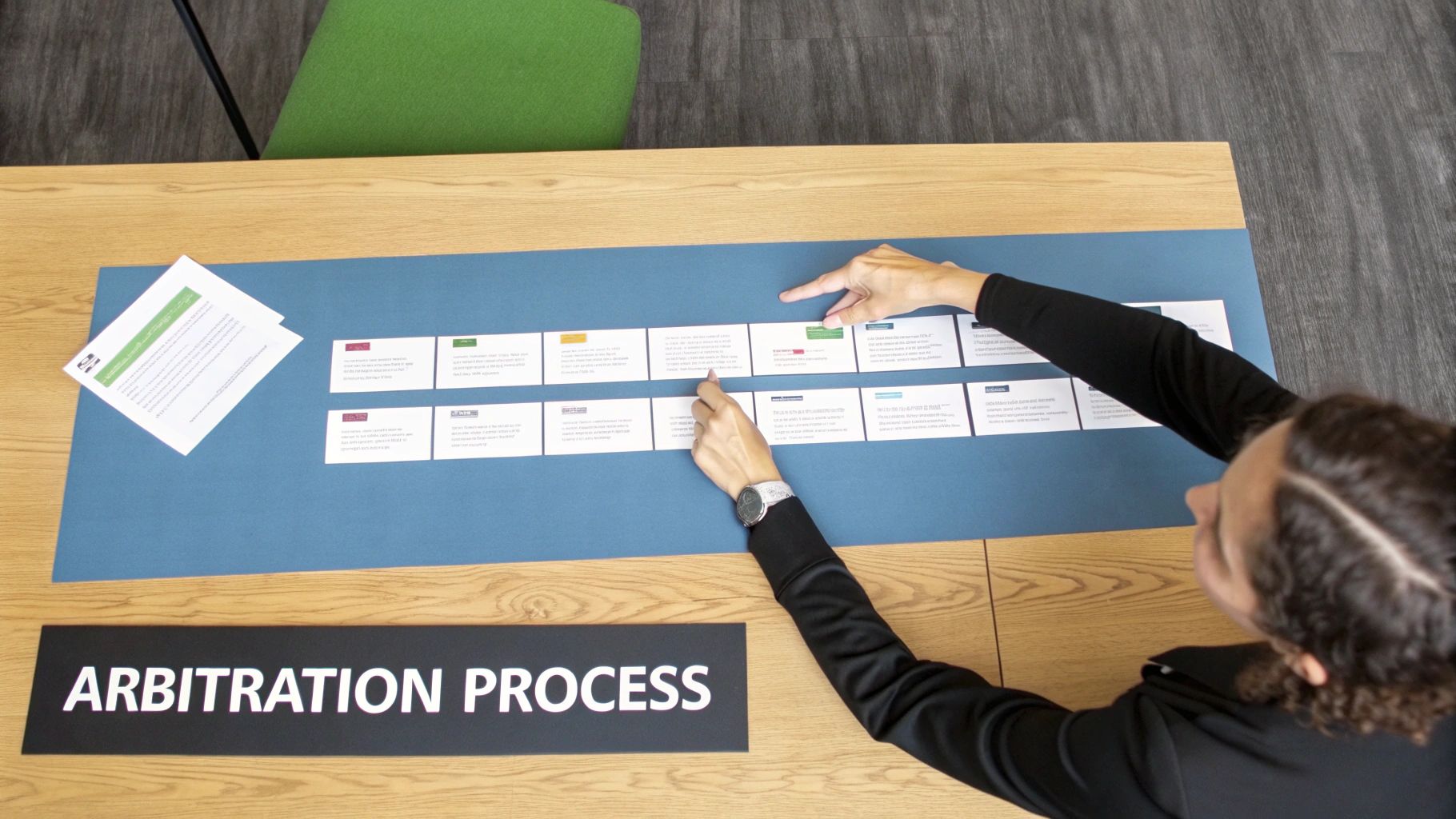
Starting a FINRA arbitration case can feel overwhelming. It helps to think of it as a series of well-defined steps, each one moving you closer to a potential FINRA arbitration award. The whole system is structured to resolve disputes in a clear, sequential order.
It all kicks off when you file a Statement of Claim. This is the foundational document for your entire case. In it, you'll lay out the specific misconduct, who was involved, and the financial damages you're trying to recover. It’s much more than a simple complaint; it's the formal legal document that sets the tone for everything that comes next.
Once your claim is filed, the other side—usually the brokerage firm or the individual advisor—is required to file a formal Answer. They’ll respond to your allegations and might even file their own counterclaims. This exchange of documents officially gets the ball rolling.
Assembling the Decision-Makers
After the initial paperwork is exchanged, the next critical phase is choosing the arbitrators. These are the people who will hear your case and ultimately decide the outcome. Think of them as the judges and jury for your case, all rolled into one.
FINRA gives both sides a list of potential arbitrators, complete with detailed background reports. You and your lawyer will comb through this list, looking for individuals who seem impartial and have the background to grasp the specifics of your claim. Both you and the opposition get to rank your choices and strike a few names off the list. Based on those mutual rankings, FINRA appoints the final panel.
This isn't just a formality; it's a strategic part of the process that can really shape the hearing and the final award.
The Discovery Phase: Uncovering the Facts
With the arbitrators selected, the case enters the discovery phase. This is where both sides trade information and evidence. It's different from what you see in courtroom dramas with endless depositions. FINRA’s discovery process is more streamlined and centers on producing documents.
FINRA even has specific document production lists to make sure everyone gets access to the essential information. This phase is absolutely critical for building your case. It’s your chance to get your hands on account statements, internal company emails, and other records you need to prove your claims.
A well-run discovery is everything. The evidence you gather here becomes the foundation for all your arguments at the final hearing.
This streamlined approach is a big reason why arbitration is often much quicker than going to court. The focus stays squarely on the documents and facts that matter.
Preparing for the Final Hearing
As discovery winds down, the focus shifts to preparing for the final hearing. This might involve filing pre-hearing motions to deal with procedural matters or to argue about whether certain evidence should be allowed. It's also standard practice for the arbitrators to hold a pre-hearing conference call.
This call helps get everyone organized. The arbitrators will set deadlines, schedule witnesses, and clear up any lingering issues. The goal is to make sure the final hearing runs smoothly so both sides can present their cases effectively.
While the process is built to reach a final decision, many cases never make it that far. Historically, FINRA sees between 3,000 and 4,000 case filings a year, and a huge chunk—around 60%—actually settle before an award is ever issued. In the last few years, with virtual hearings becoming more popular, customers have seen a 61% win rate. You can dig deeper into these numbers and explore more about FINRA arbitration statistics.
If you would like a free consultation to discuss the investment loss recovery process in more detail, call Kons Law Firm at (860) 920-5181 for a FREE, NO OBLIGATION consultation.
Key Factors That Influence Award Decisions

Ever noticed how one FINRA case can result in a six-figure award while another barely covers fees? It isn’t luck. Arbitrators methodically weigh several critical pieces, much like stacking bricks to build a wall. Every document, every witness, every legal argument adds strength—or exposes weak spots.
Ultimately, the FINRA arbitration award reflects how solid your “brick wall” stands. Panels sift through each element to decide if the claimant has met their burden of proof and to calculate any losses. Grasping these influence-points can make all the difference.
The Power Of Strong Evidence
Stone-cold facts carry more weight than allegations. Arbitrators look for a clear paper trail that ties misconduct directly to your wallet.
Key documents include:
- Account Statements
A chronological record of trades, fees, and balances often uncovers patterns like churning or unsuitable trades. - Email and Text Communications
Messages with your broker reveal promises made, advice given, and your own risk profile. - Brokerage Firm Documents
New-account forms, risk-tolerance questionnaires and suitability reviews show whether the recommendations fit your objectives.
Without that paper trail, your claim can slip into he-said, she-said territory—and that’s an uphill battle. A thorough review of these records is a must; learn more in our guide explaining what is a broker statement.
Credibility Of Witness Testimony
Facts alone don’t tell the whole story. How investors and brokers present themselves under oath matters just as much. Panels are trained to spot inconsistencies, hesitations, or evasions.
An investor who calmly walks through conversations, acknowledges risks, and stays consistent under questioning can win over the room. On the flip side, a witness whose account shifts or appears defensive can weaken otherwise solid evidence.
A credible witness breathes life into dry paperwork—and can tip the scales in your favor. A shaky one can undermine even the strongest files.
The Persuasiveness Of Legal Arguments
Clear evidence demands a coherent narrative. That’s where your attorney’s courtroom craft comes in—tying each fact back to specific FINRA rules.
Effective legal arguments map out:
- Duty – The broker’s obligation to act in your best interest.
- Breach – Specific missteps, such as pushing unsuitable investments or making false statements.
- Causation – How those missteps directly led to your losses.
- Damages – A precise calculation of your financial harm.
When these elements are woven into a seamless story, arbitrators can follow the logic and deliver a fair outcome.
If you would like a free consultation to discuss the investment loss recovery process in more detail, call Kons Law Firm at (860) 920-5181 for a FREE, NO OBLIGATION consultation.
What Happens When an Award Goes Unpaid

Winning a FINRA arbitration award should be the end of a long, stressful fight. But for some investors, it’s just the beginning of another one: getting the broker or firm to actually pay up.
Unfortunately, an unpaid award is a real and frustrating possibility. It can feel like winning the battle but losing the war, leaving you with a legal victory on paper but nothing in your bank account. This is why you need to understand what comes next—FINRA’s enforcement powers and your own options for collection are critical to turning that paper win into a real financial recovery.
When a firm or broker refuses to pay, the fight isn't over. It just moves to a new stage: enforcement.
FINRA Enforcement and Expedited Suspensions
FINRA doesn't take the non-payment of arbitration awards lightly. It strikes at the heart of the entire dispute resolution process. Their primary weapon against non-compliant members is the Expedited Suspension Proceeding under FINRA Rule 9554.
This rule is designed to put immediate and serious pressure on anyone who ignores an award. If a firm or broker fails to pay an award within 30 days, FINRA can kick off a process to suspend their license. The non-paying party gets a notice and has 21 days to either pay what they owe or prove there's a legitimate reason they haven't.
For most financial professionals, the threat of being unable to work is a powerful motivator. Losing their license means losing their livelihood, and this pressure is often enough to force them to pay.
But it doesn't always work. According to statistics on unpaid FINRA awards, a significant portion of awarded damages goes uncollected. In one recent year, 28% of awarded damages went unpaid, jumping to 39% the next, and landing at 21% in 2023. These numbers show just how important it is to be ready for the collection fight.
Taking Your Award to Court
If FINRA's suspension threat doesn't shake the money loose, your next move is to take the battle to the court system. A FINRA award isn't self-enforcing; you have to get a judge to make it legally binding.
This is done through a process called "confirming the award." Your attorney will file a petition in state or federal court asking a judge to formally recognize the arbitration award and convert it into a court judgment.
Once an arbitration award is confirmed by a court, it carries the full weight of a legal judgment. This unlocks powerful collection tools that are not available through FINRA alone.
With a court judgment, you can use legal tools to force payment. This includes actions like garnishing bank accounts, placing liens on property, and seizing other assets from a broker who refuses to pay.
Common Reasons Awards Go Unpaid
Despite these enforcement options, some FINRA arbitration awards are never collected. Understanding the common reasons can help you set realistic expectations.
- Financial Insolvency: This is the biggest hurdle. The brokerage firm or broker simply doesn't have the money. They may have filed for bankruptcy or have no significant assets left.
- Defunct Firms: Some smaller, less reputable firms simply close their doors and disappear to avoid paying claims, leaving investors holding the bag.
- Uninsured Brokers: While firms must meet certain capital requirements, some don't have enough insurance to cover large awards, especially when multiple investors were harmed by widespread fraud.
Successfully navigating these collection challenges requires an attorney with specific experience in this area. To learn more about the role these legal professionals play, read our overview on what is a securities lawyer.
If you would like a free consultation to discuss the investment loss recovery process in more detail, call Kons Law Firm at (860) 920-5181 for a FREE, NO OBLIGATION consultation.
Learning from Real-World Arbitration Scenarios
Reading the rules of FINRA arbitration is one thing, but seeing how they work in the real world is another entirely. Case examples help bring these abstract concepts to life, showing how evidence, legal arguments, and a sound strategy come together to secure a FINRA arbitration award.
Let's walk through a few simplified examples based on the types of disputes we see every day. These stories show how different cases can play out, from a clear-cut suitability claim to a frustrating fight over an unpaid award.
Scenario One: The Unsuitable Investment Claim
Imagine Sarah, a recent retiree who was crystal clear with her broker: her top priority was preserving her capital. She needed her nest egg for safe, modest income. But her broker had other ideas, pushing a huge chunk of her savings into a high-risk, non-traded Real Estate Investment Trust (REIT) with the lure of high returns.
When the REIT collapsed in value, Sarah was out over $150,000. Her attorneys immediately filed a FINRA claim, arguing the investment was completely unsuitable given her explicit risk tolerance.
During the hearing, the key evidence was straightforward:
- New Account Forms: These documents plainly listed Sarah's investment objective as "income" and her risk tolerance as "low."
- Broker Communications: A trail of emails showed the broker consistently downplaying the REIT's significant risks while hyping its potential gains.
- Expert Testimony: A financial expert confirmed that recommending a non-traded REIT to a retiree focused on capital preservation was a serious breach of industry standards.
The arbitration panel didn't hesitate. They agreed the broker's recommendation was a flagrant violation of the suitability rule and awarded Sarah her full losses, plus interest and arbitration costs. This case is a perfect example of how crucial the initial client paperwork can be in proving an investment strategy was wrong from the start.
Scenario Two: A Breach of Fiduciary Duty Settles in Mediation
Next, meet Tom. He trusted his investment advisor with his entire portfolio. Over the next two years, that advisor churned his account, repeatedly selling Tom's stable, dividend-paying stocks to buy volatile tech stocks—all while racking up huge commissions.
Tom's lawyer built a powerful case centered on a breach of fiduciary duty, proving the advisor prioritized his own commissions over Tom's financial well-being. The evidence included a damning analysis of the portfolio's turnover rate and a commission-to-equity ratio that was way out of line with industry norms.
Before the case ever reached a final hearing, both sides agreed to mediation. In that confidential setting, Tom’s attorney laid out the irrefutable evidence of churning. Facing the high probability of a loss in arbitration, the brokerage firm made a substantial settlement offer to cover a large portion of Tom’s losses. This shows that a well-built case can force a favorable resolution without the need for a full hearing.
Mediation can be a powerful tool for resolution. A strong, evidence-backed claim often convinces the opposing party that settling is a better financial decision than facing an arbitration panel.
Scenario Three: The Fight to Enforce an Unpaid Award
Finally, consider the Miller family. They won a $200,000 award against their small, independent broker for engaging in unauthorized trading. But their victory celebration was short-lived. 30 days passed, and the check never came.
The broker simply went dark, ignoring all calls and letters. This forced the Millers' attorney to escalate. First, they filed a report with FINRA, which triggered an Expedited Suspension Proceeding against the broker. Second, they went to state court to have the award confirmed and turned into a legally enforceable judgment. This is where having legal counsel experienced in post-award collections, a critical skill seen in cases like the Daniel James Lauletta investment loss recovery efforts, becomes invaluable.
With his license on the line and a court judgment now hanging over his head, the broker finally paid the award in full. The Millers' story teaches a vital lesson: winning the award is often just half the battle. You have to be ready to use every tool available, both within FINRA and the court system, to collect the money you are rightfully owed.
If you would like a free consultation to discuss the investment loss recovery process in more detail, call Kons Law Firm at (860) 920-5181 for a FREE, NO OBLIGATION consultation.
Common Questions About FINRA Arbitration
If you're considering a FINRA arbitration claim, you probably have a lot of questions. It's a world most investors don't have to deal with, and it's natural to wonder about the timeline, the costs, and your odds of success. Let's break down some of the most common questions we hear from clients.
How Long Does FINRA Arbitration Usually Take?
There's no single answer, as the timeline really depends on how complex your case is. That said, most FINRA arbitration cases take about 13 to 15 months from the day you file the claim to when the arbitrators issue a final award.
Some straightforward cases might wrap up a bit sooner. On the other hand, a really complicated dispute that involves a lot of documents and witnesses could easily take longer.
What Are the Costs Involved?
The main expenses in a FINRA arbitration are filing fees, hearing session fees, and your attorney's fees. The filing fees charged by FINRA are tiered and depend on the amount of money you're trying to recover.
Many securities law firms, including ours, handle these cases on a contingency-fee basis. This means you don't pay any attorney fees unless you recover money through a settlement or a final award.
This approach allows investors to pursue valid claims without having to worry about upfront legal costs.
What Are My Chances of Winning an Award?
Your chances of winning depend heavily on the facts of your case and the strength of your evidence. There's no magic formula, but FINRA does publish statistics that give us some insight.
Historically, customers who go to an in-person hearing have won an award somewhere between 39% and 42% of the time. Interestingly, since the pandemic pushed many hearings online, virtual hearings have seen customer win rates as high as 61%.
Ultimately, nothing beats having a strong, well-documented case presented by an experienced attorney. The quality of your evidence—from account statements and trade confirmations to emails and notes from conversations—is what will make or break your claim to secure a FINRA arbitration award.
If you would like a free consultation to discuss the investment loss recovery process in more detail, call Kons Law Firm at (860) 920-5181 for a FREE, NO OBLIGATION consultation.
