
When you hand over your hard-earned money to a brokerage firm or financial advisor, you're placing a massive amount of trust in them. You expect them to act in your best interest. But who is making sure they actually play by the rules?
That's where FINRA comes in. It's the independent, non-governmental regulator for every single brokerage firm and stockbroker in the United States.
Understanding FINRA: Your Financial Watchdog

Think of the Financial Industry Regulatory Authority (FINRA) as the securities industry's chief referee. While it operates under the watchful eye of the Securities and Exchange Commission (SEC), it's important to know that FINRA itself is not a government agency. Its sole mission is to protect investors and maintain the integrity of the market.
At its core, any person or company that sells securities—like stocks, bonds, or mutual funds—to the public is required to be licensed and registered by FINRA. This creates a powerful system of accountability, forcing financial professionals to stick to a strict code of conduct designed to keep your investments safe.
The Core Mission of FINRA
FINRA's responsibilities are vast, but they all circle back to one central goal: protecting the average investor like you. To do this, it performs several key functions that form the very foundation of financial regulation in the U.S. Understanding these functions is easier when you see how firms implement regulatory compliance solutions to stay on the right side of the rules.
The work FINRA does every day has a direct impact on the fairness and safety of the markets you invest in.
At its heart, FINRA’s mission is about making sure that America’s investors are protected. It writes and enforces the rules governing the activities of all registered broker-dealer firms in the U.S.
This oversight is absolutely critical for maintaining public trust in our financial system. Without a dedicated watchdog, the door would be wide open for fraud and misconduct, leaving individual investors dangerously exposed to unethical practices.
To break it down, here is a quick look at FINRA's primary duties and what they mean for you.
FINRA's Core Functions at a Glance
| Function | What It Means for You as an Investor |
|---|---|
| Rulemaking & Enforcement | Sets the ethical and professional standards your broker must follow. If they don't, FINRA can discipline them. |
| Firm Examinations | Proactively audits brokerage firms to find problems before they harm investors, ensuring compliance with industry rules. |
| Broker Licensing & Education | Ensures financial professionals meet rigorous qualifications and stay current on regulations and products. |
| Dispute Resolution | Provides a forum (arbitration) to resolve conflicts between you and your firm, often faster and less expensively than court. |
| Market Surveillance | Monitors trading activity across U.S. markets to detect and deter fraud and insider trading. |
These functions work together to create a powerful shield for your investments.
Key Functions and Responsibilities
So, what does this look like in practice? FINRA's authority really comes down to three main pillars that shape the entire financial industry.
- Writing and Enforcing Rules: FINRA creates the rulebook that all brokers and firms must live by. These regulations cover everything from how an investment is recommended to the way your account is managed.
- Examining Firms for Compliance: The organization doesn't just write rules and hope for the best. It sends examiners into brokerage firms to conduct regular, thorough reviews to make sure they are following those rules. This proactive work often stops bad behavior before investors get hurt.
- Providing a Dispute Resolution Forum: When things go wrong and you have a dispute with your broker or their firm, FINRA provides a mandatory arbitration forum. This process is designed to resolve issues more efficiently and fairly than going through a long, expensive court battle.
Each of these functions is another layer of protection for you. From setting the professional bar high to giving you a clear path for recourse when something goes wrong, FINRA's entire structure is built to hold the financial industry accountable. This framework is your first and most important line of defense against investment fraud and broker misconduct.
How FINRA Rules and Enforcement Actions Protect Your Money

It's one thing to know what FINRA is, but the real question for investors is simple: how does this organization actually protect my money? The answer is found in FINRA's extensive rulebook and, more importantly, its power to bring enforcement actions against those who break the rules.
These aren't just suggestions. They are the bedrock of investor protection, governing the day-to-day conduct of every broker in the country. Think of the FINRA rulebook as the traffic laws for the financial industry. It sets the rules of the road for how brokers must behave, and when someone breaks those rules, FINRA steps in to make sure there are serious consequences.
Combating Common Forms of Broker Misconduct
FINRA's rules are specifically written to target the kind of broker misconduct that can wipe out an investor's life savings. The organization is constantly investigating and disciplining brokers for a range of harmful practices.
Some of the most critical violations FINRA goes after include:
- Unsuitable Recommendations: This is when a broker recommends an investment that just doesn't fit your financial picture—your age, risk tolerance, or goals. Pushing a speculative, high-risk tech stock on a retiree who needs stable income is a classic example of a suitability violation.
- Churning: Also called excessive trading, this happens when a broker is constantly buying and selling in your account simply to rack up commissions for themselves. It's a blatant conflict of interest that can bleed your account dry, even if the trades themselves aren't big losers.
- Unauthorized Trading: In a standard non-discretionary account, a broker needs your permission for every single trade. Making trades without your explicit say-so is a major violation of both FINRA rules and the trust you placed in them.
- Misrepresentation and Omission: This is when a broker either lies about an investment or, just as damagingly, leaves out critical facts. Downplaying the sky-high risks of a private placement or "forgetting" to mention hefty fees are common forms of misrepresentation.
These rules exist to ensure your financial interests are put ahead of the broker's. For a deeper dive, you can explore our guide on the importance of FINRA suitability rules.
FINRA’s rules would be meaningless without the power to enforce them. The threat of fines, suspension, or a permanent bar from the industry is what gives the rulebook its teeth.
This enforcement arm is what transforms industry standards from mere suggestions into mandatory obligations.
The Power of Enforcement Actions
When FINRA finds that a broker or firm has violated its rules, the disciplinary actions are swift and meaningful. The goal isn't just to punish the wrongdoer; it's also about making harmed investors whole and sending a clear message to the rest of the industry to deter future misconduct.
FINRA's disciplinary actions program is aggressive. For example, in a recent month, FINRA took action against multiple firms, including hitting TD Ameritrade with a $550,000 fine for failures in its trade reporting. This shows that even the biggest names on Wall Street are held accountable. You can find more examples by reviewing recent FINRA disciplinary actions.
FINRA has a range of tools at its disposal to discipline bad actors:
- Fines: Imposing significant monetary penalties on both individuals and their firms acts as a powerful deterrent.
- Restitution: FINRA can order a broker or firm to pay back money to investors who lost funds due to their misconduct.
- Suspensions: A broker can be suspended from the securities industry for a set period, cutting off their ability to earn a living in the business.
- Bars: For the most egregious violations, FINRA can permanently bar an individual from the industry, effectively ending their career.
These enforcement powers are essential. By weeding out bad brokers, fining firms for compliance failures, and ordering the return of investor funds, FINRA's enforcement actions provide a direct line of defense for your financial security.
Using BrokerCheck to Vet Your Financial Professionals

Before you hand over a single dollar to a financial professional, FINRA provides a powerful and totally free tool you need to use: BrokerCheck. Think of it as the industry-specific background check for brokers and investment advisors. It’s one of the most direct ways FINRA empowers you to protect your own money.
Using BrokerCheck lets you peek behind the curtain to see a professional’s real history, qualifications, and any red flags before you commit. This simple step can be the difference between a secure financial future and devastating investment losses. The information comes straight from FINRA's Central Registration Depository (CRD) database.
This database gives you a detailed snapshot of a broker's professional life, providing the transparency you need to make a smart choice. Skipping this step is like hiring a contractor to build your house without ever checking their references or looking at their past work.
What BrokerCheck Reveals
A quick search on the BrokerCheck website can uncover a goldmine of information—the kind of stuff a broker might not bring up over lunch. The report is designed to be straightforward, detailing everything from their work history to past customer disputes.
Here are the key details you can find:
- Employment History: You'll see a 10-year history of where the broker has worked. Constant job-hopping can be a major warning sign.
- Licenses and Registrations: This confirms the professional is actually licensed to sell the investments they're pushing. It’s a basic but critical check of their qualifications.
- Exams Passed: The report lists the specific exams the broker has passed, which can give you an idea of their claimed areas of expertise.
- Disclosures: This is the most important section by far. It reveals any customer complaints, regulatory actions, employment terminations, or criminal records tied to the broker.
That "Disclosures" section is where the most serious red flags live. A history of customer disputes alleging things like unsuitable recommendations or churning is a massive cause for concern.
How to Interpret the Findings
Reviewing a BrokerCheck report is your chance to spot trouble before it starts. Don’t just glance at it; look for patterns. A single complaint from a decade ago might not be a dealbreaker, but a recent string of similar allegations is a serious problem. To fully grasp what you're seeing, it helps to understand what a CRD number is and how it's used to track a broker's entire career.
A clean BrokerCheck report is the absolute bare minimum you should expect from anyone managing your money. Any disclosures, especially settled customer complaints or regulatory sanctions, demand extreme caution.
Pay very close attention to the nature of the complaints. Allegations involving misrepresentation, unauthorized trading, or elder financial abuse are particularly alarming. The report will give you a summary of the allegations and the outcome—whether it was settled, denied, or is still pending.
This transparency gives you the power to steer clear of brokers with a documented history of harming investors. By using this tool, you're taking an active role in protecting yourself—which is exactly what FINRA is there to help you do.
Navigating FINRA Arbitration to Recover Investment Losses
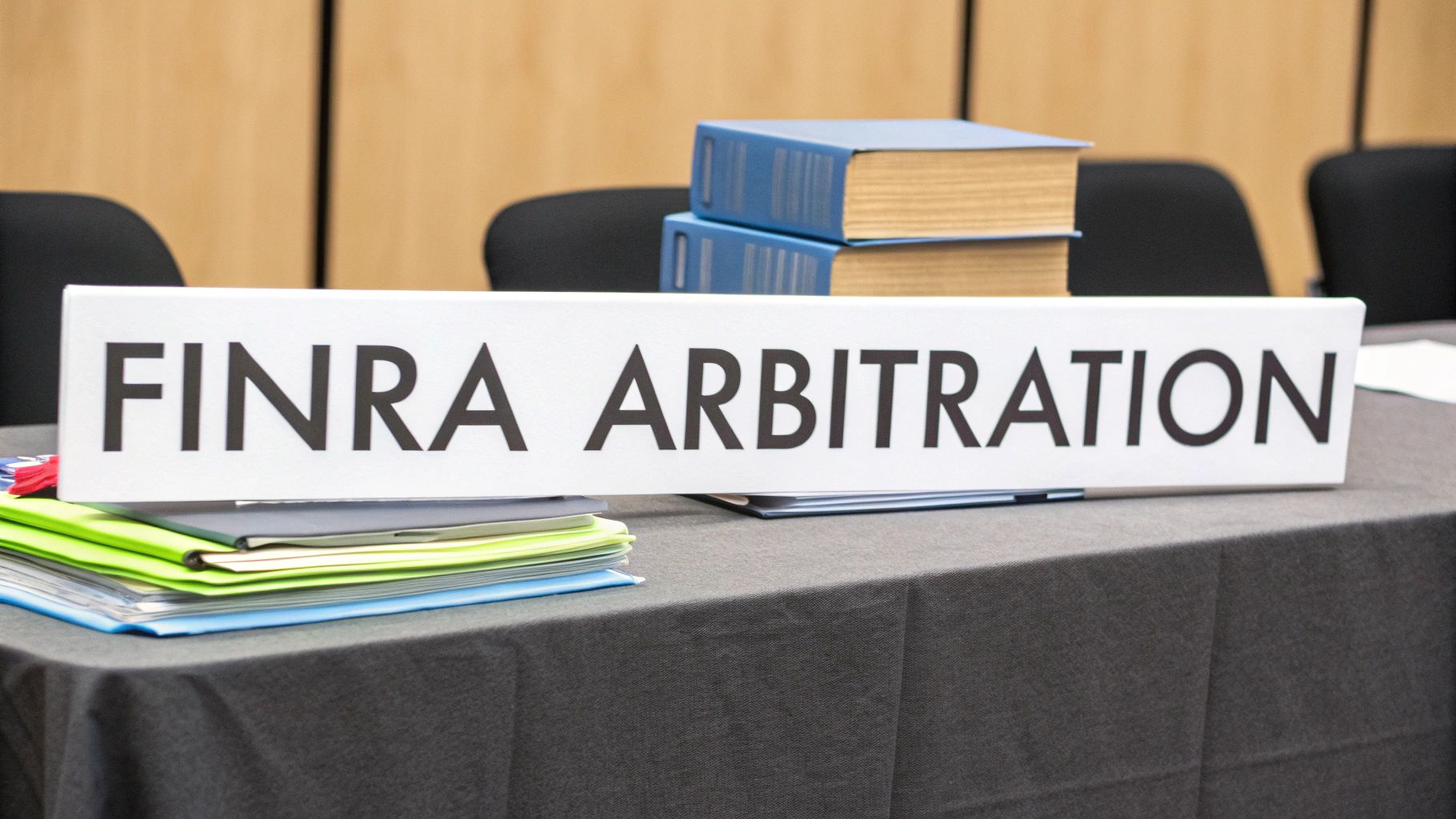
When you suffer significant investment losses because of broker misconduct, it can feel like you have no real path to get your money back. Fortunately, FINRA provides a specific—and mandatory—forum designed to resolve these exact kinds of disputes: FINRA arbitration.
This isn't a traditional lawsuit filed in state or federal court. Instead, it’s a specialized, private legal proceeding created to be more streamlined and less costly.
When you first opened your brokerage account, buried in the fine print of the customer agreement was almost certainly a mandatory arbitration clause. This legally requires you to resolve any serious dispute with the firm through FINRA's system, not by suing them in court. While this might seem restrictive, the arbitration process is often faster and is handled by arbitrators who actually understand complex securities rules.
The Stages of a FINRA Arbitration Claim
The arbitration process is a formal legal proceeding with distinct phases. Each step is critical to building a strong case to recover your lost funds, and understanding them can help demystify the journey ahead.
It all starts when you or your attorney file a Statement of Claim. Think of this as the foundation of your case. It’s a detailed document that lays out the facts, identifies the broker and firm involved, explains what they did wrong, and specifies the exact damages you are seeking.
After the claim is filed, the case moves into discovery. This is where both sides exchange crucial documents and information that will serve as evidence. A successful claim is built on a backbone of strong evidence, which might include:
- Account statements showing all the trading activity.
- Emails, texts, and other communications with your broker.
- Your notes from meetings or phone calls.
- The firm’s own internal compliance manuals and procedures.
This evidence is vital for proving wrongdoing. In fact, FINRA's record-keeping rules are incredibly strict for this very reason. A recent major enforcement action saw a firm penalized for failing to preserve at least 22.6 million electronic communications with customers. Those records are essential for investigating investor complaints.
Selecting Arbitrators and the Final Hearing
Once discovery is complete, the next crucial step is selecting the arbitrators who will hear your case and make a final decision. FINRA gives both sides a list of potential arbitrators. You then have the chance to strike certain individuals from the list and rank the remaining candidates. Depending on the size of the claim, the panel will have one or three arbitrators.
The final hearing is your opportunity to present your case directly to the arbitration panel. It functions much like a trial, with opening statements, witness testimony, cross-examination, and closing arguments.
This is where all the evidence gathered during discovery is presented and woven into a compelling story. Your attorney will argue how the firm’s actions violated industry rules and directly caused your financial losses. The brokerage firm will, of course, present its own defense. After the hearing, the arbitrators deliberate and issue a binding decision, called an "award."
What You Can Recover Through Arbitration
The ultimate goal of a FINRA arbitration is to make you whole again. The arbitrators have the authority to award various types of damages to compensate you for the harm you suffered.
Potential remedies can include:
- Compensatory Damages: This is the most common form of recovery. It’s meant to reimburse you for your actual, out-of-pocket investment losses.
- Interest: Arbitrators may award pre-judgment interest on your losses, which is calculated from the date the misconduct first occurred.
- Attorneys' Fees and Costs: In some cases, the panel can order the brokerage firm to pay for your legal fees and other costs associated with bringing the arbitration claim.
The entire process is governed by a detailed set of procedures. To get a better handle on the specific regulations involved, you can learn more about the complete FINRA arbitration rules that shape every stage of a claim. While a successful outcome is never guaranteed, the arbitration forum provides a dedicated path for investors to hold firms accountable and reclaim funds lost to negligence or fraud.
Knowing the Limits of FINRA's Power
While FINRA has significant authority over the brokerage industry, it's just as critical for investors to understand what FINRA doesn't do. Think of FINRA's power as a specific jurisdiction; it's immense within its borders but doesn't extend to the entire financial universe.
This distinction is crucial. If your dispute falls outside FINRA's turf, trying to file a claim in its arbitration forum will unfortunately be a dead end. Knowing these limits ahead of time can save you precious time and energy, ensuring your complaint is directed to the right regulator from day one.
Who FINRA Does Not Regulate
The single most important limitation to grasp is that FINRA’s authority is strictly limited to broker-dealers and the individual brokers registered with them. It absolutely does not have oversight over every professional who gives financial advice.
This means several types of professionals operate under completely different regulatory bodies:
- Registered Investment Advisors (RIAs): Many fee-only financial planners and wealth managers are RIAs. They are regulated by the U.S. Securities and Exchange Commission (SEC) or state securities regulators, not FINRA.
- Insurance Agents: If a professional only sells insurance products, like fixed annuities, they typically answer to state insurance commissioners.
- Commodities Brokers: Brokers who deal only in futures and commodities are regulated by the Commodity Futures Trading Commission (CFTC) and the National Futures Association (NFA).
So, if your issue is with an RIA who isn't also registered with a broker-dealer, your path to resolution will likely lead to the SEC or your state's regulators, not a FINRA arbitration panel.
Scenarios Outside FINRA's Scope
It's a common misunderstanding that FINRA can police any and all financial fraud. In reality, its power is tied directly to its member firms and the people registered with them. Certain investment schemes and disputes simply fall outside its reach.
FINRA can only step in when a FINRA-registered firm or individual is involved in the misconduct. If the fraud is totally disconnected from a member firm, FINRA’s hands are tied.
For instance, if you invested directly into a Ponzi scheme run by someone with no ties to a brokerage firm, you can't file a FINRA arbitration claim. Likewise, direct investments in things like cryptocurrencies or real estate often happen outside a brokerage account, which generally places them beyond FINRA's jurisdiction—unless, of course, a FINRA-registered broker was improperly involved in selling you that investment.
This is precisely why FINRA is so vigilant about the activities it can police, like anti-money laundering compliance. One enforcement action, for example, fined a firm for failing to flag suspicious wire transfers that added up to about $5.5 billion. This shows just how seriously FINRA takes its oversight duties within its defined territory. You can see more details in publications of FINRA disciplinary actions and their findings.
Understanding these boundaries is the first step toward charting the correct course for your complaint. It ensures your claim is heard by the right regulator, which is key to maximizing your chances of a successful outcome.
If you would like a free consultation to discuss the investment loss recovery process in more detail, call Kons Law Firm at (860) 920-5181 for a FREE, NO OBLIGATION consultation.
When You Need a Securities Attorney for a FINRA Claim
FINRA provides the forum for investors and brokers to resolve their disputes, but going it alone can be a serious uphill battle. You're not just filling out forms; you're going up against a large brokerage firm that has a team of experienced lawyers on its side. Knowing when to stop trying to handle it yourself and call in a professional is a critical decision that can make or break your case.
Not every disagreement needs a lawyer, of course. But some situations have bright red warning signs that professional help is essential to level the playing field. If the money you've lost is significant enough to threaten your retirement or financial security, the stakes are far too high to proceed without an expert in your corner.
Key Signals Your Case Requires an Expert
Certain circumstances make a FINRA claim much more complicated, and legal expertise becomes non-negotiable. You should seriously consider hiring a securities attorney if your situation involves any of these factors:
- Significant Financial Losses: When the amount of money at stake is substantial, you can bet the brokerage firm will fight tooth and nail to avoid paying. They will throw a ton of legal resources at the problem.
- Complex Investment Products: Cases involving sophisticated or obscure investments like non-traded REITs, private placements, or complicated options strategies are tough. They require a deep understanding of how these products work and, more importantly, how they can be misused or misrepresented.
- Dismissive Firm Responses: Has the brokerage firm ignored you? Have they flat-out denied any wrongdoing or maybe offered you a ridiculously low settlement? That’s a clear sign they don't take you or your claim seriously.
- Evidence is Hard to Obtain: An experienced attorney knows exactly what documents to demand during the discovery phase of a case. They know how to legally compel a firm to produce emails, internal reports, and other evidence it would much rather keep hidden.
The Strategic Advantage of Legal Counsel
Bringing in an experienced securities attorney gives you much more than just legal knowledge—it gives you a powerful strategic advantage. A good lawyer will build a compelling story for the arbitrators, gather the right evidence, and argue your case effectively at the final hearing. They understand the subtle details that FINRA arbitrators focus on and know how to dismantle the excuses brokerage firms often use to avoid responsibility.
To get a clearer picture of this process, you can find valuable information on what a dedicated FINRA arbitration attorney brings to a case.
A common misconception is that hiring a lawyer is financially out of reach. Most reputable securities law firms work on a contingency-fee basis, which means you pay no attorney fees unless they successfully recover money for you.
This fee structure removes the financial roadblock for many investors, giving them access to top-tier legal help without any upfront costs. If you’ve lost money and suspect misconduct, there's no reason not to explore your options.
If you would like a free consultation to discuss the investment loss recovery process in more detail, call Kons Law Firm at (860) 920-5181 for a FREE, NO OBLIGATION consultation.
Common Questions About FINRA
Even after getting familiar with what FINRA does, many investors have follow-up questions about how the process actually works and what it could mean for their specific situation. Getting clear answers is the first step toward deciding what to do after you've suffered investment losses.
Here are some straightforward answers to the questions we hear most often.
Is FINRA Part of the Government?
No, FINRA isn't a government agency. It's what's known as a self-regulatory organization (SRO)—a private corporation authorized by Congress to write and enforce the rules for the brokerage industry.
Think of it this way: FINRA is the day-to-day cop on the beat for stockbrokers, while the Securities and Exchange Commission (SEC), which is a government agency, provides high-level oversight for the entire securities industry.
Can I Get All of My Money Back Through FINRA Arbitration?
While the goal is always to recover every dollar you lost, a 100% recovery is never a sure thing. The amount an arbitration panel awards depends on a lot of moving parts, like the quality of your evidence, the legal arguments made, and the final judgment of the arbitrators.
A seasoned securities attorney will build the strongest possible case to maximize your recovery, but it’s important to understand that no outcome is guaranteed.
How Long Does the FINRA Arbitration Process Take?
The timeline can change based on how complex your case is. On average, you can expect a FINRA arbitration to take about 12 to 16 months from filing the initial Statement of Claim to getting a final award.
While that might sound like a long wait, it’s a world of difference from traditional court litigation. A similar case in the court system could easily drag on for several years. FINRA’s process is designed to be much more efficient.
Do I Have to Pay a Lawyer Upfront to File a FINRA Claim?
Almost never. Reputable securities law firms that represent investors, including Kons Law Firm, typically operate on a contingency-fee basis. This approach ensures that anyone can seek justice, no matter their financial situation.
It’s simple: you don't pay any attorney fees unless and until we recover money for you. The fee is just an agreed-upon percentage of the final award or settlement. This structure lets you pursue your claim without financial risk and aligns our interests with yours—we are only paid if you are.
If you would like a free consultation to discuss the investment loss recovery process in more detail, call Kons Law Firm at (860) 920-5181 for a FREE, NO OBLIGATION consultation.
