
If you've lost money because of your broker's bad advice or misconduct, the FINRA arbitration rules are your main, and often only, path to getting it back. This isn't your typical courtroom drama. It's a specialized process set up by the Financial Industry Regulatory Authority (FINRA) to handle disputes between investors and their brokerage firms.
Your First Step to Recovering Investment Losses
When your financial advisor's negligence, unsuitable recommendations, or outright fraud costs you money, it can feel like you're out of options. But there's a system specifically designed for these situations. FINRA arbitration is a formal process, but it's built to be faster and less expensive than a full-blown lawsuit in state or federal court.
For nearly every investor, agreeing to arbitration was something you did when you first opened your account, likely buried in the fine print of the agreements you signed. By signing, you gave up your right to a jury trial and agreed to use FINRA's system to settle any disputes. Knowing this from the get-go is key to setting the right expectations and building a solid case.
A Roadmap to Financial Recovery
Think of FINRA arbitration as a journey with a clear map and specific stops along the way. Each stage follows a strict set of rules meant to keep the case moving forward. Here's what that journey typically looks like:
- Filing the Claim: This is where it all starts. You'll file a document called a "Statement of Claim" that lays out what the broker did wrong and how much money you lost.
- Discovery and Evidence: Both you and the firm will exchange important documents. This process is much more limited than what you'd see in a court case.
- Arbitrator Selection: You and the brokerage firm will choose a neutral panel—usually one or three arbitrators—who will act as the judges for your case.
- The Hearing: This is your chance to present your side of the story, with evidence and testimony, directly to the arbitrators.
- The Award: The panel makes a final, legally binding decision.
Why This Process Matters
The numbers don't lie: FINRA arbitration is the go-to venue for these kinds of disputes. In 2021 alone, investors filed 2,893 arbitration cases with FINRA.

While there's no guarantee of success, investors who see their case through to a hearing win an award about 39% of the time. The timeline is also a critical factor. Cases that settle often take about a year, while those that go all the way to a hearing can take around 16 months from start to finish. You can dig into FINRA's own dispute resolution statistics to get a better feel for the landscape.
The FINRA arbitration process is your designated arena for holding financial professionals accountable. It's a system built on specific rules that, when navigated correctly, can lead to the recovery of your hard-earned capital.
Getting through these stages successfully means you need a rock-solid grasp of the rules. A single misstep can weaken your case or even get it dismissed. The first step is recognizing when you might have been a victim of financial misconduct, and a financial fraud attorney can provide the expert guidance you need.
If you would like a free consultation to discuss the investment loss recovery process in more detail, call Kons Law Firm at (860) 920-5181 for a FREE, NO OBLIGATION consultation.
How to File a Claim Under FINRA Rules
The first official step in any FINRA arbitration case is filing a document called the Statement of Claim. This is your formal complaint, and it kicks the entire process into gear. It’s where you lay out your story, detail the misconduct you believe occurred, and calculate the exact financial damages you suffered.
Don't mistake this for a simple form. The Statement of Claim is the foundation of your entire case. A well-written claim presents a clear, compelling story that lays out all the important facts, dates, and conversations. You have to be precise—vague complaints or sloppy math can undermine your position before you even begin.

Crafting Your Statement of Claim
Your goal here is to be logical, structured, and persuasive. The arbitrators who will ultimately decide your case read this document first, so it creates their initial impression. It needs to be thorough and backed up by solid evidence.
A strong Statement of Claim has to hit several key points to build a convincing argument:
- A Factual Narrative: This is a chronological account of your relationship with the broker, the advice you received, and the specific transactions that caused your losses.
- Allegations of Misconduct: Clearly explain which rules or duties the broker violated. Did they make unsuitable recommendations, churn your account, or misrepresent an investment? Be specific.
- Calculation of Damages: Provide a detailed breakdown of your financial losses. This should include the principal you lost, market-adjusted damages, and any other related costs.
Getting this document right is absolutely critical. While the rules have evolved over time, you can get a good sense of the procedural foundations by looking at how the old NASD arbitration rules—the predecessor to the current FINRA arbitration rules—were set up. This first filing really does set the tone for everything to come.
Understanding the Fees and Deadlines
Starting an arbitration case comes with costs and strict deadlines that every investor needs to know. The FINRA arbitration rules are inflexible on these points, and missing them can stop your case in its tracks.
First, you have to pay filing fees when you submit your Statement of Claim. These aren’t flat fees; they work on a sliding scale based on the amount of money you’re trying to recover.
For instance, a claim for $25,000 or less will have a fairly small filing fee. But a claim seeking over $1 million in damages comes with a much more substantial fee. This system is meant to keep the process accessible for smaller claims while ensuring that larger, more complex cases contribute fairly to the administrative costs.
It’s crucial to calculate your damages accurately, not just for your potential award but also to figure out your upfront costs.
The Six-Year Eligibility Rule
Beyond the fees, the single most important deadline is the eligibility rule. Under FINRA Rule 12206, you generally have six years to file a claim. That clock starts ticking from the date of the event that caused the dispute.
This is not like a typical statute of limitations that can sometimes be paused or extended. It's a hard deadline. If you file after six years have passed, FINRA simply will not hear your case, no matter how strong it is. This is why it is so important to act quickly once you suspect you've been the victim of broker misconduct. Waiting too long can be fatal to your chances of recovering your losses.
If you would like a free consultation to discuss the investment loss recovery process in more detail, call Kons Law Firm at (860) 920-5181 for a FREE, NO OBLIGATION consultation.
Building Your Case with Evidence and Discovery
Once your Statement of Claim is filed, your case moves into the discovery phase. This is where both sides gather the evidence they need to make their arguments. But if you’re picturing dramatic courtroom scenes with surprise witnesses and endless questioning, think again. The FINRA arbitration rules for discovery are a different beast altogether—far more focused and designed for efficiency.
Unlike a sprawling court case that can drag on for years with depositions and mountains of paperwork, FINRA’s process is intentionally limited. The idea is to cut through the noise and get straight to the most important evidence, saving everyone time and money. For an investor, this streamlined approach is a double-edged sword.

The FINRA Discovery Guide
The main playbook for this stage is the FINRA Discovery Guide. You can think of it as a pre-approved checklist of documents that each side is expected to hand over. It’s designed to make sure both the investor (the Claimant) and the brokerage firm (the Respondent) get the crucial information they need without getting bogged down in disputes.
This guide is a powerful tool for an investor trying to prove misconduct. It gives you the right to request key documents that can blow a case wide open, such as:
- Internal Emails: Correspondence between your broker and their supervisor about your account can be a goldmine, often revealing internal red flags or violations of the firm's own policies.
- Commission Runs: These reports show exactly how much money your broker made from trading in your account. They are essential for proving churning or excessive trading claims.
- Account Statements: These are the foundation for calculating your financial losses. Understanding what is a broker statement is the first step in building your damages model.
- Complaint Histories: Finding out if your broker has faced similar complaints from other clients can establish a clear pattern of misconduct.
Of course, the firm will ask for documents from you, too. They’ll typically want to see records of your investment history, your financial situation, and any accounts you held at other firms. It’s critical to respond to these requests thoroughly and honestly.
Key Differences from Civil Litigation
The biggest difference between discovery in FINRA and in court is the scope. FINRA’s process is narrow and fast-paced on purpose, which is often a huge advantage for individual investors who can’t afford a long, drawn-out legal battle. The downside? You get fewer shots at gathering evidence, so every request has to count.
The discovery process in FINRA arbitration is not a fishing expedition. It is a targeted exchange of specific, relevant documents guided by a standardized playbook. Your success depends on knowing exactly what to ask for and how to use what you receive.
To really understand the contrast, it helps to see the two systems side-by-side.
FINRA Arbitration Discovery vs Civil Litigation Discovery
The table below breaks down the major differences between gathering evidence in a FINRA arbitration versus a traditional lawsuit.
| Feature | FINRA Arbitration | Civil Litigation (Court) |
|---|---|---|
| Depositions | Extremely limited and rarely granted. Requires arbitrator approval and is not standard. | Common and extensive. Attorneys can question witnesses under oath for hours or days. |
| Document Scope | Primarily governed by the FINRA Discovery Guide's presumptive lists. Additional requests are possible but must be highly relevant. | Broad scope. Parties can request any non-privileged information relevant to the case, leading to massive document productions. |
| Timeline | Highly structured and much faster. Document production is expected within 60 days of the answer to the claim being filed. | Can last for many months or even years, often with multiple extensions and delays. |
| Dispute Resolution | Discovery disputes are resolved quickly by the arbitrators, often via a brief conference call. | Disputes are resolved through formal motions filed with the court, which can be a slow and expensive process. |
| Overall Cost | Significantly lower due to the limited scope and faster timelines. | Can become extremely expensive, with costs for depositions, motions, and extensive document review running into tens of thousands of dollars. |
As you can see, FINRA’s system is built for speed and efficiency, forcing both sides to focus only on what truly matters.
Strategically Using the Evidence
Once the brokerage firm sends over their documents, the real work begins. This is where you and your legal team have to sift through everything to find the "smoking guns"—the key pieces of evidence that prove your claims. It takes a sharp eye to connect the dots, and the expertise of a modern document review attorney can be invaluable in piecing together the narrative.
Ultimately, your goal is to build a clear, compelling story for the arbitration panel that shows exactly how the firm’s actions caused your financial harm. The evidence you gather in discovery is the bedrock of that story.
If you would like a free consultation to discuss the investment loss recovery process in more detail, call Kons Law Firm at (860) 920-5181 for a FREE, NO OBLIGATION consultation.
Selecting Arbitrators and Preparing for Your Hearing
The outcome of your case often comes down to who is listening just as much as the evidence you present. Picking the right arbitrators is one of the most critical stages in the entire process. Under the FINRA arbitration rules, you aren’t just assigned a judge. Instead, you get to play an active role in choosing the panel that will decide your case.
This isn't a game of chance. FINRA gives both you and the brokerage firm lists of potential arbitrators, pulled from a pool of public representatives and industry professionals. Your job, with your lawyer's help, is to carefully vet every single candidate to assemble the most knowledgeable and impartial panel for your specific situation.
Vetting the Potential Arbitrators
Think of this part like you're a hiring manager interviewing candidates for a very important job. For each potential arbitrator, you’ll receive a disclosure report packed with vital information. This report is your number one tool for digging into potential biases or conflicts of interest.
Going through these reports with a fine-tooth comb is absolutely essential. You'll want to look closely at a few key areas for each person:
- Professional Background: Does their past work give them a special insight into your case? Or, does it suggest they might lean in favor of the industry?
- Past Rulings: The report lists their decisions in prior FINRA cases. This is priceless data, showing you how they’ve ruled in disputes that might be similar to yours.
- Conflicts of Interest: The report is supposed to detail any relationships—financial or otherwise—that an arbitrator has with the parties involved.
Scrutinizing this information helps you spot candidates who might be unsympathetic to your claim and, just as importantly, those who are more likely to give you a fair shot. It’s a detailed process of research and strategy.
Using the Strike and Rank System
After you’ve done your homework on the candidates, you get to use a powerful tool called the "strike and rank" system. This gives you a surprising amount of control over who ends up on the panel. You can strike a set number of candidates from the list for any reason at all, completely removing them from consideration.
Once you’ve eliminated your least favorite options, you then rank the remaining people in your order of preference. The brokerage firm does the exact same thing with their list. FINRA’s system then compares both ranked lists to put together the final panel, trying to pick the highest-ranked arbitrators that both sides found acceptable.
This strategic selection process is a cornerstone of a successful arbitration strategy. A well-chosen panel is more likely to understand the nuances of your case and render a fair and just decision. It's about putting the odds in your favor before the hearing even begins.
Procedural Reforms for Fairness
The arbitrator selection process has changed over the years to become more transparent and straightforward. A significant change happened back in 2013 when the SEC approved updates to FINRA Rule 12403, which streamlined how panels are selected in cases with three arbitrators. This new rule standardized the process by giving both parties identical lists of chair-qualified public arbitrators, a change that boosted fairness and cut down on administrative headaches. You can find more details on these procedural changes and look at historical dispute data on FINRA's website.
Modern tools, like online portals for scheduling and accessing the disclosure reports, have also made the process much smoother. These changes show a continuing effort to make the FINRA arbitration rules more balanced for investors. A good securities lawyer knows how to use these rules to your advantage, strategically picking a panel that’s right for your case and getting you ready for a successful hearing.
If you would like a free consultation to discuss the investment loss recovery process in more detail, call Kons Law Firm at (860) 920-5181 for a FREE, NO OBLIGATION consultation.
The Arbitration Hearing and Securing Your Award
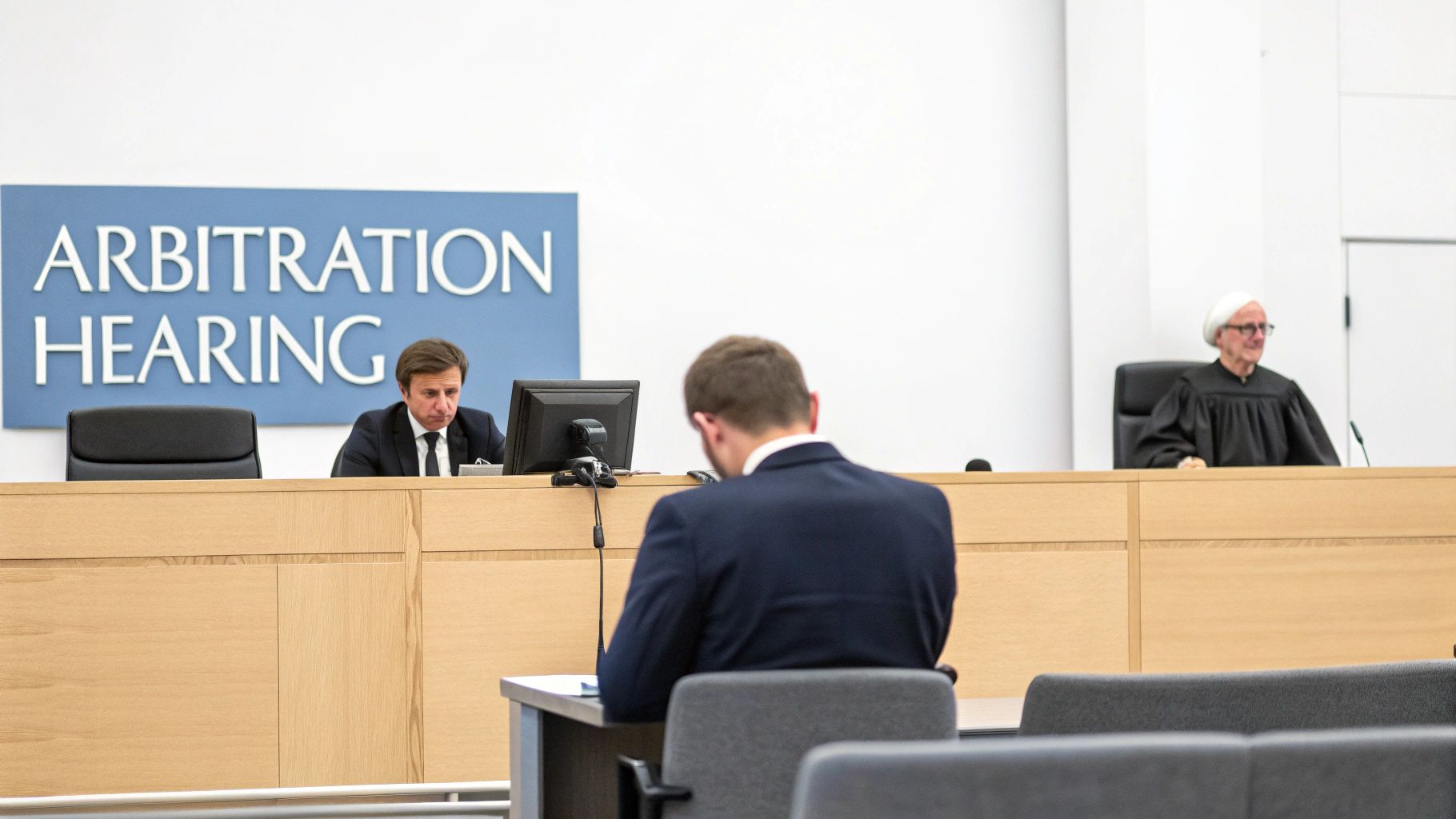
After all the preparation, document sharing, and strategic panel selection, the arbitration hearing is showtime. This is the moment your case finally moves off the page and into the real world, where arbitrators will hear live testimony and see the evidence firsthand.
While it’s a formal setting, it’s usually in a conference room, not a full-blown courtroom. The FINRA arbitration rules provide a clear structure for the day, ensuring your story gets told directly to the people making the final decision. Think of it less like a chaotic trial and more as a structured presentation of facts from both sides.
What to Expect on Hearing Day
A typical hearing follows a predictable path. Knowing the steps ahead of time helps you and your attorney build a compelling, focused case.
Here's the usual sequence of events:
- Opening Statements: Your lawyer kicks things off by summarizing your case—what the broker did wrong and the financial damage it caused. The brokerage firm’s attorney will then present their side of the story.
- Presenting Your Case: Now it’s your turn. You will likely testify, and your lawyer might call expert witnesses to bolster your claims with professional analysis.
- Cross-Examination: After you testify, the firm’s lawyer gets to question you. This is a crucial part of the hearing. Your job is to stay calm and provide clear, consistent, and honest answers.
- The Respondent's Case: The brokerage firm then puts on its defense. This might involve testimony from your broker or their manager. Your attorney will get a chance to cross-examine their witnesses, too.
- Closing Arguments: Finally, both sides wrap up by summarizing the key evidence and making their final pitch to the panel about why they should rule in their favor.
Often, your own testimony is the most powerful tool you have. The arbitrators need to hear from you directly how the broker's misconduct affected your life and your finances.
From Hearing to a Final Award
Once closing arguments are done, the panel gets to work. They’ll deliberate privately, weighing all the evidence and testimony to reach a final decision. This decision is called the "award," and under FINRA arbitration rules, it is legally binding with very few options for an appeal.
The arbitrators issue a written award that states their decision, including whether you are entitled to damages and the specific amount. While the award usually doesn't detail the panel's reasoning, it is the final word on your claim. For more specifics on these decisions, you can read about FINRA arbitration awards.
The award is the finish line of the arbitration itself, but the race isn't truly over until the funds are in your account. The enforcement of this award is the final, critical piece of the recovery puzzle.
Enforcing Your Award and Getting Paid
The good news is that most FINRA arbitration awards get paid. Brokerage firms have a massive incentive to pay up, as failing to do so can lead to their license being suspended.
But payment isn't a sure thing, particularly if you’re dealing with a smaller firm or an individual broker who just doesn’t have the money. FINRA rules require respondents to pay any monetary awards within 30 days of receiving the decision.
In 2022, FINRA reported that about 75% of the 2,412 monetary awards issued were paid in full. When firms or brokers don't pay, FINRA can fast-track suspension proceedings, and they took 38 such actions that year. Still, the total value of unpaid customer awards in 2022 hit $23 million, which shows why the collection process is so important. This is another area where having an experienced attorney is vital—not just for winning, but for making sure you actually get your money back.
If you would like a free consultation to discuss the investment loss recovery process in more detail, call Kons Law Firm at (860) 920-5181 for a FREE, NO OBLIGATION consultation.
When You Need an Experienced Attorney on Your Side
While FINRA arbitration is designed to be a simpler path than traditional court, make no mistake: it is a complex legal battleground. Brokerage firms and their advisors always show up with experienced defense lawyers, meaning that trying to navigate the complex FINRA arbitration rules on your own puts you at a major disadvantage from day one.
An experienced securities arbitration attorney is the great equalizer. They know how to properly draft your Statement of Claim, manage the discovery process to uncover the evidence you need, and help select the best possible arbitrators for your specific case.
Taking the Right Next Step
Most importantly, a skilled attorney can argue your case at the hearing, turning dry facts and documents into a powerful story for the arbitration panel. No matter what legal issue you're facing, the first step is often finding an attorney who understands your unique situation and can fight for the outcome you deserve.
Don't go it alone against a well-funded opponent. In these cases, professional legal representation isn't a luxury—it's a critical part of any successful recovery strategy.
If you would like a free consultation to discuss the investment loss recovery process in more detail, call Kons Law Firm at (860) 920-5181 for a FREE, NO OBLIGATION consultation.
Have Questions About Your Case? We Offer a Free Consultation.
Trying to make sense of the FINRA arbitration process on your own can be overwhelming, especially when you're already dealing with the stress of investment losses. You don't have to go it alone.
If you believe you have a case and want to understand your options for recovering your money, please call Kons Law Firm at (860) 920-5181 for a FREE, NO OBLIGATION consultation to discuss your specific situation.
Common Questions About the FINRA Arbitration Process
As you start exploring your options, a few key questions about the FINRA arbitration rules tend to pop up. Getting straight answers is the first step toward understanding what lies ahead and setting realistic expectations.
Here are some of the most common questions we hear from investors facing a dispute.
Is the Arbitrator's Decision Final?
Yes, for all intents and purposes, a FINRA arbitration award is final and legally binding. This is a critical difference from a court trial, where you can appeal a decision you don't agree with. The grounds for challenging an arbitration award are incredibly narrow.
A court can only overturn an award for very specific reasons, like blatant evidence of fraud, corruption, or serious misconduct by the arbitrator. Simply disagreeing with the outcome isn't grounds for an appeal. This finality is a core feature of arbitration, designed to bring a conclusive end to the dispute.
What Happens If the Firm Refuses to Pay?
Brokerage firms are required to pay any monetary awards within 30 days of receiving the decision. If a firm or its broker fails to pay up, FINRA has the power to take swift and severe disciplinary action, which can include suspending or even revoking their license to do business in the securities industry.
This creates a very strong incentive for them to comply. While non-payment can happen, it's usually with smaller or financially unstable firms. The vast majority of awards are paid on time to avoid these serious regulatory consequences.
An arbitration award isn't just a suggestion; it's a binding order with FINRA's enforcement muscle behind it. This is what ensures that a victory in your case actually turns into financial recovery.
How Long Does the Process Usually Take?
The timeline for a FINRA arbitration case can vary quite a bit depending on how complex it is. That said, it is almost always faster than trying to resolve the same dispute in the court system.
On average, a case that settles before a final hearing might take about 12 to 14 months to wrap up. If your case needs to go all the way through a hearing to a final award, you can generally expect the process to take around 16 to 18 months from the day you file.
What Is the Difference Between Arbitration and Mediation?
While they both offer an alternative to court, arbitration and mediation are two very different processes.
- Arbitration: Think of this as a private trial. It's a formal process where a neutral arbitrator (or a panel of them) acts like a judge. They hear evidence from both sides and issue a final, binding decision.
- Mediation: This is a more informal and completely voluntary process. A neutral mediator's job is to help you and the other side try to negotiate a settlement that you can both agree on. The mediator has no power to make a decision; they just help facilitate the conversation. If you can't reach an agreement in mediation, you can still move forward with arbitration.
If you would like a free consultation to discuss the investment loss recovery process in more detail, call Kons Law Firm at (860) 920-5181 for a FREE, NO OBLIGATION consultation. Learn more about how we help investors at https://investmentfraudattorneys.com.
