
Your account statement arrives, and the numbers don't make sense. The losses are larger than you expected. The investments don't look like what you thought you bought. Maybe your broker told you the account was “conservative,” but now you're staring at illiquid products, concentrated positions, or trades you barely remember approving.
That moment is disorienting. Most investors don't know whether they've suffered an ordinary market loss or whether a broker, advisor, or firm crossed a legal line.
There is a path forward. For many investors, that path is FINRA arbitration, a process built specifically for disputes with brokerage firms and registered representatives. A good FINRA arbitration guide should do more than define terms. It should tell you what the process feels like, what evidence matters, where investors make mistakes, and when legal help changes the outcome.
What Is FINRA Arbitration and Why It Matters for You

You discover serious losses in your brokerage account and start asking the obvious question. Do you sue in court, complain to the firm, or do something else entirely? For many investors, the answer is set by the account agreement they signed years ago. Claims against the brokerage firm or broker usually must be brought in FINRA arbitration.
FINRA arbitration is the dispute forum used for many investor claims against brokerage firms and registered representatives. If you want background on the regulator itself, this explanation of what FINRA does is a useful place to start. What matters for your case is practical. This is often the process that decides whether you recover any of your losses.
That can feel unfair at first. Investors often expect a judge and jury. Instead, the case is heard under FINRA's arbitration rules by one or more arbitrators, with deadlines, pleadings, document requests, witness testimony, and a final written award.
Why this forum matters
FINRA arbitration is not informal just because it is called arbitration. It is a legal proceeding, and mistakes early in the case can limit what you recover later. I often see investors wait too long, rely on the brokerage firm's explanation of what happened, or assume that a bad result in the market automatically means they have no claim. Those assumptions can be costly.
The forum also has real trade-offs. Arbitration is usually faster than full court litigation, but discovery is narrower. You may get a quicker result, but you generally have fewer procedural tools than you would in court. That makes case framing, document collection, and witness preparation matter even more, especially for retirees, widows, disabled investors, and families dealing with complex products they were never in a position to fully evaluate.
What FINRA arbitration can actually do
A FINRA case can seek compensation for losses caused by misconduct tied to the handling of your account. Common examples include unsuitable recommendations, unauthorized trading, misrepresentations, overconcentration, excessive trading, and failures by the firm to supervise the broker.
It does not reverse ordinary market declines because an investment went down.
That distinction is why legal guidance matters early. The hard part is not just saying, “I lost money.” The hard part is proving that the loss was tied to conduct that violated industry rules, the broker's duties, or the firm's supervisory obligations. Good counsel helps translate confusing account activity and technical product terms into a claim arbitrators can follow.
A useful FINRA arbitration guide should do more than define the process. It should help you understand what this forum can realistically accomplish, what it cannot, and what steps to take before records disappear, memories fade, or filing deadlines become a problem.
If you would like a free consultation to discuss the investment loss recovery process in more detail, call Kons Law Firm at (860) 920-5181 for a FREE, NO OBLIGATION consultation.
Identifying Your Claim and Common Grounds for Filing
A loss by itself is not a FINRA claim. The question is whether your broker or firm did something they should not have done, or failed to do something required by industry rules and their duties to you.
That is where many investors get stuck. They know the account went off track, but the paperwork is full of terms like breach of fiduciary duty, negligence, omission, unsuitability, or failure to supervise. Those labels matter, but only because they describe real conduct. An advisor recommends products that do not fit your age, liquidity needs, or risk tolerance. A firm ignores obvious red flags in the account. A salesperson describes a risky investment as safe income. Those are the facts that make the claim.
What these claims look like in real life
Start with suitability. A widow or retiree asks for preservation of principal and access to cash, then ends up concentrated in illiquid private placements, non-traded REITs, or other alternative investments that are hard to value and harder to sell. That fact pattern often supports a suitability claim. If you want the rule background, this discussion of FINRA suitability rules explains the standard in plain English.
Excessive trading is different. Here, the problem is not one bad product but a pattern of buying and selling that generates commissions or fees without serving the investor's goals. In a conservative account, frequent turnover can be a warning sign, especially if the investor did not understand why the trades were happening.
Misrepresentation and omission claims are also common. An investor is told a product is stable, income-focused, or bond-like, but the actual risks include loss of principal, limited liquidity, steep fees, or concentration exposure. Many clients only learn that after losses hit and redemption becomes difficult.
Sometimes the strongest claim is not against the broker alone.
Claims against the firm
Brokerage firms have supervisory duties. If the firm approved unsuitable recommendations, failed to review account activity, ignored concentration problems, or let an advisor keep using misleading sales practices, a failure-to-supervise claim may be available. In practice, that matters because firms usually have the resources to satisfy an award, while an individual broker may not.
Common fact patterns include:
- Seniors and retirees placed into complex products that did not match their need for income, liquidity, or capital preservation.
- Overconcentrated accounts with too much money in one issuer, one sector, or one speculative product type.
- Unauthorized trading or transfers made without clear consent.
- Alternative investments sold as stable or conservative without full disclosure of risk, lock-up periods, valuation issues, or commissions.
Investors often know the sales pitch felt wrong before they know the legal name for the claim.
That instinct should not be ignored, especially for vulnerable investors or families sorting through complicated account records after a sudden loss. A good case review does more than identify a label. It connects the recommendation, the account documents, the trading history, and the losses. That is usually the difference between a complaint that sounds unfair and a claim that can be proved.
Navigating the FINRA Arbitration Process Step by Step
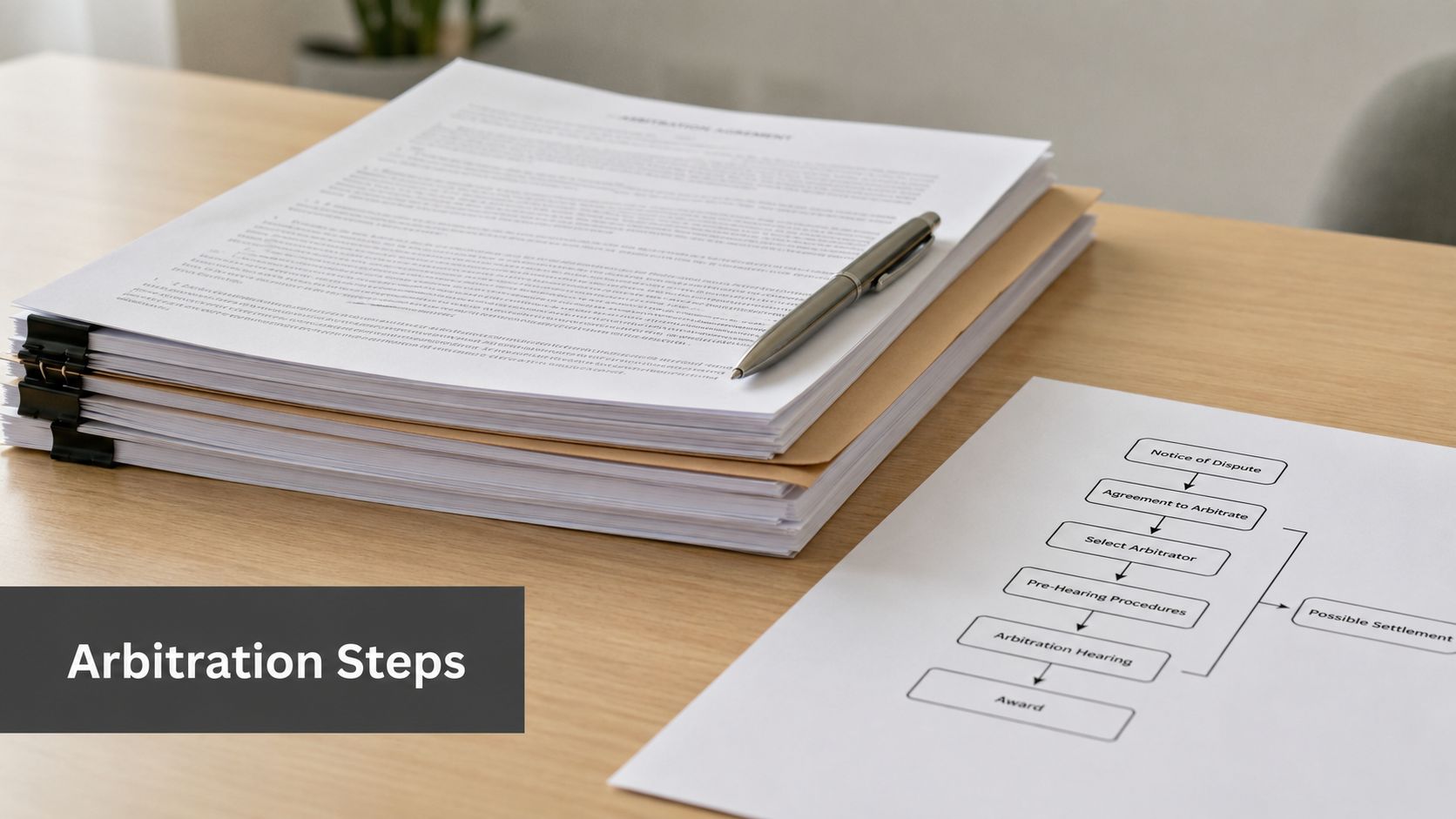
The process feels less intimidating once you see the sequence. Investors usually struggle most when they don't know what happens next. FINRA arbitration follows a defined track, even though the strategy within that track can vary.
Filing the claim
The case starts with a Statement of Claim. This is the document that tells your story, identifies the respondents, states the legal causes of action, and explains the losses you seek to recover. It isn't just paperwork. It sets the frame for the entire dispute.
A weak Statement of Claim creates problems early. It can muddy the theory of the case, omit key facts, or ask for relief in a way that constrains future influence. A strong one makes the arbitrators understand the misconduct before the first conference ever happens.
The response and panel formation
After service, the respondents must answer quickly. Under the FINRA process, respondents must file an Answer within 45 days of receiving the Statement of Claim, and claims are assigned to a single arbitrator for cases under $100,000 or a three-arbitrator panel for claims exceeding that amount, as described in FINRA's arbitration process overview.
That panel structure matters. A one-arbitrator case tends to be more efficient. A three-arbitrator case often requires more planning because presentation style, witness order, and issue framing can carry more weight before a panel.
Discovery and pre-hearing work
Discovery is the document exchange stage. During this stage, investors obtain account records, internal notes, communications, new account forms, supervisory material, and other documents that can prove what the broker recommended and what the firm knew.
If you want a deeper look at that stage, this FINRA discovery guide is useful. Discovery often reveals the gap between what the investor says happened and what the firm documented, or failed to document.
A typical pre-hearing stretch includes:
- Document requests for statements, emails, notes, compliance records, and product materials.
- Scheduling conferences where procedural issues and hearing dates get set.
- Motion practice on narrower disputes, often involving evidence or document production.
- Witness planning so your testimony and supporting testimony fit the documents cleanly.
The hearing is important, but cases are often shaped much earlier. Discovery is where hidden strengths and weaknesses usually appear.
The final hearing
The hearing is a mini-trial, but not a full courtroom trial. Witnesses testify. Documents are introduced. Lawyers argue what the evidence proves. The arbitrators decide liability and damages.
Some investors expect a dramatic courtroom atmosphere. FINRA hearings are usually more practical than theatrical. What works is a coherent timeline, disciplined exhibits, and testimony that stays grounded in documents. What doesn't work is broad outrage without proof.
That's one reason any good FINRA arbitration guide should focus on preparation, not just procedure.
Building Your Case with Strong Evidence and Documentation
Investors often know the conversation that led to the loss. Arbitration panels need more than memory alone. They need records that show what was recommended, what was disclosed, what was purchased, and how the account changed over time.
The strongest cases usually start with organization. Not legal jargon. Not anger. Organization.
What to gather first
Start with the documents you already control. Don't wait for the formal case to begin before collecting them.
- Account statements show positions, trading activity, concentrations, margin use, and losses over time.
- Emails and text messages often reveal how the investment was described before the purchase and how the advisor responded once problems appeared.
- Notes from calls or meetings can support your memory about what you asked for and what the broker promised.
- New account forms and risk-tolerance paperwork help show whether the recommendations matched your stated objectives.
- Marketing materials or prospectuses may show what risks were emphasized, minimized, or left unclear.
Why each category matters
Statements do more than show losses. They can reveal patterns. If the account churned, the statements may show frequent in-and-out trading. If the problem was overconcentration, the statements may show too much money in one product or issuer. If the issue was failure to diversify, the monthly snapshots can make that obvious.
Communications matter because many investor cases turn on the difference between the written record and the sales pitch. A broker may describe an investment casually in conversation, but the formal documents tell a different story. When those two things don't match, the gap can become central evidence.
Case-building insight: A timeline built from your own records often does more work than pages of abstract accusations.
Build a chronology before you argue the law
Create a simple timeline. Note when the account was opened, what your goals were, when the investment was recommended, what you were told, when losses appeared, and what happened after you complained. Keep it clean and factual.
That timeline helps in three ways:
- It sharpens your own memory before testimony.
- It helps counsel spot missing documents and factual gaps.
- It bolsters your settlement position because the claim looks prepared and credible.
Some investors also preserve voicemail, handwritten notes, or screenshots from account portals. Those details can matter. A brokerage firm usually arrives with records, procedures, and trained witnesses. You should arrive with a complete file.
Understanding Damages Costs and Potential Outcomes
The first question most investors ask is whether the case is worth pursuing. The answer depends on the size of the loss, the strength of the evidence, the available respondents, and the likely path to resolution. A realistic FINRA arbitration guide has to address both upside and friction.
What you may be able to recover
Damages analysis usually starts with the actual financial harm tied to the misconduct. In practice, that often means looking closely at out-of-pocket losses and then evaluating other categories of requested relief that may apply under the facts and governing law.
The right damages model depends on the case theory. Unsuitable recommendations, unauthorized trading, overconcentration, and misrepresentation cases don't always get framed the same way. This is one reason investors shouldn't assume that the account's ending balance tells the whole story.
Filing costs and timing
The initial filing fee for a FINRA arbitration claim ranges from $50 to $2,300, based on the amount of the claim, and FINRA notes that the Director of Arbitration may defer all or part of the fee if the claimant shows financial hardship, according to the SEC Investor Bulletin on broker-dealer customer arbitration.
Outcome expectations should also be grounded in actual forum data. The majority of FINRA cases resolve through settlement before a hearing, and for cases that went to a final decision, the investor win rate was 30% in 2025, while the median turnaround time for a standard hearing case was approximately 17.0 months, according to this FINRA arbitration process analysis.
You can also review examples of FINRA arbitration awards to get a feel for how claims are resolved, although every case turns on its own record.
FINRA arbitration at a glance
| Metric | Statistic |
|---|---|
| Initial filing fee | $50 to $2,300 |
| Cases resolved before hearing | Majority of cases |
| Investor win rate at final decision | 30% in 2025 |
| Median turnaround for standard hearing case | 17.0 months |
What those numbers mean in practice
Settlement is common because both sides see risk. Investors avoid the uncertainty of an award. Firms avoid hearing exposure, legal expense, and a public adverse decision. But settlement only becomes likely when the claim is documented well enough to be taken seriously.
A hearing isn't the default “successful” ending. In many strong cases, leverage comes from being ready for the hearing, not from wanting one.
The cost-benefit analysis should include filing expenses, expert needs if any, attorney structure, and the likelihood that the evidence will persuade the panel. Good advice is blunt about those trade-offs.
The Critical Choice Counsel Settlement or Hearing

The most consequential decision in many cases isn't whether to file. It's how to approach the claim once filing becomes real. Investors often underestimate how much strategy shapes the outcome before a hearing date is even close.
Why self-representation is harder than it looks
FINRA arbitrators are told to give self-represented investors “wide latitude,” but they are also cautioned not to “put on the case” for them, as discussed in FINRA's Neutral Corner publication. That sounds humane in theory. In practice, it creates a hard limit. The panel may be patient with presentation issues, but it won't assemble your timeline, connect your exhibits, or make the legal argument you forgot to make.
That's where pro se claimants often run into trouble. They know they were wronged. They may even have good facts. But the evidence comes in fragmented pieces, the account history isn't framed clearly, and the hearing becomes a story of frustration instead of proof.
Wide latitude is not advocacy. It does not replace claim drafting, document strategy, witness preparation, or a coherent damages presentation.
Settlement versus hearing
Once the case is developed, the next major call is whether to settle or continue to a final hearing. That decision shouldn't be driven by emotion alone. A settlement gives certainty. A hearing preserves the chance for a larger award but carries risk.
What works in this decision-making stage is disciplined evaluation:
- Strength of liability proof matters more than how angry the facts feel.
- Document quality often matters more than memory-based testimony.
- Respondent posture matters. Some firms negotiate early, others don't move until discovery exposes problems.
- Client goals matter. Some investors want closure and speed. Others are willing to accept more risk for a fuller recovery effort.
This is also the place where legal counsel usually adds the most value. Counsel can assess whether the evidence is settlement-grade, hearing-grade, or not yet there. Counsel can also present the claim in a way that gives the other side a reason to engage seriously.
Kons Law is one option investors use for this kind of representation, including drafting the Statement of Claim and guiding the case through the arbitration process.
If you would like a free consultation to discuss the investment loss recovery process in more detail, call Kons Law Firm at (860) 920-5181 for a FREE, NO OBLIGATION consultation.
Investor FAQs Your Specific Questions Answered
Can I recover my attorneys' fees
Sometimes, yes. FINRA says arbitrators may award attorneys' fees, but whether fees are recoverable depends on state law, and the parties must brief the arbitrator on the applicable law, as explained in FINRA's arbitration fee FAQ. That means the answer isn't automatic. It depends on the legal basis for fees in the state law that governs the claim.
What if the broker who harmed me left the firm
That doesn't necessarily end the case. Claims are often brought against the brokerage firm because firms have supervision duties and may be responsible for misconduct that occurred while the advisor was there. In some matters, both the individual broker and the firm are named.
Is there a time limit to file
Yes. FINRA has an eligibility rule that can bar older claims. Investors shouldn't guess about timing because delay can create avoidable problems. If the losses involve concealment, account transfers, or long-term products, a lawyer should evaluate the timeline promptly.
Should I file the claim myself to save money
Usually, that's a false economy in a substantial case. Filing is only the start. The harder work is framing the claim, obtaining the right records, handling discovery disputes, preparing testimony, assessing settlement, and trying the case if needed. Investors can represent themselves, but many find that the process is less forgiving than it first appears.
If you're dealing with losses caused by a broker or financial advisor, Kons Law represents investors in FINRA arbitration and other recovery actions. A consultation can help you determine whether the losses point to misconduct, what documents to gather now, and what a practical recovery strategy may look like.
