When a financial advisor leaves their brokerage firm, it triggers a mandatory filing that can be one of the most important documents for an investor to understand: the FINRA Form U5. Think of this form as a permanent mark on a broker's record, explaining not just that they left, but the crucial details of why they left.
What Is the FINRA Form U5 and Why It Matters to You

Any time a registered advisor’s employment ends—for any reason—their firm must file a Uniform Termination Notice for Securities Industry Registration, or Form U5. This isn't just an internal HR document. It's a key regulatory filing with FINRA designed to maintain transparency in the industry and protect the investing public.
You can think of the Form U5 as the "Carfax report" for a financial professional. A vehicle history report gives you the full story on a car—accidents, damages, and past owners. Similarly, a Form U5 provides a detailed history of an advisor's employment, including any "fender benders" or serious "collisions" they've had in their career.
An Early Warning System for Investors
The real power of the Form U5 is its function as an early warning system. Many terminations are perfectly normal, like an advisor retiring or switching to a new firm. However, some terminations reveal serious red flags that could signal danger for your investments.
The form forces brokerage firms to be specific about why an advisor left. The reasons for termination are broken down into several categories:
- Voluntary: The advisor resigned on their own terms.
- Permitted to Resign: This can be a major red flag. It often means the advisor quit while under an internal investigation for misconduct.
- Discharged: The advisor was fired. The firm must provide an explanation, which could be for anything from minor policy violations to serious misconduct like fraud or unauthorized trading.
- Other: A catch-all that requires a full explanation from the firm.
This isn’t private information. Once filed with FINRA, the Form U5 becomes a permanent part of the advisor’s record in the Central Registration Depository (CRD). If you're not familiar with the CRD system, it's worth learning what a CRD number is and how it tracks your broker's history. This information is then made publicly accessible through FINRA’s free BrokerCheck tool.
The Form U5 turns a private employment matter into a public record. It ensures that an advisor’s professional history—both good and bad—follows them, creating a transparent track record for regulators, employers, and most importantly, investors like you.
To give you a clearer picture, here’s a quick breakdown of what the Form U5 means from an investor's perspective.
Quick Guide to the FINRA Form U5
This table breaks down the essential components of the Form U5, giving you a quick reference for its purpose and significance.
| Aspect | What It Means for Investors |
|---|---|
| Who Files It? | The advisor's former brokerage firm. This is not optional; it's a regulatory requirement. |
| When Is It Filed? | Within 30 days of the advisor's termination date. |
| Key Information | Reason for termination (Voluntary, Discharged, etc.) and any pending or settled customer complaints, regulatory actions, or criminal charges. |
| Why It Matters | It’s an official record of potential misconduct. A "Permitted to Resign" or "Discharged" status is a significant red flag that warrants a much closer look. |
| Where to Find It | The details from a Form U5 are incorporated into the advisor’s public report on FINRA's BrokerCheck tool. |
This table underscores why you can't afford to ignore the details found in an advisor's U5 filings.
Why This Record Is So Important
Reviewing an advisor's Form U5 history is one of the most powerful due diligence steps you can take. A pattern of terminations for cause, customer disputes, or internal reviews across multiple firms is a strong indicator of a broker with a history of misconduct. It suggests that problems tend to follow that advisor wherever they go.
For investors who have already suffered financial losses, the Form U5 can be a critical piece of evidence. It can help draw a direct line between the losses in your account and a broker's documented history of similar behavior. This public record can become a cornerstone of a FINRA arbitration claim to recover your money.
If you have suffered investment losses and discovered troubling information on your advisor’s Form U5, call Kons Law Firm at (860) 920-5181 for a FREE, NO OBLIGATION consultation to discuss your recovery options.
Decoding the Secrets Within a U5 Form
It’s one thing to know a u5 form finra filing exists; it's another to understand what it’s actually telling you. The specific language a brokerage firm uses can reveal a detailed story, but you have to know how to read between the lines of the corporate-speak.
Not all terminations are the same. On a Form U5, the reason for a broker's departure falls into a few key categories, each holding different weight for an investor looking into their advisor's history.
Full vs. Partial Termination
A Full Termination means the representative has left the firm and, for now, the securities industry altogether. This terminates their licenses with all self-regulatory organizations (like FINRA) and across all jurisdictions.
A Partial Termination, on the other hand, is much more common. This simply means an advisor is leaving one firm to join another. The termination only applies to their registration with the firm they are leaving. On its own, this isn't a red flag.
The Critical U5 Amendment
The U5 Amendment is one of the most important, and often overlooked, pieces of the puzzle. A firm's duty to report misconduct doesn't stop the day an advisor leaves. If new information comes to light—like a customer complaint filed months after their departure—the firm must file an amendment.
A U5 Amendment can be a smoking gun for investors. It often reveals issues that surfaced only after the advisor left, directly linking them to problems that may have impacted your accounts.
Firms are held to a strict schedule. A Form U5 must be filed within 30 days of an employee's termination date. FINRA strictly enforces this rule to ensure transparency, and firms that miss this window face escalating penalties.
The Heart of the Matter: Sections 7A-7F
The most revealing information is tucked away in the disclosure questions, specifically Sections 7A through 7F. This is where the firm must answer "yes" or "no" to a series of critical questions about the advisor’s conduct. Any "yes" answer requires a detailed explanation.
These sections cover serious issues:
- Criminal Disclosures (7A): Pending or settled felony charges or specific misdemeanors, usually related to financial misconduct.
- Regulatory Action Disclosures (7B): Any investigations or disciplinary actions by regulators like the SEC or FINRA.
- Customer Complaint/Arbitration/Civil Litigation Disclosures (7D): Written customer complaints alleging sales practice violations over a certain dollar amount, as well as arbitrations or lawsuits.
- Termination Disclosures (7E): Whether the broker was fired, allowed to resign, or left voluntarily after facing allegations of misconduct.
- Internal Review Disclosures (7F): Discloses if the individual is under internal review for fraud, theft, or breaking industry rules.
A "yes" in any of these sections is a massive red flag that demands immediate attention. Even though firms must provide details, the language can be intentionally vague. Learning these nuances is a key part of protecting yourself, and you can learn more about the regulator's role in our article explaining what FINRA does for investors.
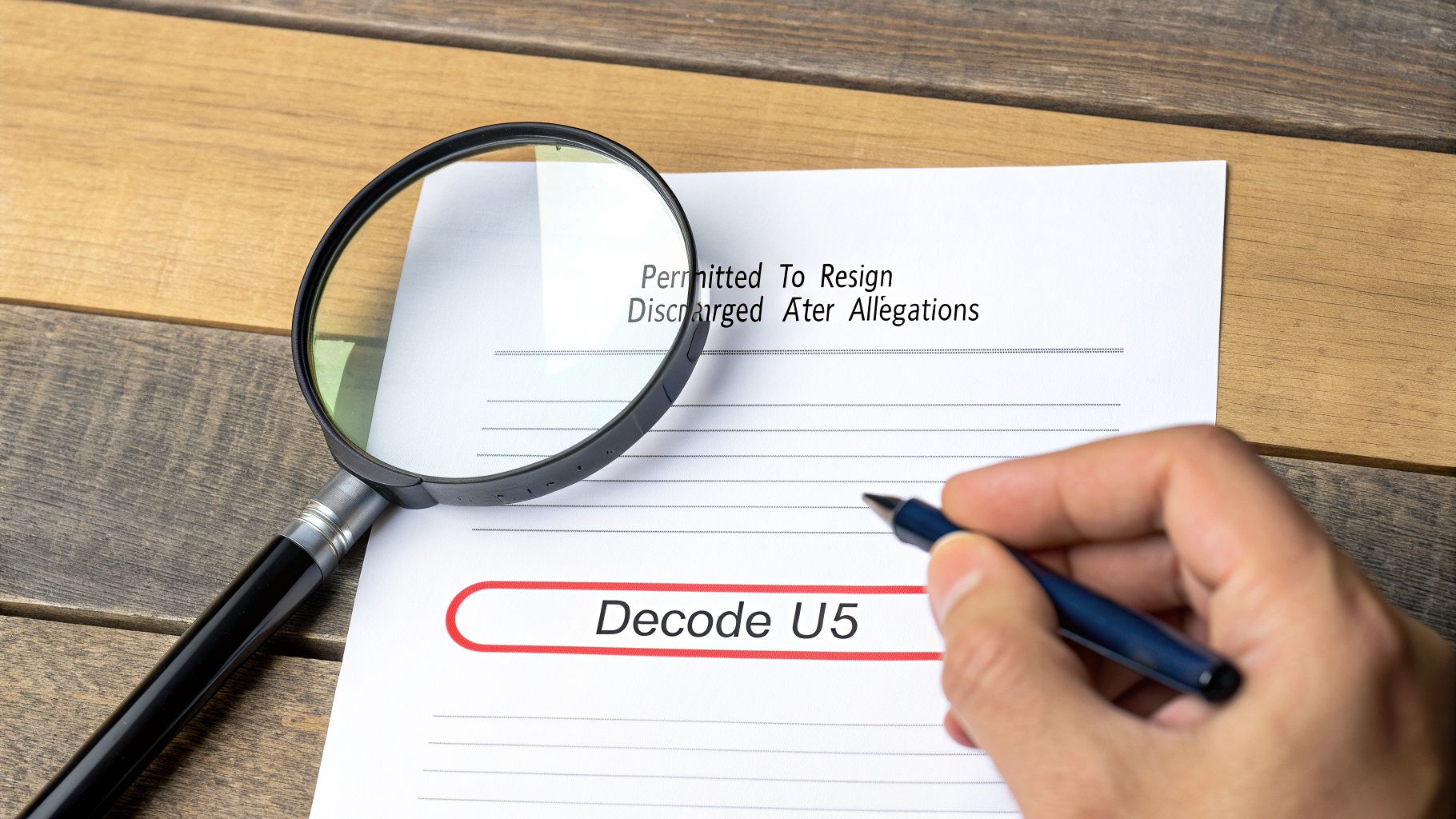
Phrases like "permitted to resign" or "discharged after allegations" are particularly alarming. "Permitted to resign" often means the firm gave the broker a chance to quit before they were formally fired, usually while under investigation. It signals serious trouble.
By dissecting these sections, you can connect the dots between the vague language on a U5 and the potential misconduct that led to your investment losses. This knowledge empowers you to take action. If you find these red flags on your advisor's record, it may be time to explore your options.
Call Kons Law Firm at (860) 920-5181 for a FREE, NO OBLIGATION consultation to understand your rights.
How a U5 Disclosure Creates a Permanent Record
A disclosure on a FINRA Form U5 isn't a temporary slap on the wrist. It’s a permanent, unerasable mark on a financial advisor’s public record. This is by design—FINRA’s system is built to create a transparent, continuous history for everyone, from regulators to the investing public, to see.
Once a firm files a Form U5, it’s stored forever in FINRA's Central Registration Depository (CRD), a massive database tracking the history of every person and firm in the securities industry. The most important details are then published for the world to see on FINRA’s free BrokerCheck tool, giving anyone the ability to look into an advisor's professional past.
The Career-Altering Impact on Advisors
For a financial advisor, a negative U5 disclosure can be a career-ending event. A termination notice, especially one tied to allegations of misconduct, acts as a massive red flag for any firm looking to hire. Brokerage firms are incredibly cautious about bringing on anyone with a history of customer complaints, regulatory problems, or internal reviews for fraud.
This permanent record follows an advisor wherever they go. Every potential employer will pull their CRD and BrokerCheck reports as a routine part of the hiring process. A problematic U5 can get an application thrown out immediately, making it nearly impossible to find another job in the securities industry. Even worse, a serious disclosure can trigger a direct FINRA investigation that could lead to fines, suspension, or a permanent bar from the industry.
A disclosure on a Form U5 becomes a permanent part of an advisor’s professional DNA. It’s not just a record of a past event; it’s a living document that regulators, employers, and investors will scrutinize for the rest of that individual's career.
These disclosures are permanent fixtures. Whether an advisor voluntarily quit or was fired for cause amid allegations of theft or unauthorized trading, those details stay etched in their BrokerCheck profile for any potential employer or investor in the U.S. to see.
A Powerful Asset for Investor Claims
While a bad U5 can end a broker's career, it can be an incredibly powerful tool for investors trying to recover their losses. This permanent record isn't just trivia; it is critical evidence that can prove a claim of misconduct. It provides a formal, documented history of an advisor's problems, often reported by the very firm that employed them.
For instance, finding out your advisor was "permitted to resign" from their last job for making unsuitable investment recommendations is a game-changer for your case. It helps establish a clear pattern of bad behavior. This information can be used in a FINRA arbitration claim to prove several crucial points:
- Pattern of Misconduct: It shows the advisor has a documented history of the exact same actions that caused your financial losses.
- Firm Negligence: It calls into question the current firm’s hiring process. Why did they hire someone with such obvious red flags on their record?
- Failure to Supervise: It can be used to argue that the brokerage firm failed in its legal duty to properly supervise an employee with a known troubled history.
This official documentation completely changes the dynamic of an investment fraud claim. It's no longer just your word against the advisor’s. Now, you have a formal regulatory filing that backs up your allegations. The Form U5 becomes a key piece of leverage, giving you the power to hold both the individual advisor and their brokerage firm accountable for your losses. Brokerage firms have a strict duty to maintain accurate records, a responsibility you can learn more about by reading our guide on FINRA's books and records rules.
If you have discovered a troubling disclosure on your advisor’s FINRA Form U5 and believe it’s connected to your investment losses, contact a legal professional. If you would like a free consultation to discuss the investment loss recovery process in more detail, call Kons Law Firm at (860) 920-5181 for a FREE, NO OBLIGATION consultation.
How to Find and Interpret Your Advisor's U5 History

Knowing what a u5 form finra filing means is important, but knowing how to find and read one is even more critical for protecting your investments. FINRA gives every investor free access to a tool called BrokerCheck, which contains the complete professional and disclosure history for financial advisors.
You can use BrokerCheck to search for an advisor by their name or by their unique Central Registration Depository (CRD) number. The report you get back will detail their work experience, licenses, and most importantly, any disclosure events tied to their record.
Locating the U5 Disclosures on BrokerCheck
When you pull up an advisor's report, look for a section titled "Disclosures." This is where the information from any u5 form finra filings is made public.
If this section states, "This broker has no disclosures," it means they have a clean record of reportable events. While that's a positive sign, it doesn't automatically mean the advisor is trustworthy.
If there are disclosures, you will see a chronological list of events like "Customer Dispute," "Termination," or "Regulatory Action." You can click on each event to see the specific details reported by the brokerage firm when they filed the Form U5.
The "Disclosure" section is the key to your research. This is where you can find the sanitized, formal language from the U5 filing and look for patterns of misconduct.
The language firms use is often intentionally vague. As an investor, it’s vital to understand what to look for and how to interpret what you find.
Translating the Jargon A "Settled" Dispute vs a "Denied" One
When looking at customer disputes on BrokerCheck, you will see different outcomes. Understanding the distinction is crucial, as they carry very different implications.
- Customer Dispute – Denied: This means the firm investigated the customer's complaint and decided it was without merit. Keep in mind, this is the firm's own conclusion, not an impartial judgment.
- Customer Dispute – Settled: This is a major red flag. A settlement means the firm paid money to the investor to make the complaint go away, usually to avoid the higher costs and risks of arbitration. Firms rarely pay to settle meritless claims.
- Customer Dispute – Pending: This means the complaint is either still being investigated or is in active arbitration. Its presence on a record is a warning sign that deserves close attention.
A single "denied" dispute over a long career may not be alarming. However, an advisor with multiple "settled" or "pending" disputes suggests a potential pattern of conduct that could put your investments at risk. To learn more about firm-level responsibilities, see our guide on what it means to be a FINRA member firm.
A Checklist of Critical Red Flags
As you review an advisor’s record, be on the lookout for these specific warning signs:
- Multiple complaints in a short time frame: A cluster of disputes can signal that a broker is engaging in misconduct or taking on excessive risk with client money.
- A history of similar issues across different firms: If a broker has suitability complaints at three different employers, the problem is most likely the advisor, not the firms.
- Terminations for cause: A "Discharged" status is a serious issue. Explanations citing policy violations, failure to follow procedures, or a "loss of confidence" are major concerns.
- "Permitted to Resign" status: This often indicates the advisor resigned while under an internal investigation for misconduct.
This knowledge is your first line of defense, whether you're vetting a new financial advisor or trying to understand losses you’ve already sustained. If you see these red flags and they sound familiar to your own experience, it's time to take action.
If you have discovered troubling information on your advisor’s U5 and want to discuss your options, call Kons Law Firm at (860) 920-5181 for a FREE, NO OBLIGATION consultation.
U5 Defamation Claims and What They Mean for Investors
While the u5 form finra is a tool for transparency, it can also be used improperly. A troubling issue in the securities industry is U5 defamation. This is what happens when a brokerage firm files a false or misleading termination notice, often as a way to retaliate against a broker who has left the firm.
This isn't just an internal issue between an advisor and their former company; it has serious consequences for investors like you. A defamatory U5 filing can act as a smokescreen, created to blame an individual broker for what may actually be much larger, firm-wide failures or misconduct.
The Rise of Retaliatory Filings
Why would a firm file a defamatory U5? It often occurs when a broker leaves to join a competitor, sometimes taking valuable client relationships with them. The old firm might file a negative U5 to hurt the advisor's reputation, making it harder for them to keep clients or find another job. It becomes a tool for punishment.
This scenario has become more and more common. FINRA Dispute Resolution statistics showed a 24% surge in Form U5 defamation arbitration cases between 2019 and 2020 alone. This spike suggests departing brokers are increasingly fighting back against what they see as false or exaggerated disclosures on their permanent record.
A defamatory U5 filing can be a strategic move by a brokerage firm to create a scapegoat. By blaming a single departing advisor, the firm can deflect attention from its own poor supervision, weak compliance culture, or even broader fraudulent activities.
For you as an investor, this means a negative disclosure on a U5 form requires a closer look. It might not be the whole story.
What U5 Defamation Means for Your Investment Loss Case
When you find a negative disclosure on your advisor’s record, it's easy to think the broker is the only one to blame. However, the increase in U5 defamation claims points to a more complicated reality. A negative U5 could be a red flag for deeper problems within the brokerage firm itself.
This provides a critical angle for a securities attorney building a case to recover your investment losses. Instead of only focusing on the individual advisor, an attorney can investigate the U5 filing itself. Was it a legitimate disclosure, or was it a desperate move by the firm to cover its own tracks?
Here’s why this is important for getting your money back:
- It Can Reveal Systemic Failures: A defamatory U5 may point to a firm that ignores misconduct until an advisor leaves.
- It Strengthens Negligence Claims: The filing can be used as evidence that the firm was not only negligent in supervising the advisor but also acted in bad faith when they left.
- It Can Expose a Cover-Up: If a firm blames an advisor for "unsuitable recommendations" only after they leave, it begs the question: why wasn't this dealt with while the advisor was still employed and managing your money?
Ultimately, while the u5 form finra is a vital starting point, you can't always take its contents at face value. The story behind a disclosure can be just as important as the disclosure itself. It can provide the leverage needed to hold the entire firm accountable for failing to protect your investments.
If you have suffered investment losses and think that information on a u5 form finra might be part of a larger story of firm misconduct, you need professional legal insight. If you would like a free consultation to discuss the investment loss recovery process in more detail, call Kons Law Firm at (860) 920-5181 for a FREE, NO OBLIGATION consultation.
When to Contact a Securities Attorney About a U5 Form

Discovering a troubling disclosure on a u5 form finra filing is a pivotal moment for an investor. While BrokerCheck provides the data, it doesn't give you a legal strategy. Knowing when to move from your own research to professional legal consultation is crucial for protecting your financial future and potentially recovering your losses.
It’s time to contact a securities attorney when the red flags on a Form U5 mirror your own negative experiences. For instance, if you’ve suffered heavy losses from what you suspect were unsuitable investment recommendations, and you then find your advisor was previously “discharged” for that exact conduct, you have uncovered powerful evidence.
Specific Scenarios Demanding Legal Consultation
Certain disclosures on a U5 are more than just minor issues; they are clear signals that you need an expert legal evaluation of your case. You should strongly consider seeking legal help if you find any of the following on your broker's record:
- Terminations for Cause: Any "Discharged" or "Permitted to Resign" status connected to allegations of sales practice violations, fraud, or making unsuitable recommendations.
- A Pattern of Customer Disputes: A single complaint might be an anomaly, but multiple settled or pending disputes—especially with similar allegations—can indicate a history of misconduct.
- Regulatory Actions: If FINRA, the SEC, or a state securities regulator has previously fined, suspended, or barred the advisor, it points to a serious breach of industry rules.
- Criminal Disclosures: Any felony charges or convictions, especially for financially-related misdemeanors, are among the most serious red flags an investor can find.
These are not just administrative notes; they are documented instances where a broker failed to meet their professional and ethical duties.
The information on a FINRA Form U5 can transform a potential claim from "your word against the broker's" into a documented case supported by the firm's own regulatory filings. A skilled securities attorney knows exactly how to leverage this as a cornerstone of a FINRA arbitration claim.
An experienced lawyer sees more than just a disclosure; they see a roadmap for building a strong case. A Form U5 can serve as direct evidence of an advisor's negligence or—even more powerfully—a brokerage firm’s failure to properly supervise its employees. This is especially true if the firm hired a broker with a known history of misconduct or failed to act on clear warning signs.
The right legal team can turn the information found on a u5 form finra into a powerful tool for recovering your investment losses. Proving firm-level negligence is often the key to a successful outcome in arbitration.
If you have discovered a problematic Form U5 and believe it is connected to your investment losses, it's time to seek a professional opinion. If you would like a free consultation to discuss the investment loss recovery process in more detail, call Kons Law Firm at (860) 920-5181 for a FREE, NO OBLIGATION consultation.
Answering Your Questions About the FINRA Form U5
Many investors have questions after reviewing a broker's u5 form finra. Here are some of the most common ones we hear, with answers to help you understand the nuances of a broker's professional history.
What If My Broker's U5 Form Is Clean but I Lost Money?
This is a critical question. A clean Form U5 does not mean no misconduct happened. It's entirely possible for an advisor's public record to be spotless even if you've suffered major investment losses due to their actions.
Sometimes, the brokerage firm simply didn't discover the issue before the broker left. In other cases, a firm might intentionally or negligently fail in its duty to report the misconduct, leaving investors in the dark.
A clean record is not a get-out-of-jail-free card. If you believe your losses were caused by unsuitable advice, unauthorized trading, or other wrongful acts, a clean U5 does not cancel out your potential claim for recovery.
If you suspect misconduct, you should have the specific facts of your case reviewed by an experienced securities attorney. They can investigate what really happened with your accounts, regardless of what the public record currently shows.
Can a Broker Remove a Negative Disclosure from Their Record?
Yes, but it's an uphill battle. The legal process for removing a negative mark from a u5 form finra is called expungement, and it is deliberately difficult and expensive.
An advisor can't just ask for a disclosure to be removed. They must file a formal FINRA arbitration case against their former firm and prove one of three very specific things:
- The disclosure is factually impossible or clearly erroneous.
- The advisor had no involvement in the misconduct that was alleged.
- The disclosure is false or defamatory.
FINRA sets this high standard for a reason. It ensures that legitimate disclosures stay on a broker's permanent record, which helps maintain the integrity of the information you find on BrokerCheck.
How Long Can a U5 Form Be Updated After a Broker Leaves?
A brokerage firm's obligation to report information doesn't end when a broker walks out the door. Firms have an ongoing legal duty to amend a Form U5 if they learn of new, reportable information after the broker’s termination. This extends far beyond the initial 30-day filing deadline.
For example, imagine a customer files a written complaint alleging misconduct six months after their broker quit. The former firm is still required to file an amendment to that broker's U5 to disclose the new complaint. This ensures the public record stays current.
Because of this continuing obligation, a broker's record is never really final. A clean U5 today could have a new, serious disclosure added to it tomorrow. This is why it's smart to check BrokerCheck periodically, especially if you have lingering concerns about an old account.
If you would like a free consultation to discuss the investment loss recovery process in more detail, call Kons Law Firm at (860) 920-5181 for a FREE, NO OBLIGATION consultation. Learn more about how we can help at investmentfraudattorneys.com.
