You see a regulator announce a major enforcement result, and you check your account expecting some of that money to offset your loss. Weeks pass, then months, and nothing arrives. That's the moment most injured investors learn the central problem with a securities fraud penalty, the headline number describes what a wrongdoer must pay, not what you're guaranteed to receive.
Why a Headline Penalty May Not Reimburse You
A retiree reads that the SEC has ordered a firm to pay a substantial penalty for misleading investors. She assumes her loss will be repaid automatically because her shares fell after the same disclosure problems came to light. That assumption is understandable, but it's often wrong.
Money ordered, money collected, and money distributed are three different things. An order may require payment to the government. A defendant may pay less than ordered, pay over time, or lack assets to pay at all. Even when funds are collected, only part of the total may be placed into a distribution process for investors.
The numbers behind the headline
In fiscal year 2024, the SEC filed 583 enforcement actions and obtained $8.2 billion in financial remedies, including approximately $6.1 billion in disgorgement and prejudgment interest and $2.1 billion in civil penalties, according to the SEC fiscal year 2024 enforcement results announcement. Those categories aren't interchangeable. Disgorgement generally targets gains tied to misconduct, prejudgment interest addresses the time value of that money, and a civil penalty punishes and deters.
Total monetary relief tells you the scale of enforcement across hundreds of matters. It doesn't tell you whether your transaction falls inside a distribution, whether you can prove causation, or whether the defendant has collectible assets. Enforcement volume also doesn't predict your recovery, because one very large case can dominate an annual total.
A penalty is a public sanction first. Your reimbursement depends on a separate question, where does compensation for your specific loss come from?
Your path usually runs through four connected decisions. You identify the conduct and the responsible party, calculate your net loss, determine which forum can hear your claim, and check whether any deadline has narrowed your options. A free, no obligation consultation can help you organize account records and communications before you choose among SEC distribution procedures, private litigation, FINRA arbitration, or reporting misconduct for criminal or regulatory review.
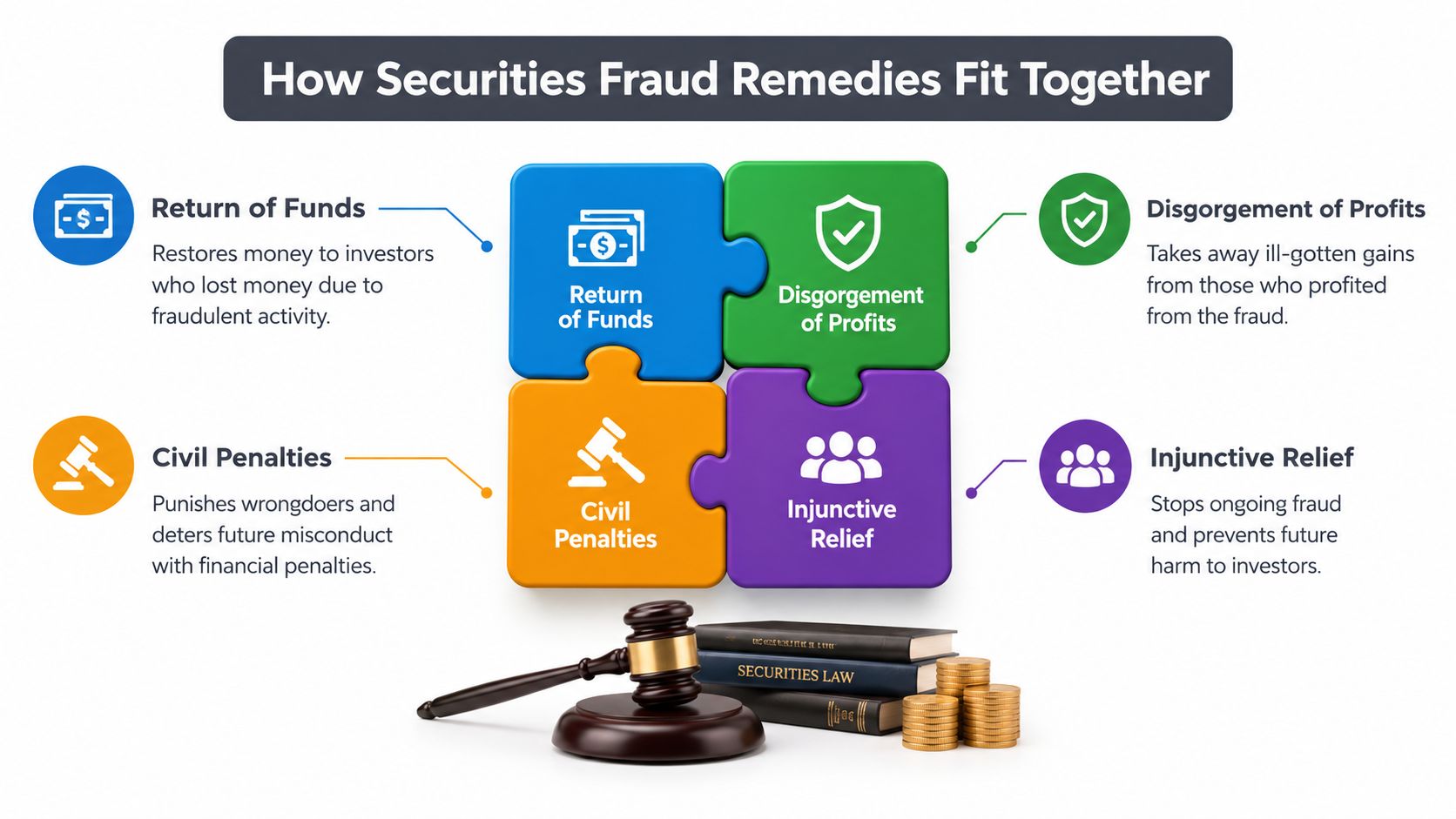
How Securities Fraud Remedies Fit Together
Think of securities fraud remedies as a recovery waterfall rather than a single pot. Money and sanctions flow for different reasons, and each stream answers a different question. Once you see those purposes clearly, enforcement news becomes much easier to interpret.
Use the analogy of a damaged building. Restitution and private damages aim to repair the investor's loss. Disgorgement removes lumber, tools, or rent the wrongdoer wrongly took from the site. A civil penalty or criminal fine resembles a citation imposed because the conduct endangered the public, whether or not it pays for your repairs.
Three purposes you shouldn't merge
- Compensation: Damages and restitution focus on making an injured investor whole, to the extent loss can be proved and collected.
- Removal of gain: Disgorgement asks what profit the wrongdoer obtained from the violation and whether that profit should be returned for victims.
- Punishment and deterrence: Penalties, fines, bars, and criminal sanctions discourage repetition and protect markets, even when no individual investor receives the full amount.
Civil and criminal systems can address the same conduct in parallel. A regulator may seek an injunction and monetary relief, prosecutors may pursue criminal charges, and investors may bring their own claims. Each proceeding has its own decision-maker, burden of proof, remedies, and procedural rules.
That's why one outcome doesn't automatically satisfy another. A firm can settle with a regulator and still face a private damages claim. An individual can face an industry bar while investors still need a separate forum to prove what they lost. Conversely, a private settlement doesn't necessarily end a government investigation.
Guiding principle: Follow the purpose, the payer, and the recipient. If you can't identify all three, you don't yet know whether a remedy helps your recovery.
Why labels can mislead
News coverage often calls every payment a fine. Legal documents are more precise, and that precision matters. An injunction may stop future violations but pay nothing today, while undertakings may require compliance reforms. A bar can remove someone from the industry without restoring your account.
When you evaluate a securities fraud penalty, separate the sanction from the compensation mechanism. Ask who receives the money, how eligibility is decided, and what proof links your purchase to the misconduct. Those questions turn an abstract enforcement result into a practical recovery decision.
Comparing Civil and Regulatory Money Remedies
Investors encounter several money remedies, and the labels matter because each one measures something different. Some look at your loss. Others look at the defendant's gain. Still others ignore both figures and focus on punishment.
Civil damages are the most direct compensation concept. In a private claim, you generally try to prove a legal violation, causation, and a measurable loss tied to the misconduct. Market declines alone don't establish that connection, so transaction timing, disclosures, recommendations, and alternative causes become important.
Punitive awards serve a different role. They're exceptional rather than routine and are intended to punish especially wrongful conduct and deter others. You shouldn't build a recovery plan around them, because availability and limits depend on the claim, forum, and governing law.
Return of money versus punishment
Restitution focuses on returning money wrongfully obtained. The question is often what the defendant received from investors and what remains available to repay. Disgorgement is related, but it's an enforcement remedy tied to profits from the violation and victim benefit. It isn't every dollar investors contributed, because expenses, losses, and the connection between conduct and profit may affect the calculation.
A civil fine or civil penalty is primarily punitive and deterrent. As of January 15, 2025, statutory ceilings for a fraud violation under Securities Act Section 20(d) can reach $150,000 for a natural person and $725,000 for a non-natural person when the conduct causes significant losses or creates a substantial risk of significant gains, under the SEC civil penalties inflation adjustments. Those ceilings show maximum exposure under that provision, not a promised payment to any investor.
Additional context on how enforcement fits into the broader regulatory process appears in this overview of SEC enforcement for investors. Read any order with the recipient in mind. A large securities fraud penalty may strengthen deterrence, while a smaller disgorgement fund may matter more to you if you're eligible for distribution.
Securities Fraud Remedies at a Glance
| Remedy | Primary Purpose | Basic Calculation | Intended Beneficiary | Recovery Consideration |
|---|---|---|---|---|
| Civil damages | Compensate provable loss | Loss caused by misconduct | Injured investor | Requires liability, causation, and collectability |
| Punitive awards | Punish and deter | Based on wrongful conduct and governing limits | Claimant, when authorized | Exceptional and forum dependent |
| Restitution | Return wrongfully obtained funds | Money taken or loss subject to repayment | Victims | Depends on identifiable funds and payment ability |
| Disgorgement | Remove violation profits | Net profits tied to misconduct | Victims when distributed | Isn't an automatic refund of all contributions |
| Civil penalties and fines | Punish and deter | Statutory factors and ceilings | Government or designated fund | Doesn't automatically reimburse your loss |
The practical filters
Three filters sit between an award and money in your account. First, proof determines whether your loss qualifies. Second, distribution rules determine how eligible claims share available funds. Third, collection risk determines whether the defendant can pay.
That last filter deserves blunt attention. A judgment against an insolvent promoter may be worth little, while a claim against a solvent firm with supervisory responsibility may present a different analysis. Don't assume a fixed result from the remedy label. The amount ordered, the amount funded, and your eligible share can diverge sharply.
Understanding Criminal and FINRA Sanctions
Criminal and FINRA consequences can look similar in a news story because both may involve fines, bars, or orders to repay money. They come from different authority, however, and they serve different functions. Confusing them can cause you to wait for compensation from a process that was never designed to calculate your full claim.
Criminal sanctions punish through the court system
Federal prosecutors decide whether to bring criminal charges. If a defendant is convicted or pleads guilty, a court may impose consequences that can include incarceration, probation, criminal fines, restitution, and forfeiture, depending on the charges and applicable law. The sentence turns on the offense, the proof, the defendant's conduct, and the court's application of governing rules.
Criminal restitution can matter to victims, but it isn't the same as winning a private case. The government controls the prosecution, and the court addresses restitution within that criminal judgment. You may need to document your loss for the government while also evaluating whether a separate civil or arbitration claim is available.
Incarceration also creates a hard practical tradeoff. It may deliver accountability, but it doesn't create assets. A defendant in custody may have limited ability to earn income or satisfy a judgment, which makes early attention to other responsible parties, insurance questions, and collectible assets important.
FINRA disciplines industry members
FINRA is a self-regulatory organization for brokerage firms and their representatives. Its disciplinary sanctions can include fines, suspensions, expulsions, bars, and requirements connected to compliance or repayment. Those sanctions protect the industry and the public, but a disciplinary fine isn't automatically your damages award.
FINRA arbitration is separate from FINRA discipline. Arbitration is the investor facing forum where you present a claim against a brokerage firm or broker and seek a monetary award. FINRA states that, for an arbitration claim involving the business activities of a brokerage firm or broker to be considered, the alleged act underlying the claim generally must have occurred within the previous six years, as explained in FINRA guidance on legitimate avenues for recovery.
That eligibility period is not the only timing issue. Separate limitation rules, contract provisions, and discovery questions can affect a claim. You shouldn't assume that filing a regulatory complaint pauses every other deadline.
Compliance failures also sit in a wider regulatory environment, and readers who want background on how overlapping duties shape recordkeeping can review material on understanding GDPR PCI-DSS SOX as a general compliance resource. For your claim, the useful point is narrower. Preserve the communications and records that show what your broker recommended, what you were told, and what the firm documented before those materials become harder to obtain.
How Penalty Amounts Are Calculated
A statutory maximum is a ceiling, not a calculator. Courts and regulators don't start with the largest possible securities fraud penalty and award it automatically. They examine the violation, the harm, the gain, and the defendant's conduct before selecting a sanction within the available authority.
Annual enforcement totals can distort your expectations in the same way. A year with fewer cases can still produce unusually high monetary relief if one matter involves extensive losses. A year with many actions can produce lower total relief if most matters are smaller. Aggregate figures describe a portfolio of unrelated cases, not the likely result in yours.

Disgorgement starts with net profits
In Liu v. SEC, the Supreme Court held that disgorgement is permissible equitable relief when it does not exceed the wrongdoer's net profits and is awarded for victims, and the underlying district court award included approximately $26.7 million in disgorgement and $8.2 million in civil penalties, as summarized in the Congressional Research Service summary of Liu v. SEC. That pairing shows the boundary clearly. Disgorgement measures gain, while the penalty adds a punitive component.
Suppose investors contributed a large sum to a scheme and the operator spent much of it on business expenses, repayments to earlier participants, and personal items. The disgorgement analysis doesn't ask how much investors lost. It asks what net profit the wrongdoer obtained from the violation and whether the award can be directed for victims.
Calculation check: Investor loss, defendant gain, and statutory punishment can produce three different numbers in the same case.
Variables that matter more than the headline
- Violation type: The charged provisions define available relief and what the government or claimant must prove.
- Duration: A long running scheme may involve more transactions, victims, and gains than an isolated misstatement.
- Investor harm: The scale and traceability of losses can influence penalties, restitution, and settlement posture.
- Gains obtained: Disgorgement focuses on profits connected to the violation, not gross receipts alone.
- Cooperation and remediation: Self reporting, cooperation, and corrective steps may affect enforcement outcomes.
- Recidivism: Prior misconduct can support stronger sanctions because earlier deterrence failed.
- Ability to pay: A defendant's finances affect both settlement structure and practical collection.
- Distribution fund: Your recovery depends on whether collected money is designated for investors and whether your claim qualifies.
Prejudgment interest can increase the amount tied to disgorgement because the wrongdoer had use of the money over time. Injunctions, officer and director bars, and industry bars don't add dollars, but they can change future risk and settlement advantage. Undertakings may require compliance changes that matter to a firm even though they don't compensate you directly.
For an investor, the better question isn't whether a penalty sounds large. Ask how much is penalty, how much is disgorgement, who controls distribution, and what assets stand behind the order. A smaller funded amount with clear eligibility rules may be more valuable than a dramatic judgment against a defendant who cannot pay.
Examples of How Investors May Recover
Representative situations show why two investors with similar losses can reach different outcomes. The forum, evidence, and source of payment change the analysis. None of these examples promises a result, but each one highlights the questions you should ask early.
Four routes, four different proof problems
An SEC distribution claimant learns that a defendant paid disgorgement into a fund. Her task is usually administrative as well as factual. She needs records showing qualifying purchases, sales, and losses within the distribution definition, and she must follow claim procedures. The fund may pay only part of recognized losses if eligible claims exceed available money.
A private civil claimant alleges that false statements caused a measurable investment loss. He must do more than point to an enforcement order. He needs evidence connecting the misstatement to his decision or to the security's value, plus a defensible loss calculation and a defendant capable of paying. Regulatory findings may help, but they don't replace his own proof.
A FINRA arbitration claimant says a broker recommended an unsuitable, concentrated position and misrepresented its risks. Account opening documents, risk tolerance records, communications, confirmations, and supervisory evidence become central. Later enforcement of any award is a separate practical issue, addressed in this discussion of arbitration award enforcement and collection.
A criminal case victim watches a promoter plead guilty and receive probation or incarceration. The sentence may include restitution, yet payment still depends on the judgment terms and the defendant's assets and income. Accountability and repayment advance on different tracks, and the victim may still need advice about related firms or other responsible parties.
Why aggregate relief can mislead your expectations
In fiscal year 2025, the SEC reported 456 enforcement actions and $17.9 billion in total monetary relief, but approximately $14.9 billion arose from one long-running matter, excluding which produced roughly $2.7 billion in penalties and disgorgement, according to the SEC fiscal year 2025 enforcement results. If you used the top line as a benchmark, you'd overstate what an ordinary matter produces.
Your facts sit at matter level, not annual level. Did the broker control the account, did the firm supervise the recommendation, and did you receive partial distributions already? Those details can matter more than whether national enforcement relief rose or fell that year.
What Evidence and Deadlines Matter Most
Strong records let counsel test liability, loss, and collectability without guesswork. Weak records force everyone to reconstruct events from memory. Start preserving documents as soon as you suspect misconduct, even before you know which forum fits.
Build a loss file that answers basic questions
- Account statements: Show balances, deposits, withdrawals, dividends, fees, and the timing of losses.
- Trade confirmations: Establish what you bought or sold, when, at what price, and through which account.
- Offering documents: Preserve prospectuses, private placement memoranda, presentations, projections, and risk disclosures.
- Communications: Save emails, texts, letters, notes, advertisements, and messages describing safety, income, liquidity, or guarantees.
- Suitability records: Keep account forms, investment objectives, income and net worth information, and risk tolerance documents.
- Payment records: Track distributions, partial refunds, settlements, tax forms, and any money already returned.
- Chronology: Write down who recommended the investment, what was promised, when concerns arose, and what you were told afterward.
Identify every potentially responsible entity, not only the individual who sold the investment. A brokerage firm, advisory firm, issuer, promoter, or control person may have played a different role. Your file should separate what each party did from what you infer they knew.
Deadlines depend on the remedy
Congress established a limitations period of up to 10 years for certain SEC disgorgement claims involving specified antifraud provisions, while civil-penalty claims generally remain subject to the five-year period under 28 U.S.C. § 2462, as reflected in the Supreme Court material discussing Kokesh and disgorgement. Those are government enforcement periods. They don't give you a personal deadline for every private claim.
Your own claims may involve statutes of limitation, statutes of repose, contractual provisions, discovery rules, and FINRA eligibility. This guide to statutes of limitation for securities fraud can help you frame questions, but a lawyer still needs your transaction dates and discovery facts. Don't wait for a regulator to finish before asking whether your separate claim is expiring.
Preserve first, classify second. You can decide whether a document helps after you've saved it, but you can't analyze a message that was deleted.
Choosing the Right Recovery Path
Start by matching the remedy to the conduct. A distribution claim fits when collected funds have been designated for eligible investors. A private damages action fits when you need a court to decide liability and loss. FINRA arbitration fits many disputes with brokerage firms and brokers, while regulatory or criminal reporting serves public enforcement and may generate evidence, restitution, or both.
Public enforcement can help without completing your case. In fiscal year 2024, more than 70 firms paid roughly $600 million in civil penalties in matters involving off-channel business communications, illustrating that penalties can arise from recordkeeping and compliance failures as well as traditional false statements, according to the Paul Weiss SEC enforcement 2024 year in review. A recordkeeping penalty against your firm doesn't prove your recommendation was fraudulent, but missing communications may affect what evidence exists and how the firm explains its supervision.
Use this decision sequence. Preserve documents, calculate net investment loss, identify every responsible entity, check each deadline, and assess whether the remedy compensates or merely punishes. Then ask about collectability before you spend time chasing the largest theoretical number. Group claims may also change forum and proof, which makes securities fraud class action considerations relevant when many investors share the same alleged misstatement.
Bring specific questions to counsel. Which party has assets, which forum controls the claim, what loss method fits, and does an enforcement fund already exist? If you would like a free consultation to discuss the investment loss recovery process in more detail, call Kons Law Firm at (860) 920-5181 for a FREE, NO OBLIGATION consultation.
If a broker, advisor, or firm caused losses through fraud or other misconduct, Kons Law can review your records, identify whether FINRA arbitration, litigation, or a distribution claim fits your facts, and explain the deadlines and collectability issues before you file. Reach out for a free, no obligation consultation so you can decide your next step based on evidence, not on a headline penalty.
