You open your phone, see a news alert that the SEC has charged your broker, your advisory firm, or the company behind an investment you bought, and your first question is simple. Do I get my money back now?
If you'd like a free consultation to discuss the investment loss recovery process in more detail, call Kons Law Firm at (860) 920-5181 for a FREE, NO OBLIGATION consultation.
For most investors, that alert creates more confusion than clarity. An SEC case is important. It can validate that something was seriously wrong. But it usually does not operate as a personal recovery case for each investor who lost money.
That gap matters. The SEC says its Enforcement Division investigates securities law violations, files enforcement actions, and returns money to harmed investors whenever possible, as described by the SEC Division of Enforcement. But investors still need to understand what public enforcement does, what it doesn't do, and when they need to move on their own claim instead of waiting.
An SEC Action Was Filed What Does It Mean for My Money
The hardest moment is often the first one. You learn that the SEC sued your broker or announced charges tied to an investment you bought, and you assume that some government process is now underway that will automatically reimburse you.
Usually, that's not how it works.

An SEC action often means the government believes there was a securities law problem serious enough to investigate and pursue. That can include fraud, misleading disclosures, improper sales practices, market manipulation, or supervisory failures. It can also give you something valuable: a public factual record that may help you evaluate your own claim.
What it does not usually mean is that the SEC is now acting as your personal lawyer.
What the filing tells you
An SEC complaint or settlement can signal several things at once:
- The conduct mattered: The agency chose to spend resources on it.
- Documents likely exist: Emails, account records, trade data, compliance reviews, and testimony may have been gathered.
- The issue may be broader: Your losses may be part of a larger pattern, not a one-off mistake.
If you want a plain-English primer on how these government matters work, this overview of SEC investigations and what they mean is a useful place to start.
What the filing does not promise
Many investors assume an SEC case answers the wrong question. The agency asks whether securities laws were violated and what public remedies are appropriate. You need answers to different questions:
For most investors, the real issue isn't whether the SEC acted. It's whether you still have a viable path to recover your own losses.
Those are separate matters. An SEC case can help your private recovery effort, but it rarely replaces it.
That distinction has become more important because enforcement intensity can change. Public commentary about recent enforcement trends has highlighted a drop in public-company enforcement and smaller penalties in fiscal 2025, which leaves many investors wondering whether less SEC activity reflects less misconduct or merely less visibility. For someone who has already lost money, waiting for clarity from Washington usually isn't a sound recovery strategy.
Understanding SEC Enforcement Its Mission and Targets
Think of SEC and enforcement as public law enforcement for the securities markets. The SEC's job is to police conduct that threatens market integrity and investor trust. Your job, if you've suffered losses, is to decide whether that same conduct supports your own arbitration or court claim.
Those two tracks overlap, but they aren't the same.
The market police analogy
A practical way to understand the SEC is this: it functions like a market police force. It investigates, gathers evidence, files charges, negotiates settlements, and sometimes goes to court. It can punish wrongdoing and try to stop it from happening again.
But the SEC usually doesn't serve as the attorney for individual victims in the way a private lawyer does. If a broker churned your account, sold unsuitable products, ignored concentration risk, or misrepresented an illiquid private placement, the SEC may care about that conduct as a public issue. Your own recovery still depends on whether you bring a claim and prove your damages.
Who the SEC typically targets
In the investor-loss context, SEC enforcement often touches these categories:
- Brokerage firms: For supervision failures, sales practice violations, books and records issues, or broader misconduct.
- Financial advisors and investment advisers: For misleading statements, conflicts, undisclosed compensation, or fiduciary failures.
- Public companies and executives: For false or misleading disclosures.
- Offering sponsors and promoters: For unregistered securities sales, misleading offering materials, or fraud in private deals.
A good investor should also learn to filter financial headlines carefully. General market commentary can be useful for context, and resources like summarized tech news by Typist can help you quickly scan broader developments, but they don't substitute for reading the actual SEC complaint, settlement papers, or your own account records.
What the SEC focuses on versus what investors need
The SEC often asks broad public-interest questions. Investors need narrower, claim-specific answers.
| SEC focus | Investor focus |
|---|---|
| Was there a securities law violation? | Did my broker or advisor cause my losses? |
| Should the defendant be penalized or barred? | Can I recover through FINRA arbitration or litigation? |
| Does this conduct threaten the market? | What documents prove my case? |
A regulator measures public harm differently than an investor measures personal loss.
That's why a case that looks major in the news can still leave an investor with no check, no timetable, and no clear explanation of what to do next.
The SEC Enforcement Process From Tip to Trial
Most SEC cases don't begin with a dramatic raid or a headline. They begin discreetly. A whistleblower reports suspicious conduct. A customer complains. A compliance review raises concerns. Or the agency's own surveillance tools flag patterns that don't look right.
The process can move in stages, and it often moves slowly.
How a case usually starts
A modern SEC investigation is increasingly data-driven. Recent enforcement commentary explains that the Market Abuse Unit uses the Consolidated Audit Trail and advanced analytics to detect misconduct such as insider trading by identifying abnormal trading patterns and correlations in communications, as discussed in this review of the evolving SEC enforcement landscape. In plain English, people leave digital trails. Trades, texts, emails, account links, and timing around major events can all become evidence.
That matters to investors for one reason. If your broker or advisor said, "There's nothing in writing," that may not be the end of the story.
The core stages
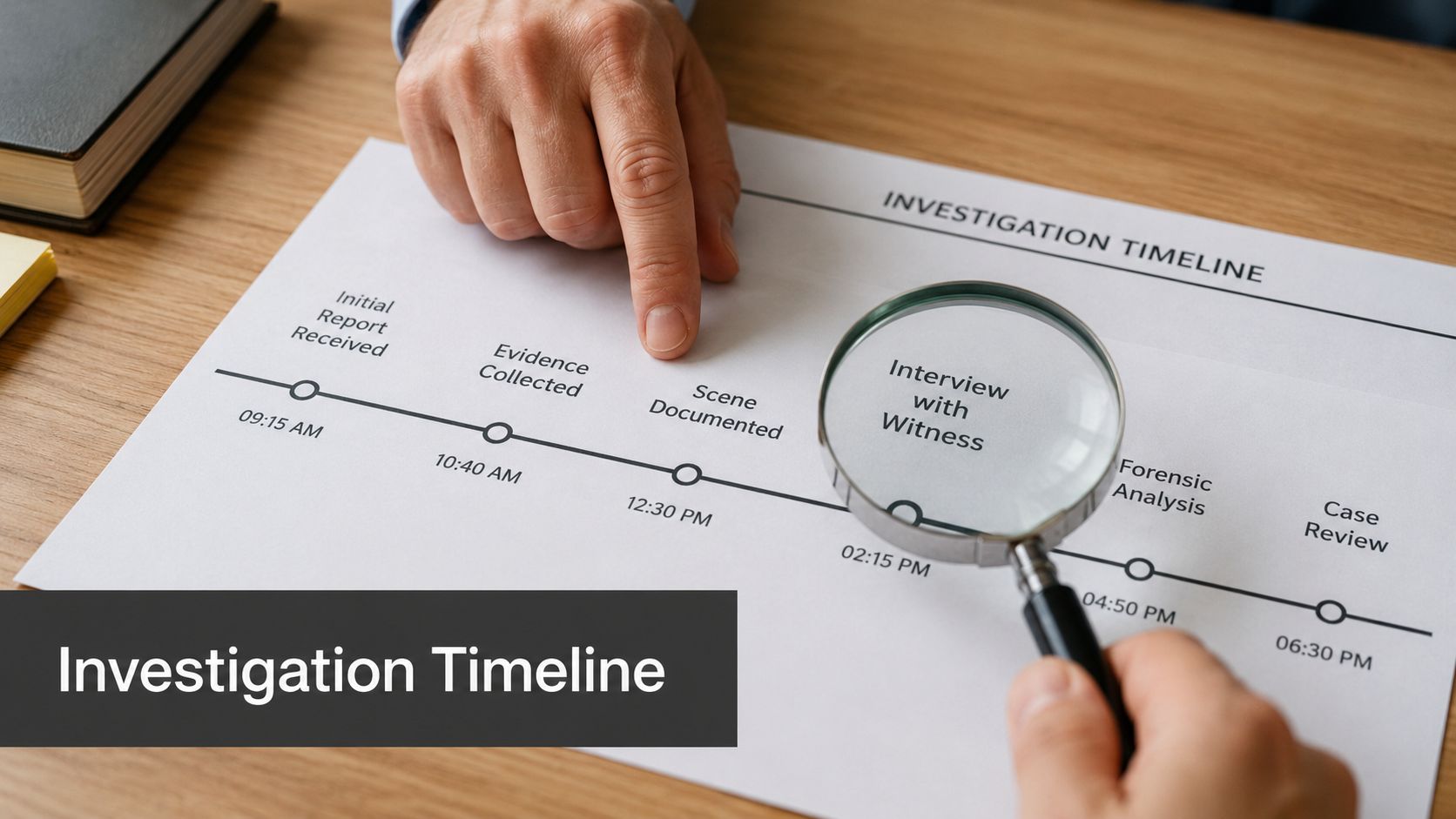
Here is the rough lifecycle investors should expect:
Initial inquiry
Staff gather information, often before anything public happens. Some matters end here.Formal investigation
The SEC can demand documents, take testimony, and reconstruct events in detail.Wells stage
Before recommending charges in many cases, staff may send a Wells notice to the target. The recipient gets a chance to argue why charges shouldn't be filed. If you want a basic explanation, this guide on what a Wells notice is gives the investor-facing version.Settlement or litigation
The case may resolve through settlement, or the SEC may file in federal court or pursue an administrative proceeding.
Why timing frustrates investors
Government cases often take a long time. That delay creates a practical problem for people who lost money. Your own deadlines may keep running while the SEC investigates. Witness memories fade. Emails disappear. Financial statements get harder to organize.
Practical rule: Never assume your private claim can wait just because the SEC is still investigating.
If you're trying to understand how lawyers build chronology from regulatory filings, subpoenas, and pleadings, tools such as PDF AI's legal research agent can help organize dense records. The important point, though, is that private counsel doesn't need to wait for a final SEC judgment to start evaluating your case.
What works and what doesn't
What helps investors:
- Saving documents early: Account statements, emails, texts, notes, offering materials.
- Tracking dates: When the recommendation was made, when losses occurred, when disclosures changed.
- Getting advice before the public case ends: Delay usually helps the defense, not the customer.
What doesn't help:
- Relying on headlines alone
- Assuming the SEC will call you
- Waiting for a settlement fund before assessing your own rights
An SEC investigation can be a strong factual tailwind. It is not a substitute for your own claim strategy.
Remedies the SEC Can Obtain and Their Limits
When investors see a large SEC case, they often focus on the headline remedy. Penalty. Settlement. Injunction. Industry bar. Those outcomes matter, but they don't always put money back into your account.
That's where expectations need to be realistic.

What the SEC can seek
The SEC commonly pursues several kinds of relief:
- Civil penalties: Monetary punishment for violating securities laws.
- Disgorgement: Repayment of ill-gotten gains.
- Injunctions: Court orders directing a party to stop certain conduct.
- Bars and suspensions: Limits on a person's ability to work in the industry.
- Undertakings: Compliance changes, training, reporting obligations, or independent reviews.
Those remedies serve public purposes. They punish, deter, and restructure conduct. They don't always compensate victims fully, and sometimes they don't compensate them at all.
Why investors shouldn't rely only on the SEC
Enforcement intensity changes with leadership and policy priorities. A 2025 enforcement review reported that new SEC enforcement actions fell to 313 in FY 2025, the lowest level in a decade and 27% below FY 2024's 431 cases, according to Paul Weiss's SEC Enforcement 2025 Year in Review. That same review reported 56 enforcement actions against public companies and subsidiaries, down 30% from FY 2024, and total monetary settlements dropped 45% to $808 million, the lowest annual total since FY 2012.
For investors, the lesson is straightforward. The SEC can't be your only line of defense. The number of cases filed, and the amount of money collected, can swing sharply from year to year.
The practical limits of SEC recoveries
Even in a strong SEC case, several problems remain:
| Public enforcement result | Investor reality |
|---|---|
| A firm pays a penalty | That money may not go directly to investors |
| The SEC gets an injunction | Your losses still need to be proven separately |
| An executive is barred | That doesn't automatically establish your personal damages |
If your retirement account dropped because of broker misconduct, a regulatory victory may feel satisfying and still leave your personal recovery unfinished.
I often tell investors to treat an SEC action as evidence and advantage, not as the final answer. Public enforcement can strengthen a private claim. It rarely eliminates the need for one.
What works is parallel thinking. Let the government do what it does. At the same time, preserve your own claims, evaluate your losses, and consider whether FINRA arbitration or civil litigation gives you a more direct path to recovery.
How to Interpret an SEC Announcement About Your Broker
SEC press releases are useful, but they are written for public enforcement purposes, not for helping you decide whether to bring a claim. Investors who read them too quickly often make two mistakes. They overvalue the headline number, and they undervalue the factual narrative buried in the filing.
The second part is usually more important.
Read the misconduct section first
Start with the actual description of conduct. What did the SEC say happened? Did the broker recommend unsuitable products? Did the firm fail to supervise? Did the advisor omit conflicts, overconcentrate the account, or make false statements about risk or liquidity?
Those facts matter far more to your personal claim than the press office language at the top of the release.
If you have access to the broker's employment and termination history, documents tied to registration events can also matter. For background, this explanation of what a U-5 form is helps investors understand why departure disclosures may be relevant when misconduct surfaces.
Don't treat big numbers as the whole story
A Cornell Law Review analysis found that the SEC's aggregate enforcement statistics could be "invalid" and "inconsistent" because they sometimes double- or triple-counted matters and overstated activity. After adjusting for those distortions, the study concluded enforcement was steady from 2002 to 2014, while the mix shifted toward easier-to-prosecute violations, as explained in the Cornell Law Review article on SEC enforcement metrics.
That matters when you read a dramatic headline. A press release may sound larger than the investor-specific reality.
What to look for in the announcement
Use a lawyer's checklist, even if you're just reading on your own:
- Admissions or no admissions: If the settlement says the defendant neither admits nor denies, that's still meaningful, but it isn't the same as a litigated finding.
- Identity of the charged parties: The firm, the individual broker, a supervisor, or an issuer.
- Time period: You need to know whether your losses fall inside the conduct window.
- Product type: Variable annuities, private placements, non-traded products, options, margin strategies, or something else.
- Language about harm: Was the conduct framed as intentional fraud, negligence, books and records issues, or supervisory failure?
An SEC announcement is rarely the endpoint. For an investor, it's often the beginning of a better investigation.
What investors often miss
The most useful part of the SEC filing may be what it suggests, not just what it states. A complaint can identify witnesses, branch offices, internal warnings, sales scripts, due diligence failures, or product features that weren't explained correctly to customers.
That information can shape your arbitration theory. It can also tell you whether your case is likely about fraud, unsuitable recommendations, failure to supervise, misrepresentation, or some combination of all four.
Using SEC Findings in Your FINRA Arbitration Case
An SEC case can make your FINRA claim stronger. It does not recover your losses by itself.

Investors often call after seeing that the SEC sued a broker, adviser, or firm connected to their losses. The first question is usually simple: does this mean I get my money back? Usually, no. The SEC's case may help prove misconduct, but your recovery still depends on building your own damages claim and pursuing it in the right forum, often FINRA arbitration.
That gap matters. A government action can create useful evidence, pressure, and structure. It rarely proves every part of an investor's private case.
What SEC findings actually do for your case
An SEC complaint, order, or settlement can give your lawyer a head start in several practical ways:
- It narrows the factual dispute
- It identifies the people and entities involved
- It describes the product, sales practice, or strategy at issue
- It points to supervision, compliance, or disclosure failures
- It suggests what internal documents and communications likely exist
Used well, those materials help shape the statement of claim, focus discovery requests, and test defenses early. They also help explain the case to arbitrators in a way that is concrete and easier to follow.
If you're trying to understand how lawyers compare authorities and organize legal arguments across forums, resources such as LegesGPT as a Casetext alternative can be useful for legal research workflow. In an investor case, though, the real work is tying those materials to your account statements, emails, new account forms, risk profile, and loss history.
Why the SEC record helps, and where it falls short
The SEC may have already done some of the expensive investigative work that private counsel would otherwise need to reconstruct. A filing may identify the same branch office, the same product line, or the same sales practices that affected your account. That can save time.
But there are limits. SEC pleadings are drafted to prove securities law violations, not to prove your individual damages, reliance, or suitability claim. A settlement without admissions may still be useful, but it usually does not carry the same weight as sworn testimony, a final judgment, or your own account records.
That is why experienced counsel uses the SEC case as support, not as a substitute.
How lawyers use SEC materials in FINRA arbitration
A strong arbitration strategy usually starts with matching the SEC matter to your facts.
Compare the conduct to your account history
Was it the same broker, office, product, recommendation pattern, or time period? If your losses sit outside the conduct window described by the SEC, the filing may have limited value.Build targeted discovery requests
Once the SEC has identified red flags, lawyers can ask for supervision files, internal reviews, compensation records, due diligence materials, email correspondence, training documents, and exception reports with more precision. This FINRA discovery guide for investors gives a useful overview of the kinds of records that can matter.Evaluate the procedural value of the SEC outcome
A litigated judgment may carry more weight than a no admit, no deny settlement. In some cases, issue preclusion arguments may be worth examining. In many others, the better use is practical rather than technical. The SEC record helps frame the misconduct and expose weak defense themes.
Cooperation and remediation still matter
Firms sometimes emphasize cooperation, remediation, and internal discipline when resolving an SEC matter. Investors should read that carefully. Those statements are not the same as an admission to your claim, but they can support an argument that the firm recognized a serious compliance problem and took corrective action only after customer harm or regulatory scrutiny.
In practice, that can matter during case development and settlement discussions. It may also help explain why certain documents should exist and why supervisory failures were not isolated.
What helps recovery, and what does not
The best investor cases stay grounded in personal proof. That includes account opening documents, notes about what you were told, concentration levels, trading history, income needs, risk tolerance, liquidity needs, and the actual losses tied to the recommendation.
What hurts a case is assuming the SEC already did all the work for you. Arbitrators still want to know what happened to you, why the recommendation was improper for you, and how the misconduct caused your losses.
Kons Law handles FINRA arbitration and court actions involving broker misconduct, unsuitable recommendations, and investment fraud claims. Whether that is the right fit depends on the facts, the forum, and how quickly limitation and eligibility issues need to be addressed.
The SEC Whistleblower Program A Path for Insiders
Many investors hear about SEC awards and assume the whistleblower program is another way to recover losses from a bad investment. Usually, it isn't.
The SEC Whistleblower Program is designed for people with non-public information about securities law violations. It exists to encourage insiders and others with direct knowledge to report misconduct to the agency.
Who the program is for
This path is generally aimed at people such as:
- Employees with internal knowledge: Compliance staff, finance personnel, operations employees, or executives who saw misconduct from the inside.
- Industry professionals: People who observed suspicious practices in brokerage, advisory, or issuer settings.
- Others with original information: Individuals who can provide non-public, useful evidence to the SEC.
A customer who lost money is not automatically a whistleblower. A victim and a whistleblower can be the same person in some cases, but not usually.
The key distinction
The whistleblower program rewards qualifying tips that lead to successful SEC enforcement outcomes. It is not a substitute for a customer claim based on unsuitable recommendations, unauthorized trading, misrepresentation, omission, overconcentration, or failure to supervise.
If your core issue is, "My advisor put me into something inappropriate and I lost money," your main path is usually private recovery, not whistleblower status.
Why investors get this confused
The confusion is understandable. SEC enforcement is public. Whistleblower stories get media attention. Award announcements can sound like a compensation program for victims.
They're not.
A whistleblower claim asks, "What do you know?"
A customer recovery claim asks, "What was done to your account, and what did it cost you?"
If you have insider information and also suffered losses, both tracks may need to be evaluated. But they should be evaluated separately, because they serve different purposes and involve different legal risks.
Your Practical Next Steps After an SEC Action
An SEC case against your broker or investment sponsor can feel like the answer to what happened. For many investors, it is only the point where the actual work starts. The government may have identified misconduct, but you still need to connect that misconduct to your account, your losses, and your recovery options.
Time matters here. SEC enforcement and investor recovery are related, but they do not run on the same track or the same deadline.
Start by building your file while the facts are still easy to collect.
A practical checklist
- Save your account records: Pull statements, trade confirmations, new account forms, emails, text messages, notes from calls, and any sales materials you received.
- Keep the SEC documents: Download the complaint, order, settlement papers, and press release. Do not assume they will always be easy to find later.
- Write out a timeline: Note when the recommendation was made, what you were told about risk, when the investment dropped, and when you learned about the SEC action.
- Identify the sales story: Write down whether the product was described as safe, income-producing, diversified, principal-protected, or appropriate for retirement money.
- Check for concentration and complexity: Many strong customer cases involve illiquid products, private placements, structured products, alternatives, or a large position in one investment.
- Get legal advice early: A lawyer can assess whether the SEC case supports a FINRA arbitration claim or a court case, and whether waiting creates avoidable risk.
Some investors wait for the SEC case to finish before speaking with counsel. That can be a mistake. A public enforcement action may help your claim, but it does not preserve it for you.
When to call a securities attorney promptly
You should speak with a lawyer soon if any of these apply:
| Situation | Why it matters |
|---|---|
| Your broker recommended an investment you did not really understand | The issue may involve suitability, disclosures, or misrepresentation |
| A large share of your account was placed in one product or strategy | Overconcentration often becomes a central issue in investor claims |
| You found unauthorized trades, transfers, or missing funds | Records need to be preserved quickly and the facts need immediate review |
| Your advisor told you not to worry, stay quiet, or avoid putting concerns in writing | Those facts can matter to proof, timing, and credibility |
| You are older, retired, or relied on the account for income | The recommendation may have been inconsistent with your stated objectives and risk tolerance |
The practical question is not just whether the SEC brought a case. It is whether you have a claim that can return money to you.
Kons Law handles investor claims involving broker misconduct, unsuitable recommendations, fraud, and supervision failures. If you believe an SEC action may relate to your losses, you can contact the firm for a free consultation at (860) 920-5181.
The point investors need to keep in mind
The SEC can punish misconduct. It does not represent you personally in a FINRA arbitration, calculate all of your account-specific damages, or make sure your filing deadline is met.
Use the SEC action for what it is. Evidence, context, and sometimes pressure. Then make a separate, deliberate decision about your own recovery case.
