An SEC violation is any breach of federal securities laws or SEC rules, such as fraud, unregistered offerings, or broker misconduct, and the SEC filed 456 enforcement actions in fiscal year 2025. For an investor, the important question is what the conduct did to the account and which recovery route may apply.
You may have noticed something that doesn't add up. A broker recommended a complex private investment as “safe,” an adviser failed to disclose a conflict, or your account shows trades you never approved. Perhaps the investment collapsed, and you're unsure whether the loss reflects ordinary market risk or unlawful conduct.
That distinction matters. A losing investment isn't automatically an SEC violation, and an SEC enforcement action doesn't automatically return every investor's money. Understanding SEC violation meaning helps you identify the conduct involved, preserve evidence, and assess whether an SEC distribution, FINRA arbitration, or private lawsuit may offer a path forward.
Introduction What an SEC Violation Means for Everyday Investors
Suppose a financial professional tells you an investment has dependable income and limited risk. You rely on that explanation, transfer money, and later discover that the product carried risks the recommendation never mentioned. Or your monthly statement shows frequent purchases and sales that you didn't request, with commissions steadily reducing the account.
Those experiences can feel like poor advice or bad luck. They may also point to a securities-law problem, depending on what the professional said, what the account documents disclosed, whether the trades were authorized, and how the conduct caused your loss.
In plain English, an SEC violation means breaking a federal securities law or an SEC-enforced rule. The category includes misleading investors, selling securities without required registration, fraudulent sales practices, insider trading, market manipulation, theft of customer assets, and other prohibited conduct. The SEC's role is to investigate and enforce those rules, while investors may need a separate legal process to pursue their own damages.
The framework arose from a crisis in public confidence. The Securities Act of 1933 established the first federal disclosure rules for securities offerings, and Congress created the Securities and Exchange Commission in 1934. Those measures followed the 1929 stock-market crash and the Great Depression, when lawmakers sought stronger disclosure and market safeguards. The SEC explains its enforcement mission through its enforcement and litigation materials.
The agency remains active. In fiscal year 2025, it filed 456 enforcement actions, including 303 standalone cases and 69 follow-on administrative proceedings, and obtained orders for $17.9 billion in monetary relief, according to the SEC's fiscal year 2025 enforcement announcement.
Practical rule: A market loss tells you what happened to your money. It doesn't, by itself, tell you why it happened or who may be legally responsible.
The rest of the analysis turns that broad definition into practical categories. You'll see how federal rules operate, how common violations affect accounts, why material disclosures matter, and how government enforcement differs from an investor's private recovery claim.
How Federal Securities Laws Define an SEC Violation
Think of the securities markets as a road system. Registration rules help identify the vehicle before it enters traffic. Disclosure rules tell other drivers what they need to know. Anti-fraud rules prohibit someone from disguising a dangerous vehicle or deliberately causing a collision.
An SEC violation is technically any breach of federal securities laws or SEC-enforced regulations. The SEC investigates conduct, not merely disappointing results. Investigators may examine misstatements, market manipulation, insider trading, theft of customer assets, or sales of unregistered securities. The relevant question is whether the facts satisfy the elements of a legal prohibition.
Registration and disclosure work together
Registration doesn't guarantee that an investment will succeed. It creates a regulatory process through which an issuer generally provides required information before offering securities to the public. Disclosure rules then help investors evaluate the opportunity, its risks, its business model, and the people involved.
For a broker-dealer, a registration violation can be proven through specific statutory elements. A prima facie Section 5 violation requires no effective registration statement, an offer or sale of securities, and use of interstate facilities, as described in the SEC's enforcement framework. That element-by-element approach explains why the legal meaning of an SEC violation is more precise than the everyday phrase “something went wrong.”
A registration failure can matter even when an investor can't prove classic fraud. Depending on the security and applicable law, the investor may have rescission rights or another statutory remedy. The analysis requires careful review of offering documents, transaction records, exemptions, and communications.
Readers comparing securities regulation with other financial sectors may find broader background in SEBI in real estate lending, particularly when trying to distinguish a regulator's market role from a private claim for losses. For a related discussion of fraudulent conduct, see what securities fraud means.
Poor performance is different from prohibited conduct
A company can fail despite accurate disclosures. A diversified portfolio can decline during a difficult market. An adviser can make a reasonable recommendation that later performs badly. Those facts alone don't establish an SEC violation.
The analysis changes when the loss follows conduct such as:
- A false statement: The seller gives inaccurate information about the investment's operations, risks, or financial condition.
- A misleading omission: The seller makes a statement that becomes misleading because an important related fact was left out.
- An unauthorized transaction: The broker executes a trade without the authority required for that account.
- An unregistered sale: The issuer offers or sells a security without an effective registration statement and without a valid exemption.
The label comes after the facts. A securities attorney typically asks who made the statement, when it was made, what the investor knew, what documents said, and how the conduct connects to the loss.
Common Types of SEC Violations Investors Encounter
An SEC violation can affect an investor in different ways depending on who acted and how the conduct distorted the investment decision. The SEC's fiscal year 2025 standalone docket included 88 securities-offering cases, 72 investment-adviser cases, 39 broker-dealer cases, and 36 issuer reporting, auditing, and accounting cases, summarized in King & Spalding's review of fiscal year 2025 enforcement.

Fraudulent offerings and Ponzi schemes
A fraudulent offering may promise returns that the business cannot support, misstate revenue or collateral, conceal liquidity problems, or misrepresent how investor funds will be used. In a Ponzi arrangement, payments to earlier investors may come from newer investors rather than from genuine investment returns. Account statements can therefore show value that does not exist.
The investor's harm may include lost principal, blocked withdrawals, or an inflated position value. Recovery depends on the facts. An SEC distribution or receiver's process may return some funds, while arbitration against a responsible broker or firm, or a lawsuit against the people and entities involved, may provide a separate path.
Unregistered securities and disclosure failures
A private placement, alternative investment, or other security may be sold without an effective registration statement or a valid exemption. The sales pitch may describe the opportunity accurately in some respects and still violate offering requirements. That distinction matters because an unregistered sale is not automatically proof that every statement was fraudulent.
Issuer reporting failures create a different investor problem. Public-company reports, financial statements, or accounting disclosures may omit or misstate information used to decide whether to buy or hold shares. A retirement account holder could retain a position without learning about a material weakness, undisclosed obligation, or serious deterioration in the issuer's business. Depending on the facts, recovery may involve an SEC action, a private claim, or arbitration where a broker or adviser also contributed to the loss.
Insider trading and market manipulation
Insider trading generally involves buying or selling while possessing material nonpublic information in breach of a duty or another legal obligation. Market manipulation involves conduct intended to create a false appearance of trading activity, demand, price, or market interest.
The practical injury is often a distorted price. An investor may buy at an artificially high price or sell after manipulation has depressed the market. Readers seeking basic terminology can review understanding insider trades, but whether conduct violates securities law depends on the information, the trading, and the duties owed.
Broker and adviser misconduct
Some losses result from how a recommendation or transaction was handled, rather than from an issuer's public disclosure. Examples include unsuitable recommendations, undisclosed conflicts, churning, unauthorized trading, and misleading sales conduct.
Churning can steadily reduce an account through repeated commissions and transaction costs. An unauthorized trade can expose the investor to a position or risk the investor never approved. An unsuitable recommendation may place a retiree in a complex alternative investment, private placement, non-traded REIT, annuity, or structured product without matching it to the investor's objectives, finances, liquidity needs, and risk tolerance. FINRA arbitration may be relevant for broker or firm misconduct, while an SEC enforcement action serves a different public purpose.
A violation may involve ordinary-looking transactions rather than dramatic fraud. Missing authority, repeated trading, or incomplete explanations can determine whether an investor has a claim and which recovery route fits the facts.
Understanding Material Misstatements and Rule 10b-5
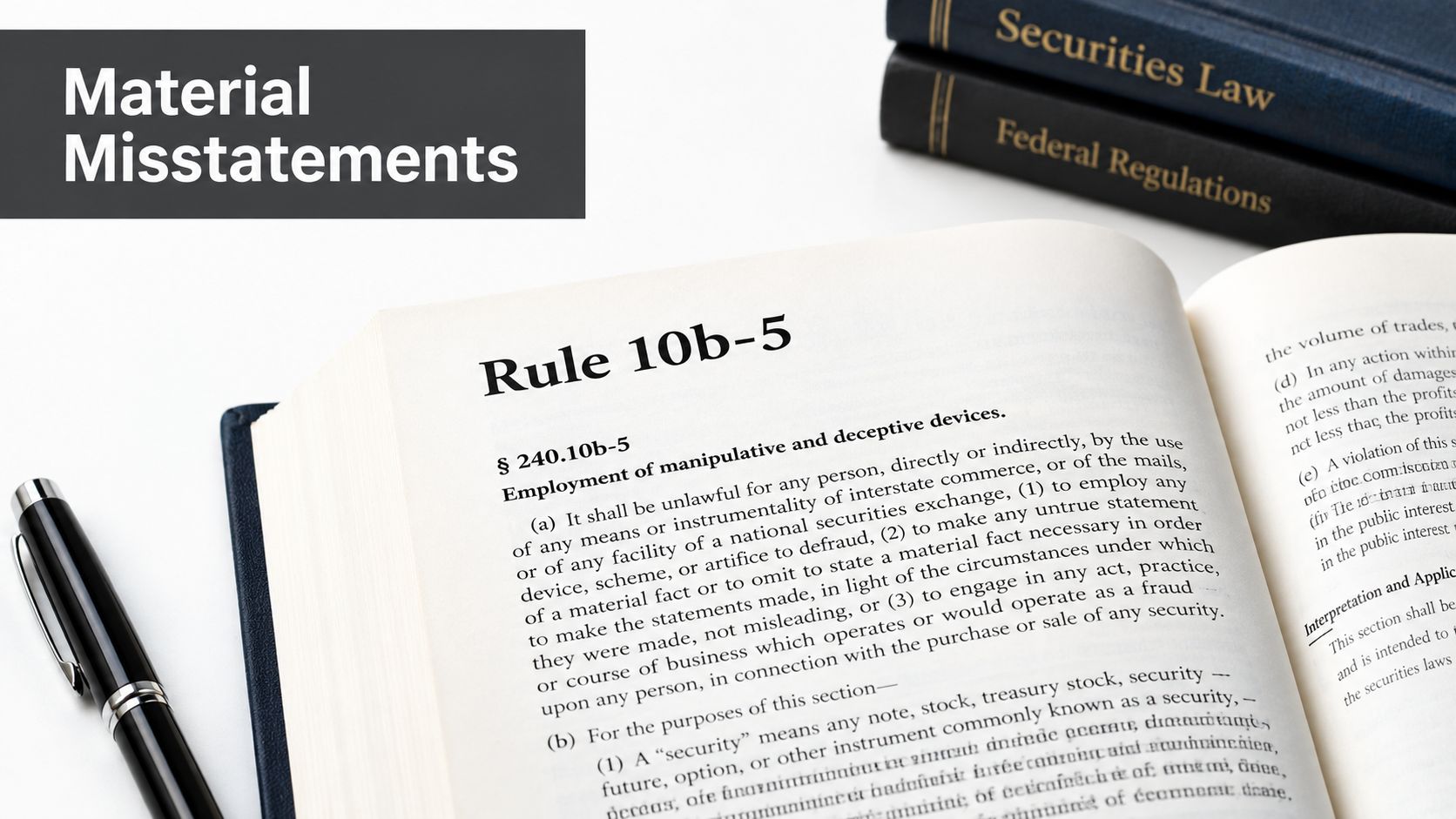
Rule 10b-5 is one of the central anti-fraud provisions in securities law. It addresses deceptive conduct connected with securities transactions, but it doesn't treat every incomplete conversation as actionable fraud. The statement, context, materiality, reliance, and loss all matter.
The rule has three distinct prohibited categories, reflected in the Supreme Court's Rule 10b-5 materials:
- Subsection (a): A device, scheme, or artifice to defraud.
- Subsection (b): An untrue statement of material fact, or an omission that makes statements made not misleading.
- Subsection (c): An act, practice, or course of business that operates as a fraud or deceit in connection with a securities transaction.
Materiality asks what mattered to a reasonable investor
“Material” doesn't mean every detail. The standard asks whether there's a substantial likelihood that disclosure of the fact would have significantly altered the total mix of information available to a reasonable investor, as explained in this discussion of the reasonable-investor materiality standard.
A home inspection offers a useful analogy. If a seller says a house has a sound roof but doesn't mention an active leak directly connected to that statement, the omission can make the statement misleading. By contrast, a minor cosmetic defect may not change a reasonable buyer's decision.
The same reasoning applies to securities. A recommendation may emphasize income while failing to explain that the investment is illiquid, highly concentrated, dependent on a narrow market, or subject to significant loss. Whether the omitted fact is material depends on the entire communication and the investment context.
An omission isn't automatically a Rule 10b-5 claim
The Supreme Court has clarified that a Rule 10b-5 claim must be tied to an actual statement. A pure omission, standing alone, isn't automatically actionable under the rule, as explained in this analysis of pure omissions under Rule 10b-5.
That distinction often confuses investors. A person may know that an adviser failed to volunteer information, but the legal theory may depend on whether the adviser made a related statement that became misleading, had a duty to disclose, or violated another securities-law provision.
For example, “this investment produces stable income” may require different analysis from a complete silence about the investment. The precise wording, surrounding documents, sales process, and relationship between the parties can determine the available claim.
A financial statement can create similar issues. Investors reviewing fraud in financial statements should preserve the actual reports, amendments, analyst materials, and communications rather than relying on memory of what was said.
How the SEC Enforces Violations and What Penalties Follow
A suspicious trade or misleading offering does not become an SEC case automatically. Enforcement usually starts with information from filings, trading activity, investor complaints, referrals, or another investigation. SEC staff then examine whether the conduct violated a federal securities law or SEC rule and whether an administrative proceeding or federal-court action fits the facts.
SEC enforcement is generally civil or administrative. Possible remedies include injunctions, disgorgement, civil penalties, industry bars, officer or director bars, suspensions, and other remedial orders. If the evidence suggests criminal conduct, the SEC may refer the matter to the Department of Justice, which decides whether to bring a criminal prosecution.
Civil and criminal paths are different
| Feature | SEC Civil Action | Criminal Prosecution |
|---|---|---|
| Primary decision-maker | The SEC, through administrative proceedings or a federal civil action | The Department of Justice and federal prosecutors |
| Main purpose | Enforce securities laws, stop misconduct, impose civil remedies, and seek investor-related monetary relief | Seek criminal convictions and criminal punishment |
| Possible consequences | Disgorgement, civil penalties, bars, suspensions, and injunctions | Criminal fines, probation, and imprisonment where authorized |
| Investor compensation | May create a distribution or fund for harmed investors, but payment isn't automatic or necessarily complete | Criminal restitution may be available, but it also doesn't guarantee full recovery |
| Investor's separate options | An investor may still pursue arbitration or a civil claim, subject to applicable defenses and deadlines | A criminal case doesn't replace an investor's own damages analysis |
The distinction matters for investors. $17.9 billion in monetary relief obtained in fiscal year 2025 does not mean every harmed investor received full reimbursement. Relief may consist of disgorgement, penalties, or an order establishing a distribution process. Eligibility rules, recognized losses, available assets, and the order's terms can determine what an investor receives.
Enforcement numbers need context
The Commission filed 456 enforcement actions in fiscal year 2025. Reuters and the SEC described the lower case count as a deliberate course correction toward higher-harm matters, including retail fraud, insider trading, market manipulation, and adviser fiduciary-duty breaches, rather than a retreat from investor protection, according to Reuters' analysis of the SEC's enforcement recalibration.
Counting methods also produce different totals. An independent review identified 313 standalone enforcement actions, described as the lowest in a decade, down 27% from fiscal year 2024's 431 and 38% from fiscal year 2023's 501, as discussed in the earlier enforcement review. The comparison shows why readers should ask what a reported total includes before treating it as a measure of investor protection.
For an investor, an SEC action can provide useful evidence and may establish a distribution process. It does not decide whether a broker, adviser, issuer, or other party owes additional damages. SEC enforcement serves the public interest, while a private recovery claim depends on the account records, statements, losses, legal theory, and applicable deadlines. A practical explanation appears in SEC enforcement and investor implications.
How SEC Violations Affect Investors and How to Seek Recovery
The legal category becomes easier to understand when you connect it to the account statement. Excessive trading may appear as repeated purchases and sales, rising commissions, and a portfolio that changes without a sensible investment purpose. Unauthorized transactions may appear as positions you didn't request or understand. Misleading sales conduct may appear in emails, presentations, or account forms that describe a risky product as conservative or liquid.
State securities rules reflecting SEC standards prohibit conduct such as unreasonable order delays, trading excessive in size or frequency relative to the account, transactions without authority, discretionary trading without written authorization, and prices or commissions not reasonably related to market value, as set out in Wisconsin's securities conduct rule.
Match the harm to the recovery route
SEC action and Fair Funds. If the SEC creates a distribution process, investors may submit claims under the order's procedures. Keep the claim form, account records, transaction history, and proof of loss. The distribution administrator, not an investor's private attorney, typically determines eligibility under the order.
FINRA arbitration. A brokerage customer may have a claim against the brokerage firm, registered representative, or both. Arbitration can address unsuitable recommendations, churning, unauthorized trading, failure to supervise, breach of fiduciary duty, and other misconduct. The claim generally focuses on the investor's account, the firm's conduct, and the damages caused.
Private litigation. Court actions may be appropriate for securities fraud, unregistered securities, Ponzi schemes, issuer misstatements, investment-adviser conflicts, or group claims involving many investors. The correct forum depends on the security, agreements, parties, facts, and available legal theories. A discussion of securities litigation provides related background.
Preserve the records that show causation
Save account statements, trade confirmations, prospectuses, private-placement memoranda, emails, text messages, meeting notes, risk questionnaires, complaints, and withdrawal requests. Don't edit the originals. A timeline connecting the recommendation or transaction to the loss can help counsel evaluate what happened and which records are missing.
An unregistered offering may create rescission rights in appropriate circumstances. SEC guidance indicates that an investor may be entitled to recover principal plus interest without proving classic fraud, although the specific security, exemption, transaction, and statutory requirements control the result.
Next Steps If You Suspect an SEC Violation Caused Your Losses
Start with three questions:
- Was a rule or legal duty potentially broken? Look for misleading statements, unregistered sales, unauthorized trades, excessive activity, conflicts, or manipulation.
- Was the information or conduct material? Ask whether the missing or inaccurate fact could have changed a reasonable investor's overall understanding.
- Did the conduct cause a measurable loss? Connect the transaction, account activity, or investment value to the harm with documents rather than assumptions.
Then collect your records in one folder. Include statements from before and after the disputed activity, trade confirmations, offering materials, emails, texts, notes from calls, tax records, and communications with the broker or adviser. Write down the names of the people involved and the dates you remember. Don't wait for a regulator to contact you before seeking advice, because arbitration and litigation deadlines can affect your rights.
A securities attorney can compare the evidence with possible SEC, FINRA, state-law, contract, and common-law claims. Kons Law handles investor disputes through FINRA arbitration and litigation, and its attorneys speak directly with investors about matters involving broker misconduct, unsuitable recommendations, unregistered securities, private placements, and other investment losses. The firm offers free, no-obligation consultations and typically structures representation on a contingency-fee basis, subject to the engagement terms.
Understanding SEC violation meaning is a starting point, not a final legal conclusion. If your account shows unexplained activity or your investment documents didn't match what you were told, preserve the evidence and discuss the facts with qualified counsel.
Kons Law evaluates whether broker or adviser misconduct, misleading disclosures, unauthorized trading, unsuitable recommendations, or an unregistered investment may support an investor-loss claim through FINRA arbitration or litigation. If you would like a free consultation to discuss the investment loss recovery process in more detail, call Kons Law Firm at (860) 920-5181 for a FREE, NO OBLIGATION consultation, or visit Kons Law.
