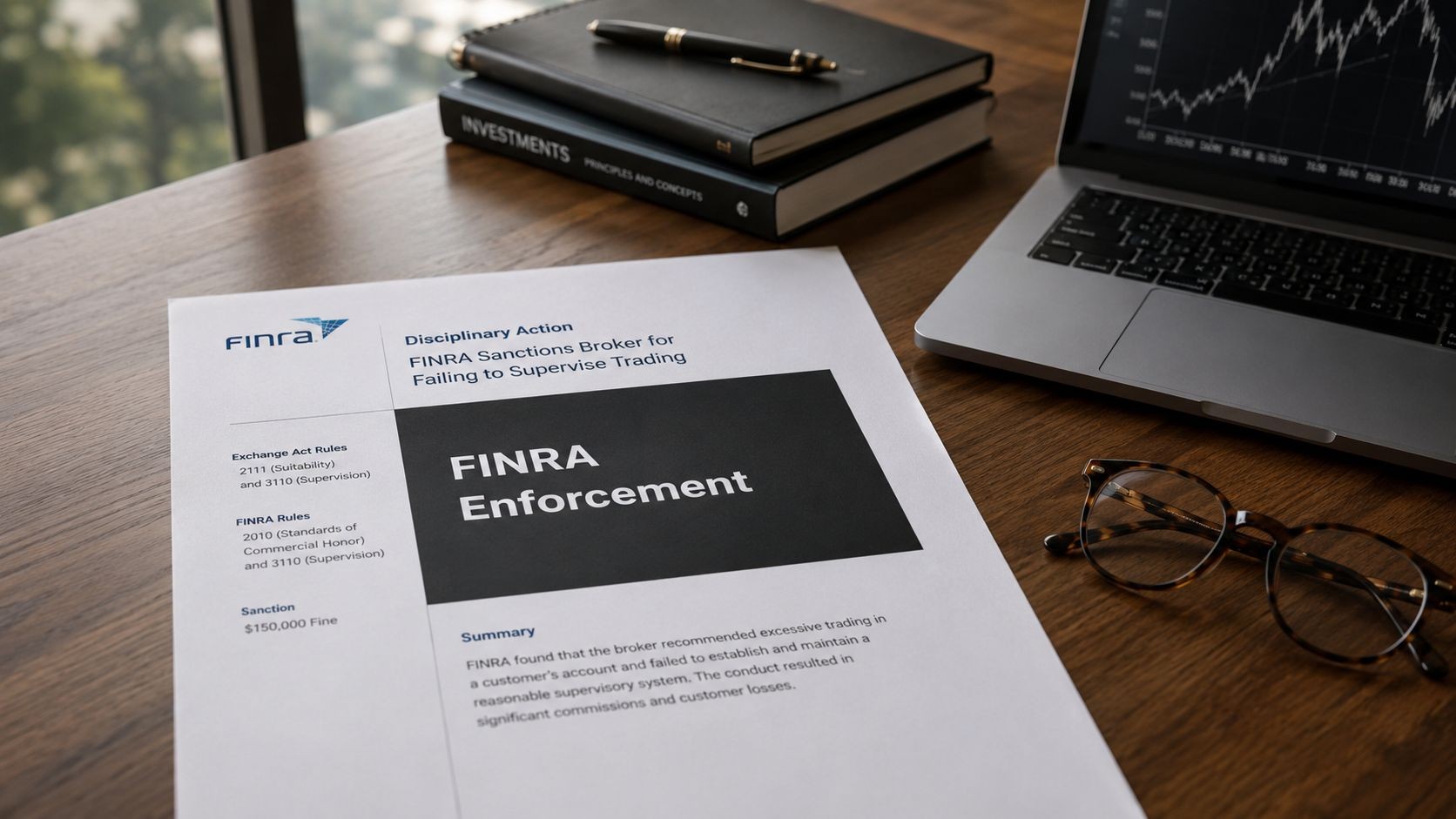
You opened a brokerage statement expecting an explanation, not a mess. Maybe a recommendation didn't fit your age, income, or risk tolerance. Maybe an adviser stopped returning calls after losses started, or a trade appeared that you never approved.
That's where FINRA enforcement actions become more than regulatory headlines. For an investor, they can point to the first hard proof that a broker or firm may have crossed the line, and they can also help build the record for a recovery claim.
What FINRA Enforcement Actions Actually Mean for Investors
A FINRA enforcement action is a formal case brought by FINRA's Department of Enforcement against a broker, brokerage firm, or registered person for violating industry rules. It is not the same thing as a customer arbitration claim, which is the private process an investor uses to try to recover money after misconduct. If you're trying to make sense of your own losses, that distinction matters because the regulator's case and your case can move on separate tracks.
FINRA is the self-regulatory organization that oversees U.S. broker-dealers under SEC oversight. Its enforcement work matters because it creates a public trail of misconduct, and that trail can later become evidence in an investor's arbitration filing or settlement discussion.
The current enforcement picture shows activity that remains substantial even as the long-run case count has moved lower than earlier peaks. FINRA reported 625 new disciplinary actions in 2025, down from 730 in 2024 and 782 in 2021, while fines and disgorgement ordered rose to $99.6 million in 2025 from $75.6 million in 2024 and $97.9 million in 2021. Those figures show why investors should focus on both volume and severity, not just one or the other. FINRA statistics
Practical rule: if your account history, emails, and statement trail line up with conduct that later appears in a public FINRA case, don't treat that as coincidence. Treat it as a document set worth preserving.
Not every matter becomes public. FINRA's published database captures formal disciplinary actions eligible under Rule 8313, while informal matters can be resolved outside the public spotlight. For investors, that gap means the absence of a public case doesn't prove nothing happened, it just means the matter may have been diverted before publication.
If you want a plain-English explainer on FINRA itself, the overview at What Does FINRA Do is a useful companion. Investors comparing overseas brokers may also find the FCA regulated brokers guide helpful for understanding how a different regulator handles oversight.
Common Violations and the Sanctions They Produce
The violations investors run into most often aren't mysterious. They usually start with a recommendation that didn't match the client, a trade that happened without permission, or supervision that should have stopped a problem before it reached the account statement. FINRA's sanctioning system is designed to respond to those failures with a range of outcomes, from censures and fines to suspensions, bars, restitution, and, in extreme cases, expulsion.
The conduct investors tend to see first
Unsuitable recommendations often show up as concentrated positions, opaque products, or strategies that make sense for the broker's compensation but not for the client's objectives. Unauthorized trading is more direct, the account shows activity the investor never approved. Churning is usually easier to spot after the fact, because the account turns over too often and fees start eating the balance.
Failure to supervise is different. It usually doesn't show up in one trade, it shows up in the pattern that nobody caught. Misrepresentations, selling away, and AML or supervisory breakdowns sit in that same category of control failure, where the firm's systems should have interrupted the conduct but didn't.
FINRA's own sanction framework reflects that variety. Its Sanction Guidelines span more than 70 violation types across 11 categories and were revised in 2015 to emphasize progressively escalating sanctions indexed to the Consumer Price Index. Harvard Corporate Governance review of FINRA enforcement actions
A mistake many investors make is assuming the biggest headline fine tells the whole story. It doesn't. In 2021, FINRA brought 126 enforcement actions and assessed $99.3 million in firm fines, but more than half of that total came from one $57 million action. That concentration is why issue-specific exposure matters more than a simple average, especially for supervision, communications, suitability, market access, and AML problems. Harvard Corporate Governance review of FINRA enforcement actions
The size of the sanction often tells you more about how serious the conduct was than how many customers were hurt.
For investors, the practical takeaway is simple. A small-looking case can still involve severe misconduct, and a large-looking case may be driven by one outlier event. That's why the conduct category matters more than the headline number when you're comparing your own losses to a public enforcement record.
How an Enforcement Action Becomes an Enforcement Action
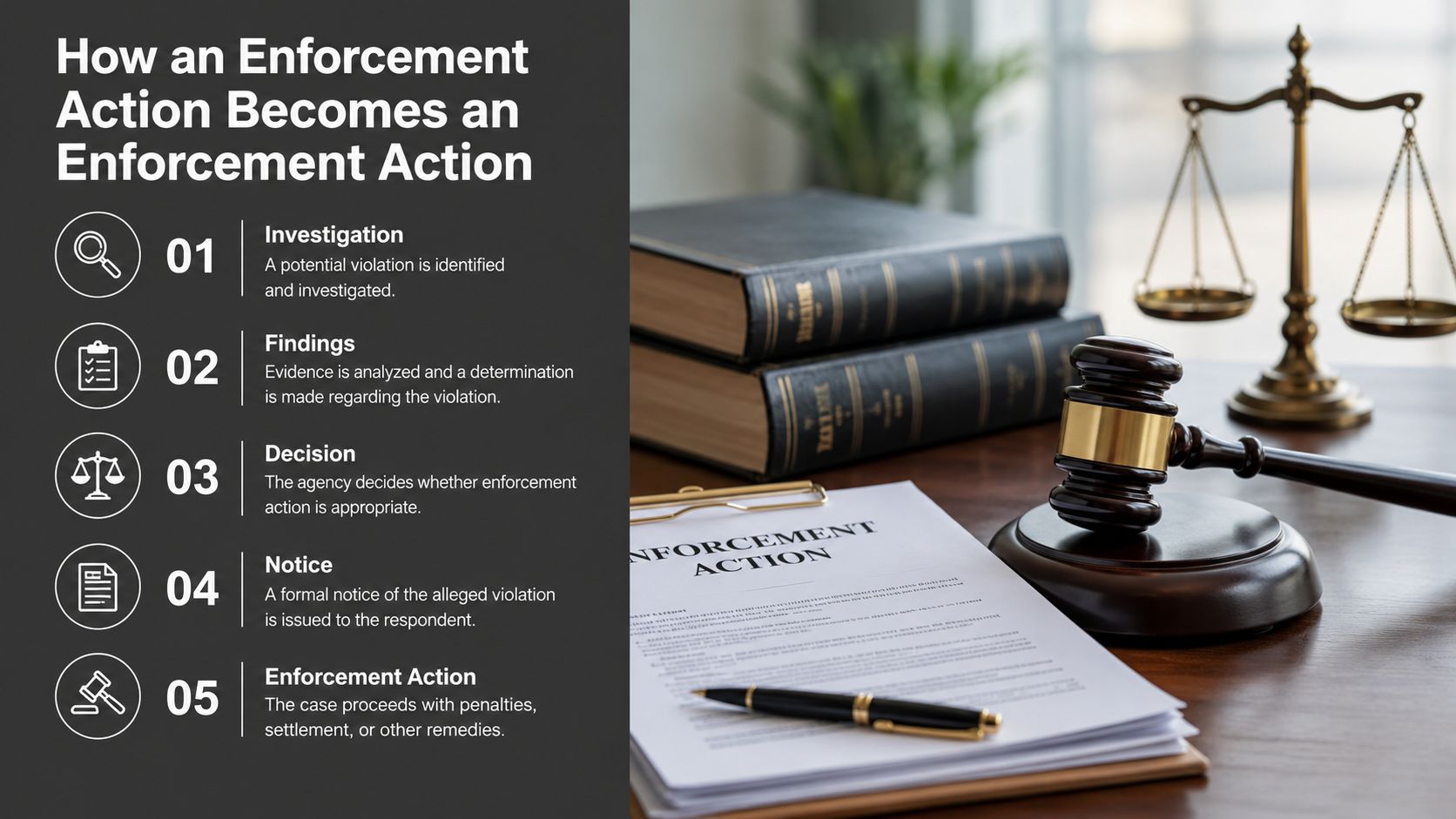
Most investors never see how a case moves through FINRA, and that's where confusion starts. A complaint may begin with an examination, a referral, a tip, or a customer report, but only a small share of examinations become enforcement actions. FINRA says it reserves formal cases for matters involving financial harm, market-integrity impact, or significant risk to investors, firms, or the market. FINRA enforcement process
The gatekeeping happens before publication
Once a matter is referred, an Enforcement attorney reviews the file and may add investigative steps. That attorney must consider exculpatory or mitigating facts before recommending no action, informal action, or formal action. Any proposed discipline then needs approval from FINRA's Office of Disciplinary Affairs before it becomes final. FINRA enforcement process
That gatekeeping matters because it separates fact-gathering from adjudication. It also explains why two people can describe the same conduct differently, one as a regulatory dead end and the other as a case that eventually becomes public discipline.
A weak or low-harm file can die in review long before an investor ever sees a published sanction.
If the matter settles, the common resolution is a Letter of Acceptance, Waiver and Consent, usually called an AWC. If it doesn't settle, the case can go to a three-person Office of Hearing Officers panel. That structure gives FINRA multiple decision points, and it gives respondents a chance to contest the charges before a final outcome is reached.
For investors, the visibility issue is the part that gets missed most often. FINRA publishes only formal disciplinary actions eligible under Rule 8313 in its online database and monthly summaries. So if you're looking for a pattern, you might never see matters that were stayed, resolved informally, or screened out before a public filing. For a closer look at the record-keeping side of these matters, see FINRA Rule 8210.
FINRA Discipline Versus Customer Arbitration
A published FINRA disciplinary case and a customer arbitration claim often start from the same misconduct, but they do different jobs. The disciplinary case is brought by the regulator to punish rule violations and protect the market. The arbitration claim is brought by the investor to recover money.
That difference changes how you should read the record. A FINRA case may produce fines, bars, suspensions, restitution orders, or an expulsion. An arbitration case is about whether your losses can be traced to the misconduct and whether damages should be paid to you directly.
Most brokerage agreements push customer disputes into FINRA arbitration rather than court, so investors usually don't get to choose freely. That's why a regulatory finding matters so much. A public AWC or hearing decision can become a roadmap for the arbitration claim, especially where the facts overlap and the broker or firm already fought the issue once.
Practical rule: if the regulator already found the conduct, your arbitration filing may not need to prove the misconduct from zero. It still needs to prove your losses and causation, but the public record can do a lot of the heavy lifting.
The internal mechanics also differ. FINRA discipline is about public sanctions and market protection. Customer arbitration is about compensation for the individual claimant. The overlap is where investors gain an advantage, because the same documentary record can support both accountability and recovery.
A public disciplinary outcome can also sharpen the settlement conversation. Firms understand that a published case creates discovery pressure, damages risk, and reputational exposure. That's one reason a record pulled from FINRA Dispute Resolution can matter so much when a customer claim is being prepared.
Finding and Reading Enforcement Reports That Matter to Your Case
Start with the records that help you match misconduct to losses. BrokerCheck shows background information on brokers and firms, while FINRA's Disciplinary Actions Online database and monthly disciplinary-action PDFs show formal enforcement outcomes. FINRA says the online database is the authoritative place to verify outcomes, and its monthly reports list each action by exact type, date, and sanction outcome. FINRA disciplinary actions online, January 2026 disciplinary-actions PDF
How to search without missing the right person
Search by the broker's name and the firm's name, then check the CRD number if there's any ambiguity. Names change, firms merge, and similar names show up often enough to create false matches. If you're dealing with a team of advisers, pull the records for every person who touched the account, not just the one you remember most clearly.
How to read the outcome
An AWC usually means the respondent settled without taking the matter to a hearing. An OHO decision means the case was litigated through FINRA's hearing process. A suspension or bar tells you the conduct was serious enough to remove or restrict a person's ability to work in the industry. A fine is a regulatory penalty, but it is not the same thing as the amount an investor lost.
For investors, the distinction matters because the public record often becomes evidence in a FINRA arbitration claim. The AWC, the hearing decision, and the complaint can show what FINRA already investigated, what conduct was alleged, and how the firm responded. If the same product, time period, and sales pitch appear in your statements, the disciplinary file can help tie your losses to a specific pattern of misconduct. See FINRA online awards for the part of the record investors usually overlook.
A large fine does not tell you how much any one customer was harmed, and a restitution order may still cover only part of the full loss picture. The better approach is to compare the conduct described in the public record with the trades, emails, and suitability notes in your own file.
A good example is the December 2024 enforcement action involving Edward Jones, Osaic Wealth, and Cambridge Investment Research, which ordered the firms to pay a combined $8.2 million in restitution. That kind of case does not just show that misconduct happened, it can show that customer money was already identified as recoverable.
Pull the AWC, the complaint, and your account history side by side. If the product, dates, and sales pitch line up, you've probably found more than a coincidence.
A search habit that helps: when a broker or firm appears in a public action, save the PDF immediately and compare it to your statements the same day. Delay is how critical details get lost.
What Recent FINRA Enforcement Trends Mean for Investors
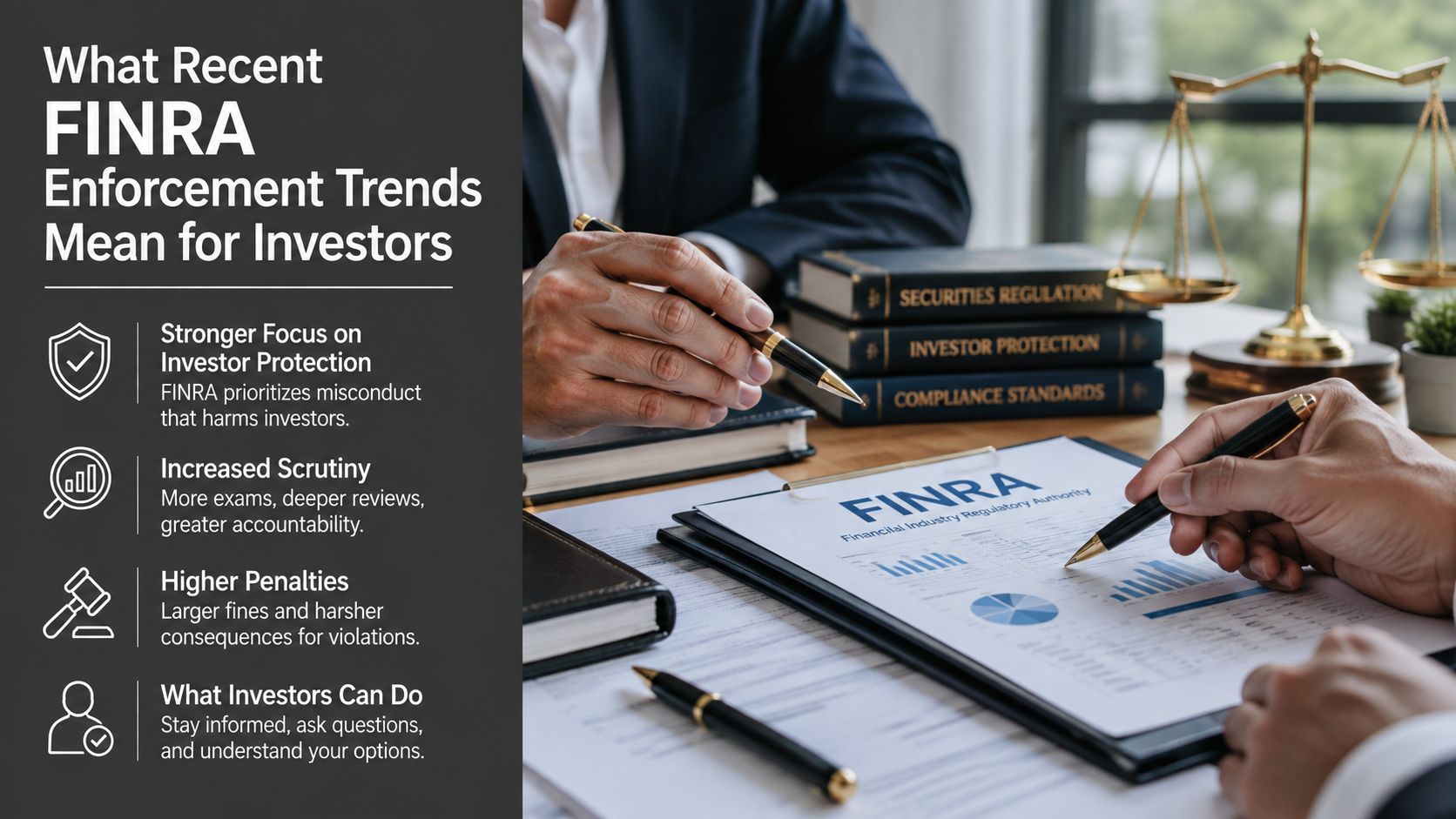
The long view matters because it shows where FINRA's priorities have shifted. Analysis of FINRA enforcement data shows 1,512 new disciplinary actions in 2015, then 1,434 in 2016, and by 2023 total enforcement actions had fallen to 338, a decline that reflects a much smaller case load than the earlier peak. The same historical record notes 1,093 formal actions resolved in 2016, and it also shows that penalties can stay large even when the case count falls. JDSupra analysis of FINRA enforcement data
Then the numbers moved again. FINRA reported a 22% increase in disciplinary actions in 2024, with 552 enforcement actions compared with 453 in 2023, driven in part by a December action that produced $8.2 million in combined restitution. Eccleston Law summary of the 2024 increase in FINRA disciplinary actions
That doesn't mean oversight weakened when the count moved around. It usually means FINRA is choosing cases more selectively and putting more weight on the types of conduct it thinks create the highest investor risk. Secondary reporting on recent priorities points to best execution, Reg BI, AML, electronic communications platforms, outside business activities, social-media influencer programs, and generative AI as a newer compliance focus. Jackson Lewis overview of recent FINRA enforcement areas
For investors, those priorities translate into very familiar loss patterns. Unmonitored messaging apps, social-media pitches, and overly personalized recommendations can all hide the same old problem, a salesperson pushing a product before suitability gets a real review. If your losses came from fast-moving digital communication, the public enforcement record may be pointing at the exact channel that harmed you.
Another signal worth watching is the complaint surge. FINRA reported 24,899 investor complaints in 2025, up from 11,908 in 2024. FINRA statistics That kind of jump tells investors that enforcement and supervision are still central, and that complaints are not a side issue, they're part of the pipeline.
Steps Injured Investors Should Take and How Kons Law Can Help
Start with records, not memory. Pull the BrokerCheck report for every adviser who touched the account, request complete account statements and trade confirmations from the firm in writing, and save every email, text, voicemail note, and statement you still have. Then write a dated timeline of what was recommended, who said it, and when the losses started to show up.
Do the preservation work before the firm controls the file
Do not sign a release, acceptance, or settlement paper from the firm until counsel reviews it. Firms often move quickly once a complaint is raised, and once you sign something broad, you may give up claims you didn't know you had. Acting quickly also helps because document retention can get messy and the eligibility window for some claims can tighten before you expect it.
Practical rule: if the paper trail is still intact, your leverage is stronger. Once records disappear, your case gets harder to prove even when the misconduct was real.
Investors who want to understand how legal advertising and client intake are handled online can also review marketing of legal services as a reference point for how firms present themselves publicly. The more important point for your case, though, is whether the firm handling your claim knows securities disputes, FINRA arbitration, and the documents that make these cases work.
Kons Law is one option for that kind of work. It is a nationwide securities and investment litigation firm with more than 18 years of experience and over $50 million recovered across 700+ matters, handling claims against brokerage firms, financial advisers, and investment advisory entities for issues like breach of fiduciary duty, unsuitable recommendations, churning, unauthorized trading, private placements, non-traded REITs, broker theft, and financial elder abuse. The firm represents investors in FINRA arbitration and related court actions, typically on a contingency-fee basis, and offers a free consultation.
If you think public FINRA discipline lines up with your account losses, don't wait for the firm to “make it right” on its own. Call Kons Law Firm at (860) 920-5181 for a FREE, NO OBLIGATION consultation, and get your records reviewed before they go stale or incomplete.
If you're seeing losses, suspicious trades, or a broker who stopped explaining the account, Kons Law can review the public FINRA record alongside your statements and help determine whether you have a viable recovery claim. Visit Kons Law to take the next step and ask about a FINRA arbitration case review.
