
You open a statement and the balance is far lower than you expected. The broker who recommended the investment described it as suitable for income, but you can't sell it easily, you don't fully understand how it works, and nobody explained how much of your savings it would tie up. That's a frightening place to be, and it's also where careful questions matter more than labels. A loss alone doesn't prove misconduct. The facts behind the recommendation might.
When an Investment Loss Becomes Broker Negligence
Consider a retiree who told a broker that she needed steady income and access to her money for living expenses. The broker recommends a complex, illiquid product. Months later, distributions fall, the account value drops, and she learns she can't exit without difficulty. She has suffered a loss, but that fact by itself doesn't answer whether broker negligence occurred.
Markets fall even when everyone acts carefully. A diversified portfolio can decline during volatility without any professional failure. Concentration, borrowing, illiquidity, and complexity increase risk, but they don't automatically establish misconduct either. The legal question is narrower and more demanding. Did the broker or firm fail to meet an applicable duty, and did that failure cause a loss you can measure?
Four Questions That Separate Bad Luck From a Claim
A useful evaluation follows a connected chain:
- What duty existed: What was the broker or firm required to do before and after the recommendation?
- What went wrong: What specific act or omission fell short of that duty?
- What proves it: Which documents, messages, or trading records support the allegation?
- What loss followed: How does the claimed damage connect to that conduct rather than to general market movement?
If one link is missing, the claim weakens. A broker may have communicated poorly, for example, but that doesn't prove the communication caused the economic loss. Likewise, a steep decline doesn't prove the broker lacked a reasonable basis at the time of the recommendation.
These distinctions arise often in securities disputes. FINRA reported 1,113 customer dispute cases categorized as negligence through the reported 2025 period and 1,162 cases involving breach of fiduciary duty, showing that investors commonly encounter both theories without establishing that either applies to every case, as reflected in FINRA's 2025 dispute resolution statistics.
Don't decide from the ending balance alone. Preserve the statements, confirmations, questionnaires, emails, and notes that show what you told the broker, what the broker recommended, and what happened next.
That record gives you something concrete to evaluate. It also protects details that memory tends to blur, including dates, amounts, disclosures, and who initiated each trade.
The Four Elements of a Negligence Claim
Negligence isn't one loose accusation that a broker should have done better. It's typically analyzed through four elements: duty, breach, causation, and damages. Think of traffic lights at an intersection. The duty is the rule telling drivers to stop on red. A breach is running the light. Causation asks whether running it contributed to the collision. Damages are the resulting harm that can be identified and measured.
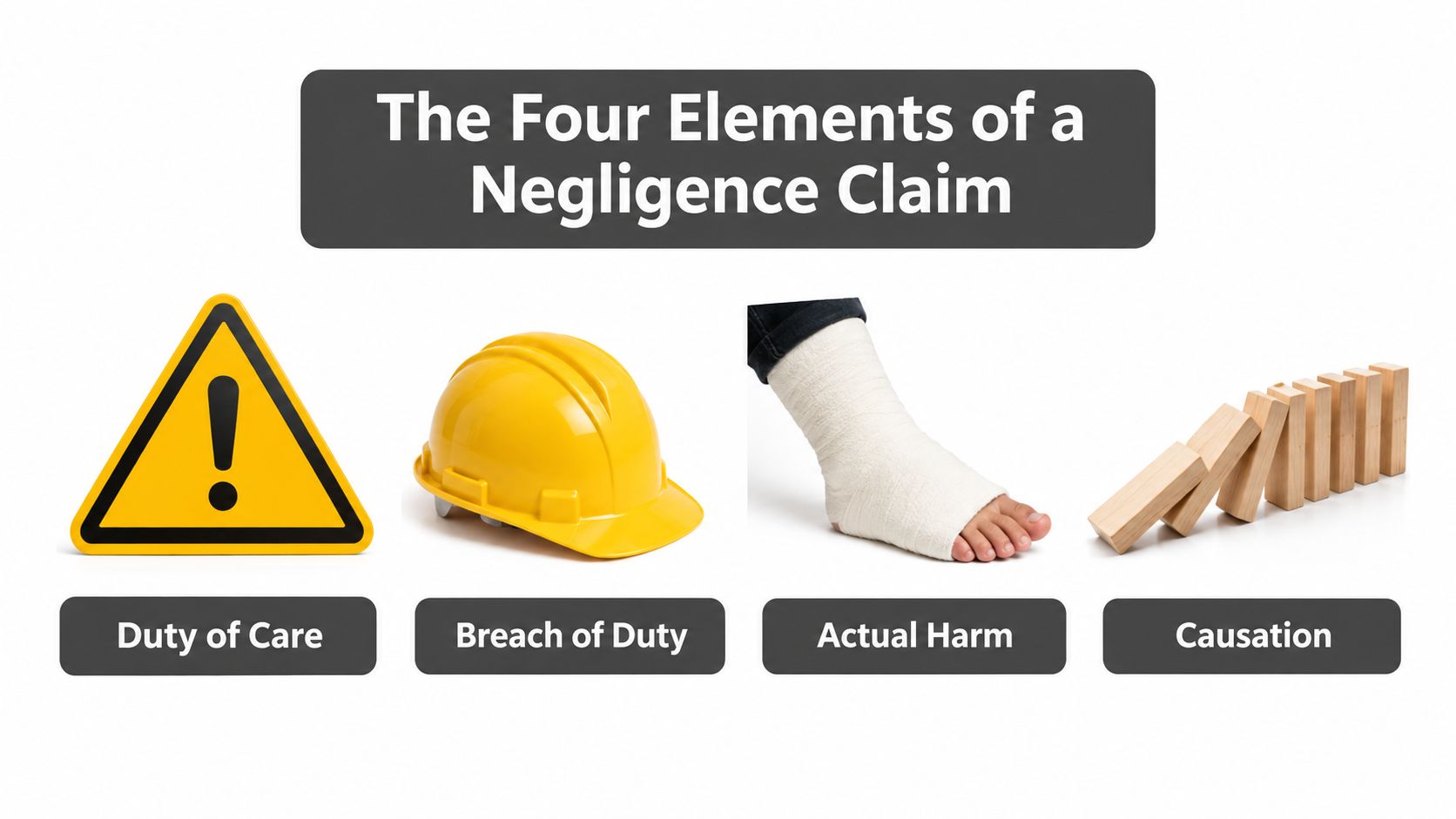
Duty comes first because a broker can't breach an obligation that never existed. The precise duty may depend on the relationship with the broker-dealer, whether the broker made a recommendation, who controlled the account, the investor's status, the type of product, and the governing law and industry rules. A broker who actively recommends a strategy faces different questions from a firm that merely executes an unsolicited order.
Breach is the failure to meet that duty. It might involve inadequate investigation, disregard of a customer's profile, or a recommendation made without a reasonable basis. The allegation should identify a specific failure tied to a transaction or pattern, rather than point to disappointment with performance.
Why Causation Often Decides the Case
Causation has two practical parts. First, did the failure contribute to placing or keeping you in the investment? Second, is the claimed loss sufficiently connected to that failure, rather than to an unrelated market event or your own later decision?
Damages then ask what recoverable harm resulted. The amount isn't automatically every dollar the account declined. It may require separating losses linked to challenged conduct from losses that would likely have occurred in a suitable portfolio during the same period.
Working test: A negligence claim should be able to complete this sentence without gaps. Because the broker owed a specific duty and failed to meet it in an identifiable way, you made or kept an investment that caused a measurable loss.
Negligence also differs from intentional wrongdoing at this basic level. A careless failure to investigate isn't the same as deliberately making a false statement. Both may be serious, but they rest on different proof. Keeping that distinction clean early helps you ask for the right records and avoid overstating what the evidence shows.
Unsuitable Recommendations and Customer Duties
An account can fall because the market fell. Suitability gives you a narrower test: at the moment of the recommendation, did the product, the customer profile, and the trading pattern line up?
FINRA Rule 2111 on suitability obligations requires a reasonable basis for believing a recommendation is suitable and separates the duty into reasonable-basis, customer-specific, and quantitative suitability. Read those as three gates. A recommendation can fail at any one of them.
| Suitability gate | What you compare | Example mismatch |
|---|---|---|
| Reasonable basis | What the broker knew about the product before recommending it | A complex note is sold before the broker can explain its liquidity limits, fees, or downside exposure |
| Customer-specific | The product against your profile | Your forms list capital preservation and near-term liquidity needs, yet the recommendation ties up funds for years |
| Quantitative | The series of trades, where the broker had actual or de facto control | Each transaction looks plausible alone, but together they create heavy turnover, costs, or concentration |
The customer-specific gate is where many files become clear. The broker should use reasonable diligence to learn your age, other investments, financial situation and needs, tax status, investment objectives, experience, time horizon, liquidity needs, and risk tolerance. Those details matter because suitability is measured at the time of the recommendation, not after the loss appears.
Take a retiree whose new account form lists income, preservation, and access to funds. A recommendation of an illiquid private placement is not automatically negligence. The issue sharpens if the restrictions conflict with documented liquidity needs, the broker's product file shows limited diligence, and the account later holds more of the same exposure.
A suitability failure still has to connect to harm. It can support negligence when the mismatch helped cause you to buy or keep the position and a measurable loss followed. It does not require proof that the broker intended to deceive you, and it is narrower than a fiduciary claim based on a broader duty of loyalty.
For a plain-language walkthrough of how these duties fit together, see this overview of the FINRA suitability rule and investor claims. The discipline is comparison: this product, for this customer, in this amount, inside this trading pattern, at that time.
How Negligent Supervision Differs
A broker's bad recommendation and a firm's failed system are two different questions. Say a complaint file shows three similar warnings about the same broker spread over two years, and nothing in the branch records shows anyone reviewed them. Each individual trade might have looked defensible on its own. The file still raises a separate problem: what was the firm doing while the pattern developed?
The difference works like the difference between a pilot's error and an airline that never scheduled maintenance. A negligence claim against the broker asks what he knew, investigated, and recommended to you. A supervision claim asks whether the firm built a reasonable system and ran it. FINRA Rule 3110 on supervision systems requires member firms to maintain supervisory procedures reasonably designed to achieve compliance with securities laws and FINRA rules, and it places final responsibility for proper supervision on the firm itself.
That duty shapes the whole claim. Breach might look like exception reports that flagged the same account repeatedly with no documented response, a branch audit that noted turnover concerns and closed without follow-up, or procedures written carefully on paper and ignored in practice. Causation asks the harder question: would a functioning supervisory system have caught the problem before the later trades that caused the loss? Damages then measure the harm traceable to that window, the losses a reasonable supervisor would have prevented rather than every dollar the account ever declined.
None of this requires proving anyone intended to deceive you. That is what separates negligent supervision from fraud, where intent or recklessness must be shown, and from a fiduciary claim, which rests on a broader duty of loyalty rather than on whether a control existed, was followed, and worked. The four elements stay the same; the defendant and the evidence change.
In practice, the evidence file shifts from your account records to the firm's own records: written supervisory procedures, exception reports, branch audits, complaint logs, escalation memos, and communications between the broker and supervisors. Investigators compare what those documents show against what the procedures required. You can read more about how this firm-level theory works in this discussion of failure to supervise in securities cases.
One careless recommendation can support a negligence claim against the broker alone. Repeated warnings that a reasonable system would have caught open a second door.
Common Broker Negligence Fact Patterns
Fact patterns help you recognize issues without treating every warning sign as proof. The examples below are illustrative. They don't describe a specific broker or establish that a particular investment was negligently recommended.
Illiquid products and documented cash needs. An investor says she needs access to funds for housing and medical expenses, but the broker repeatedly recommends private placements that can't readily be sold. The duty question concerns investigation and customer-specific fit. Account forms, liquidity questionnaires, offering documents, and messages about upcoming expenses either support or contradict the mismatch. Causation still requires proof that the recommendations caused the claimed loss.
Complex options without an updated profile. A customer with limited experience and conservative objectives is moved into complex options after a major life change, but the account profile isn't updated. Product approvals, experience disclosures, trade confirmations, and communications about risk become central.
The SEC care-obligations guidance explains why repeated recommendations of illiquid private placements or complex options to a retiree may support a negligence or suitability theory if the firm lacked a reasonable factual basis, failed to update the investor profile, or did not disclose material limitations, as discussed in the SEC staff bulletin on care obligations.
Patterns That Require a Closer Look
- Ignored concentration: The account becomes heavily weighted in one security, sector, or illiquid product. Compare concentration over time with stated diversification and risk objectives.
- Excessive trading: Frequent purchases and sales generate costs that may overwhelm any reasonable strategy. Review turnover, commissions, and who initiated the trades.
- Unauthorized transactions: Trades appear that you didn't approve. Confirmations, recorded instructions, discretionary-authority forms, and your contemporaneous objections matter.
- Failure to investigate product risks: The broker repeats marketing claims but can't explain fees, liquidity restrictions, or downside scenarios. Due diligence files and disclosures help test what the broker knew.
- Overlooked client circumstances: Retirement, job loss, declining health, or a new need for cash is communicated but never reflected in the strategy. Updated forms and written notices are especially important.
- Weak supervision of another representative: Complaints, exceptions, or unusual trading continue after the firm should have intervened. Supervisory records address that separate issue.
For each pattern, write down the likely duty, the best supporting record, the best contrary record, and the causal link you still need. That exercise keeps suspicion from becoming assumption. It also helps you distinguish an ordinary market outcome from conduct that may support a claim.
Evidence That Supports Causation and Damages
A statement on an account record can help connect a broker's conduct to an investment loss. For example, a note that a customer needed access to retirement funds within a year may matter if the account later shows a recommendation to buy an investment that could not readily be sold. The note alone does not establish negligence. The evidence must connect the broker's duty, a failure to meet it, and a loss that failure caused.
Start with the records created before the investment. Account-opening forms, risk questionnaires, brokerage or advisory agreements, and authorization documents can show the customer's goals, risk tolerance, and who controlled trading decisions. Compare those records with recommendation notes, emails, messages, trade confirmations, disclosures, and offering materials. If the concern involves the firm's supervision, review records may also matter. The FINRA guide to discovery in arbitration describes categories of records that may be relevant in a formal dispute.
A timeline helps test causation. Put the recommendation and any risk discussion beside the purchase date, amount invested, and account value at the time. Then add later purchases, relevant product or market events, distributions, and any sale or withdrawal. This sequence can show whether the alleged failure preceded the loss and whether the loss followed from that failure, rather than from market conditions alone.
Damages require a separate calculation. An account statement showing a decline is a starting point, not a measure of legally recoverable loss. An analysis may account for deposits, withdrawals, fees, income, gains, and the investment's remaining value. It may also compare the actual result with a suitable benchmark or alternative, while separating the effect of broad market movements from the effect of the challenged conduct.
Keep original records intact. Save full email threads, statements, confirmations, voicemails, and portal messages, including their dates and surrounding context. A separate chronology can help preserve your recollection, but it should not replace or alter the underlying documents.
Regulatory figures can provide context, but they do not prove an individual claim. FINRA's enforcement and complaint statistics report fines, restitution, and complaints across broader categories of matters. Those totals do not show that a particular investor's loss resulted from negligence.
The clearest account is usually one that links contemporaneous records to each step: what the professional was expected to do, what happened, and how that conduct caused a measurable loss.
Broker Negligence Compared With Fraud and Fiduciary Claims
Investors often use negligence, fraud, and breach of fiduciary duty as if they were interchangeable words for misconduct. They aren't. The label you choose can affect what must be proven, which records matter most, and how responsibility is analyzed.
Broker negligence generally centers on reasonable care. The central allegation is that the broker or firm failed to do what a careful professional should have done, and that failure caused loss. The broker may not have intended to deceive anyone.
Fraud generally concerns material false statements, misleading omissions, or deceptive conduct. A claim may focus on what was said, what was withheld, whether the information was material, and whether the investor relied on it in a legally sufficient way. Carelessness alone isn't the same as deception.
Breach of fiduciary duty generally turns on whether a special relationship created duties involving loyalty, care, disclosure, or avoidance of conflicts. Whether that relationship existed can depend on the account, the professional's role, control over decisions, and governing law. You shouldn't assume every broker-customer relationship automatically creates the same fiduciary duties in every context.
Comparing Investor Misconduct Theories
| Theory | Central question | Core proof | Principal distinction |
|---|---|---|---|
| Broker negligence | Did the professional fail to exercise reasonable care? | Applicable duty, specific failure, causation, and measurable damages | Focuses on careless conduct rather than intentional deception |
| Fraud | Was the investor misled by material false or deceptive conduct? | False statement or omission, materiality, reliance, causation, and damages | Centers on deception, not merely poor investigation or judgment |
| Breach of fiduciary duty | Did a trusted professional violate duties arising from a special relationship? | Fiduciary relationship, breach of loyalty or care, causation, and damages | Depends first on whether fiduciary duties existed in that relationship |
Consider one hypothetical recommendation. A broker recommends an illiquid product after doing little investigation but believes it will perform well. That may raise a negligence question. If the broker knowingly describes it as guaranteed when it isn't, fraud issues may arise. If a professional with fiduciary responsibilities favors the product because of an undisclosed conflict, fiduciary-duty issues may also require analysis.
The same transaction can therefore support more than one theory, but overlapping labels don't reduce the proof required for each. Remedies, defenses, filing forum, and deadlines also require separate review. Start with facts, documents, and dates. Let the legal theory follow the evidence rather than forcing the evidence into a preferred label.
Next Steps for a Potential Broker Negligence Claim
Start with preservation, not argument. Download statements and confirmations before online access changes. Save emails, texts, portal messages, handwritten notes, illustrations, disclosures, and account forms in original form. If you need to organize long PDFs for review, a legal PDF toolkit for casework can be a practical resource for keeping records searchable and in chronological order.
Next, write a focused timeline:
- Identify the conduct: Name the recommendation, omission, trade, or supervision concern that troubles you
- Pin down dates: Record when you opened the account, received advice, bought or sold, complained, and discovered the loss
- Map each transaction: Note amounts, account concentration, fees, and whether you approved the activity
- Request missing records: Ask for account documents you don't have and keep copies of your requests
- Avoid legal labels for now: Describe facts first, then have the possible theories evaluated against governing law
Timing deserves prompt attention. FINRA Rule 12206 on arbitration eligibility generally makes a claim ineligible for FINRA arbitration when six years have elapsed from the occurrence or event giving rise to the claim. The rule is distinct from an ordinary statute of limitations and doesn't extend time limits imposed by applicable law. Court deadlines may differ, and the event that starts the clock can be disputed, so don't guess.
Understanding the FINRA arbitration process can help you prepare better questions about forum, filing, discovery, mediation, and hearing procedures. Still, general information isn't a substitute for individualized advice about your account, contracts, deadlines, and potential respondents.
If you would like a free consultation to discuss the investment loss recovery process in more detail, call Kons Law Firm at (860) 920-5181 for a FREE, NO OBLIGATION consultation. This article is general information, not legal advice, and reading it doesn't create an attorney-client relationship.
If your statements show recommendations that conflicted with your documented objectives, liquidity needs, or risk tolerance, Kons Law can review the records, evaluate potential broker negligence and related claims, and explain the FINRA arbitration and court options that may fit your situation. Visit Kons Law to request a free, no-obligation consultation and get a clear assessment of your next steps.
