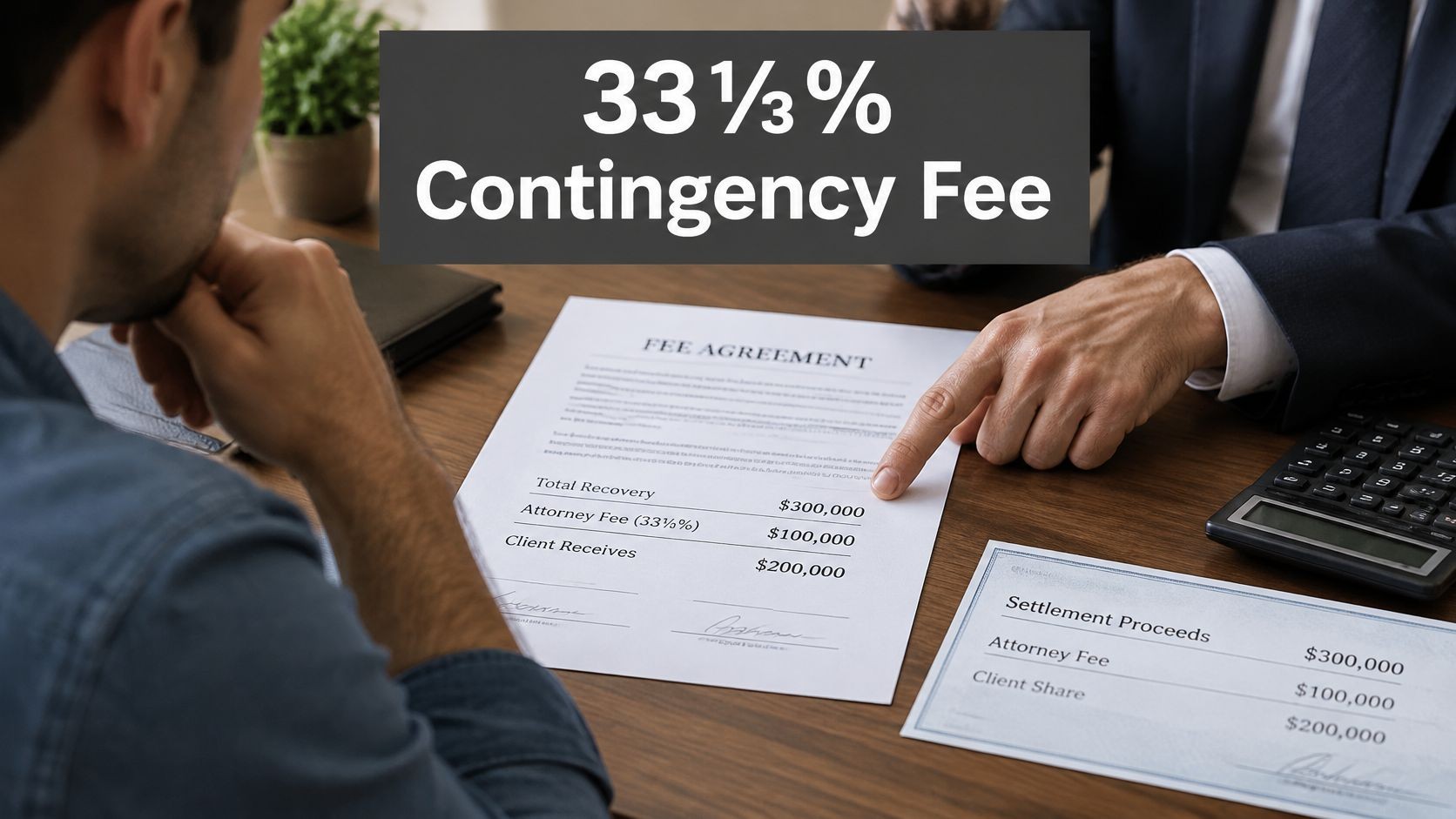
The most commonly cited attorney contingency fee percentage in the United States is one-third, or 33⅓% of the recovery, taken out of the award or settlement rather than paid upfront. It's a market convention rather than a legal rule, and it's rarely the number that decides what an investor keeps.
Two claims with the same headline rate can finish with different amounts in the client's pocket. The rate is only one of three numbers that matter, and the other two sit in the engagement letter: which expenses come out of the recovery, and whether they come out before or after the fee is calculated. Put those numbers in front of a forum that doesn't shift fees to the losing side, and the spread widens further.
The question is arithmetic and paperwork: what gets deducted, in what order, and what you owe if the claim produces nothing.
Typical Attorney Contingency Fee Percentages at a Glance
In a Wisconsin survey, 88% of fixed-percentage contingency-fee cases used a one-third rate. The figures show how common that benchmark can be, while also showing that rates vary by practice and case.
| Benchmark | Percentage | Source or note |
|---|---|---|
| Most common U.S. rate | 33⅓% (one-third) | American Bar Association consumer guidance |
| RAND survey: one-third fee | 55% of contingent-fee cases | RAND survey |
| RAND survey: below one-third | 25% of contingent-fee cases | RAND survey |
| RAND survey: above one-third | 20% of contingent-fee cases | RAND survey |
| Wisconsin survey: one-third fee | 88% of fixed-percentage cases | Survey of Wisconsin attorneys |
| Wisconsin survey: 25% or less | 5% of fixed-percentage cases | Survey of Wisconsin attorneys |
| Wisconsin survey: above one-third | Under 1% of fixed-percentage cases | Survey of Wisconsin attorneys |
| Wisconsin survey: percentage unavailable | 4% of fixed-percentage cases | Survey of Wisconsin attorneys |
| Personal-injury cases | 20% to 50%; average 33.3% | 2024 legal-fee article |
| Securities and FINRA matters | Negotiated; no published fixed rate | Set in the engagement agreement |
The figures are not interchangeable. The Wisconsin survey describes fixed-percentage cases in one state, while the personal-injury article reports a range for injury cases. Neither establishes a standard rate for securities claims.
For securities matters, the percentage is negotiated case by case. It may depend on the difficulty of proving the claim, the stage at which the matter resolves, and how clearly the loss can be tied to a particular recommendation or transaction. The headline rate alone does not show what the client will keep after expenses.
Practical rule: Compare the agreement's percentage with the relevant benchmark, then ask what explains any difference. A personal-injury rate is a comparison point, not a securities-fee standard.
Contingency fee guidance from Lein Law Offices explains how injury firms present rates and costs. Use it to understand the structure of those arrangements, while recognizing that securities engagements can differ in both percentage and expense terms.
How a Contingency Fee Turns Into Your Net Recovery
A contingency fee works like a real estate commission paid only when the house sells. The agent does the work, carries the marketing cost and takes a slice at closing. Everyone discusses the slice. The closing costs are what people forget.
Five stages from signature to check
- You sign a written agreement that fixes the percentage, the recovery base and who pays expenses.
- The case runs, and the cost of running it is tracked: filing fees, expert reports, hearing fees, transcripts, travel.
- Money arrives, whether by negotiated settlement, arbitration award or judgment.
- The fee and the agreed expenses come out, in whatever order the agreement specifies.
- You receive the balance, with a written accounting showing how the number was produced.
Step four is where agreements differ, and where most of the money is won or lost.
No upfront fee doesn't mean no cost
A contingency arrangement shifts the attorney's fee risk to the lawyer. It doesn't necessarily shift everything else. Depending on the agreement, you may still owe case expenses if the claim produces nothing, which is why the expense paragraph deserves more scrutiny than the percentage.
The line worth finding in any draft is what you owe if the case loses. If it's blank, vague, or answered in conversation rather than in writing, get it in writing.
The net recovery formula
Three amounts produce the only figure that matters:
- Gross recovery: everything the other side pays, including any interest, before deductions.
- Contractual fee: the agreed percentage, applied to whichever base the agreement names.
- Unreimbursed expenses: case costs that haven't been repaid or shifted to the opposing party.
Net to you equals gross recovery, minus the contractual fee, minus unreimbursed expenses. Run every comparison between two lawyers through that formula rather than the headline rate.
The order of operations changes the answer. The American Bar Association's ethics guidance on charging and collecting fees works a $100,000 recovery with a 33⅓% fee and $10,000 in expenses both ways: charged after expenses, the fee is $30,000 and the client keeps $60,000; charged before expenses, the fee is $33,333 and the client keeps $56,667.
The same guidance sets out the rule behind that example. ABA Model Rule 1.5 requires the written agreement to identify the percentage payable at settlement, at trial and on appeal, to name the expenses being deducted, and to state whether those expenses are subtracted before or after the fee is calculated.
Worked outcomes at three recovery sizes
| Recovery and expenses | Fee if calculated before expenses | Client net, fee before expenses | Fee if calculated after expenses | Client net, fee after expenses |
|---|---|---|---|---|
| $50,000 recovery, $5,000 expenses | $16,667 | $28,333 | $15,000 | $30,000 |
| $100,000 recovery, $10,000 expenses | $33,333 | $56,667 | $30,000 | $60,000 |
| $250,000 recovery, $25,000 expenses | $83,333 | $141,667 | $75,000 | $150,000 |
The order matters more as the expense load grows. A claim that needs expert reconstruction, forensic accounting or a multi-day hearing carries a heavier expense line, and that line is exactly what the before-or-after clause multiplies against.
Forum charges are their own budget item, separate from the lawyer's percentage. This breakdown of FINRA arbitration fees is a reasonable starting point for estimating what the arbitration itself will cost.
How staged percentages change the math
Many agreements charge one rate if the matter settles early and a higher rate if it runs through hearings and briefing. That isn't a penalty. It prices the hours and risk the lawyer absorbs by going further.
Say a claim settles before the final hearing at a 25% rate, and the same claim taken to an award is priced at 33⅓%. On a $250,000 recovery with $25,000 in expenses, the early rate produces a $56,250 fee and $168,750 to the client. The later rate produces $75,000 and $150,000. That $18,750 spread is the price of the extra stage, and it's enforceable only if it's agreed in advance.
The useful comparison between two engagement letters is the expected net recovery under each stage, weighted for how likely you think each stage is. A 25% rate that steps up to 40% at hearing is a different deal from a flat 33⅓%, and the two only become comparable once the numbers are on paper.
Contingency Fees in Securities and FINRA Arbitration
A securities arbitration award does not automatically make the losing broker pay your legal bill. FINRA's guidance for investors filing a claim explains that arbitrators may award attorneys' fees only when applicable law or an enforceable agreement allows it. The governing rules vary by state, so a recovery may still leave the client responsible for the agreed fee and case expenses.
What the forum charges on top of the fee
FINRA's arbitration and mediation fee FAQs explain that parties generally pay their own fees unless arbitrators allocate them differently. Filing fees depend on the amount claimed, and some may be partly refundable. Other costs can include hearing sessions, discovery motions, postponements, subpoenas, travel and interpretation. Each expense reduces what remains from the award.
| Cost item | Amount or range | Who pays by default |
|---|---|---|
| FINRA filing fee | $50 to $2,300 | Filer, based on amount claimed |
| Attorney fee | Contractual percentage | Client, unless arbitrators award fees under law or an enforceable agreement |
| Hearing, discovery-motion, postponement and subpoena fees | Vary by case | Parties, unless arbitrators allocate them |
| Travel and interpretation | Actual cost | Client, unless arbitrators allocate them |
| Hardship deferral or waiver | Available in some cases | Requested through FINRA |
An SEC Investor Advisory Committee comparison of arbitration forums reports FINRA filing fees of $50 to $2,300, compared with $925 to $11,000 for AAA commercial filing fees. It also highlights how an inconvenient venue can add difficulty when the investor and adviser live in different states.
Why the percentage alone misleads on investor claims
A contingent fee agreement can set different percentages for different stages, provided the terms are stated in advance. ABA guidance recognizes that a fee may reflect the lawyer's knowledge, skill, experience and time. Investor-loss cases involving expert analysis, account reconstruction, suitability evidence or tracing funds can require substantial work beyond the percentage calculation.
Compare the expected net recovery at each stage, including forum charges and other case expenses. A modest award with high hearing and expert costs may leave little for the investor, even when the headline fee percentage appears low.
How State Rules and Case Type Change the Percentage
One-third isn't automatically fair just because it's familiar. U.S. contingency fees have been judged on reasonableness rather than a fixed national rate for more than a century. The ABA formally recognized contingent-fee contracts in its 1908 Canons of Ethics, and by 1933 the language required the fee to be reasonable under all circumstances, including the risk and uncertainty of compensation, while remaining subject to court supervision, as this Duke Law review of contingency fee regulation recounts.
Modern conduct rules carry that forward. Model Rule 1.5 asks whether the fee is reasonable given the time and labor required, the novelty and difficulty of the matter, the likelihood that accepting the case precludes other work, and the result obtained. Read those factors as a test of any quoted number. A straightforward claim that settles in four months on clean documentary evidence is a weak candidate for the top of the range.
State rules can go further. Michigan's court rule caps a contingent or partially contingent fee in covered personal-injury and wrongful-death matters at no more than one-third of the net recovery. Other states impose their own limits and disclosure requirements, and some regulate particular claim types through fee schedules rather than negotiation.
Securities and investment-loss claims are governed mainly by the engagement agreement, the arbitration forum's rules, and reasonableness review if the fee is ever challenged. There's no schedule to hold your number against.
A quoted percentage is a proposal, not a finding. It has to be measured against the risk you're asking the lawyer to carry, the expected duration, the expense load and the odds of an early resolution.
Courts test these numbers regularly. Judges reviewing class settlements scrutinize the requested percentage against the work performed and the benefit delivered, and this overview of class action attorney fees shows the kind of analysis that gets applied. Before treating one-third as a ceiling or a floor, confirm which state's rules and which forum govern your own claim.
Contingency Fees Compared With Hourly and Flat Fees
Contingency billing isn't the only way to hire a lawyer, and it isn't always the cheapest. It is common among smaller practices: the ABA's 2024 TechReport found that 23% of respondents at firms with 2 to 9 attorneys reported practicing on a contingent-fee basis. Whether it suits your claim depends on the size and certainty of the recovery and how much cash you can put in upfront.
| Fee type | How you pay | If the claim fails | Best fit |
|---|---|---|---|
| Contingency | Percentage of the recovery | Attorney fee usually not owed; expenses may still apply | Clear money claim with a recoverable loss |
| Hourly | Billed for time worked | Hourly charges still owed | Advice, reviews or an uncertain or small recovery |
| Flat fee | Fixed price for defined work | Flat fee still owed | A single defined task, such as reviewing an agreement |
| Hybrid | Reduced hourly or flat fee plus a percentage | Partly owed | Complex matters with heavy upfront work |
- Contingency fits a documented loss, a solvent respondent and limited cash for upfront fees. You trade a share of the upside for carrying none of the fee risk.
- Hourly fits a defined review of statements, an account reconstruction or an assessment of whether a claim exists at all, particularly where the loss is small enough that a percentage would overpay the work.
- Flat fee fits one discrete task, like reading a fee agreement or an arbitration clause before you sign it.
- Hybrid fits matters with heavy early work that a firm won't fully finance, where a reduced rate is paired with a smaller success percentage.
A lower percentage can cost more than a higher one. If the low rate excludes substantial expenses, or climbs sharply once a hearing is scheduled, the effective cost ends up above a flat one-third with expenses absorbed. How the forum treats its own charges, and whether arbitrators can shift them, is covered in this explainer on arbitration attorney fees.
Weigh four things: the size of the recovery, the cash you can commit, how much control you keep over settlement decisions, and how long the matter is likely to run. A fee that looks generous on a percentage basis may be the better deal if it buys you the patience to refuse a low offer.
Check the Written Fee Agreement Before You Sign
The written agreement should show how the headline percentage becomes your net recovery. Under ABA Model Rule 1.5(c), as set out in the Model Rules of Professional Conduct on fees, a contingency agreement must be signed by the client and state the fee percentages at settlement, trial or appeal. It should also explain which expenses are deducted and whether they come out before or after the fee is calculated. The lawyer must disclose expenses you might owe if there is no recovery and provide a written accounting at the end.
Check that the agreement spells out:
- Signatures and a copy: The agreement is signed, and you receive a copy.
- Fees at each stage: The percentage for settlement, trial and appeal, including any change between stages.
- Expense deductions: Which expenses apply and whether they are deducted before or after the fee.
- No-recovery terms: Whether you owe expenses if the claim produces no recovery.
- Final accounting: How the fee, expenses and amount remitted to you are calculated.
Ask for dollar estimates, not just a percentage. What would your net recovery be at $50,000, $150,000 and $400,000, after the fee and expenses? Which amount does the percentage apply to, gross recovery or recovery after expenses? Clarify whether interest or a fee award is included in the fee base, whether arbitrators can award fees against the other side, and whether expenses are advanced or repayable if there is no recovery.
At Kons Law, most cases are offered on a contingency-fee basis. The attorney's fee is a percentage of the recovery before expenses; if there is no recovery, the client does not pay attorneys' fees. Depending on the case, the client may still be responsible for expenses. Each potential case is assessed individually, and the firm does not guarantee it will propose representation. If recovery efforts continue after an award, asset recovery representation may involve separate terms.
Kons Law offers a free consultation. Investors can request one through the Kons Law website to discuss a potential securities claim and the firm's contingency-fee arrangement.
