
You just opened a settlement notice, saw a big headline number, and then tried to figure out why the check on your kitchen table looks so much smaller. That confusion is normal. Class action attorney fees are one of the main reasons the number in the notice is not the number that lands in your pocket, and the rest of the reduction often comes from litigation expenses, administration costs, and sometimes the way the settlement is built in the first place.
If you're an investor, the question isn't whether the case settled for a large figure. The question is how much of that fund is available for class members after the court, counsel, and settlement structure take their share. This overview of the settlement process helps frame why the headline amount and the net recovery can be very different things. The rest of this article walks through the fee formulas, the court rules, and the practical issues that decide what reaches investors.
What Every Class Member Should Know Before Cashing That Settlement Check
A lot of investors open a notice and go straight to the settlement amount in bold type. That number feels like the recovery, but it usually isn't. The fund often gets divided into layers before any class member sees a dime, and the fee award is only one of those layers.
A typical settlement can include attorney fees, litigation expenses, claims administration costs, and, in some deals, amounts that never make it to claimants because the structure is claims-based. If a settlement uses a claims-made design, the amount that ultimately reaches investors can shrink further when people don't file claims or when the recovery is defined in a way that doesn't translate into direct cash. For an investor reading the notice, that means the key number is not the top-line settlement, it's the net pool left for valid claimants.
Practical rule: read the notice like a budget, not like a headline. Every deduction changes the amount available for the class.
That's why a fee petition matters so much. The court isn't just checking whether the lawyers got paid, it's deciding how much of the common fund stays with the class and how much leaves it. In a securities case, that distinction can be the difference between a modest pro rata check and a noticeably smaller one after deductions.
The investor's real job is to identify the pieces that affect net recovery, then ask whether each one is justified. That means looking at the requested percentage, the lodestar cross-check, the costs, and the claims rate, not just the settlement total. It also means understanding that different settlement structures can change the dollar outcome even when the headline figure stays the same.
How Courts Actually Price Class Action Attorney Fees
Courts usually price recovery work in one of two ways. The first is the percentage-of-the-fund method, where counsel asks for a slice of the total recovery. The second is the lodestar method, where the court starts with documented hours multiplied by hourly rates, then may adjust that number with a multiplier if the case was unusually risky or complex.
Think of it as two different ways to bill from the same bucket of money. Under the percentage method, the question is simple, how much of the bucket should go to counsel. Under the lodestar method, the court asks how much time the lawyers spent, what that time is worth, and whether the result justifies an adjustment.
Most class settlements still turn on the percentage method, with the lodestar used as a cross-check to make sure the percentage isn't a windfall. In practice, counsel often request something in the 20% to 45% range under the percentage approach, but that range is a starting position, not a guaranteed award. Judges then compare the request against the time spent, the risk of the litigation, and the size of the recovery.
Why the lodestar still matters
The lodestar is useful because it grounds the fee request in work performed. If a case settles early, the hours may be lower. If the matter drags on through discovery, motion practice, and expert work, the hours can rise, and the multiplier becomes part of the fight.
The cross-check matters even when the percentage method is the main lens because it keeps the court focused on proportionality. A large fund can make a percentage fee look normal even when the underlying time records don't support it. A small fund can make the percentage look modest while still producing a fee that seems high relative to the work.

The fee method is not just a billing choice. It's the lens that shapes how a judge sees fairness.
A securities investor doesn't need to memorize the terminology, but it does help to know the basic tradeoff. Percentage pricing rewards results. Lodestar pricing rewards documented effort. Courts often use both because each one catches a different kind of distortion.
The Real Numbers Behind Common Fund and Securities Settlements
The textbook story says one-third of the fund is normal. The empirical record is more complicated. A major study of common fund settlements from 1993 to 2002 found a mean fee award of 21.9% of the recovery, and the same research found that the single most important determinant of fee size was the amount recovered for the class Cornell empirical study. In that study, fees were around 30% in the smallest cases and fell to about 10% in the largest cases, which is the scaling effect investors rarely hear about.
What the pattern means for investors
The practical lesson is simple. Bigger recoveries often produce lower percentage fees, even though the dollar fee can still be huge. That's why an investor should never stop at the percentage on the page. The size of the fund changes the economics of the case, and judges notice that.
A later federal study of 733 class action securities fraud cases filed between January 1991 and May 1999 found an average fee award of about 30.12% of settlement value, with roughly $6.1 billion in settlements generating about $1.837 billion in class-counsel fees and about $4.263 billion left for class members Grundfest analysis. That same source also explains that, in a later review of 458 class action settlements from 2009 to 2013, researchers concluded that little has changed in fee patterns and that settlement size still drives the award.
A Duke study of federal settlements in 2006 and 2007 found nearly $5 billion in fees and expenses, about 15% of total settlement value, with mean and median fee percentages around 25% under the percentage method Duke empirical study. In securities cases specifically, that study reported fee-and-expense awards of 11% of 2006 settlements and 20% of 2007 settlements. Taken together, the studies point to a market where awards often cluster in the high teens to low thirties, but courts still trim requests when the settlement size, risk profile, or evidentiary support doesn't justify the ask.
Average Class Action Fee Awards Across Major Studies
| Study Period | Case Type | Average Fee Award | Key Driver |
|---|---|---|---|
| 1993 to 2002 | Common fund class actions | 21.9% | Settlement size, with larger recoveries producing lower percentages |
| 1991 to 1999 | Securities fraud class actions | 30.12% | Recovery size and the economics of major securities settlements |
| 2006 to 2007 | Federal settlements | About 25% mean and median under the percentage method | Settlement value, risk, and judicial cross-checks |
| 2009 to 2013 | Class action settlements | No major shift in fee patterns | Size of the class recovery remained the key driver |
Bottom line: the one-third benchmark is familiar, but the actual numbers move with case size and court scrutiny.
For investors, that means the fee percentage is not a fixed rule. It's a contested number that changes when the fund grows, when the case risk changes, and when the judge decides the request doesn't match the result.
Rule 23(h) and the Court Approval Process Investors Rarely See
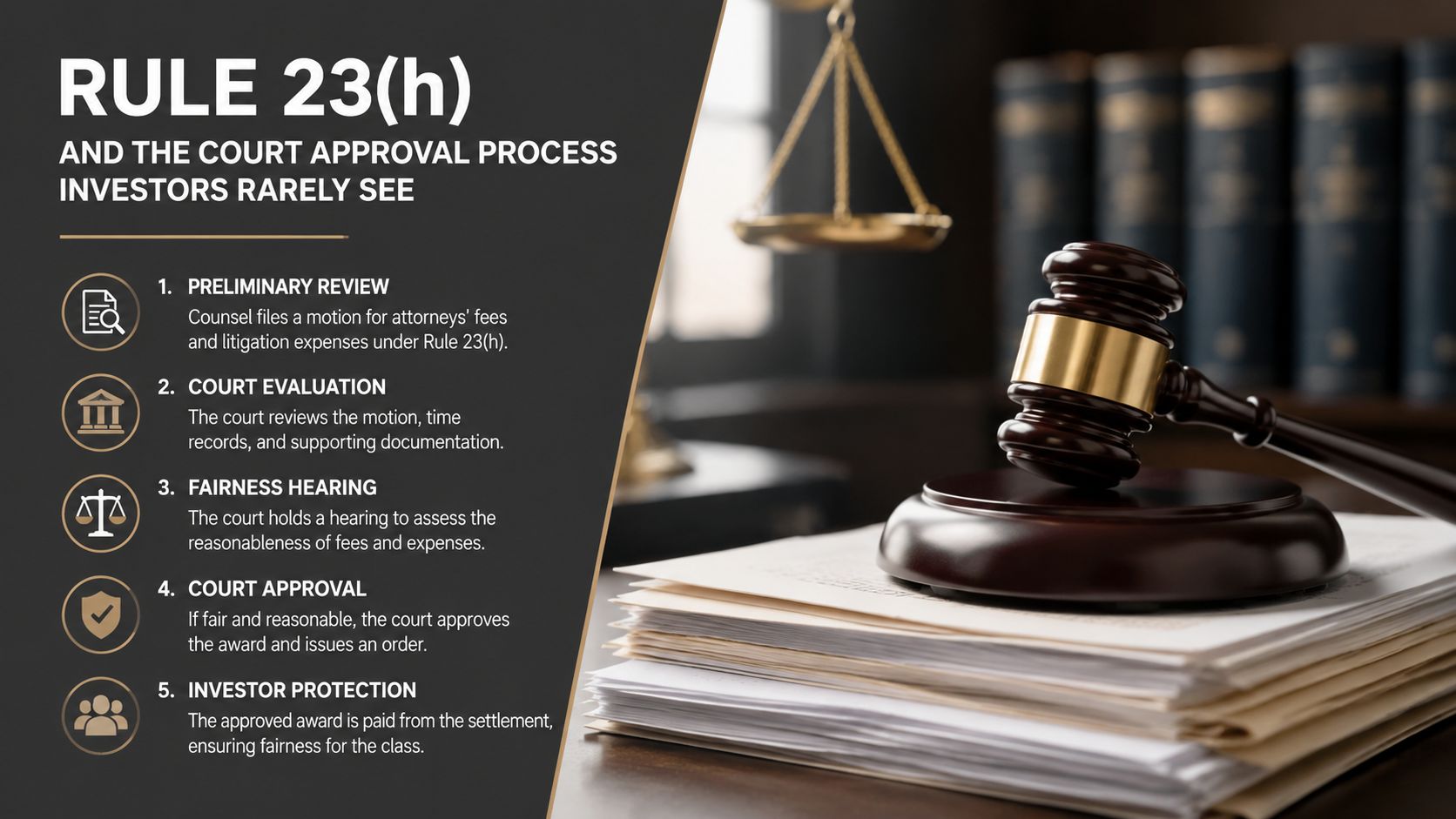
A fee award in a certified class action starts with Rule 23(h). That rule lets the court award reasonable attorney fees and nontaxable costs authorized by law or by the parties' agreement, and the Federal Judicial Center summarizes the process well Federal Judicial Center summary. The motion is filed on a schedule the court sets, not on a fixed 14-day deadline, so the judge controls both timing and the record.
How the objection process works
Rule 23(h) gives class members or any party from whom payment is sought the right to object to the fee motion Rule 23 text. The court can also hold a hearing, and it must find the facts and state its legal conclusions under Rule 52(a). That makes fee approval an adversarial process, not a paperwork formality.
A class member who thinks the request is too high can object directly. A defendant can also push back if the fee arrangement reaches beyond what the settlement supports. The judge then reviews the motion, the billing records, and any objections before deciding whether the fee is reasonable in light of the result the class received.
Rule 23(h) only operates in a certified class action, so the case has to clear the class certification stage before the fee process even starts. Read our guide on class certification requirements to see what has to be in place before the court can even evaluate how counsel should be paid.
Why coupon settlements get special treatment
Congress added a separate rule for settlements that use coupons. Under 28 U.S.C. § 1712, when fees are tied to coupon recovery, the award must track the value of coupons redeemed. If redeemed coupons are not used to set the fee, the award must instead be based on the time class counsel reasonably spent on the action, and the statute also says nothing in that subsection prohibits using a lodestar with a multiplier method coupon-settlement statute.
That rule exists for a reason. A coupon can look generous in a notice and still produce little usable value for the class. The court wants the fee to follow the actual benefit, not the printed face value.
A settlement can look generous in the notice and still leave investors with very little usable value. Courts know that, so they test the structure before approving the fee.
Worked Example of a Hypothetical Class Action Settlement
Suppose a securities case settles for $50 million. Counsel asks for 25% of the fund, which would be $12.5 million in fees. The court then checks that request against a lodestar of $6 million, and counsel argues for a 2x risk multiplier, which would bring the cross-check close to the same neighborhood.
Now add the other deductions. Assume $1.2 million in claims administration expenses comes out of the fund. The gross settlement is still $50 million, but the amount available for the class is already lower because fees and expenses come off the top. That's the difference between a headline number and a distributable fund.
How a claims-made structure changes the math
Now assume only 60% of class members file claims. In a claims-made setup, the money that doesn't get claimed doesn't stay in the pool for everyone else in the same way a simple common fund would. In this hypothetical, the amount available to verified claimants drops to roughly $18.5 million rather than the larger gross figure that appeared in the notice.
That's the number investors should care about. Not the original settlement total. The question is how much is left after the fee award, the expenses, and the claims process do their work. If the distribution is based on recognized loss, then each claimant's check depends on their own loss share, not on the settlement headline.
A class member reading a notice should translate every dollar line into one of four buckets.
- Settlement fund: the money the defendant pays.
- Fee award: the share paid to class counsel.
- Expenses and administration: the costs of running the case and the claims process.
- Net class recovery: the amount left for verified claimants.
In real life, the dispute usually centers on the second bucket. Counsel says the fee matches the risk and the result. Objectors say the fee is too high relative to the class recovery. The court then decides whether the requested percentage fits the work and the outcome.
That's why two settlements with the same headline number can produce very different checks. A higher fee percentage, a larger expense request, or a lower claims rate can all push the investor's actual recovery down. The net result matters more than the gross amount.
How Fee Structures Shape Opt-In and Opt-Out Decisions
A settlement notice is a decision packet. One line shows the fee request, which tells you how much counsel wants from the fund. Another line shows the lodestar cross-check, which lets you compare the requested fee with the hours and rates that were documented. A separate line shows expenses, and the class definition tells you whether you are included at all.
Read the notice in that order.
- Check the fee percentage. Compare the requested share with the size of the recovery and the type of case.
- Look for the lodestar figure. If the request is much larger than the documented time suggests, read more closely.
- Review the claims rate. A low claims rate can leave a gap between the headline settlement and the cash that is distributed.
- Look for claims-made or coupon language. Those structures can change the value a class member receives.
- Decide whether to object, stay in, or opt out. Each choice carries different tradeoffs for the investor's net recovery.
A class member who wants a more individualized recovery may opt out and pursue a separate claim if the alleged loss is large enough to justify direct action. Others may stay in and object if they think the fee request is too high or the settlement structure leaves too little for the class. A securities attorney can review the petition and explain whether the requested percentage fits the case size and the relevant jurisdiction.
Kons Law Firm also handles investor recovery matters outside class actions, including FINRA arbitration and other securities claims, so a fee notice can be the right moment to ask whether an individual path makes more sense than staying in the class. That review matters most when the notice uses a complicated distribution formula or when the class release is broader than the cash recovery.
The key question is whether the settlement delivers cash to class members. If the notice does not make that clear, ask for an explanation before you decide whether to stay in, object, or opt out.
Where the Money Really Goes and Why Courts Are Watching
A securities-fraud study found that the top-tier firms collected more than three-quarters of total fees Richmond empirical discussion. That does not mean smaller firms never recover fees, but it does show how concentrated the market can be. In practice, the biggest names usually handle the biggest matters, and the biggest matters usually produce the largest checks.
Why claims-made numbers can be misleading
The Eleventh Circuit has reaffirmed that fees should be based on the percentage of the total monetary award made available to the class, not only the amount claimed. That matters because claims-made structures can make the class look smaller than it really is if the court focuses only on the claims that came in. It also matters when a settlement includes cy pres or injunctive relief, because those components can make the deal look larger on paper even when the cash value to investors stays limited.
A court that accepts the face value of non-cash relief without looking harder can overstate the class benefit. Fee disputes often turn into valuation disputes for that reason. Class counsel pushes for the broadest defensible recovery figure. Objectors push for the narrowest realistic one. The judge has to decide which number reflects the benefit to investors.

The practical takeaway is blunt. The fee award functions as a fight over how the recovery is defined, and that single line item sets the denominator for every percentage calculation. Change the denominator, and the percentage changes too. Courts keep checking whether the class received the value the notice suggests.
Practical Checklist for Investors Evaluating a Class Action Settlement
Start with the notice and the fee request. Find the percentage counsel wants from the settlement fund, then compare that request with the total fund and the amount the class is likely to receive after fees, expenses, and any other deductions. The fee request reveals counsel's target share, and the lodestar cross-check shows whether documented hours and billing rates support that share.
Next, read the distribution terms line by line. If the settlement uses a claims-made process, the check on the cover page may look larger than the amount many investors will collect, because only submitted claims get paid. If the deal includes cy pres or injunctive relief, ask what those components mean in dollar terms for class members, since those items can sound expansive while leaving the cash recovery unchanged.
A short example helps. If a notice says a fund is available, then the net recovery is the fund after the requested fee, approved expenses, and any administrative costs are subtracted, divided among the eligible claimants who submit valid claims. If the claims rate is low, the per-member payment may rise for those who file, but the broader class may still receive little or nothing unless they act.
Check the deadline with the same care you would use for a filing date in a securities case. Start with the notice date, then count the claims, objection, or opt-out window listed in the notice itself, because that window controls when your rights expire. Mark the final day on a calendar, keep proof of mailing or electronic submission, and save the notice, claim form, and any confirmation number.
If you are deciding whether to object, opt out, or file an individual claim, read the settlement's release language before the deadline. A release can limit later claims even when the settlement payment is modest. If the notice leaves you unsure about the tradeoffs, a securities lawyer can review the petition and help you compare the expected check against the rights you may give up.
If you want help evaluating a settlement notice, recovering investment losses, or deciding whether an objection or opt-out makes sense, call Kons Law Firm at (860) 920-5181 for a free, no-obligation consultation.
Kons Law helps investors read settlement notices the right way, from the fee request to the claims process and the net recovery. If you're deciding whether to object, opt out, or pursue a separate securities claim, visit Kons Law to discuss your options with a securities attorney.
