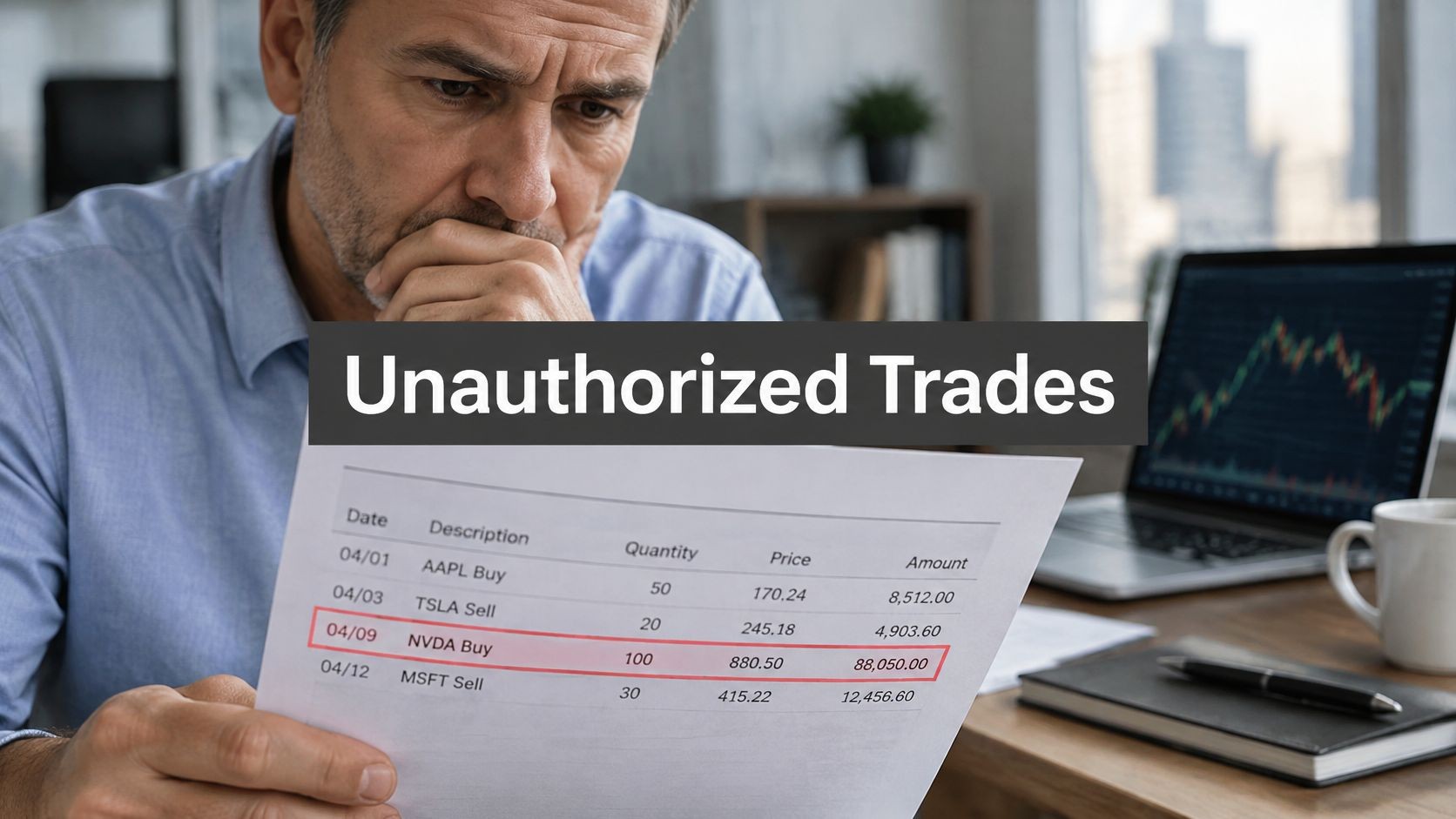
You open your statement and see a sale you don't recognize. You never approved it, you don't remember a call about it, and the confirmation seems to have arrived days after the money moved. Your first question is usually simple. Can the broker be punished, and does that punishment get your money back? Those are two different questions, and they follow two separate tracks. Unauthorized trading penalties punish the broker. Your own claim, usually in arbitration or court, is what pursues your losses.
What Makes a Trade Unauthorized
The authorization question decides which remedy applies. An investor who finds a long held stock position sold two weeks earlier, with no call note, no email approving the sale, and a confirmation buried in mail, is looking at the core test. Did the broker have your authority before placing the order?
Authority can take a few clear forms. It can be written discretionary authority you signed, a specific recorded instruction for that trade, or an approved strategy for the transaction. Written authority is usually easiest to prove because it sits in the account paperwork. A specific instruction can be shown through a recorded call or a trade ticket. An approved strategy depends on what the account documents and your stated goals say. A valet who parks your car where you asked is authorized. A valet who takes it for a drive because he thought you would enjoy the route is not, even if it comes back undamaged.
Three Categories Investors Often Confuse
An unauthorized trade has no authority behind it. An unsuitable trade was authorized, but it did not fit your profile, goals, or risk tolerance. A trade induced by deception was technically approved by you, but only because you were misled about the risks or facts. The classification changes the defense a firm will raise, the evidence you need, and the damages theory your claim can support. A trade that was authorized but unsuitable asks whether the recommendation fit the account. A trade obtained through deception asks what you were told before you said yes. A trade with no authority asks a simpler question: who gave permission, and where is the record? Our explanation of solicited versus unsolicited trades helps sort who initiated the idea, which is a related but separate question.
| Scenario | Authority in place | Likely classification |
|---|---|---|
| Broker sells a position after a recorded verbal instruction for that specific trade | Specific instruction | Authorized |
| Broker trades without instructions in an account with no discretion | None | Unauthorized |
| Broker trades in a discretionary account without signed written authority | Missing written grant | Unauthorized, discretion violation |
| Broker follows an approved strategy but trades far more often than needed | Approved strategy, excessive frequency | Possible excessive trading or churning |
| Trade placed after a written objection to a prior confirmation | Objection on record | Likely unauthorized; timing matters |
| Authorized trade recommended with misleading risk information | Consent obtained through deception | Unsuitable or fraudulent inducement, not a simple unauthorized trade |
| Third party uses the investor's login without permission | Credentials misused | Unauthorized, may be account takeover or fraud |
Trading with discretion without signed written authority is a violation on its own, even when the individual trades look reasonable. Automated setups need the same record trail. If platforms turn TradingView alerts into Robinhood orders, keep the rules you set, because a trade fired by your own instructions is different from one placed by someone else.
The category often turns on a short set of facts. Did you share login credentials, approve a strategy, grant discretion, or object promptly after a confirmation? Online solicitation adds another layer. An SEC litigation release on a 2025 Facebook group solicitation describes money represented as pooled in shared accounts and traded for investors, which shows how purported authority can complicate proof. Pull your account agreement, every confirmation, and a list of everyone who had access. Those documents decide the category.
Penalties Regulators Can Impose on Brokers
Regulators don't impose one standard punishment. They choose from fines, suspensions, bars, and orders that stop future violations, and each one serves a different purpose. The recipient of any money matters just as much as the amount.

| Penalty | Issued by | Typical scope | Who receives payment |
|---|---|---|---|
| FINRA fine | FINRA | Unauthorized-trade guideline $5,000 to $75,000; general baseline up to $116,000 | FINRA, not the customer |
| FINRA suspension | FINRA | One month to two years, depending on aggravation | No payment to the customer |
| FINRA bar | FINRA | Permanent exclusion from any FINRA member firm | No payment to the customer |
| SEC cease-and-desist order | SEC | Order to stop future antifraud violations | No payment to the customer |
| SEC civil monetary penalty | SEC, by tier | Tiered amounts, such as $50,000 and $110,000 in cited cases | U.S. Treasury |
| Disgorgement with interest | SEC or court | Surrender of illegal profits plus interest | U.S. Treasury in SEC matters |
| Restitution | FINRA panel or court | Repayment of provable customer losses | Harmed investors |
FINRA treats unauthorized trading as a Rule 2010 violation, because trading without authority breaches high standards of commercial honor and just and equitable principles of trade. The FINRA Sanction Guidelines identify a baseline framework of a $5,000 to $116,000 fine and a one-month to two-year suspension, and they direct adjudicators to strongly consider a permanent bar when aggravating factors predominate.
A more specific unauthorized transactions guideline appears in a FINRA National Adjudicatory Council decision summarizing the Sanction Guidelines, which states a fine of $5,000 to $75,000 and a suspension from 10 business days to one year, extending to two years or a bar for egregious conduct. Editions differ, so check which version applies to the date of the conduct.
What Pushes a Fine Toward a Bar
Two guideline factors frame the analysis. Did the broker misunderstand the scope of authority or the terms of your order, and was the trading egregious? A genuine misunderstanding about one order looks different from a broker who knew he had no discretion and traded anyway.
Escalation drivers then fill in the picture:
- Number and dollar value: A pattern of trades weighs more than a single mistaken order.
- Customer vulnerability and harm: Losses to an elderly or inexperienced customer increase severity.
- History and concealment: Prior discipline, repeated conduct, or hiding trades points toward a bar.
- Financial benefit: Commissions generated by the unauthorized activity show motive and impact.
Practical rule: A fine punishes the broker. A bar protects future customers. Neither one, by itself, puts money back in your account.
Enforcement happens at scale. FINRA reported in its 2024 report on the use of fine monies that it imposed $59.8 million in total fines during 2024, based on individual facts and the Sanction Guidelines. FINRA guidance also notes that a fine may be inappropriate where a respondent is barred and restitution is ordered. That tells you regulators view customer repayment and market access as distinct tools. If you want repayment, you generally need a separate claim for it.
Enforcement Case Outcomes at the SEC and FINRA
Published cases show that unauthorized trading can lead to different outcomes, depending on the conduct and the charges regulators prove. The SEC and FINRA can impose discipline on brokers, but the outcome in one case does not predict what an investor may recover in a separate claim.
| Matter | Conduct found | Sanction imposed |
|---|---|---|
| Piontek (SEC) | Unauthorized trading and unsuitable recommendations in two accounts | Bar with reapplication after two years in a limited role, cease-and-desist order and $50,000 second-tier penalty |
| Alacan (SEC, 2003) | Willful violations of Section 17(a), Section 10(b) and Rule 10b-5 in 1997 and 1998 | Third-tier civil penalty of $110,000 payable to the U.S. Treasury |
| Colletti (FINRA) | Unauthorized and excessive trades under Rules 2111 and 2010 | Eight-month suspension in any capacity and $10,000 fine |
| FINRA Rule 8210 matter | Failure to provide requested information | Bar |
| Egregious-conduct guideline (FINRA) | Unauthorized transactions judged egregious | Suspension up to two years or bar from any FINRA member firm |
SEC Matters That Connected Unauthorized Trading to Fraud
In the SEC administrative decision involving William C. Piontek, the SEC opinion in the Piontek matter found unauthorized trading and unsuitable recommendations in two customer accounts. The SEC barred him from association with a broker-dealer or national securities exchange, with potential reapplication after two years in a limited, nonsupervisory and nonproprietary capacity. It also ordered him to cease and desist and imposed a second-tier civil penalty of $50,000. The decision connected the trades to federal antifraud provisions, including Section 17(a), Section 10(b), and Rule 10b-5.
The 2003 Alacan matter involved willful violations of those same provisions for conduct in 1997 and 1998. The SEC opinion in the Alacan matter found substantial customer losses and broker gains. It imposed a third-tier civil penalty of $110,000 payable to the U.S. Treasury, along with a permanent bar and disgorgement with interest. The case illustrates how unauthorized trades tied to fraud can carry consequences beyond a fine.
FINRA Matters From Suspension to Bar
FINRA's Colletti decision shows a suspension and fine outcome. The FINRA Office of Hearing Officers decision in Colletti found unauthorized and excessive trades in a customer's account, violating Rules 2111 and 2010. The sanctions were an eight-month suspension in any capacity and a $10,000 fine.
A separate FINRA disciplinary decision involving Rule 8210 concerned a failure to provide requested information and resulted in a bar. That outcome addresses noncooperation with the regulator; it should not be confused with a payment to customers for unauthorized trades.
FINRA's egregious-conduct sanction guideline allows for a suspension of up to two years or a bar from any FINRA member firm when unauthorized transactions are judged egregious. The guideline describes a range of possible discipline, not the outcome of a particular case.
A single mistaken order and a prolonged pattern of trades without approval present different enforcement questions. The FINRA enforcement actions overview offers context on how disciplinary matters are handled. To compare a published outcome with your situation, focus on what conduct was established and what sanction was imposed. A regulator's penalty is separate from an investor's claim for compensation.
Why a Fine Does Not Pay You Back
This is the point where many investors get misled by headlines. A broker is fined a large sum, the firm issues a statement, and the customer assumes a check is coming. It usually isn't, because a fine is a disciplinary sanction paid to the regulator, not compensation paid to you.

Restitution works differently. It's calculated from your provable, causally connected loss, not from the broker's commissions, and it can exceed what the broker earned. The FINRA Sanction Guidelines on restitution state that adjudicators should use the actual loss demonstrated by evidence, explain the calculation method, and may add interest, and they cite unauthorized trades in an 87-year-old customer's account that generated $1,380 in commissions and $1,494 in realized losses, resulting in a bar plus $1,494 restitution with interest from the date of the final unauthorized trade.
Notice the two numbers in that example. The commission figure explains what the broker gained. The loss figure, plus interest, is what the customer got back. If restitution had been tied to commissions alone, the customer would have been underpaid.
Think of a reckless driver. The state can fine him and suspend his license, and that punishment may be entirely deserved. The injured passenger still has to bring a claim to recover medical bills and other damages. The traffic fine doesn't pay the hospital.
That's why recovery depends on proving liability, causation, and damages in the right proceeding. You need to show the trade lacked authority, that the unauthorized trade caused the loss, and what that loss was trade by trade. We bring claims against brokerage firms, financial advisors, investment advisory firms, and other third-party financial services firms to pursue that recovery, because the firm that employed and supervised the broker is often part of the claim.
Your documents do the heavy lifting. Statements, confirmations, trade records, written objections, and account authority forms establish both the missing permission and the loss on each transaction. Without that link between a specific trade and a specific loss, even a strong misconduct story can produce a weak damages number.
Arbitration Routes and Filing Deadlines
Deadlines decide more unauthorized trading cases than investors expect. A claim can be factually strong and still fail because it was filed in the wrong forum or after the clock ran out. Start with the route, then work backward from the date you discovered the trade.
| Claim route | Typical deadline | What to know |
|---|---|---|
| FINRA arbitration against a broker or member firm | Six years from the occurrence under FINRA Rule 12206 | Customer agreements often require arbitration |
| Federal securities claim under Rule 10b-5 | Two years from discovery, five-year outer limit | Requires proof of fraud or scienter |
| State claims such as negligence or breach of fiduciary duty | Two to six years under many state limitation periods | Discovery and tolling rules differ |
| FINRA complaint | No recovery deadline | Reports misconduct but does not pay the investor |
| Criminal or agency restitution | Set by the prosecutor or agency | Depends on whether a case is opened |
FINRA arbitration is the usual forum for disputes with brokers and member firms, largely because most customer agreements require it. Eligibility generally runs six years from the occurrence under FINRA Rule 12206. That isn't a suggestion to wait. Records get harder to obtain, memories fade, and other claims bundled with your case may have shorter clocks.
How the Clock Usually Starts
For many claims, time starts when you knew or should have known about the trade. A confirmation sitting unopened for months can become an argument that you should have known earlier. A prompt written objection helps on two fronts. It disputes authorization, and it creates a clear discovery date you can prove.
Federal claims under Rule 10b-5 generally run two years from discovery of the facts, with a five-year outer limit, and they require proof of fraud or scienter rather than simple error. State claims such as negligence or breach of fiduciary duty follow state periods, often two to six years, with discovery and tolling rules that differ by state. The same trades can therefore be timely under one theory and late under another. Our guide to the claim filing deadline for investment losses walks through how to check yours.
Don't wait for the regulator. An investigation can run for a long time, and it doesn't pause your arbitration or court deadline.
A claim against the firm may also rest on failure to supervise. Firms must monitor for trading that doesn't match account authority, and a pattern of unapproved trades can show that supervision broke down. Comparative fault arguments can cut the other way. If you shared credentials, approved a strategy in writing, or stayed silent after clear confirmations, the firm will argue you contributed to the loss.
Arbitration is where many of these disputes are resolved. We secured a $3.5 million FINRA arbitration settlement for investors in California who lost money in an unapproved investment sold away from the brokerage firm. We also secured a $1.45 million FINRA arbitration settlement for investors in Texas who lost money in penny stocks with an investment adviser convicted of fraud. Those outcomes came from claims filed by investors, not from fines. Confirm your deadline with a securities attorney promptly, because the account agreement, the state, and your discovery date control the answer.
Document Your Losses and Request a Free Case Review
Good documentation turns a suspicion into a claim that can be valued. Work through these steps in order, and keep everything in one folder, digital or paper, so dates line up.

- Collect the account records. Gather every statement, confirmation, account agreement, and any written trading authority form. If you're unsure what a statement should show, our explainer on what a brokerage statement contains helps you read it line by line.
- Build a dated timeline. Note when each disputed trade occurred, when you first noticed it, and every instruction you gave.
- Object in writing. Send a written objection to the firm and keep a copy with proof of delivery. Verbal complaints are easy to dispute later.
- Calculate loss trade by trade. Add realized losses, commissions, fees, and any margin interest you paid on each unauthorized transaction.
- Save every message. Keep emails, texts, and social media solicitations, including pooled account offers. If instructions were discussed by phone, the VoxNote guide to recording phone calls is a useful reference on recording options and consent considerations before you document future calls.
- Consider a FINRA complaint. Filing one reports misconduct and can run alongside a money claim, but it doesn't replace that claim.
- Talk to counsel before sending sensitive files. Confirm intake terms in writing first.
The FINRA investor complaint page warns that disciplinary sanctions may produce no payment or return of securities, states that a complaint does not replace arbitration or mediation, and reports that 84% of customer arbitration cases closed in 2024 ended in settlement or paid damages. That's the practical picture. Regulators discipline. Arbitration and court compensate.
If my broker is fined, do I automatically get my money back? Generally, no.
A few terms protect you at intake. We offer a free, no-obligation consultation to learn your rights after investment losses. Please don't send confidential or sensitive information until you've talked to an attorney and entered a written agreement letter establishing the attorney-client relationship. If there's no recovery in a contingency fee case, you don't pay attorneys' fees, and you'll confirm the fee arrangement during the consultation before any engagement.
If you'd like a free consultation to discuss the investment loss recovery process in more detail, call Kons Law Firm at (860) 920-5181 for a FREE, NO OBLIGATION consultation. Bring your timeline, your confirmations, and your written objection if you have one. That's enough to start assessing authority, deadlines, and damages.
If you're looking at trades you never approved, we can review your account authority, confirmations, and deadlines and explain whether a FINRA arbitration or court claim fits your situation. Visit Kons Law to request a free, no-obligation case review, and we'll walk through your recovery options before you decide on next steps.
