
You check your account and see a stock you trusted has collapsed. The headline says the company's story was false, the numbers were cooked, or the risk was hidden, and now you're left staring at a loss that feels both personal and unfair. That is where fraud on the market matters, because the law can treat a lie that inflated the market price as harm to everyone who bought at that distorted price, even if you never read the false statement yourself.
For retail investors, that idea is powerful. It turns a lonely loss into a legal theory that can support collective recovery, especially in public-company cases where the price moved because the market absorbed misleading information. The doctrine also has real limits, and those limits matter most for investors in thinly traded names, microcaps, SPACs, and other securities where price behavior is harder to prove.
When Corporate Lies Destroy Your Portfolio
You buy shares because the company sounds solid, the filings look polished, and the price seems to confirm the story. Then the truth comes out, the stock drops, and suddenly the “great opportunity” in your account looks like a trap. That's the moment most investors realize they weren't just unlucky, they may have paid too much because the market was fed a lie.
Fraud on the market gives that loss a legal shape. Under the doctrine, a misleading public statement can contaminate the price itself, so the harm is not limited to people who can prove they read the exact press release, earnings call, or filing. The law recognizes that in a market where prices are supposed to reflect public information, a distorted price can injure everyone who traded at that price.
Why the price matters more than the brochure
Think of a marketplace scale that's been tampered with. You don't have to prove you inspected the scale's wiring to know you were overcharged if the displayed weight was false. The same basic idea sits behind fraud on the market. If the stock price was inflated by deception, the investor's loss can be tied to that distorted price, not just to personal reading habits.
That's why this doctrine became such a major tool in U.S. investor protection after the Supreme Court's 1988 decision in Basic Inc. v. Levinson (Cornell Law School's summary of the doctrine). It helped move securities fraud cases away from millions of separate “Did you read it?” questions and toward a market-wide inquiry into whether the lie affected price.
Practical rule: if the company's public story inflated the stock, the legal injury may be shared by many investors at once.
That collective logic is what makes class-wide recovery possible in the right case. But it only works when the market and the price evidence support it, which is where many investors get surprised later.
The Legal Building Blocks of a Fraud-on-the-Market Claim
A valid claim is less like a single argument and more like a stack of blocks. If one block is missing, the whole structure can wobble. In fraud on the market cases, the blocks usually include a material misstatement or omission, an efficient/open market, a reliance presumption, loss causation, and damages.
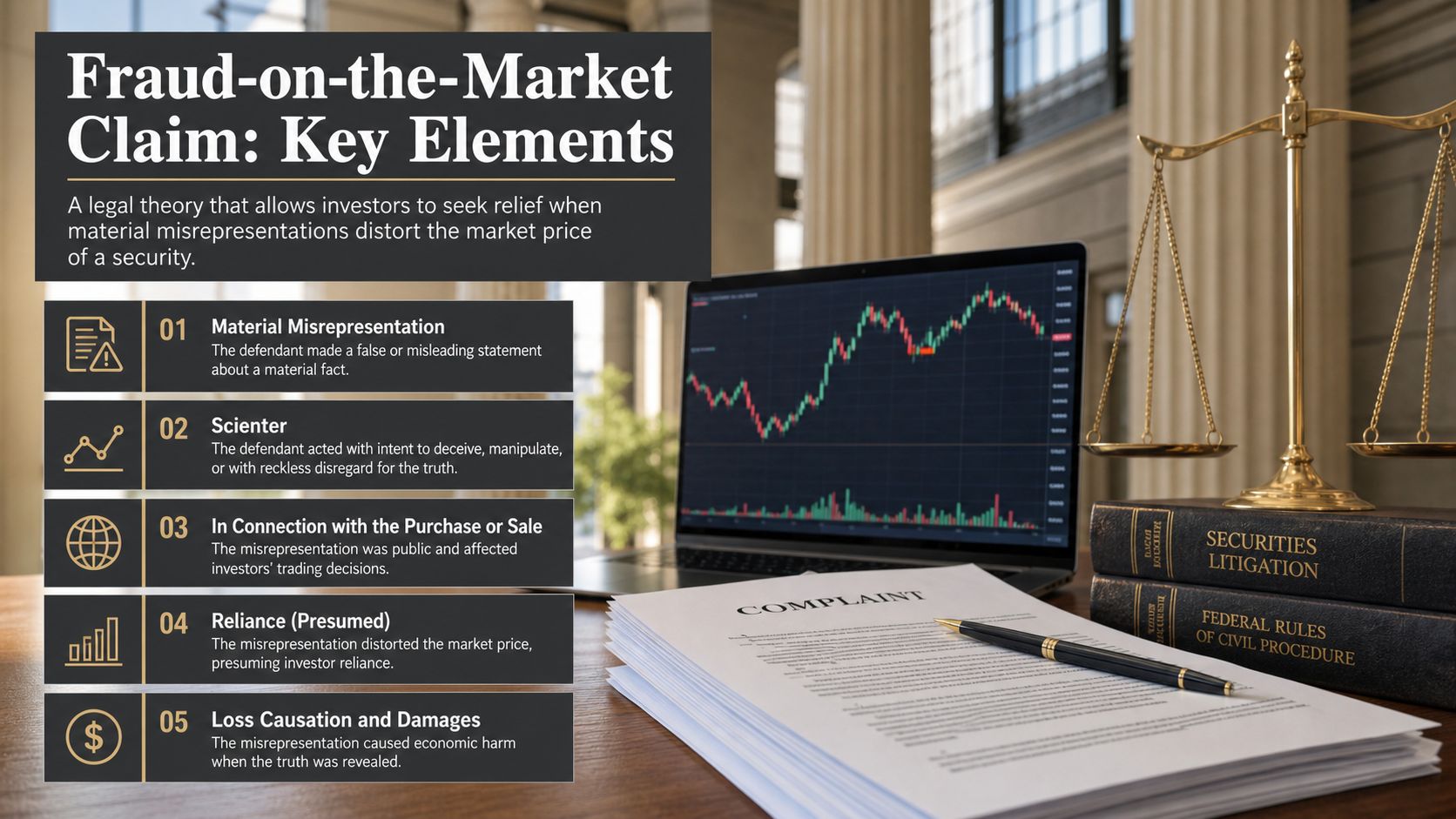
The first block is materiality. A statement is material when it's significant enough that a reasonable investor would care about it, because it affects how the market values the stock. If the lie is trivial, the claim gets weaker. If it hides revenue trouble, regulatory problems, or a collapsing business line, the issue usually becomes much more serious.
How reliance gets proven without reading everything
The doctrine's big advantage is the reliance presumption. Instead of forcing every investor to testify, “I read this filing and trusted it,” the law can treat buyers as having relied on the integrity of the market price. That matters because public markets are supposed to process information collectively, and a distorted price can mislead people who never saw the original statement.
The next block is market efficiency. Courts commonly look to the Cammer factors, which include average weekly trading volume, analyst coverage, market-maker or arbitrage activity, SEC Form S-3 eligibility, and the price reaction to unexpected news; later guidance also looks at market capitalization, bid-ask spread, and public float (Proskauer's discussion of Cammer factors). The reason price reaction matters so much is simple, if the stock doesn't react to news in a predictable way, it's harder to say the market absorbed the lie.
A fraud-on-the-market case often rises or falls on the price chart, not the emotional force of the story.
The last two blocks are loss causation and damages. Loss causation links the fraud's revelation to the stock decline. Damages measure the actual economic harm. Without those, even a proven lie doesn't automatically translate into a recoverable amount.
If you want a broader look at how securities cases fit together, this overview of securities litigation can help connect the doctrine to the rest of the process.
Landmark Court Decisions That Shaped Investor Protections
The modern doctrine started with Basic Inc. v. Levinson. That case made clear that investors in an efficient market can invoke a presumption of reliance when a public misrepresentation is reflected in the price. Before that, individual proof of reliance would have made many large securities cases nearly impossible to manage at scale. Basic is the case that turned a legal theory into a practical route for collective investor recovery (Cornell Law School's explanation).
Later cases and practice tightened the proof requirements. Courts did not eliminate the presumption, but they made price impact and market conditions much more important. That's why investors often hear that the fight is no longer just about whether a company lied, it's also about whether the lie moved the stock.
Why class certification is such a big gate
Class certification is where many cases rise or fall. In plain English, it's the court's decision on whether one group case can go forward on behalf of many investors instead of forcing everyone into separate lawsuits. In fraud-on-the-market cases, the class question often turns on whether common proof can show that the market was efficient and that the alleged misstatement affected price.
That's where the doctrine connects to the class-certification fight. Defendants can try to show the statement had no price effect, because if the market didn't react, they'll argue the presumption should not apply. That kind of argument matters long before trial, because it can shape whether investors stay together in one case or splinter into individual claims.
For investors trying to understand how that gate works in practice, this guide to class certification requirements is the right place to start.
The practical lesson is straightforward. These cases are not history lessons. They're live disputes about how courts measure markets, price movement, and investor reliance today. If the stock traded like a true public market and the lie moved the price, the doctrine can be a powerful tool. If not, the path gets narrower.
Where the Doctrine Falls Short in Modern Markets
A stock can be public and still trade in a market that does not behave like the textbook version courts often describe. That shows up most often in thinly traded microcaps, many SPAC-related securities, and other fragmented trading settings where prices can wobble for reasons that have little to do with real information. In those cases, the investor may have a strong fraud claim, but the reliance shortcut from fraud on the market can be harder to use.

The legal issue is the market's structure, not whether the security was real. A thin market can work like a shallow pond, even a small stone can make a splash, but the price may not absorb information in a steady or reliable way. If the stock price did not react in a way experts can trace, defendants may argue that the market never took the statement into account.
Why modern trading makes the old model shaky
The classic doctrine assumes that public information gets reflected in price quickly enough to support common proof of reliance. Modern trading is messier than that. Orders can move through multiple venues, liquidity can be thin in one place and present in another, and rapid trading strategies can blur the connection between a statement, a price move, and an investor's loss. That is why these cases often still require an economist, even when the fraud seems obvious to the people who bought the stock.
Courts still look to whether the market was active and whether the alleged misstatement affected price. The Ninth Circuit's civil jury instructions explain that the presumption can be rebutted by showing there was no actual reliance or no price effect (Ninth Circuit civil instructions on fraud-on-the-market reliance). Scholarship on market microstructure also questions how well older price-formation assumptions fit fragmented trading and high-frequency markets (Indiana Law Journal discussion of modern market microstructure).
Practical warning: a public stock is not automatically an efficient market.
That gap matters for investors in thinner names. The lie can be real, and the loss can be real, yet the class-action path may still narrow if the market-efficiency proof is weak. Investors in microcaps, SPACs, and thinly traded securities sometimes end up with better options outside a federal class case, including an individual lawsuit, FINRA arbitration, or a claim tied to the way the account was handled. If the dispute involves repeated misinformation, a pump-and-dump pattern, or trading meant to distort price, market manipulation may be part of the recovery analysis.
For investors, that distinction is more than academic. The doctrine promises a shortcut, but modern markets do not always give it one clear lane to travel on.
Class Actions Versus FINRA Arbitration Recovery Paths
Fraud on the market is central to federal securities class actions, but it is not the only way investors recover losses. The right path depends on who did the wrong, what was sold, and how the loss happened. If the problem was a misleading public company statement in a traded stock, class litigation may fit. If the problem came from a broker's recommendation, account handling, or disclosure failure, FINRA arbitration often makes more sense.
| Factor | Federal Class Action | FINRA Arbitration |
|---|---|---|
| Main defendant | Public company and related parties | Broker, advisor, or firm |
| Core theory | Public misstatement or omission affected market price | Suitability, churning, unauthorized trading, failure to disclose risks |
| Need for fraud on the market | Usually yes in open-market cases | No |
| Best fit | Widely traded securities with market-price evidence | Brokerage misconduct, private placements, non-traded products |
| Process shape | One case for many investors | Individualized claim process |
That difference matters for investors in private placements, non-traded REITs, and alternative investments. Those products often fail the market-efficiency assumptions that support class claims, but they can still support strong arbitration claims if a broker pushed them without proper disclosure or suitability analysis. In other words, the absence of a fraud-on-the-market class case does not mean there's no recovery path.
The procedural rules also differ. FINRA arbitration is built around customer-firm disputes, and the claim focuses on what the broker did in the account, not whether the market price of an exchange-traded security reflected deception. If you want the rulebook itself, FINRA arbitration rules show why these claims are handled differently from federal class actions.
Many investors lose time by choosing the wrong forum. A class action can be the right tool for one kind of harm and the wrong tool for another. The fastest way to lose momentum is to force a broker-misconduct case into a market-fraud framework that doesn't fit.
Your Action Plan After Discovering Investment Fraud
Start by saving everything. Pull account statements, trade confirmations, emails, text messages, offering materials, pitch decks, screenshots, and any notes you made when the investment was sold. If the dispute is over a token, a new platform, or a risky alternative product, a quick screening tool like Solana Tracker's rug risk API can help you understand basic project-risk signals before you spend time reconstructing the case.
What to do before you call the broker
Do not start by giving the broker a clean version of your concerns. Talk to securities counsel first, because once the paper trail is fragmented, the facts get harder to prove. A good lawyer will tell you whether the case belongs in court, in arbitration, or in a class setting built around fraud on the market.
A few practical steps matter right away:
- Preserve records immediately: save statements, confirmations, and every communication tied to the recommendation or trade.
- Write down your timeline: note when you bought, when you sold, and when the truth became public.
- Do not guess on deadlines: securities claims can be time-sensitive, and the clock can start running well before you feel ready to act.
- Ask about fee structure: many investor-fraud cases are handled on contingency, so you may not pay upfront if the firm accepts the matter.
The legal timing issue is serious. The plan for many securities claims is tied to filing within two years of discovery of the fraud or five years from when it occurred, whichever comes first, so waiting can close off recovery even when the underlying misconduct was real.
Practical rule: preserve first, explain later.
That order helps protect your case. It also keeps you from relying on the wrong document, the wrong memory, or the broker's preferred version of events. When you're ready, a consultation should focus on the type of security, the trading venue, the size of the loss, and whether market-price proof or broker-misconduct proof is the better path.
Answers to Common Investor Questions About Fraud Recovery
Can I recover if I sold before the fraud was exposed? Yes, sometimes. If you sold while the price was still artificially inflated, the loss can still matter. The key question is whether you traded at a distorted price, not whether you held the stock until the final collapse.
How long does recovery take? It depends on the forum. Arbitration is often faster than class litigation, but both can take time because each side may fight over records, experts, and valuation. The process can feel slow because price impact and loss calculations usually need careful analysis.
How much can investors get back? There's no fixed number, and anyone promising one is overselling the case. Recovery depends on the facts, the defendant's solvency, the strength of the proof, and whether the claim fits the right legal path. In successful matters, the goal is to recover as much of the provable loss as the record supports.
Do I have to join a class action? Not always. If your loss came from broker misconduct, private offerings, or account-level abuse, an individual claim may be better. If your loss came from a public company's misleading statements in a market that can support the doctrine, class litigation may be the right framework.
Will my broker retaliate if I file? FINRA rules prohibit retaliation against customers who bring claims. If you're worried about account access, transfers, or pushback, that's another reason to get advice before you make your next move.
For a plain-language walk-through of online evidence preservation and why claim forms can get messy, Scrapfly's guide to solving captchas in web scrapers is a useful reminder that digital records can be harder to collect than they look, which is exactly why investors should save screenshots and messages early.
If you think a public-company lie, a broker recommendation, or a risky alternative investment damaged your portfolio, Kons Law can review the facts, identify whether class litigation or FINRA arbitration fits, and explain the recovery process in plain English. Visit Kons Law to request a free consultation and get help deciding what to do next.
