
Misappropriation of funds is the unauthorized conversion or diversion of money entrusted to a financial professional. In occupational-fraud cases studied by the ACFE, asset misappropriation appeared in 89% of 1,921 cases, with identified losses exceeding $3.1 billion.
You may be reviewing a brokerage statement and notice a wire transfer you don't recognize, a fee that wasn't in your agreement, or a sudden reduction in account value that the reported investment performance doesn't explain. Perhaps your advisor assures you everything is normal, yet the statements look unusually polished and the underlying transactions are difficult to verify. Those circumstances deserve careful attention.
In an investment relationship, misappropriation goes beyond someone taking cash. It can include hidden fee skimming, forged transfers, unauthorized securities sales, diverted client proceeds, or using account access for a purpose you never approved. The central question is whether a broker, advisor, or related entity used money entrusted to them outside the authority you granted.
The legal label may differ depending on the facts and jurisdiction. Potential theories can include criminal theft or embezzlement, civil conversion, breach of fiduciary duty, securities fraud, or regulatory violations. What matters first is preserving the evidence and tracing what happened to the money.
Defining Misappropriation in Investment Accounts
A statement arrives, and one line doesn't fit. It may show an unfamiliar ACH withdrawal, a check bearing a signature you don't remember providing, or a transfer to a bank beneficiary with no obvious connection to your investment plan. The transaction may look routine because it appears inside a legitimate brokerage account. That appearance doesn't establish authorization.
Misappropriation of funds means the unauthorized, improper, or unlawful use of money or other property for a purpose different from the one intended. In the brokerage context, FINRA Rule 2150(a) prohibits a member firm or associated person from making improper use of a customer's securities or funds, as explained in FINRA's discussion of customer-property protections.
The professional's lawful access is what makes these cases difficult. A broker may have authority to place trades, receive instructions, deduct disclosed fees, or transfer money under a written agreement. That authority has boundaries. It doesn't give the professional permission to redirect proceeds to a personal account, pay personal bills, or create a transaction that serves an undisclosed purpose.
Practical rule: A transaction can be misappropriation even when it passes through a real account and appears on a formal statement. The issue is whether the use matched the authority granted.
Investors should also distinguish misappropriation from commingling of funds. Commingling may create serious control and tracing problems, but it isn't automatically proof that someone converted money for personal use. The investigation must connect the account access, the specific movement of funds, the investor's instructions, and any personal or related-party benefit.
A useful first review asks four questions:
- Who controlled the funds? Identify the broker, advisor, custodian, assistant, outside entity, or family member who could initiate or approve the transaction.
- What authority existed? Locate the investment-management agreement, limited power of attorney, transfer instructions, fee schedule, and written communications.
- What occurred? Compare the stated purpose with the destination, timing, amount, and accounting entry.
- Was the record accurate? Check whether the statement, confirmation, tax document, or performance report describes a real asset and a genuine transaction.
This approach moves the analysis away from the emotionally understandable conclusion that “my account lost money” and toward the evidence that can establish unauthorized conversion.
The Three Elements of Fund Diversion
Misappropriation typically develops through three connected features, not one unexplained loss. The professional has access or control, uses the property outside the authorized mandate, and conceals the diversion so the investor doesn't discover it promptly. The SEC has described this pattern in cases involving unauthorized transfers, personal credit-card payments, and forged signatures, as detailed in an SEC enforcement release concerning adviser misuse of client funds.
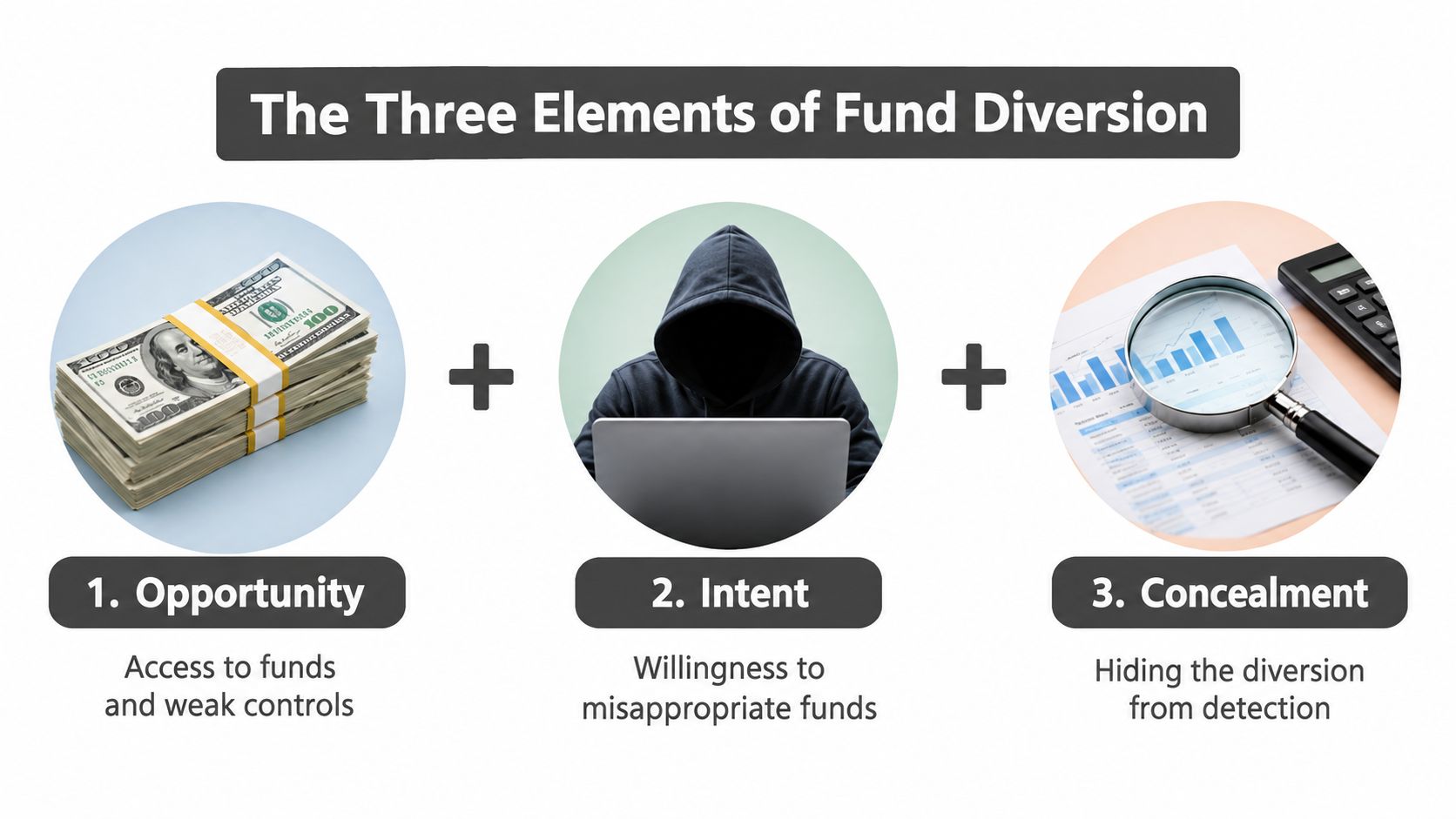
Access creates the opportunity
The first element is practical control. An advisor may hold discretionary trading authority, communicate with a custodian, recommend wire instructions, or arrange transfers from an investment account. A representative may also gain access through check-writing privileges, beneficiary paperwork, insurance-policy loans, or authority granted during a client's illness.
Access alone isn't misconduct. Many legitimate investment relationships require a professional to handle transactions efficiently. The risk appears when the professional's access allows funds to move without a second, independent confirmation from the client or custodian.
Unauthorized use changes the character of the transaction
The second element is the mismatch between the authorized purpose and the actual use. Selling securities can be proper if the client approved the sale and the proceeds were invested or distributed as directed. The same sale can become the mechanism of conversion if the advisor generated cash and redirected it to a personal account.
Recurring fees require the same scrutiny. A disclosed advisory fee calculated under the written agreement may be legitimate. A fee charged outside that agreement, increased without authorization, or routed to an undisclosed related entity may support a civil or regulatory claim.
Concealment delays discovery
The third element is concealment. False descriptions, incomplete transaction histories, altered statements, unexplained performance figures, and missing confirmations can make an unauthorized transfer appear ordinary. Concealment does not require an elaborate forged document. A professional may offer reassuring explanations while avoiding the underlying bank records.
The strongest review compares documents that were created by different systems. A brokerage statement should be tested against custodian confirmations, bank records, wire instructions, tax reporting, and the written investment mandate. An account that looks profitable on paper may still contain assets that don't exist or values that can't be independently verified.
Concealment Tactics and Outright Broker Theft
Some diversions announce themselves. Others remain hidden behind a sequence of apparently legitimate investment activity. Both patterns can injure an investor, but they demand different investigative methods.
In a concealed scheme, the fiduciary first receives money for a stated investment purpose. The funds may then move to personal expenses, a related company, an earlier investor, or a fabricated investment. False statements, tax documents, and performance representations can conceal the shortfall. The SEC has described this type of fraud-and-concealment cycle in an enforcement matter involving false investment values and fund records.
The polished statement problem
A statement can be genuine as a document while inaccurate as a description of the underlying assets. If an account reports that a private fund owns a valuable position, the investor still needs to determine whether the fund operates, whether the asset exists, and whether the reported value has a reliable basis. A familiar logo, professional formatting, or regular mailing schedule doesn't verify the asset.
Red flags include:
- Unverifiable holdings: The reported investment can't be confirmed through an independent custodian, issuer, auditor, or governing document.
- Unexplained value stability: The account shows smooth or reassuring results while market conditions and available transaction records point elsewhere.
- Related-party destinations: Proceeds move to an advisor-controlled company, personal account, or entity that wasn't disclosed in the investment agreement.
- Changing explanations: The advisor gives different reasons for a withdrawal, delayed redemption, or missing confirmation.
A practical response is to trace the money, not merely reread the statement. Match each contribution to a deposit, each promised investment to an actual purchase, and each redemption request to a documented payment.
The obvious theft pattern
Outright theft may involve a forged endorsement, a check cashed without consent, a loan against an insurance policy, or a wire sent to an advisor's personal bank account. In a FINRA hearing-panel decision, a representative borrowed against a customer's insurance policy and forged the customer's endorsement to cash checks without the customer's knowledge or consent. FINRA stated that its sanction guidance identifies a bar as the standard sanction for misappropriating customer funds, even when the misuse isn't connected to a securities transaction.
These cases often produce clear documentary evidence, but investors still shouldn't confront the suspected wrongdoer by deleting or altering records. Preserve the original statements and communications, download account histories, and use written requests so the record shows what the firm was told and when. A focused review of unauthorized withdrawals can help organize the transaction history before a formal claim is filed.
Distinguishing Misappropriation from Poor Performance
A declining account isn't automatically evidence that someone stole from you. Markets fall, investments fail, advisors make unsuitable recommendations, and brokers may trade excessively. Those events can create serious civil claims, but they don't all involve conversion of entrusted funds.
Government guidance distinguishes dishonest and deliberate fraud from mistakes or poor results. An unsuitable recommendation, failure to diversify, or excessive trading may support negligence, breach of fiduciary duty, or another civil theory without satisfying the narrowest definition of criminal theft, as explained by Michigan government guidance on fraud and misuse of assets.
Start with the type of loss
Consider two different examples. An advisor places a client in an unsuitable annuity, despite the client's need for liquidity and income. The investment may perform poorly, and the advisor may have breached duties or industry standards. But if the funds were invested as documented and no one diverted them, the core claim may be unsuitability rather than misappropriation.
Now consider an advisor who tells the client that money will be invested, transfers it to a secretly associated company, and uses part of it for personal expenses. Even if the advisor later sends an account statement, the issue is no longer merely investment performance. It concerns authorization, destination, personal benefit, and concealment.
A disciplined review separates these questions:
| Question | What it helps determine |
|---|---|
| Who controlled the money? | The potential duty, access, and responsibility |
| What did the client authorize? | The boundaries of the mandate |
| Was the transaction suitable and disclosed? | Possible negligence, fiduciary, or regulatory claims |
| Where did the money actually go? | Whether conversion or diversion occurred |
| Was the transaction accurately recorded? | Whether concealment or false reporting may be involved |
Unauthorized trading is not the same as theft
An unauthorized trade may expose a broker or firm to liability even when the proceeds remain in the customer's account. The trade may have caused losses, generated commissions, or violated the client's instructions. That doesn't automatically mean the broker appropriated the funds for personal use.
The reverse is also true. An advisor can misuse client property without withdrawing cash in a visibly criminal manner. Redirecting funds, deducting unauthorized fees, selling securities to generate cash, or using authority for an undisclosed purpose can create actionable misconduct.
Don't force every fact into one label. A claim may involve multiple theories, and the best recovery strategy often depends on identifying each one accurately.
Vulnerabilities and Financial Elder Abuse
Older investors often rely on the same professional for years. That familiarity can make a suspicious transaction easier to approve and harder for relatives or successor advisors to question. Memory loss, isolation, health problems, pressure from a trusted person, or dependence on an advisor for everyday financial decisions can create opportunities for diversion.
A securities-industry example involved an advisor who allegedly persuaded at least five clients and customers, some elderly or experiencing memory loss, to transfer money from investment accounts into personal bank accounts and entities secretly associated with him. The SEC alleged that he represented the transfers as investments while siphoning at least $680,000 for himself from at least July 2018 through November 2020, as described in the SEC's enforcement release.

The mechanics aren't always dramatic. A client may receive a call from someone impersonating a trusted institution, grant remote access to a device, approve a transfer after repeated pressure, or sign paperwork without understanding that the beneficiary has changed. A transaction that appears “approved” still requires context. Consent obtained through deception, manipulation, or exploitation may not resolve the legal issue.
Federal reporting shows that financial losses reported by Americans age 60 and older exceeded $4.89 billion in 2024, an almost 43% increase from 2023. The Department of Justice also reports that alleged offenders attempted to steal or stole more than $2 billion from over one million older Americans, according to its elder-justice materials.
Underreporting complicates the picture. Victims may feel embarrassed, fear losing independence, or believe the advisor's explanation because the account statements look official. Families should focus on preserving evidence rather than blaming the investor. A private review of elder financial abuse can help identify whether the conduct involved unauthorized transfers, unsuitable products, exploitation of authority, or a combination of these issues.
Gathering Evidence and Reporting the Misconduct
If you suspect a diversion, protect the records before demanding an explanation. The advisor or firm may control access to online statements, and a later version of an account history may not show the same detail as the original. Download files, save emails in their original form, and keep paper statements rather than relying only on screenshots.
Build a transaction file
Collect the documents that establish both authorization and movement of money:
- Account statements: Preserve monthly brokerage, advisory, bank, insurance, and retirement-account statements.
- Trade confirmations: Keep confirmations for securities sales, purchases, redemptions, and transfers.
- ACH and wire records: Obtain the destination account, beneficiary information, dates, amounts, and any reference numbers.
- Authorization forms: Gather powers of attorney, transfer forms, check images, signature cards, and written instructions.
- Communications: Save emails, text messages, letters, call notes, and calendar records concerning the transaction.
- Fee schedules: Compare every charge with the advisory agreement, disclosure documents, and amendments.
- Tax records: Preserve Forms 1099, account tax reports, and statements describing income or asset values.
Next, create a reconciliation. List each questionable disbursement, identify the stated purpose, locate the corresponding authorization, and compare the destination with the investment-management agreement. If the money supposedly purchased an investment, request independent confirmation from the custodian or issuer rather than relying on the advisor's internal statement.
Evidence matters more than the label. A clear timeline showing who instructed what, when the money moved, and how the firm responded often proves more useful than an early accusation of “theft.”
Report the concern in writing to the brokerage firm's compliance or legal department. Ask for a written response, preserve proof of delivery, and avoid sending originals. FINRA advises investors to question transactions they don't understand or authorize, complain in writing, and preserve correspondence and account records.
Background research can also reveal conflicts that deserve follow-up. For example, when evaluating a business or related entity receiving funds, check business owners background using independently obtained information. That research won't prove misappropriation by itself, but it can help identify undisclosed ownership, related-party connections, or inconsistencies in the advisor's explanation.
Depending on the facts, investors may also report conduct to FINRA, the SEC, a state securities regulator, adult-protective-services authorities, or law enforcement. A regulatory complaint doesn't replace a private recovery claim, and it shouldn't delay urgent efforts to preserve records or stop additional transfers.
Pursuing Recovery Through FINRA and Litigation
Identifying the diversion is only the beginning. Recovery usually requires matching the facts to the correct defendant, legal theory, forum, and available assets. A registered representative may be personally responsible, while the brokerage firm may face claims based on supervision, control, agency, or failures in its systems.
FINRA arbitration is a common forum for disputes involving brokerage firms and registered representatives. Depending on the agreement and the facts, an investor may pursue theories involving unauthorized trading, securities antifraud violations, breach of fiduciary duty, conversion, negligence, or failure to supervise. Court litigation may be appropriate where the dispute involves an advisory firm, an outside entity, non-broker defendants, emergency relief, or claims that don't belong exclusively in arbitration.
The firm's internal controls deserve close review. The ACFE's 2024 study found that the typical occupational-fraud case lasted 12 months before detection, and more than half of the reviewed cases involved missing controls or an override of existing controls, according to the ACFE report. In a brokerage setting, that can raise questions about supervision, approval procedures, transaction alerts, reconciliations, employee access, and the firm's response to earlier warning signs.
Match the remedy to the harm
The recovery analysis may seek return of misappropriated property, damages, disgorgement where available, interest, or other relief permitted by the governing law and forum. The amount isn't determined solely by the unauthorized withdrawal. Counsel may need to examine lost investment opportunities, tax consequences, later transfers, account fees, and whether the firm or advisor concealed the conduct.
A claimant should also act promptly. Arbitration agreements and statutes of limitation can impose deadlines, and a delayed report may allow additional transfers or destruction of useful evidence. The right strategy may involve sending a preservation demand, notifying the custodian, filing a written complaint, and pursuing arbitration or litigation without waiting for an informal explanation.
Investors often benefit from a focused legal review of the misappropriation theory alongside related claims. The objective isn't to use the most alarming label. It's to present a fact-supported account of authority, movement of funds, concealment, responsibility, and measurable loss.
Kons Law evaluates investment-loss claims involving broker theft, unauthorized transfers, fiduciary breaches, and related misconduct, and represents investors through FINRA arbitration and civil litigation. If you would like a free consultation to discuss the investment loss recovery process in more detail, call Kons Law Firm at (860) 920-5181 for a FREE, NO OBLIGATION consultation, or visit Kons Law to discuss the facts and available recovery options.
