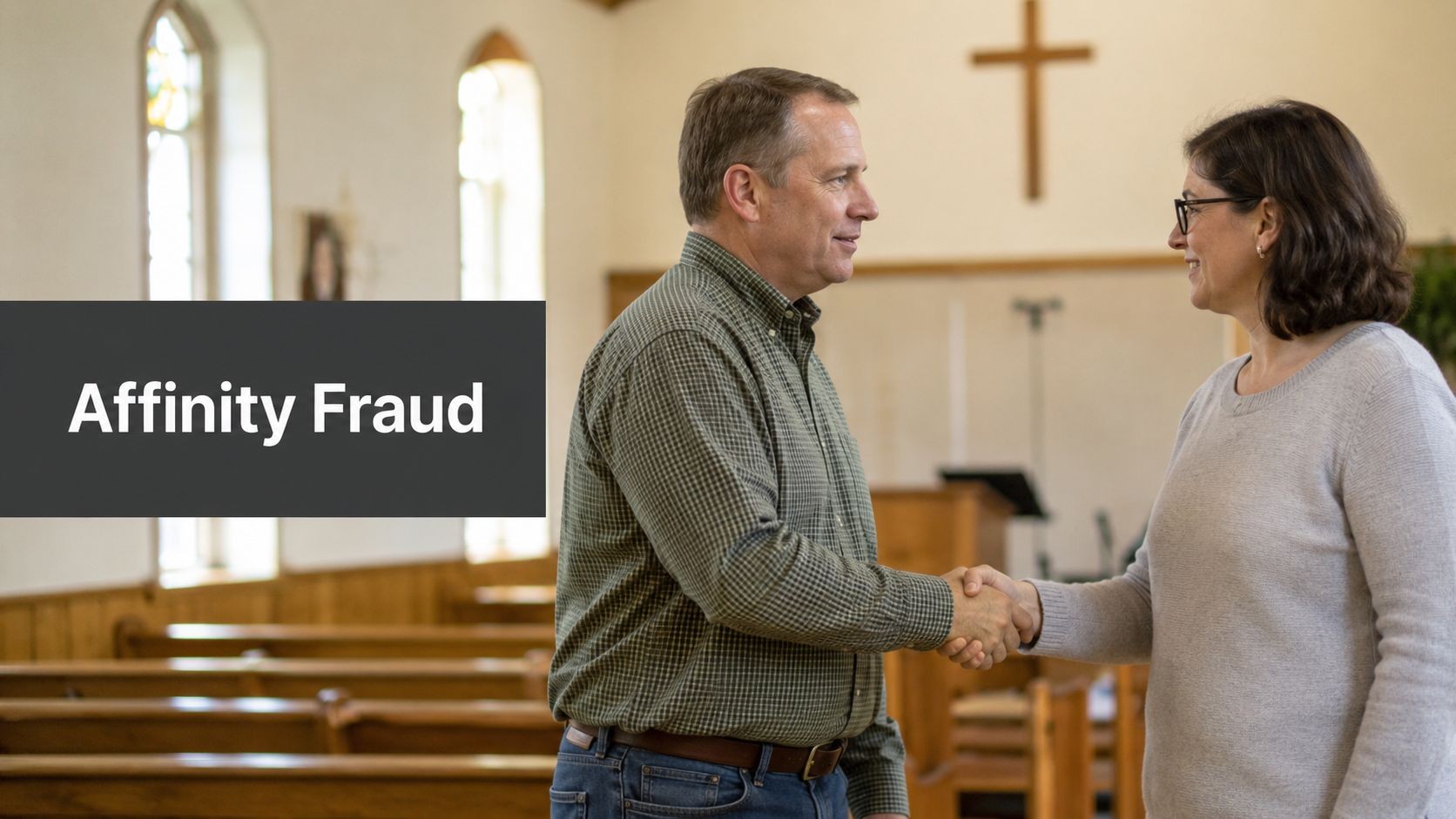
Someone in your circle brought you an investment that felt safe because it came through a familiar face. Maybe it was a fellow church member, a leader in a cultural organization, someone from your military network, or a longtime friend from work. The pitch didn't feel like a cold solicitation. It felt like an opportunity shared inside a trusted community.
That's what makes affinity fraud so damaging. Victims usually aren't reckless. They're targeted through relationships that were supposed to mean something. When the money disappears, people often feel two losses at once. The financial loss is obvious. The betrayal is harder to describe.
The Betrayal of Trust in Affinity Fraud
A common pattern begins subtly. A respected member of a close-knit group mentions an investment over coffee, after a service, at a reunion, or in a private message. Other people in the group seem involved already. Early investors may even report that they've been paid. The deal starts to feel vetted because it traveled through people you already trusted.
If you would like a free consultation to discuss the investment loss recovery process in more detail, call Kons Law Firm at (860) 920-5181 for a FREE, NO OBLIGATION consultation.
Affinity fraud is fraud aimed at members of an identifiable group. The group might be connected by religion, ethnicity, profession, age, military service, or another shared bond. The fraudster uses that built-in trust to lower skepticism, gain access, and persuade people to invest.
What is affinity fraud in practical terms? It's a scam that uses community as camouflage. The investment may be completely fake, or it may involve a real asset wrapped in lies about risk, performance, or the promoter's background. In many cases, victims delay reporting because they want to handle the matter privately with the person who brought in the deal. That delay often gives the scheme more time to spread.
The hardest part for many victims isn't admitting they lost money. It's admitting that someone they knew used trust as a weapon.
This problem also overlaps with other forms of financial exploitation, especially when older investors are targeted through personal relationships. If that sounds familiar, it may help to read about elder financial abuse and how it often starts.
People searching for what is affinity fraud usually want more than a definition. They want to know whether what happened to them fits a known pattern, what warning signs they may have missed, and what they can still do now. That is the primary concern.
How Affinity Fraud Schemes Exploit Community Bonds
A fraudster doesn't need to defeat your judgment head-on if he can borrow someone else's credibility first. That's why these schemes often show up inside communities where trust already exists.

Trust is the delivery system
Affinity fraud is defined as any fraud that targets members of an identifiable group, such as those with a common religion or ethnic heritage, where perpetrators exploit the group's inherent trust to recruit victims, and that misuse of trust often makes the fraud harder to detect because victims try to resolve problems directly instead of reporting them, as Cornell Law explains in its investor protection guide on affinity fraud.
The simplest analogy is a wolf in sheep's clothing. The fraudster doesn't appear as an outsider. He appears as one of us. Sometimes he really is a member of the group. Sometimes he only pretends to be. Either way, the point is the same. He wants the community to perform the credibility check for him.
That's why these scams spread so effectively through referrals. One person trusts the promoter. Then that person tells a sibling, a neighbor, a fellow retiree, or a business contact. Soon, skepticism is replaced by social proof.
A useful contrast appears in legitimate marketing and relationship-building. Real communities create value through transparency, service, and long-term trust. If you want a legitimate example of how organizations try to earn trust rather than exploit it, this overview of what is community building for business growth is helpful. Fraud does the opposite. It takes the language of belonging and turns it into a sales shortcut.
The structure underneath is often old-fashioned fraud
Most affinity fraud lacks originality. The wrapper changes. The mechanics usually don't.
A large share of these cases involve a Ponzi scheme or pyramid structure. New money is used to pay earlier participants. That creates the appearance of success, especially at the beginning. Early investors may receive statements, distributions, or verbal updates that make the investment look stable.
Here's how that tends to unfold:
The promoter enters through a trusted channel
A congregation, alumni group, veterans' network, ethnic association, or professional circle gives the promoter warm access.The pitch sounds exclusive
The opportunity is described as private, limited, or available only within the group.Early payments create confidence
Some investors receive returns, not from real profits, but from newer investors' money.Questions are softened by loyalty
People hesitate to challenge someone tied to the community.The flow of new money slows
Once recruitment weakens or withdrawal requests rise, the illusion cracks.
Practical rule: If an investment depends on trust in the person more than verifiable information about the product, that's not a relationship advantage. It's a legal warning sign.
Victims often think they should have seen it sooner. In reality, the scheme was designed to bypass the normal filters people use with strangers. That isn't a personal failure. It's the central mechanism of the fraud.
Common Schemes and Red Flags You Cannot Ignore
Most affinity fraud pitches sound slightly different on the surface, but the warning signs repeat. When clients describe these cases, the details vary by setting. The pattern does not.
Utah regulators warn that fraudsters use limited-time offers and promises of spectacular or “guaranteed” returns with no risk, and they caution investors never to invest based only on a group member's recommendation, no matter how trustworthy that person seems, in this guidance on recognizing affinity fraud warning signs.
Affinity Fraud Red Flag Checklist
| Red Flag | What It Looks Like |
|---|---|
| Guaranteed returns | You're told the investment can't lose, is protected, or will produce steady profits regardless of market conditions |
| No real paperwork | The promoter avoids offering formal disclosures, account records, or clear written explanations |
| Pressure to act now | You hear that the opportunity is closing fast or is available only for a short time |
| Community-based persuasion | The main reason to trust the deal is that other members of your group are in it |
| Vague strategy | The promoter talks around how the investment actually makes money |
| Secrecy or exclusivity | You're told to keep the opportunity quiet or that outsiders “won't understand it” |
| Discouraging outside review | The promoter resists input from a lawyer, accountant, adult child, or independent advisor |
| Unusual payment methods | You're asked to wire money personally, make checks to an individual, or send funds in a nonstandard way |
| Crypto hype without documentation | The pitch leans on digital assets, high yield, and speed, but avoids giving written materials |
How red flags appear in real communities
In a religious congregation, the sales pitch often borrows moral credibility. The promoter may frame the deal as a blessing, a ministry-minded business, or an opportunity reserved for believers. Questions get reframed as a lack of faith or loyalty.
In a senior living community, the approach may be more personal. A neighbor says he has found a safe income strategy. Another resident confirms she's already invested. The product is described as conservative, private, and ideal for retirement funds.
In a professional association or ethnic business network, the promoter may rely on status. He says he understands the community's values, that traditional firms don't serve the group properly, or that the investment should stay within the network.
Modern versions still use the same pressure points
Crypto affinity fraud deserves separate attention because it often strips away the few safeguards investors expect. The pitch may include claims of high yield, no risk, and quick access, but little or no written disclosure. California's DFPI has noted in its discussion of crypto affinity fraud risks that social media and celebrity-driven promotion can help fraudsters target groups such as veterans or ethnic communities, while recent data on specific demographic shifts remains limited.
That lack of hard recent data doesn't make the danger smaller. It means investors often have to rely on classic fraud analysis instead of waiting for a perfect statistical profile. If the promoter can't explain custody, documentation, risk, and who controls the money, the label “crypto” doesn't modernize the scheme. It usually just obscures it.
When the strongest proof offered is that “everyone in the group knows him,” you're not hearing due diligence. You're hearing the core pitch of affinity fraud.
Some cases also involve a broker recommending outside investments that were never properly supervised by the firm. If that sounds familiar, this explanation of FINRA selling away and investor claims may help connect the dots.
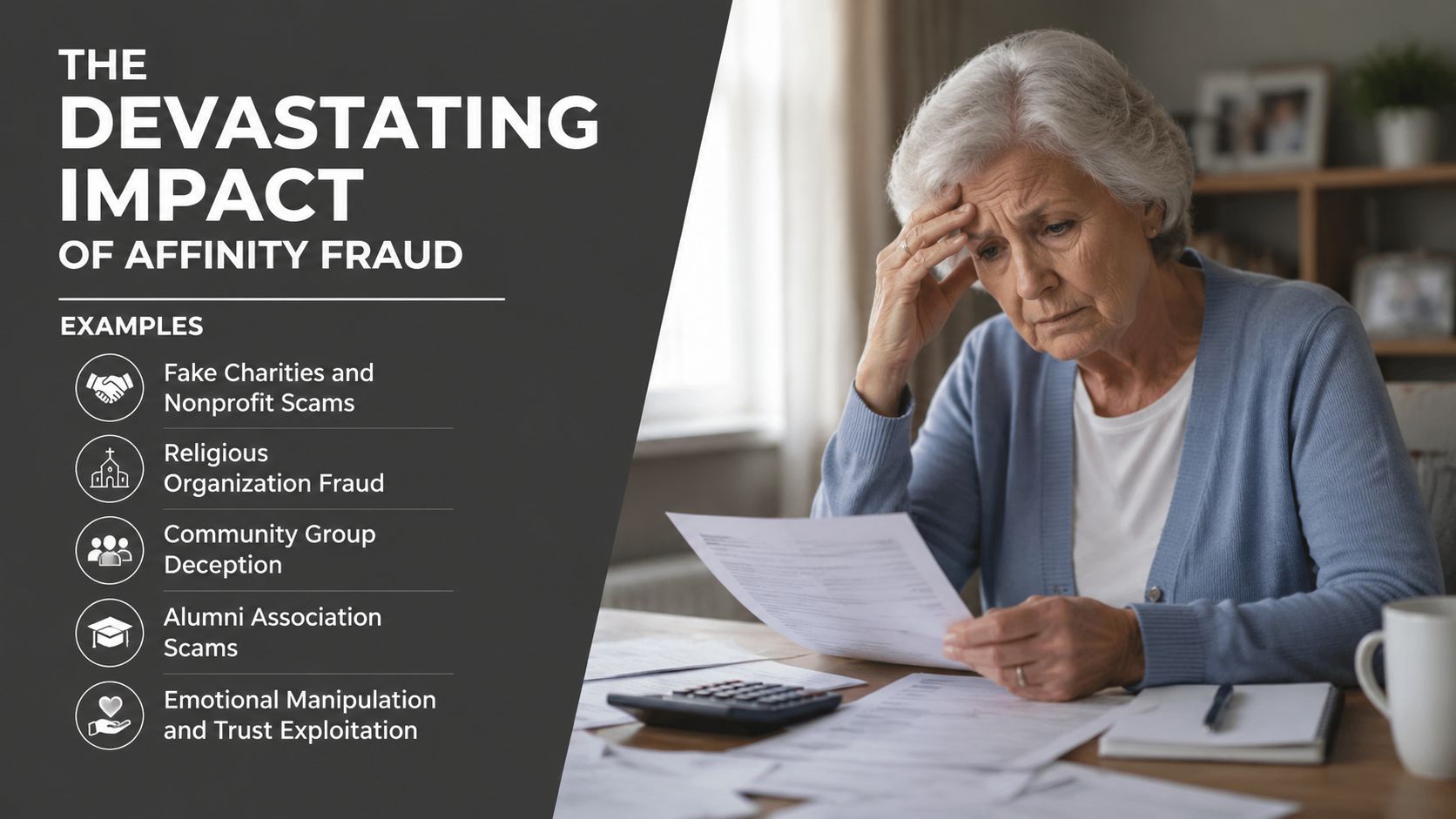
The Devastating Impact of Affinity Fraud Examples
The financial damage from affinity fraud can be enormous, but the community damage is often just as severe. People don't just lose savings. They lose confidence in the relationships that led them into the investment.
A large-scale example
Authorities estimated that affinity fraud cost Utah residents $1.4 billion in 2010 alone, a striking example of how badly close-knit communities can be harmed when fraudsters weaponize trust, as summarized in this overview of affinity fraud and the Utah losses.
That figure matters because many victims think their experience is too unusual or too embarrassing to fit a recognized type of misconduct. It does fit. Affinity fraud has a long history, and it can devastate an entire state, congregation, or local network when enough people rely on the same trusted messenger.
A personal scenario many victims recognize
Consider a retiree who belongs to a church group. A charismatic member introduces a private real estate investment. He says the project is low risk, backed by property, and already producing returns for other members. A few respected people in the congregation mention they're in.
The retiree uses savings set aside for medical expenses and income needs. At first, statements or updates look normal. Then payments slow. Questions are answered with excuses about temporary delays, permit issues, refinancing, or paperwork. Eventually calls go unanswered.
What makes this kind of fraud so difficult is that the victim may spend months trying to handle it privately. He doesn't want to accuse a fellow member. He doesn't want to divide the group. By the time he accepts that the investment may have been fraudulent, records are harder to gather and money is often gone.
If the underlying operation depended on new investor funds rather than legitimate profits, it may also fit the broader pattern discussed in this article on what a Ponzi scheme looks like in practice.
Your Legal Options for Recovering Investment Losses
Once you suspect affinity fraud, the instinct to wait is understandable. It's also dangerous. Delay can make recovery harder, both legally and practically.

According to the U.S. Securities and Exchange Commission, affinity fraud costs investors hundreds of millions of dollars annually, often through Ponzi or pyramid schemes that collapse and leave victims with little to no recovery without legal intervention, as discussed in this summary of SEC guidance on affinity fraud losses.
Act quickly and preserve the record
Your first job is to stop the information loss. Don't delete emails, texts, voicemail messages, account statements, screenshots, pitch decks, subscription agreements, checks, wire confirmations, or social media messages. Keep envelopes, handwritten notes, and calendars of meetings if you have them.
Create a simple timeline. Include when you first heard about the investment, who introduced it, what representations were made, how much you invested, when you asked questions, and when payments stopped or excuses began. A clean timeline often reveals legal issues that victims don't recognize on their own.
Save the evidence in the form you received it. Don't “clean it up” first. Original messages and documents often matter more than polished summaries.
Report the fraud to the right places
Reporting serves two purposes. It helps regulators identify patterns, and it creates a documented record that you responded once concerns became clear.
Depending on the facts, victims may report to:
- The SEC for securities-related fraud concerns
- FINRA if a broker or brokerage firm may be involved
- State securities regulators where the investment was sold
- Local law enforcement or federal authorities if theft, wire fraud, or document falsification appears involved
Reporting is important, but many people misunderstand what it will do. A regulatory complaint may trigger an investigation. It does not automatically recover your money. Victims often need a separate legal claim to pursue actual compensation.
Identify who may be legally responsible
The obvious target is the person who sold the investment. But legal recovery often depends on finding financially viable defendants beyond the promoter.
That may include:
A brokerage firm
If a registered representative recommended or sold an outside product, the firm may face claims involving supervision failures or related misconduct.An investment advisory firm
If an adviser steered client money into a fraudulent or unsuitable product, the advisory firm may bear responsibility.Third parties who handled the transaction
In some cases, entities that processed, distributed, or facilitated the offering may become relevant to the legal analysis.Control persons or business entities
The fraudster may have used a company, LLC, or affiliated venture as the sales vehicle.
This is where legal analysis matters. Many victims focus only on the individual they trusted, who may be insolvent by the time the scheme collapses. A good recovery strategy looks wider.
Understand the difference between arbitration and court
Two common paths are FINRA arbitration and traditional litigation. The right path depends on who sold the product, how the account was structured, and whether there's an arbitration agreement.
FINRA arbitration
FINRA arbitration is often used when the claim involves a broker or brokerage firm. It can be a strong forum for disputes involving unsuitable recommendations, lack of supervision, unauthorized outside business activity, and misrepresentations tied to securities sales.
Arbitration is not informal in the everyday sense. You still need evidence, witness preparation, legal theories, and a clear damages presentation. But it can offer a direct path when the defendant is in the securities industry.
Court action
Court may be the better route when the case centers on private actors outside the FINRA system, fraudulent entities, certain advisory relationships, or broader business tort claims. Litigation may also allow wider discovery tools in some circumstances.
The right answer isn't ideological. It's strategic. Forum choice can affect advantage, timing, procedure, and who can be brought into the case.
Gather proof that matches the legal claim
Victims often think they need to prove every detail of the fraud before talking to counsel. They don't. They do need to gather the evidence they already have.
Focus on practical categories:
- Sales materials such as brochures, slide decks, emails, or text messages
- Payment records including wires, checks, ACH records, and transfer confirmations
- Account history such as statements, online screenshots, and tax documents
- Identity evidence showing who made the pitch and in what capacity
- Follow-up communications especially excuses, reassurances, and delayed-payment explanations
A lawyer can often use those documents to determine whether the problem involves misrepresentation, omission of risk, sale of unregistered securities, outside business activity, breach of fiduciary duty, negligence, or outright theft.
For a broader look at how investors pursue these cases, this overview of working with a financial fraud attorney for investment losses gives useful context.
What usually does not work
Victims lose time when they rely on the wrong fixes. These approaches usually don't solve the problem:
- Private promises of repayment: Fraudsters commonly ask for more time.
- Handshake resolutions inside the group: Community pressure often protects the wrong person.
- Partial explanations accepted at face value: Delays, audits, frozen accounts, and refinancing stories are common stalling tactics.
- Waiting for another victim to act first: By then, key evidence may be harder to obtain.
What works is prompt analysis, preserved evidence, and a realistic assessment of where recoverable assets or responsible institutions may exist.
Take the Next Step Toward Financial Recovery Today
If you've been asking what is affinity fraud, the answer is no longer abstract. It's a form of investment fraud that uses shared identity and trust to lower your defenses. It often follows recognizable patterns, and it leaves victims feeling isolated even though their experience is painfully common.
You still have options. The fact that you trusted someone in your community doesn't destroy your legal rights. It may explain exactly how the fraud succeeded. What matters now is documenting what happened, identifying the right defendants, and choosing the proper path for recovery.
Many victims wait because they feel embarrassed or because they want one more explanation from the person who sold the investment. That hesitation helps the wrong side. Taking action doesn't mean overreacting. It means protecting your position while records, communications, and legal claims are still available.
If you would like a free consultation to discuss the investment loss recovery process in more detail, call Kons Law Firm at (860) 920-5181 for a FREE, NO OBLIGATION consultation.
If you believe you were harmed by affinity fraud, Kons Law can evaluate the facts, explain possible recovery options, and help you determine whether FINRA arbitration or court action makes sense for your case. A prompt review can make a meaningful difference in preserving evidence and pursuing investment loss recovery.
