You may be sitting on shares that looked valuable when you received them, then turned out to be frustratingly hard to move. Maybe they came from a private placement, an employer grant, a merger, or a stock option exercise, and now your broker says you need to wait, file paperwork, or qualify under Rule 144 before you can sell. That's where restricted securities create real-world problems, because the issue isn't only liquidity, it's also whether someone explained the restriction clearly in the first place.
What Restricted Securities Are in Practice
A client once hands over a stock certificate and asks the same question in different words, I own this, so why can't I sell it? That question usually starts from the wrong assumption. The restriction is not just a sticker on paper. It comes from how the security was issued and what exemption was used.

Restricted securities are securities acquired directly or indirectly from the issuer or an affiliate in a transaction not involving a public offering. They are typically sold in private, unregistered transactions rather than public offerings, and Rule 144 is the most common resale pathway. That is the core federal concept, and it matters because legal status affects resale rights, disclosures, and, in some cases, tax treatment. The SEC's investor glossary explains that these securities often carry a restrictive legend, which is the market's warning that the shares cannot be sold into the public market without an exemption applying SEC investor glossary on restricted securities.
Why the label matters in practice
The restriction follows the transaction, not just the certificate. A private placement often produces restricted stock because the buyer received shares in a non-public deal, not through the open market. For a closer look at that issuance path, this private placement overview connects the offering side to the resale problem. If the shares were issued that way, the law usually treats them as less liquid until an exemption clears the way.
Under Rule 144, the definition reaches securities acquired from an issuer or affiliate in a non-public offering, including some securities acquired under Regulation D or Rule 701. That is why the same-looking share can carry very different legal consequences. A founder's shares, an employee grant, and a private placement purchase may all look like “stock,” but the path to resale can be very different.
For anyone trying to determine whether the shares are really restricted, the plain-English question is simple. If the security came from a deal that bypassed the public offering process, the shares usually remain hard to sell until an exemption allows the resale. If the issuer, broker, or transfer agent mishandled that restriction, the investor is the one who often gets stuck dealing with the fallout, delayed sales, frozen accounts, or a resale that should have been disclosed more clearly from the start.
Practical rule: if the legend is still on the shares, do not assume a broker can trade them the same way as listed stock.
For readers who want to see how the certificate language is described in practice, view the image from Blue Sage and compare it to the paperwork on your own account.
Restricted Securities vs Control Securities
Restricted securities and control securities often get lumped together, which is why investors get tripped up. The overlap is real, but the source of the restriction is different. One comes from how the shares were acquired. The other comes from who owns them.
| Feature | Restricted Securities | Control Securities |
|---|---|---|
| Origin of restriction | Acquired in a non-public transaction from the issuer or affiliate | Held by an affiliate or person with control over the issuer |
| Legal source | Rule 144 and the underlying exemption framework | Rule 144 affiliate status and resale limits |
| Typical resale treatment | Subject to holding period and information requirements, sometimes more | Subject to volume and manner-of-sale limits, even if the shares are otherwise unrestricted |
| Practical consequence | Often illiquid until an exemption applies | Usually subject to extra scrutiny because the seller may influence the issuer |
The best way to see the distinction is to ask two separate questions. First, were the shares originally issued in a private or otherwise exempt transaction? Second, does the current holder count as an affiliate or control person? Those questions can stack, so a single block of stock can be both restricted and controlled.
Why affiliates face the hardest path
If you're an officer, director, or large shareholder with real influence, Rule 144 usually expects more from you before resale is allowed. That's because the market treats insider access differently from ordinary investor ownership. A non-affiliate who has held restricted shares long enough may face fewer conditions than an affiliate selling the same economic interest.
That distinction is especially important in private markets. Thomson Reuters notes that restricted securities frequently arise in Section 4(a)(2) transactions and Rule 506 of Regulation D private placements, and some market sources describe contractual lock-up periods of 6 months to 2 years after an IPO or financing event Thomson Reuters practical law reference). The practical lesson is simple, the same share can be locked up because of its issuance history, the seller's status, or both.
If you're sorting through a brokerage statement or a transfer restriction notice, this recovery-focused private-placement resource is useful when the issue is whether the security was sold to you with the wrong explanation.
Restricted status follows the paper trail. Control status follows the person.
Common Sources of Restricted Stock
A client usually does not buy a share certificate labeled “restricted” and walk away knowing what that means. The problem shows up later, when the investor tries to sell, transfer, or pledge the shares and learns that the paper trail controls the outcome. The source of the shares matters more than the label on the account statement.
The usual entry points
Private placements are the most common source. Regulation D offerings, including Rule 504 and Rule 506 structures, are often used to raise capital without a public registration statement. If the issuer relies on a private-offering exemption instead of registering the offering, the securities usually come with resale limits attached. If you are reviewing that kind of deal after the fact, this private placement guide helps explain why the resale restrictions are built into the transaction from the start.
Employee compensation is another common path. Restricted stock grants, restricted stock units, stock options, and other equity awards can all create securities-law issues, even after vesting. Vesting does not mean the shares are freely tradable. The employment restriction and the securities-law restriction are separate questions, and brokers often blur them when they should not.
Acquisition-related shares also appear often. In mergers, stock-for-stock exchanges, and reorganizations, investors can receive equity that has not been registered for public resale. That is why people who believe they are receiving “new public shares” sometimes find out they hold restricted ones instead. The legal character of the replacement shares follows the transaction, not the investor's expectation.
Other common sources that surprise investors
Founder shares are a classic example. Pre-IPO investors may also receive securities with long resale constraints, especially when the company is still privately held. Convertible debt that turns into equity can produce the same result, because the new shares inherit the legal history of the financing.
The SEC's Rule 144 framework captures that point. Restricted securities can include certain securities acquired under Regulation D or Rule 701, so the instrument name alone does not answer whether the shares can be sold. The records behind the issuance matter, and brokers who ignore them can put investors in a bad position when a sale is rejected or later challenged.
A good habit is to check the transaction documents, not just the account title. A stock certificate, cap table entry, grant notice, merger exchange letter, or subscription agreement can tell you more than the ticker symbol ever will. That is often where the dispute starts, especially when a seller or brokerage told the investor the shares were “normal stock” and left out the restriction issue.
How Rule 144 Resale Rules Work
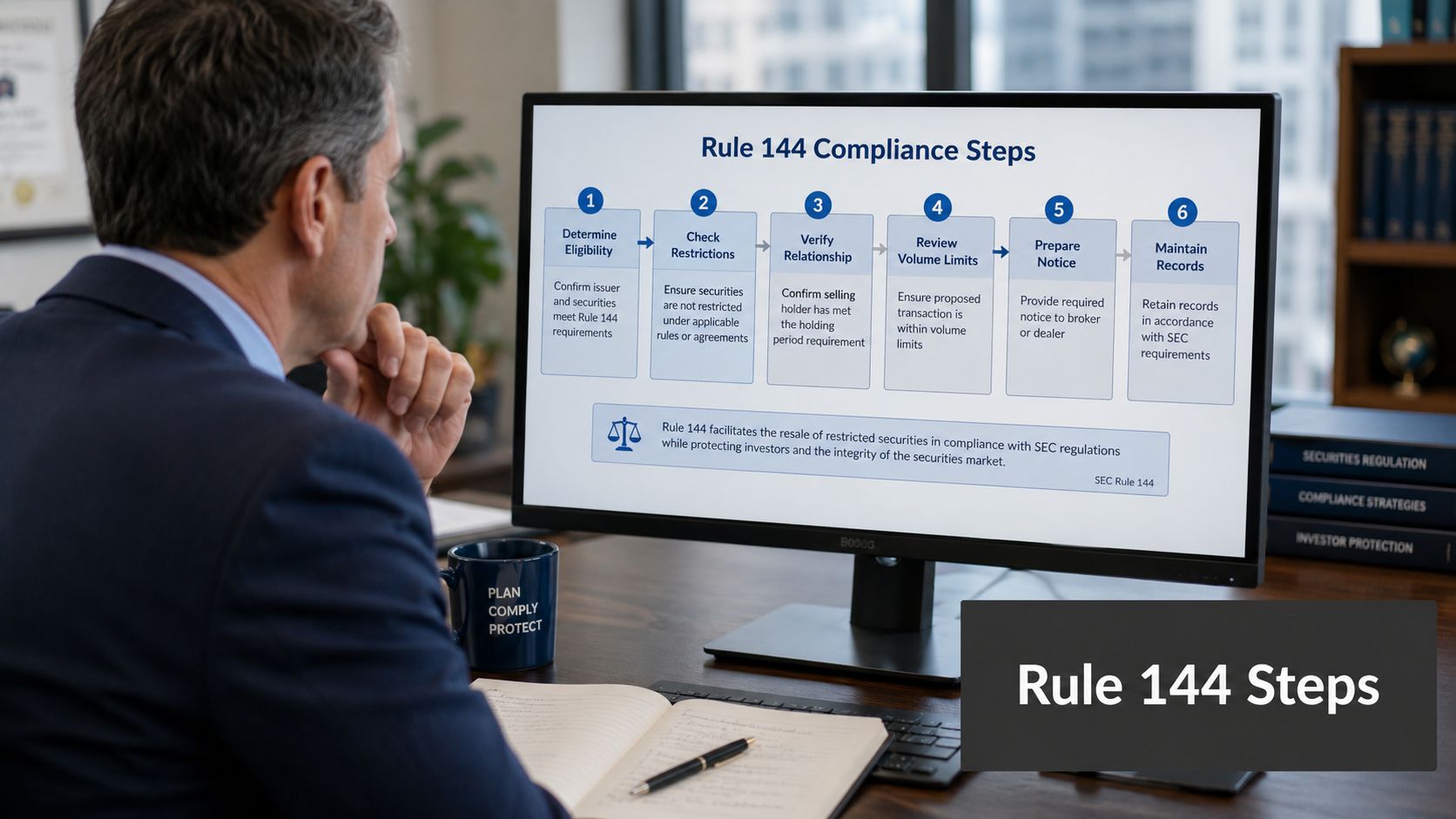
Rule 144 is the main resale safe harbor, but it does not make restricted stock freely tradable by itself. Each condition has to be checked before a sale goes through, and brokers who skip that analysis create avoidable risk for the customer.
The first gate is the holding period
For securities of a company subject to SEC reporting requirements, the minimum holding period is six months. For non-reporting companies, it is one year CGAA summary of restricted securities. That is the starting point, not the finish line.
The period generally runs from the time the shares were fully paid for. If the stock is not paid for yet, or if the record does not support the payment date, the sale analysis gets messy fast.
Current information, affiliate status, and resale mechanics
Rule 144 also depends on adequate current public information about the issuer. For reporting companies, that usually means the market can access current issuer information through ongoing reporting. If the company does not report, you need to be much more careful before assuming the resale path is open.
Affiliate sales bring additional limits on volume and manner of sale. That is where many brokers make mistakes. They focus on the holding period and ignore whether the seller is an affiliate, whether a broker's transaction is required, or whether the sale fits the rule's structure.
A holding period alone does not make the stock tradable. It only clears one hurdle.
Form 144 can also come into play for proposed sales by affiliates or holders of restricted securities, which is why the resale process is often more paper-driven than investors expect. If you are trying to understand the issuer-side disclosure record that often sits behind these transactions, this private placement memorandum resource is worth reviewing alongside the stock documents.
The long-term exemption investors overlook
After a security has been fully paid for and beneficially owned for at least two years, some sales may be exempt from Rule 144's volume limitations, filing requirements, and manner-of-sale requirements if the seller has not been a control person for at least three months Rule 144 explanation. That is the kind of detail that changes a client's plan from “maybe someday” to a concrete sale analysis.
Rule 144 is a safe harbor, not the only possible route. If someone tells you the shares are “free and clear” without walking through the rule's conditions, that is a red flag. Brokers and issuers sometimes use that kind of shortcut to move a transaction forward, and investors are the ones left dealing with a rejected sale, a frozen position, or a dispute over what was disclosed at the start.
Key Exemptions That Shape Restricted Resales
The issuer's exemption and the investor's resale exemption are related, but they do different jobs. That's where a lot of confusion starts, because the law doesn't use one single rule for the whole life cycle of the share.
Issuer-side exemptions
Section 4(a)(2) is the statutory foundation for private offerings. It's the classic private-sale exemption that lets an issuer raise money without registering the offering as public securities. Regulation D builds on that framework, and Rule 506(b) and Rule 506(c) are the workhorses many issuers use when selling to private investors.
Those rules matter because they shape the original issuance. They don't make the securities “public” later. They explain why the issuer was allowed to sell them without registration in the first place.
Investor-side resale exemptions
That's where Rule 144 comes in. It's the usual path for holders who want to resell restricted securities, especially when the resale is not being done by the issuer itself. Section 4(a)(1) also matters on the resale side, because it addresses non-issuer resales that fall outside the registration requirement.
Rule 144A sits in a different lane. It creates a private resale path for certain institutional buyers, which is why it's often described as an institutional liquidity channel rather than a retail one. For investors, the main point is that restricted securities can have more than one potential exit route depending on the buyer, the holder's status, and the paper trail.
Why the layering matters
A client can be looking at the same shares through multiple legal lenses at once. The issuance might have been exempt under Regulation D, the resale might rely on Rule 144, and a separate private institutional resale route might exist under Rule 144A. Those pathways don't cancel each other out, they overlap.
If you're reading offering materials and the legal structure still feels fuzzy, that's usually because the issuer-side and investor-side rules were described as if they were one thing. They aren't. Each exemption answers a different question, and mixing them up is how people wind up with bad trade assumptions.
Investor Red Flags and Common Risks
The biggest losses tied to restricted securities often start with a promise that sounded too easy. Someone says the shares are “basically liquid,” the legend will come off soon, or a broker can “take care of it.” That's not due diligence, it's marketing.
Signs the deal was misunderstood
A private placement marketed like a public stock sale should get immediate scrutiny. If the pitch emphasized near-term liquidity without clearly explaining the exemption, the holding period, or the issuer's reporting status, the investor may have bought something that wasn't what it sounded like.
Stale legends are another problem. Brokers sometimes paper over the restriction or treat the legend as outdated without confirming whether the issuer authorized removal. That's how harmless paperwork turns into a resale dispute.
You also want to look out for concentrated positions in a single restricted security. Retirees and seniors are especially vulnerable when they're told a large position can be sold quickly, only to learn the market is thinner or the rule analysis is incomplete. Liquidity risk becomes personal very fast when the investment is supposed to fund ordinary expenses.
Tax and reporting traps people miss
UK HMRC's treatment shows why employment-related restricted securities deserve separate attention. Under HMRC rules, restricted securities are defined by any contract, agreement, arrangement, or condition that affects market value, and they can trigger an income tax charge when restrictions lift or are varied, even if the shares still can't be freely sold HMRC employment-related securities manual. That's a reminder that “restricted” can mean more than one thing depending on the jurisdiction and the compensation structure.
If a broker or employer never explained that timing, the investor may be facing a tax event before there's a practical exit. That mismatch is exactly where complaints and recovery claims often begin.
For a different kind of identity-related due diligence that's unrelated to securities but useful as a reminder that appearances can deceive, a guide on face scanning for daters shows how easily a surface-level match can fail to answer the question underneath. Securities due diligence is no different, the label on the outside isn't enough.
Selling Restricted Shares and Pursuing Recovery
When restricted shares are handled correctly, the path is procedural. When they're mishandled, the path can turn into a dispute with the issuer, the broker, or both.
The practical selling checklist
Start with the holding period. Confirm whether the issuer is a reporting company or not, then verify the payment date and whether the shares have satisfied the applicable Rule 144 clock. Next, check whether current public information is available and whether the seller is an affiliate.
If the sale requires it, Form 144 needs to be filed as part of the process. That doesn't automatically mean the trade will happen, but it does mean the resale is being routed through the correct compliance lane.
Legend removal is its own issue. The issuer usually has a role in confirming that the restriction is gone or that the shares qualify for removal. If the issuer refuses to remove a stale legend, the investor should not let the broker improvise a shortcut. The records need to support the sale.
When the problem becomes a recovery case
The recovery question starts when a broker or advisor misrepresented the shares as liquid, sold them without authorization, or failed to follow reasonable supervisory procedures. In those cases, investors may have claims tied to unsuitable recommendations, negligence, or breach of fiduciary duty.
FINRA arbitration is the usual forum for brokerage disputes, and securities class actions can also matter when a broader pattern affected many investors. Many firms handle these matters on a contingency-fee basis, which helps clients pursue claims without paying up front. Kons Law is one example of a securities litigation firm that handles investor-loss matters in this space, including brokerage and private-placement disputes.
If the person who sold you the security couldn't explain the resale restrictions, that's not a paperwork issue. It's a conduct issue.
If you're holding restricted shares you can't sell, or you were told a position was liquid when it wasn't, document everything now. Keep the offering materials, account statements, emails, trade confirmations, and any legend-removal correspondence, then have a securities lawyer review the full chain before more damage piles up.

Making Smart Decisions on Restricted Holdings
Restricted securities can fit a real strategy, but only when the buyer understands the trade-off from day one. They make more sense for accredited investors with a long horizon, employees who understand the vesting and resale terms, and venture-backed investors who are already planning around lock-ups and private-market exits.
They're a poor fit for anyone who needs dependable liquidity soon, especially retirees or investors relying on a broker's promise of a quick exit. They're also a bad fit when the advisor can't clearly explain the exemption behind the shares, because that usually means the rest of the analysis is shaky too.
Before buying, ask three questions. What exemption covered the issuance? How long before Rule 144 sales can begin? Am I an affiliate or otherwise subject to additional limits? If those answers aren't clear in writing, don't treat the investment as if it were ordinary stock.
If you already own restricted securities and something feels off, a legal review is not an overreaction. It's normal due diligence, especially when a broker, advisor, or issuer mishandled the restriction analysis or misrepresented the exit.
If you're dealing with restricted shares, a stale legend, or a broker who sold you on liquidity that wasn't really there, contact Kons Law for a free consultation and get the paperwork reviewed before the situation gets worse.