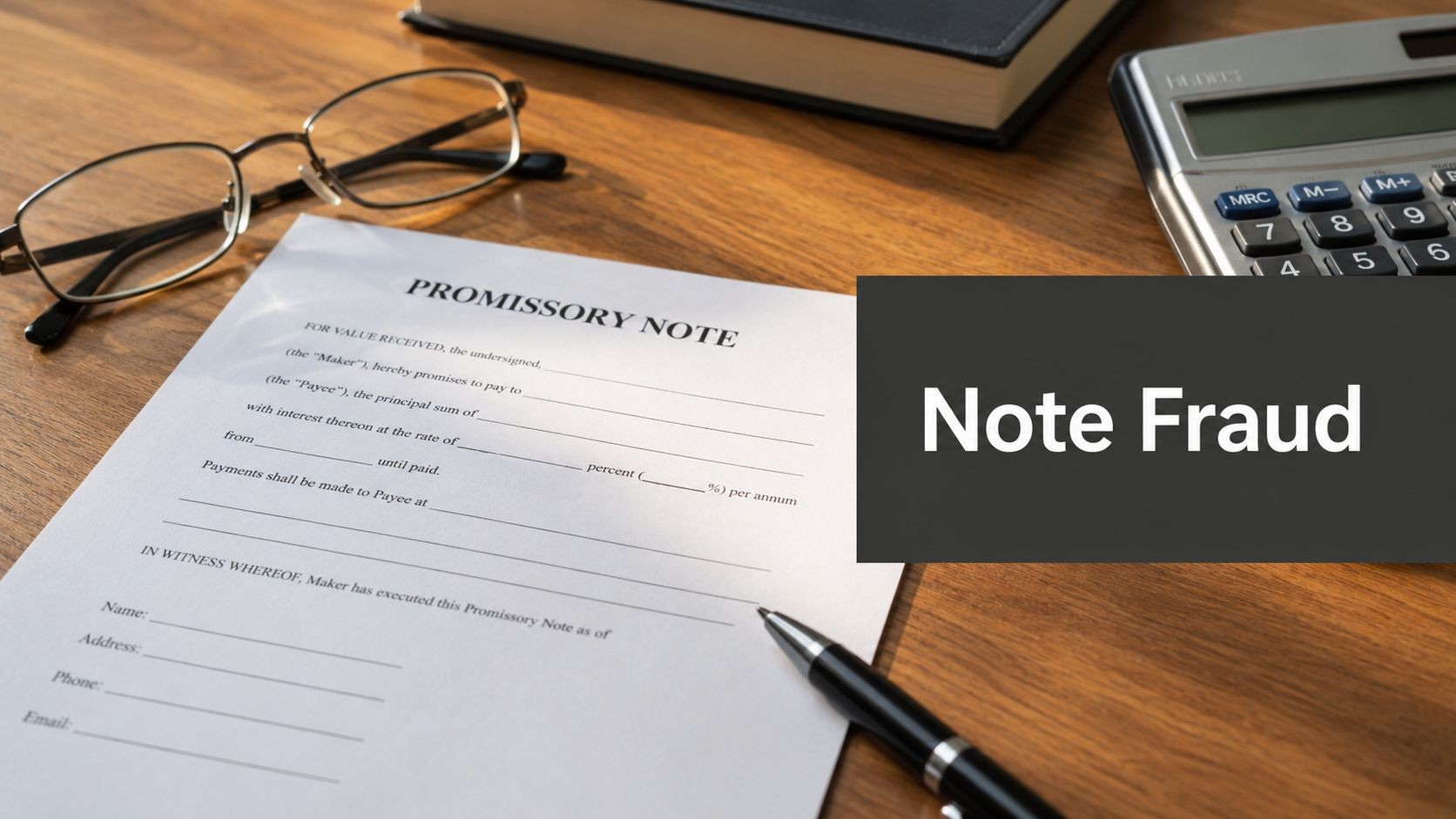
A lot of investors reach out after the same kind of pitch. The investment was described as safe. The return sounded unusually attractive, but the person offering it seemed trustworthy. Sometimes it was a longtime insurance agent. Sometimes it was a financial professional the investor already knew. And the paperwork looked simple enough: a promissory note.
Then the payments stopped, excuses started, and the investor realized the “note” may never have been the conservative investment it was presented to be.
If that sounds familiar, you're not alone. Promissory note fraud has been around for decades, and regulators have repeatedly warned that it can cause very serious losses. If you suspect you were sold a fraudulent note, or an unregistered note disguised as a routine loan, getting clear legal advice early matters. A useful starting point is understanding what investment fraud can look like in practice, especially when the misconduct is wrapped in ordinary-looking documents.
Introduction to Promissory Note Fraud
A legitimate promissory note is not suspicious. Businesses use them. Individuals use them. In the right setting, a note is a written promise to repay borrowed money under stated terms.
The problem starts when fraudsters use that familiar format to sell something very different from what investors think they're buying. Instead of a straightforward debt obligation backed by a real borrower with the ability to repay, the “note” may be unregistered, unsupported, or entirely fictitious. The sales pitch usually does the heavy lifting. It emphasizes safety, certainty, and income. It minimizes risk. It often leans on trust.
Practical rule: If the seller focused more on “guaranteed” returns and personal reassurance than on verifiable financial information, stop and reassess.
Promissory note fraud often leaves investors with two kinds of damage. The first is financial loss. The second is confusion about what rights they still have, especially when the seller was a professional rather than an obvious scammer. That confusion is understandable. Many victims don't realize that the legal analysis may involve securities law, broker-dealer supervision, licensing rules, and arbitration obligations, not just a simple broken promise to repay.
Concerned investors usually need answers to three immediate questions:
- Was this a security?
- Who can be held liable besides the person who sold it?
- What evidence do I need to preserve before it disappears?
Those questions are where recovery work begins. The legal path depends heavily on who sold the note, how it was marketed, what was disclosed, and whether a brokerage firm or advisory business should have supervised the sale.
If you would like a free consultation to discuss the investment loss recovery process in more detail, call Kons Law Firm at (860) 920-5181 for a FREE, NO OBLIGATION consultation.
What Is Promissory Note Fraud
A promissory note, in its basic form, is an IOU. One party borrows money and promises to repay it, often with interest, on a defined schedule. In ordinary commerce, that can be perfectly legitimate.
In fraud cases, the document itself is rarely the whole story. The key issue is how the note was sold and what the investor was told. A fraudulent note may be pitched as a low-risk, high-income investment when the issuer lacks the assets, business operations, or cash flow to repay anyone. In other cases, there is no real business behind it at all.
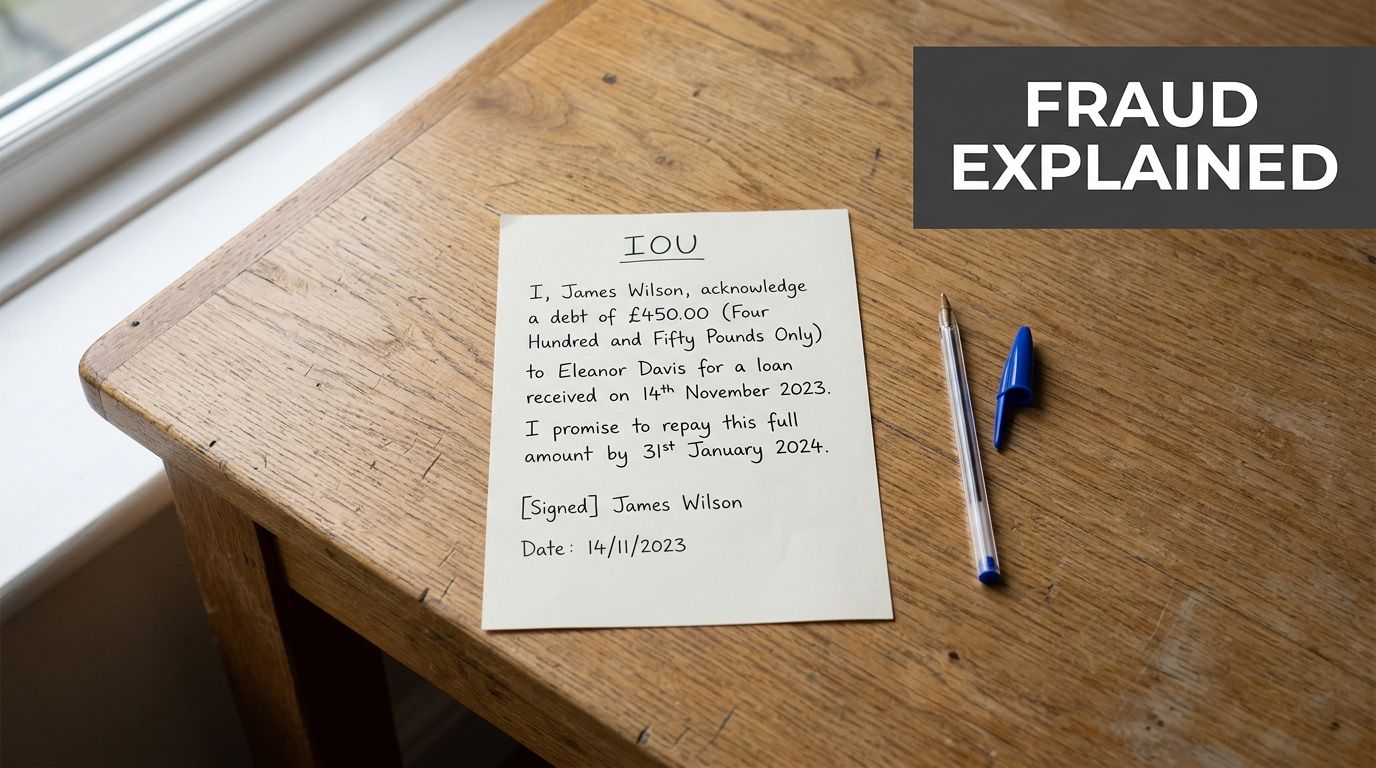
The note is often just the wrapper
What many investors aren't told is that a promissory note may be treated as a security, which means securities laws can apply even if the seller insists “this is just a private loan.” That matters because securities regulation exists to force disclosure, licensing, and accountability.
The SEC has warned that fraudsters across the country have used promissory notes to defraud investors out of “hundreds of millions of dollars,” and it explains that notes with terms of nine months or less may not require federal or state registration, creating a loophole scammers exploit to market high-yield products with less scrutiny in the SEC's investor warning on promissory notes.
That short-term exemption is one of the most misunderstood features of these cases. Investors often hear “exempt” and assume it means safe or approved. It doesn't. In practice, the lack of registration can make it harder for investors to verify the issuer's finances, debts, collateral, and ability to repay.
Why short-term notes create legal risk
A short maturity can sound reassuring. It suggests quick repayment and limited exposure. But in many promissory note fraud matters, short duration is part of the sales strategy. The seller uses it to make the product seem simple and temporary, while also avoiding the level of disclosure investors would expect in a registered offering.
That becomes even more dangerous when a trusted professional presents the note as a routine income product rather than an unregistered security. Investors dealing with losses tied to note offerings sometimes also need to look at similar patterns in other private or opaque investments, including recovery issues involving private promissory note offerings.
A promissory note can be real on paper and still be fraudulent in substance.
That is the central point. The fraud usually lies in the misrepresentation of safety, yield, use of proceeds, registration status, or the seller's authority to offer the investment.
Common Promissory Note Fraud Schemes
Promissory note fraud rarely looks the same from case to case. What repeats is the method. Someone creates trust, limits scrutiny, and keeps investors focused on the promised payment instead of the actual risk.

The interest payments that buy time
A common scheme starts with punctual interest checks. For a while, everything appears to work. Investors see money coming in and conclude the issuer is profitable and the note is performing as promised.
In many fraud matters, those early payments prove very little. The money may be coming from new investor funds rather than business revenue. That matters because the payments are serving a sales purpose. They calm existing investors, attract additional money, and delay complaints.
Once fundraising slows, the explanation usually changes. Investors hear about refinancing delays, temporary cash flow issues, bank problems, or a deal that is about to close. Then the missed payment arrives. After that, calls and emails become harder to return.
The business story that covers a weak or nonexistent operation
Another pattern relies on a business pitch that sounds plausible but is difficult for an investor to verify. The note is tied to real estate, bridge lending, oil and gas, receivables, equipment finance, or another niche operation presented as complex and profitable.
The legal issue is usually the gap between the story and the facts. I often see the same categories of misrepresentation in these cases: the issuer's financial condition was worse than disclosed, the proceeds went somewhere else, collateral was overstated or missing, or the promised return had no reasonable basis. A promissory note can be backed by a real company and still be sold through material lies.
State regulators have warned about this pattern for years. NASAA issued an alert describing elderly investors who were allegedly bilked out of substantial sums through fraudulent promissory notes. The alert emphasized that the fraud turned on deception about yield, safety, and legitimacy, not on any complicated financial structure.
The licensed professional exploiting trust and regulatory gray areas
The cases that cause the most anger often involve a licensed professional, especially an insurance agent or financial professional who uses an existing client relationship to sell a note as a conservative income product.
Investors get hurt by a dangerous assumption. They assume the professional's license, office, and routine paperwork mean the product was vetted. Often it was not. In some matters, the note was sold away from the professional's firm. In others, the seller used the short-term nature of the note, including the nine-month exemption investors hear about, to make the product sound ordinary and outside securities scrutiny.
That loophole does not erase liability. It often sharpens the issues. The recovery case may turn on what the professional told the client, whether the firm knew or should have known about the outside activity, what supervision was required, and whether emails, account records, commission trails, or marketing materials tie the firm to the sale. Those are not abstract points. They are the kinds of facts that drive FINRA arbitration claims against the firm, not just the individual seller.
Fraud often comes from a familiar professional who presented the note as routine, safe, and suitable for retirement money.
Investors should also consider whether payment instructions or account changes were manipulated during the transaction. Email compromise sometimes overlaps with investment fraud, especially where wiring details suddenly changed or messages arrived at suspicious times. In that situation, GoSafe's guide to BEC can help investors spot whether a parallel communications fraud was part of the loss.
Recognizing the Red Flags of a Scam
Promissory note fraud rarely announces itself at the start. The investor usually hears a polished explanation, sees a familiar professional, and gets a promise of steady income with little apparent risk. By the time payments slow down or stop, the paper trail is harder to assemble and the seller has an answer for every delay.
The better approach is to evaluate the offer before money leaves your account. In these cases, one red flag may be explainable. Several at once usually point to a sale that was misleading, unsuitable, or both.
The sales pitch red flags
Start with what the seller said and what the documents did not say.
- Guaranteed return claims: Promissory notes are debt investments. They carry repayment risk. If the salesperson described the note as guaranteed, risk-free, or protected from loss, treat that as a serious warning sign.
- High yield with no credible risk explanation: As noted earlier, regulators have long warned investors about short-term notes promising unusually high returns compared with ordinary low-risk products. If the yield sounds far better than bank or Treasury alternatives, ask what specific risk justifies it, and demand documents that support that answer.
- Pressure to act quickly: A legitimate investment can withstand review. A fraudulent one often depends on urgency, limited-time language, or claims that paperwork can be handled later.
- Retirement money targeting: Extra caution is warranted when the pitch is tied to IRA rollovers, retirement income, or preservation of principal. Fraud sellers know retirement funds are often concentrated, conservative, and emotionally important.
The seller red flags
Who sold the note matters. In many promissory note cases, the problem is not only an obvious scammer. It is a licensed professional who used client trust to place an investment the client did not understand and the firm may later try to disown.
Connecticut regulators specifically warn investors to be cautious when promissory notes are sold by unlicensed individuals, including insurance agents, because a professional title does not itself authorize the sale of securities. That point matters in recovery cases. Insurance agents and other financial professionals sometimes rely on the note's short-term label or a claimed exemption to make the transaction sound routine, private, or outside ordinary securities rules. Investors should hear that for what it is. A sales explanation, not a defense.
If the seller avoided clear answers about securities licensing, routed the transaction away from your regular brokerage account, used personal email, or said the firm was not involved, those facts deserve immediate attention. They can also become evidence in a later FINRA case against the firm, especially if the firm's name, office, email system, marketing materials, or customer relationship were used to build trust. Similar warning signs often appear in matters involving misstatements and omissions in financial records and disclosures, where the investor was denied the information needed to evaluate repayment risk.
Promissory Note Fraud Red Flags Checklist
| Red Flag Category | Specific Warning Sign |
|---|---|
| Seller status | The note was sold by an insurance agent or planner who did not provide securities licensing information |
| Return claims | The investment was described as guaranteed, insured, or risk-free |
| Time pressure | You were told to decide quickly or miss the opportunity |
| Transparency | You did not receive clear financial information showing the issuer's ability to repay |
| Registration | The seller brushed off questions about whether the note was registered or exempt |
| Oversight | The transaction took place outside your usual brokerage statements or account portal |
| Use of proceeds | The explanation for how your money would be used was vague, inconsistent, or changed over time |
| Payment pattern | Early interest payments arrived, then delays, excuses, or requests to roll over the note followed |
If you cannot independently verify who is borrowing your money, why they need it, and how they plan to repay it, you are not making an informed investment decision. You are relying on the seller's credibility.
Your Legal Options for Recovering Losses
Once an investor suspects promissory note fraud, the next question is practical. What forum gives the best chance of recovery against the right defendants?
FINRA arbitration
If the seller was a registered broker or affiliated with a brokerage firm, FINRA arbitration is often the primary route. It is a private dispute forum used for many securities cases. The key advantage is that it is built for broker-investor disputes and can allow claims based on unsuitable recommendations, misrepresentations, selling away, failure to supervise, and related misconduct.
This option is especially important when the note was sold by someone whose firm may claim the transaction was “outside” approved activities. That defense does not end the analysis. Firms can still face exposure depending on notice, supervision, outside business activity, and how the relationship was presented to the customer. Investors exploring this route often benefit from counsel focused on financial fraud claims against securities industry defendants.
State or federal court
Court litigation may be more appropriate when the seller was not a FINRA member, when the transaction involved non-broker defendants, or when there are contract, fraud, negligence, fiduciary-duty, or state securities law claims better suited to court.
The trade-off is practical. Court can offer broader procedural tools in some situations, but it may also involve a slower timeline, more motion practice, and more complicated collection issues even after a favorable result.
Regulatory complaints and parallel actions
Investors can also report the matter to state securities regulators, the SEC, or other authorities. Those reports can be valuable. Regulators may investigate, issue orders, or pursue enforcement.
But investors should keep expectations realistic. A government action does not automatically return money to individual victims, and it does not replace a private recovery claim. The strongest approach is often parallel. Preserve evidence, evaluate private claims promptly, and make regulatory reports where appropriate.
A simple way to compare the options is this:
- FINRA arbitration: Often best when a broker or brokerage firm is involved.
- Court litigation: Often useful when the defendants fall outside FINRA or the claims require broader judicial remedies.
- Regulatory reporting: Important for oversight and pressure, but not a substitute for your own recovery strategy.
The right path depends on the seller's status, the documents you signed, the account relationship, and whether a firm can be tied to the misconduct.
Navigating the Recovery Process with an Attorney
Most investors wait too long because they think they need the whole case figured out before talking to counsel. They don't. The first job is to preserve facts while they're still available.
Start with documents, not conclusions
The most useful evidence is often sitting in ordinary files and devices:
- The note itself: Signed copies, renewals, amendments, and payment schedules.
- Sales materials: Emails, text messages, brochures, slide decks, handwritten notes from meetings.
- Account records: Wire confirmations, canceled checks, account statements, and records showing where the money came from.
- Communications after problems began: Delay explanations, repayment promises, restructures, and requests not to contact others.
What matters is not just what the seller promised. What matters is what can be proven. Lawyers evaluate these cases by building a chronology, identifying all potentially liable parties, and comparing the pitch against the legal duties that applied at the time.
The case theory matters
In note fraud matters involving professionals, the strongest claim is not always “he lied to me.” The more effective theory may be that the note was an unregistered security, the seller lacked authority to sell it, the recommendation was unsuitable, or the firm failed to supervise obvious red flags.
That is why cases involving insurance agents and financial professionals can be stronger than investors initially assume. The legal issue isn't limited to whether the issuer defaulted. The issue may be whether the investment should never have been recommended or sold in that manner at all.
Case-building insight: In arbitration and litigation, the paper trail around the sale often matters more than the note's wording by itself.
What the process usually looks like
A recovery matter usually unfolds in stages:
- Initial review: Counsel reviews the note, seller identity, account relationship, and available records.
- Forum analysis: The claim is assessed for FINRA arbitration, court, or both depending on the parties.
- Claim drafting: The pleading sets out the facts, legal theories, and requested damages.
- Discovery and testimony: The parties exchange documents and take testimony where permitted.
- Resolution path: The case may settle, proceed to hearing, or move through court adjudication.
If testimony becomes part of the process, investors often feel less anxious when they understand the mechanics ahead of time. A plain-English overview of essential deposition guidance can help demystify what questioning typically looks like and how preparation matters.
Choosing counsel and moving quickly
Time matters in these cases. Documents disappear. Memories fade. Firms change personnel. Sellers become harder to locate. Delay can also create statute-of-limitations problems depending on the claims and forum.
Investors looking at representation options should ask direct questions. Does the attorney handle securities matters regularly? Do they pursue FINRA arbitration when appropriate? Will they investigate firm liability, not just the individual seller? What documents should be preserved immediately?
One option is Kons Law, a securities and investment litigation firm that handles investor loss claims through FINRA arbitration and court actions. The firm offers free consultations, and these matters are typically evaluated based on the seller's role, the available evidence, and whether recoverable defendants exist beyond the note issuer.
The right time to investigate is not after every excuse has been exhausted. It is when the story starts to stop making sense.
Take Action to Protect Your Rights and Recover Your Funds
Promissory note fraud often succeeds because it looks ordinary. The document is familiar. The promises are framed as conservative. The seller may be someone you already know. That combination can make investors second-guess themselves long after the warning signs have appeared.
Don't let embarrassment or uncertainty keep you in place. Investors who act promptly usually put themselves in a stronger position to preserve evidence, identify the correct defendants, and evaluate whether arbitration or litigation is available. Waiting rarely improves the facts.
If a promissory note was sold to you as safe, guaranteed, insured, or appropriate for retirement money, and the payments stopped or the explanations don't hold together, treat that as a legal issue, not just a disappointing investment result. The facts may support claims under securities law even if the seller insists the transaction was “private” or “outside the firm.”
If you would like a free consultation to discuss the investment loss recovery process in more detail, call Kons Law Firm at (860) 920-5181 for a FREE, NO OBLIGATION consultation.
If you believe you were harmed by promissory note fraud, Kons Law can help you evaluate potential recovery options, including FINRA arbitration and court claims against brokers, advisors, firms, and other responsible parties.
