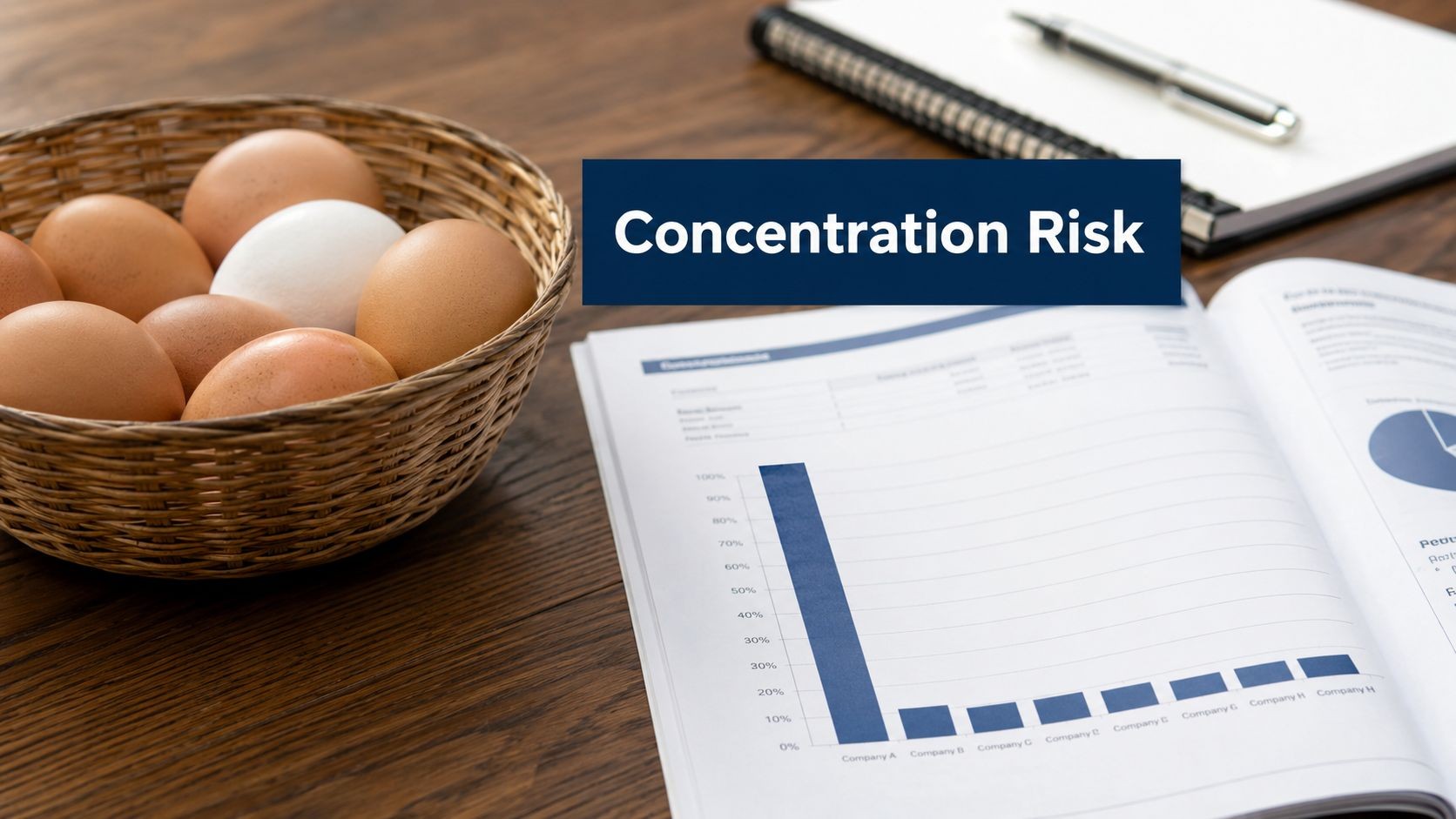
You may be looking at an account statement right now and wondering how a lifetime of savings became so fragile. The market may have gone down, but that isn't always the full story. In many investor loss cases, the deeper problem is that the account was built around one stock, one sector, one product type, or a cluster of investments that all rise and fall together.
That is portfolio concentration risk, and it often hides in plain sight until the damage is already done.
I've seen the same pattern over and over. A retiree trusts an advisor. The advisor says the position is strong, temporary, misunderstood, or bound to recover. The account keeps leaning harder into the same idea. Then one earnings miss, one liquidity problem, one regulatory issue, or one sector drop hits, and the losses are brutal. At that point, the investor isn't just dealing with poor performance. The investor may be dealing with unsuitable recommendations, failure to diversify, or outright broker negligence.
If that sounds familiar, the first thing to do is slow down and get clear on what your statements show. If you need help reading the account paperwork, start with this guide to what a broker statement is. The statements usually tell the story long before the broker does.
The Hidden Danger in Your Investment Account
A concentrated account rarely announces itself as a problem. It usually arrives dressed up as confidence.
The broker says the stock is a winner. The sector is "where the future is." The income product is "stable." The private placement is "uncorrelated." The client hears expertise. What may be happening is dependence. Too much of the account starts depending on a narrow set of outcomes.
That becomes dangerous fast. If your retirement account holds a dominant position in one technology company, and that company drops hard, the rest of the account often can't cushion the blow. The same is true when an advisor spreads money across several funds or products that look different on paper but are all tied to the same economic driver.
A portfolio can look diversified on a statement and still be dangerously concentrated in reality.
I've spoken with investors who owned a large single stock position they never meant to build. I've also spoken with investors whose accounts held multiple products, only to learn those products were all exposed to the same sector, the same credit conditions, or the same liquidity risk. In both situations, the investor thought they had a plan. What they had was a vulnerability.
Loss cases involving concentration are frequently framed incorrectly. Firms like to say, "The market moved." That answer is incomplete. Fundamentally, the legal question is whether the account was suitable for the investor in the first place, whether diversification was ignored, and whether the broker kept allowing risk to accumulate when a competent professional should have intervened.
What Exactly Is Portfolio Concentration Risk
Portfolio concentration risk is the danger that too much of your financial future depends on one investment, one issuer, one sector, one country, or one cluster of holdings that move together.
The old phrase about putting all your eggs in one basket is still the cleanest explanation. It remains accurate because concentration isn't just about owning one large position. It is also about owning several positions that react the same way under stress.

The practical thresholds that should get your attention
A commonly used working threshold is that a balanced portfolio typically keeps any single stock or asset at about 5% to 10%, while a concentrated portfolio begins at 20% or more in one asset or a group of correlated assets, and a highly concentrated portfolio is one where a single asset or correlated set reaches 50% or more of the mix, according to Britannica's explanation of concentration risk management.
Those numbers matter because they give investors a simple way to test whether an account has drifted from diversification into dependence. Once one idea starts controlling the outcome of the whole account, risk stops being theoretical. It becomes structural.
If you're trying to evaluate whether recommendations were appropriate for your situation, this discussion of FINRA suitability rules is a useful companion. Suitability and concentration are closely linked.
Concentration is bigger than one stock
Investors often think concentration only means a giant position in a single company. That's too narrow.
Concentration can show up as:
- Sector concentration when multiple holdings all depend on the same industry.
- Product concentration when large portions of the account are pushed into one product type, such as illiquid alternatives.
- Correlation concentration when different names or funds move together because they share the same underlying risk.
- Geographic concentration when political, currency, or regional economic shocks can hit a large part of the account at once.
Practical rule: If one adverse event can explain most of your losses, your portfolio probably wasn't diversified enough.
Regulators and risk professionals treat this as measurable
This isn't just a common-sense concern. Risk professionals use concentration tools such as the Herfindahl-Hirschman Index, Gini coefficient, Hannah-Kay index, Hall-Tideman index, and Theil entropy index, and they also use stress testing and scenario analysis to estimate how much value can be lost when holdings move together, as described by MathWorks on concentration risk methods.
That matters for one reason. If professionals can identify concentration with disciplined methods, brokers don't get to shrug and call it unforeseeable after the account collapses. A competent advisor should know when risk is clustering. A competent firm should supervise for it.
How Harmful Concentration Occurs in Real Portfolios
Most concentrated portfolios aren't created by accident alone. They emerge through neglect, sales pressure, or advice that never should have been given.

The employee who trusted company stock too long
One common scenario involves a professional who accumulates stock in the company where they work. The shares come from compensation, options, grants, or retirement plan elections. At first, it feels rational. The employee knows the business and wants upside.
Then the account becomes tied to the same source that pays the salary. If the company stumbles, the investor can suffer a double hit. Job instability and investment losses at the same time. A careful advisor should recognize that risk immediately and discuss ways to reduce it over time. Too often, that conversation never happens.
The investor steered into one product again and again
Another version is less obvious. The account statement lists multiple positions, but they are variations of the same underlying bet. I've seen investors placed heavily into illiquid income products, private offerings, or alternative investments that were sold as diversifiers but behaved like a single concentrated strategy under pressure.
That issue comes up often with products such as non-traded real estate investment trusts. They may be sold as income-oriented and stable, but if an advisor stacks too many similar illiquid holdings into one account, the investor can end up trapped with limited exit options when conditions turn.
The client pushed to chase a hot theme
Concentration also grows when an advisor builds around a trend. Technology. Energy. Artificial intelligence. Crypto-related equities. Regional banking. Pick the theme. The sales pitch changes, but the weakness doesn't.
Several holdings may look different by ticker symbol, yet all of them may depend on the same story continuing. When that story breaks, the portfolio drops in a cluster. The investor then learns a hard truth. Owning several names isn't the same as owning true diversification.
Here are the patterns I watch for most closely:
- Repeat recommendations in the same lane: Different securities, same economic exposure.
- High conviction language from the advisor: "You need to be invested here" is often a warning sign, not reassurance.
- Little discussion of downside planning: Brokers who focus only on upside usually aren't managing risk.
- Illiquid products treated as core holdings: That's especially troubling for retirees or investors who may need access to cash.
When an account is built around one narrative, it can fail all at once.
The legal significance is straightforward. If the concentration came from unsuitable recommendations, poor supervision, or failure to diversify in light of the client's needs, the losses may be recoverable. The fact that the market moved doesn't excuse a broker who loaded the gun.
Was Your Broker at Fault Signs of Negligence
Not every concentrated loss supports a claim. Some investors knowingly choose a focused strategy and fully understand the risk. But many do not. Many were told they were diversified when they were not. Many were placed into portfolios that didn't match their age, liquidity needs, stated risk tolerance, or investment objectives.
That is where a bad investment outcome becomes a legal issue.
What a broker's duty looks like in practice
A broker can't recommend whatever pays well or whatever fits a sales narrative. Recommendations must fit the client. That means the advisor should understand the client's financial condition, investment goals, need for liquidity, risk tolerance, time horizon, and existing holdings. If the account becomes overly dependent on one investment or one cluster of correlated investments, that raises a serious suitability concern.
FINRA warns that a concentrated portfolio becomes more vulnerable when a small number of positions dominate returns or when correlated holdings move in the same direction, and it also warns that diversification has to occur across and within asset classes. FINRA further notes that even mutual funds and ETFs can still leave investors concentrated if they overlap in the same stocks, sectors, or regions, and that illiquid holdings can amplify the problem because they are harder to exit efficiently, as explained in FINRA's investor guidance on concentration risk.
That is not a minor point. It means a broker can't defend a bad account structure by saying, "You owned several funds." If those funds were loaded with the same exposures, the concentration problem remains.
The red flags that often support a claim
Some warning signs appear before the losses. Others become obvious only after the account falls apart. Both matter.
| Red Flag | What It Looks Like |
|---|---|
| Account built around one position | A single stock or issuer dominates the statements and drives overall performance |
| False appearance of diversification | Multiple funds or products hold overlapping names, sectors, or regions |
| Illiquid holdings stacked together | The account is hard to unwind without delay or pricing problems |
| Risk tolerance ignored | A retiree or conservative investor is placed into a narrow, volatile strategy |
| Advisor used sales language instead of analysis | The recommendation leaned on confidence, familiarity, or yield without serious discussion of downside |
| No rebalancing or reduction plan | The position kept growing and the broker did nothing meaningful to manage exposure |
| Client communications don't match the account | Notes, emails, or forms describe conservative goals, but the holdings tell a different story |
A pattern of concentration often shows up more clearly when someone outside the firm reconstructs the account activity. In some complex cases, investors and counsel use specialists similar to those who handle forensic accounting for Jacksonville SMBs because tracing how risk accumulated over time can be just as important as proving the final loss.
Questions that cut through the noise
Ask these questions bluntly:
- Did the broker know your objectives? If your forms say income, preservation, or moderate risk, a highly concentrated strategy is hard to justify.
- Were you warned in concrete terms? General boilerplate buried in account documents isn't the same as a meaningful discussion.
- Did the broker monitor overlap? Owning different wrappers around the same risk is still concentration.
- Could you exit when trouble started? If not, the concentration may have been made worse by liquidity problems.
The strongest cases often involve a mismatch between what the client asked for and what the broker actually built.
Negligence cases are rarely about one sentence or one trade. They are about the full record. The account documents, holdings, emails, and trade history usually reveal whether the concentration was a reasoned client choice or the product of bad advice.
Protecting Yourself and Gathering Evidence
If you suspect your account was dangerously concentrated, stop relying on memory. Start building a file.
A recoverable claim often turns on documents that show when the concentration developed, what the advisor knew, what the client requested, and whether warnings were real or just generic disclosures. You don't need a perfect file on day one, but you do need an organized one.
What to collect right away
Start with the records that show the account's evolution over time:
- Monthly and quarterly statements: These show position size, account value, and whether one holding or product type came to dominate.
- Trade confirmations: These help identify when purchases happened and whether the concentration was built gradually or in a short push.
- New account forms and updates: These may show your stated risk tolerance, objectives, liquidity needs, and time horizon.
- Emails, letters, and text messages: Written communications often contain the most revealing promises and reassurances.
- Marketing materials and product presentations: If the investment was sold with a particular narrative, preserve it.
- Your own notes: Write down conversations while they are still fresh. Include who said what, when, and what you understood.
What to review in the account itself
Once you've assembled the file, look for patterns rather than isolated moments.
Review the account with these questions in mind:
Which holdings drove the losses
Was the damage tied to one issuer, one sector, or one product category?
Did multiple positions move together
Different labels don't help if the underlying risk was the same.
Did the concentration grow without discussion
If a position expanded and no one addressed rebalancing, that matters.
Were your needs ignored
A portfolio that may be aggressive for a young speculator may be entirely unsuitable for a retiree.
Save documents before asking the firm too many questions. Once disputes become obvious, accounts and communications often get harder to reconstruct cleanly from memory.
How to protect yourself while the review is underway
There is no single move that fits every investor, and I won't pretend otherwise. But there are sensible steps that usually help:
- Get an independent review: Don't ask the same advisor who created the problem to grade their own work.
- Avoid verbal-only discussions: If you speak with the firm, follow up in writing.
- Don't sign explanations you don't agree with: Investors sometimes get pushed into language that minimizes what happened.
- Preserve electronic records: Download statements, emails, and portal messages rather than assuming they'll remain available.
This stage is about control. The investor who gathers records early is in a far better position than the investor who waits and hopes the firm will explain things truthfully.
Seeking Recovery Your Legal Options
When concentration losses stem from misconduct or negligence, the path to recovery is often through a legal claim against the brokerage firm or advisor. In many investor disputes, that means FINRA arbitration, not a courtroom trial.
FINRA arbitration is a binding dispute process commonly used for claims involving unsuitable recommendations, failure to diversify, misrepresentations, poor supervision, and other forms of broker misconduct. It is usually more efficient than traditional litigation, but don't confuse efficiency with simplicity. These cases still depend on evidence, chronology, product knowledge, and a clear explanation of why the account was unsuitable.
Why concentration matters legally
Concentration is not just an investment preference issue. In banking and credit markets, it has long been treated as a formal regulatory concern. The U.S. Office of the Comptroller of the Currency defines a concentration of credit as direct, indirect, or contingent obligations exceeding 25% of a bank's capital structure, as described by the OCC's discussion of concentrations and portfolio management.
That banking benchmark matters because it reflects a broader legal and risk principle. When exposure becomes too dependent on one economic driver, professionals are expected to recognize and manage the danger. Brokers should be no exception.

What a recovery case usually focuses on
A strong claim often centers on several overlapping issues:
- Unsuitable recommendations
- Failure to diversify
- Misrepresentation or omission of material risk
- Negligent supervision by the firm
- Breach of fiduciary duty, where applicable
In some matters, broader investigative thinking also helps. The same disciplined mindset used to examine how to address corporate fraud can be useful when reconstructing who knew what, when the warning signs appeared, and how the harm developed.
If you're evaluating whether to move forward, it also helps to understand what an experienced broker misconduct attorney examines in an investor loss case. The details matter.
Time matters too. Filing deadlines can affect whether a claim can proceed. Waiting usually doesn't improve the facts, and it rarely improves bargaining power.
If you'd like a free consultation about whether concentration, unsuitable recommendations, or failure to diversify may support an investment loss claim, contact Kons Law. The firm handles investor recovery matters nationwide and can discuss the process in clear terms. You can also call Kons Law at (860) 920-5181 for a FREE, NO OBLIGATION consultation.
