You log into your brokerage account and see a stock you researched carefully sliding day after day. The company hasn't reported bad earnings. There hasn't been a market-wide shock. Management hasn't announced a dilutive financing. Yet the chart keeps bleeding lower, volume looks strange, and every bounce gets sold.
That experience leaves many investors in the same place. Confused, angry, and unsure whether they're looking at ordinary market risk or something far more troubling. In some cases, the answer may involve naked short selling, a practice that is widely discussed, often misunderstood, and difficult for ordinary investors to prove with public data alone.
The hardest part isn't understanding the basic accusation. It's the evidence gap. Investors usually sense that something is wrong long before they can identify records, trading patterns, or settlement failures that might support a claim. That gap matters because suspicion alone won't recover losses. Evidence, timelines, and the right legal theory do.
The Unseen Force Driving Down Your Stock
A pattern I've seen repeatedly in investor complaints goes like this. A shareholder buys into a small or mid-cap company after reading filings, listening to management, and following the business closely. Then the price starts dropping in a way that doesn't match the public story.
The investor checks news releases. Nothing explains the move. They compare peers. The whole sector isn't collapsing. They watch trading activity and start noticing what feels off. Large bursts of selling. Repeated pressure near key levels. Heavy turnover without the kind of new information that usually drives a genuine repricing.
That's where many people first encounter the term naked short selling. They don't come to it through a textbook. They come to it because they're trying to explain a market move that no longer feels organic.
Some of those situations turn out to involve ordinary short selling, liquidity stress, dilution risk, or investor panic. Some involve broker misconduct, unsuitable recommendations, or other forms of market manipulation and abusive trading conduct. And some raise legitimate questions about whether shares were sold into the market without proper borrowing or delivery arrangements.
Investors usually don't start by asking legal questions. They start by asking a simpler one: “Why is this happening when nothing public seems to justify it?”
That question deserves a careful answer. Naked short selling can be harmful because it may create artificial selling pressure through shares that were never properly borrowed and may not be delivered on time. Investors often describe this as the creation of “phantom shares,” because the apparent supply in the market can exceed what should be available for lawful trading.
The problem is that the misconduct, if it exists, is rarely visible in real time. Retail investors see the damage first. The paper trail usually comes later, if it comes at all. That delay is why so many harmed investors feel they're always behind the trade and behind the proof.
Legal Short Selling vs Illegal Naked Shorting
Not every short sale is abusive. In fact, lawful short selling is a recognized market practice. A trader believes a stock is overpriced, borrows shares, sells them, and later tries to buy them back at a lower price to return to the lender. Whether you like short sellers or not, that process is legal when it follows the rules.
A simple way to think about it
Think of lawful short selling as borrowing a book before lending it onward. You may not own the book, but you've secured the right to deliver it. The market can function around that transaction because the shares are expected to arrive within the settlement process.
Naked short selling is different. The seller acts as if the shares are available without borrowing them, owning them, or securing a borrowing arrangement. In the United States, the SEC defines naked short selling as the illegal practice of selling shares that the seller has not borrowed, does not own, and has not secured a borrowing arrangement for, and explains that Rule 10b-21 was proposed to prohibit deception about the ability to deliver by settlement date, as described in the SEC's Regulation SHO investor guidance.
Why the distinction matters
The legal issue isn't just bearishness. It's settlement integrity. When a lawful short seller has properly located or borrowed shares, the trade fits within the market's delivery framework. When a naked short seller doesn't, the transaction can inject supply that shouldn't be there, adding pressure to the stock and potentially distorting price discovery.
Here is the difference at a glance.
Lawful vs. Naked Short Selling at a Glance
| Feature | Lawful Short Selling | Naked Short Selling (Illegal) |
|---|---|---|
| Share access before sale | Shares are borrowed or properly located before the sale | Shares are sold without borrowing, owning, or securing a borrowing arrangement |
| Delivery expectation | Seller has a documented basis to believe delivery can occur in settlement | Delivery risk is built into the trade from the outset |
| Regulatory posture | Permitted when rules are followed | Illegal when it involves selling shares that were not borrowed or properly arranged |
| Market effect | Can contribute to price discovery and hedging | Can create artificial selling pressure through phantom supply |
| Core problem | Market participants may disagree with the trade thesis | The trade may undermine settlement and market fairness |
Where investors get misled
Retail investors often hear two oversimplified claims. One is that all short selling is predatory. The other is that any unexplained decline must be naked shorting. Both are wrong.
What matters is the process behind the trade, the settlement outcome, and whether the broker and seller followed the rules. That's why serious analysis usually starts with the plumbing of the transaction, not with social media outrage or message-board certainty. The SEC and FINRA framework is technical, and investors who suspect manipulation are better served by understanding the actual oversight role of the SEC and FINRA than by relying on slogans.
Practical rule: A falling stock price alone doesn't prove naked short selling. A broken borrowing and delivery process is what turns a legal short into a potentially unlawful one.
The Mechanics of Fails to Deliver and Regulation SHO

To understand how naked short selling can happen, you have to look at settlement. A trade doesn't end when you click buy or sell. The market still has to complete delivery through the standard settlement cycle.
How the settlement cycle creates a paper trail
In ordinary terms, a seller agrees to deliver shares and the buyer agrees to pay. If the seller or the seller's broker doesn't produce the shares on time, the result can be a fail to deliver, often shortened to FTD.
An FTD is not automatic proof of fraud. Administrative mistakes, processing problems, and legitimate market mechanics can produce delivery issues. But when FTDs are persistent, especially in hard-to-borrow securities with heavy short activity, they become one of the most important warning signs investigators examine.
Under SEC staff guidance, Regulation SHO Rule 203(b)(1) requires short sellers to execute a locate before effecting a short sale, meaning they must have reasonable grounds to believe the security can be borrowed and delivered within the standard settlement period, and that locate must be documented before the trade occurs, as described in the SEC's trading and markets FAQ on Rule 203(b)(1).
That locate requirement is the front-end control. It is supposed to prevent short sellers from selling shares they can't realistically deliver.
Where Regulation SHO helps and where it doesn't
Regulation SHO is the SEC's main regulatory framework for this area. It was designed to reduce abusive settlement failures and force close-outs where problems persist. The system works best when brokers document locates carefully, monitor settlement failures, and enforce close-out obligations without delay.
For threshold securities, the rules become more explicit. Under Regulation SHO Rule 203(b)(3), broker-dealers must close out any failure to deliver that has persisted for exactly 13 consecutive settlement days, and they may not continue short selling in that security without pre-borrowing the share or entering a bona fide borrowing arrangement, according to the NYSE's Regulation SHO resource guide.
That sounds straightforward. In practice, investors run into two problems.
- First problem: public visibility is delayed. By the time an investor sees a threshold designation or reported settlement issue, losses may already be substantial.
- Second problem: the legal analysis is technical. You need to separate routine settlement noise from persistent failures that suggest something more serious.
- Third problem: different actors may bear different responsibilities. The short seller, introducing broker, clearing broker, or market maker may all have distinct roles.
If you want a deeper practical explanation of the settlement issue itself, this overview of fails to deliver in securities trading is a useful place to start.
A strong case usually doesn't come from one bad trading day. It comes from patterns. Repeated failures, persistent anomalies, and records that line up over time.
Why this matters in a legal claim
From a litigation standpoint, Regulation SHO gives structure to the inquiry. It helps frame the questions. Was there a proper locate? Did delivery occur? Were failures temporary or persistent? Did the broker follow close-out rules when the security met threshold conditions?
Those questions don't answer themselves. But they often determine whether a complaint sounds speculative or grounded.
Warning Signs Every Investor Should Watch For
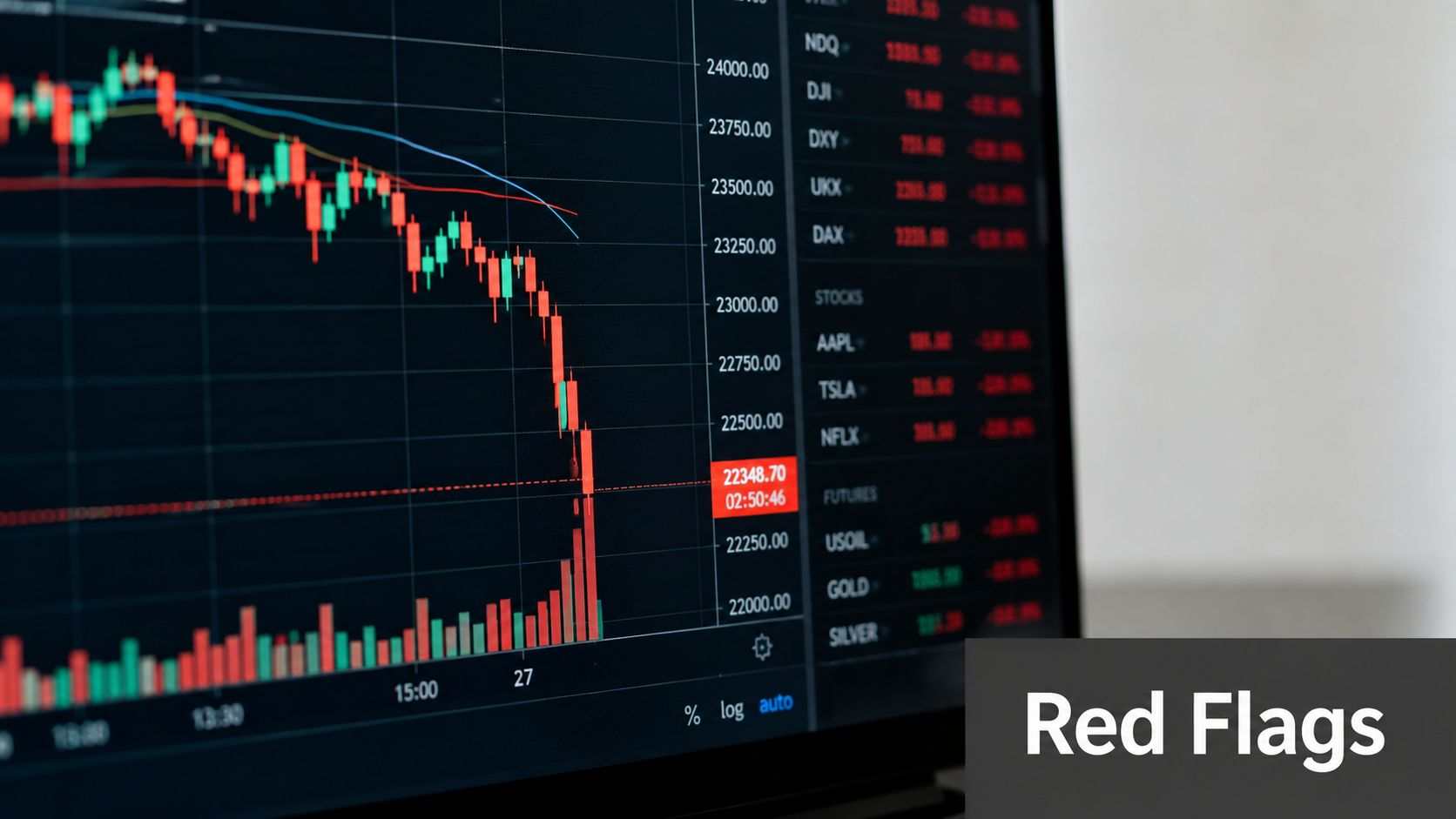
Most investors won't have access to the full internal records needed to prove naked short selling. That's the core evidence gap. Still, there are warning signs that can justify a closer look.
What can actually be seen from the outside
The most important point is also the most frustrating. The only definitive, publicly visible sign of naked short selling is when short interest exceeds 100% of a company's float, a metric that many retail investors misread and that is hard to pair with timely FTD data, as stated in this discussion of over-100% short interest and the public detection gap.
That does not mean every stock with extreme short interest is a naked shorting case. It means that when public indicators become unusually stretched, investors should stop treating the move as routine.
A practical checklist of red flags
- Threshold security status. If a stock appears on a Regulation SHO threshold list, it suggests significant and persistent settlement failures that deserve attention.
- Persistent fails to deliver. Isolated failures happen. Repeated or stubborn ones are more concerning, especially when they coincide with heavy short pressure.
- Trading volume that feels detached from the public float. Investors often notice volume patterns that seem inconsistent with ordinary ownership turnover. That isn't proof, but it can be a clue worth preserving.
- Price weakness without matching public developments. A stock can decline for many legitimate reasons, but a prolonged drop in the absence of company-specific or sector-wide catalysts often drives investors to ask the right questions.
- Broker explanations that don't hold together. If your broker can't clearly explain stock loan issues, trade execution, or unusual account treatment, document that immediately.
What these signs do and do not prove
These are indicators, not courtroom-ready conclusions. Many online communities blur that line. They gather screenshots, compare threshold lists, and track unusual activity with real dedication. That crowdsourced attention can be helpful, but it can also turn assumptions into certainty too quickly.
Public warning signs help you identify a possible issue. They do not replace subpoenaed records, clearing data, or expert review.
A practical investor should treat these signs as a signal to preserve evidence. Save account statements. Export trade confirms. Capture watchlist history if your platform allows it. Keep the company's public filings and press releases for the same period. Build a timeline while events are still fresh.
That preparation matters because by the time a lawyer or forensic analyst reviews the case, your own records may be the only immediate source showing what you saw, when you saw it, and how the losses unfolded.
Pathways to Recovery for Harmed Investors
Investors often make the same mistake after a suspicious collapse. They spend months trying to prove the entire market structure problem themselves before speaking with counsel. That usually delays the one thing that matters most, which is preserving claims while records and deadlines are still workable.
Start with your own file, not with a theory
Build a case file before memories fade. That file should include account statements, trade confirmations, broker messages, notes from calls, screenshots of unusual price and volume activity, and any public company disclosures that help frame the timeline. Don't worry if you can't prove naked short selling from those materials alone. Most investors can't.
What you can do is preserve facts that may support a later investigation.
- Collect transaction records. Download confirms, monthly statements, and realized loss summaries.
- Preserve communications. Save emails, chat logs, and notes from phone calls with your advisor or brokerage firm.
- Create a chronology. List when you bought, what you were told, when the stock began acting abnormally, and when losses accelerated.
- Document market context. Keep copies of company announcements and other public materials showing whether the decline matched known developments.
Understand the enforcement gap
One reason these cases are hard is that many investors assume the rules should trigger an immediate correction. They don't always. As one congressional research summary explains, many discussions oversimplify Regulation SHO as a total ban, when brokers can legally tolerate fails to deliver for up to 13 trading days before forced closure in threshold securities, creating a window that can be exploited by bad actors, as noted in this CRS discussion of the 13-day close-out framework.
That timing issue matters because a harmed investor may experience prolonged downward pressure before the formal close-out regime kicks in.
Choosing between arbitration and court
Many securities disputes involving brokerage firms proceed through FINRA arbitration rather than a traditional lawsuit. Other cases may belong in court, especially where the facts, parties, or remedies point in that direction. The right venue depends on the account agreement, the defendant, the legal theories available, and the evidence that can realistically be developed.
A useful way to think about it is this:
| Path | Often works well when | Main trade-off |
|---|---|---|
| FINRA arbitration | The dispute centers on broker misconduct, supervision failures, account handling, or unsuitable conduct tied to investment losses | Discovery can be narrower than in court |
| Court litigation | The case involves broader fraud theories, multiple non-broker defendants, or relief beyond a customer arbitration claim | Procedure can be slower and more expensive |
If your potential claim may belong in arbitration, it helps to understand the mechanics of filing for FINRA arbitration against a brokerage firm.
What works and what doesn't
What works is a disciplined claim grounded in records, timelines, and the right defendant. What usually doesn't work is filing a complaint based only on internet theories about phantom shares, bots, or conspiracies without matching evidence.
Overstock.com and similar disputes became famous because they captured investor frustration with suspected abusive shorting and settlement failures. But those stories also show a harder truth. Market misconduct claims live or die on documentation, expert analysis, and procedural strategy, not on how obvious the unfairness feels.
Notable Cases and the Fight for Fair Markets
Investors who suspect naked short selling often feel isolated. They shouldn't. This has been a recurring market controversy for years, and it tends to resurface whenever confidence in settlement fairness breaks down.
The crisis-era backdrop
During the financial crisis, regulators responded aggressively to fears that abusive short selling could intensify panic. In September 2008, amid the collapse of Lehman Brothers and growing instability, the SEC expanded a temporary short-sale ban to all U.S. listed companies, covering more than 700 financial firms, and then adopted an interim final rule on October 1, 2008 that effectively banned abusive naked short selling across all stocks, as summarized in this historical account of the 2008 SEC actions.
That response mattered for two reasons. First, it confirmed that regulators viewed abusive naked shorting as a serious market integrity issue. Second, it showed that public concern about settlement-related selling pressure wasn't coming only from retail investors or fringe commentators.
Why these disputes keep returning
High-profile fights like the long-running controversy around Overstock.com gave a human face to the issue. Shareholders believed something beyond ordinary bearish trading was depressing the stock. More recently, so-called meme stock volatility reignited public interest in share lending, settlement failures, and the relationship between visible short interest and less visible market plumbing.
The exact facts differ from case to case. The common thread is the same. When investors believe the market is trading more claims to shares than should lawfully exist in circulation, trust erodes fast.
Fair markets depend on more than price movement. They depend on confidence that actual shares, actual borrowing arrangements, and actual delivery obligations are being respected.
The practical lesson for investors
These examples don't mean every volatile stock is being manipulated. They do mean the concern is legitimate enough that regulators, issuers, shareholders, and litigants have fought over it for years.
For harmed investors, the lesson is not to chase every online accusation. It is to recognize that unusual selling pressure, settlement concerns, and broker-side irregularities can raise real legal questions. Those questions deserve evidence-based review, especially when the losses are substantial and the timeline suggests more than ordinary market risk.
How Kons Law Pursues Justice for Victimized Investors
Naked short selling claims sit at the intersection of trading mechanics, broker obligations, and proof problems. That's why investors often struggle to evaluate whether they've experienced market misconduct, ordinary volatility, or a separate form of brokerage wrongdoing that happened to surface during a declining stock.
A firm handling these matters has to look beyond the slogan. It has to examine account records, execution details, supervision issues, communications, and potential arbitration or court strategies. In many situations, the strongest recovery path isn't a direct naked short selling claim by itself. It may be a claim tied to broker misconduct, unsuitable recommendations, misrepresentations, concentration risk, or a failure to respond appropriately when obvious warning signs emerged.
What a serious review should focus on
A useful legal review usually asks practical questions.
- Was the investor steered into an unsuitable or overly concentrated position?
- Did the broker or advisor misstate the risks of the security?
- Were there account handling failures once trading irregularities became apparent?
- Is the best path a customer arbitration claim, a court action, or coordination with a broader litigation effort?
Those are recoverable issues in the right case, even when the market manipulation theory itself is technically complex.
Communication matters too
Investors also underestimate how much public company communication can affect the timeline around suspected manipulation. If an issuer fails to respond clearly to unusual trading conditions, confusion grows and the record gets muddier. For companies and investor relations teams trying to communicate responsibly during periods of abnormal trading, guidance on writing effective IR press releases can help create a cleaner public record without inflaming speculation.
The strongest investor recovery matters are built from documents, timing, and a clear theory of who breached what duty.
Kons Law represents investors nationwide in securities and investment disputes through FINRA arbitration and court actions. The firm focuses on recovering money for investors harmed by misconduct, negligence, and fraud, and clients work directly with an experienced securities attorney through the process. That matters in cases involving naked short selling concerns because the issue rarely appears in a neat, self-contained package. It usually overlaps with other conduct that has to be investigated carefully and framed correctly from the start.
If you would like a free consultation to discuss the investment loss recovery process in more detail, call Kons Law Firm at (860) 920-5181 for a FREE, NO OBLIGATION consultation.
If you believe suspicious trading, broker misconduct, or market manipulation contributed to your losses, contact Kons Law to discuss your options. A prompt review can help preserve evidence, identify the right recovery path, and determine whether FINRA arbitration or litigation makes sense for your case.
