
Your December statement shows trades you never approved. You called the broker, got an explanation that sounded reasonable on the phone, and hung up still uneasy. A week later you can't remember exactly what was said, and nothing about it is in writing.
Here's the split that confuses almost everyone in that position. Complaining to a regulator and recovering your money are two different processes running on two different clocks. One gathers information and may lead to an investigation. The other has a filing deadline that keeps running whether or not anyone has reviewed your complaint.
This guide walks through both, in the order they happen, in plain language. No step assumes you already know what a confirmation is or which agency handles what.
The Filing Path From First Email to Recovery
Say an investor opens her December statement and finds four trades in an options strategy she never agreed to. She calls the broker, who says the trades were "part of the managed strategy." She calls again a week later and gets a different explanation. By February she has lost real money and has nothing in writing.
That gap between the phone call and the paper is where most cases weaken. Here's the sequence that holds up.
- Preserve the record first. Download every statement, confirmation, email and text before you raise the issue. Once a dispute starts, account access can change and messages get harder to retrieve.
- Put your question to the broker in writing. One message per transaction you didn't understand or authorize, asking for a written answer. Keep the reply, including silence.
- Escalate inside the firm. Branch manager first, then the compliance department. Compliance is where settlement authority usually sits.
- File with the regulator that fits the problem. FINRA for FINRA-registered brokers and firms, the SEC for federal securities issues, your state securities regulator for state-level conduct.
- If you want money back, evaluate arbitration or a court claim before the deadline runs. This is a separate decision with a separate clock.
Steps 4 and 5 are not the same step, and treating them as one is the most common mistake investors make. A regulatory complaint can trigger a review of the broker's conduct. It does not automatically pay you, and it does not pause the deadline for a damages claim.
The first document to pull is the statement where the trade first appeared, because it fixes the date you had notice.
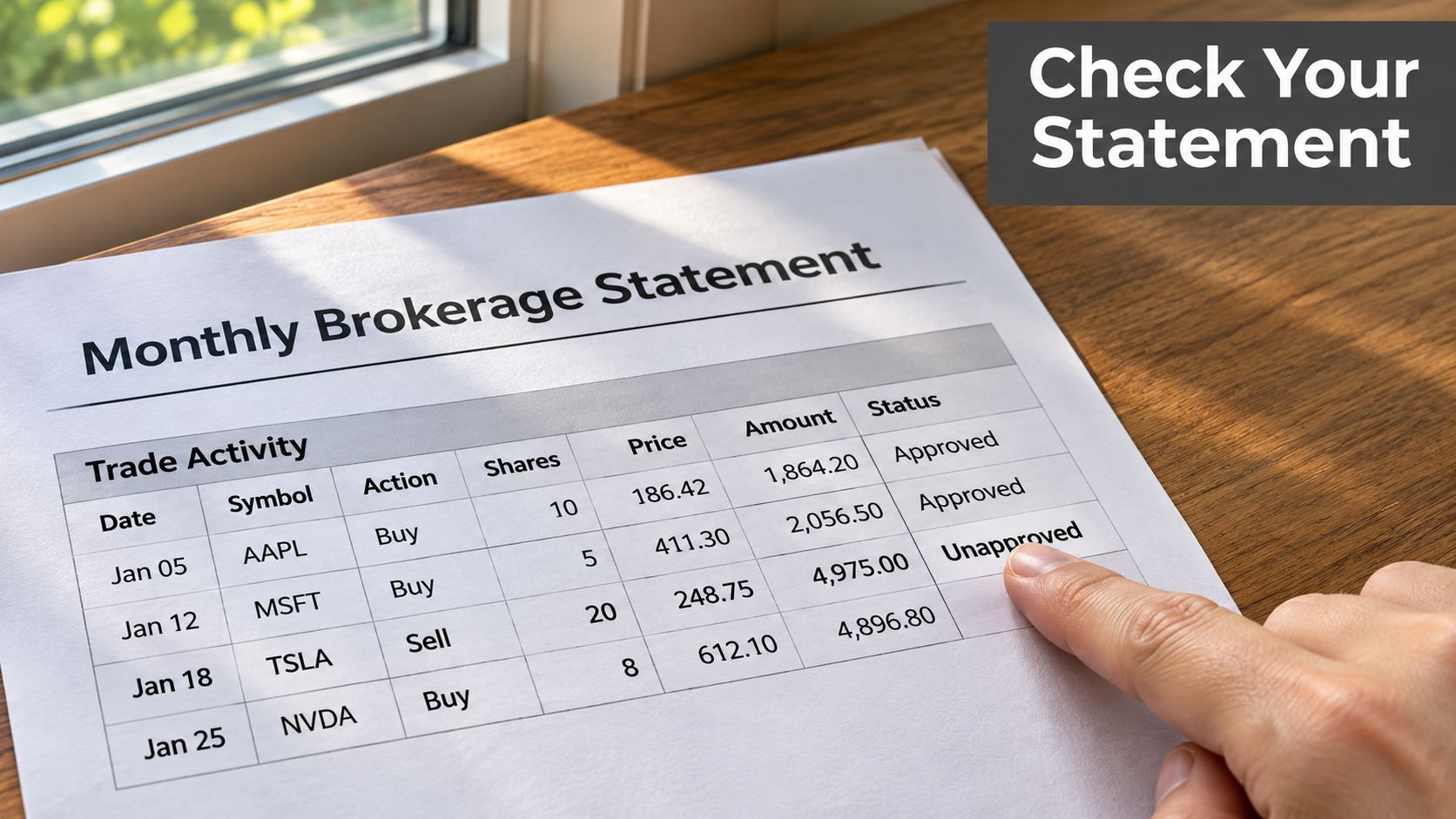
Start with the paper trail. Everything after it depends on what that trail proves.
Document the Misconduct Before You Write Anything
A complaint is only as strong as the records behind it. Before you draft a single sentence, build the file. Download account statements, trade confirmations, prospectuses, emails, text messages, suitability questionnaires, fee schedules and tax records, and keep the originals in a locked folder while you work from copies, as the SEC's guide to handling problems with your broker recommends. If you're unsure which sections of a statement show activity versus positions, this breakdown of what a brokerage statement contains is worth ten minutes.
| Record | What it proves | Where to get it |
|---|---|---|
| Monthly account statements | Holdings, balances and activity over time | Brokerage online portal or mailed statements |
| Trade confirmations | Date, price, quantity and account for each transaction | Brokerage portal confirmation archive |
| Account-opening documents and suitability questionnaire | Objectives, risk tolerance and experience the broker recorded | Original paperwork from account opening |
| Prospectuses and risk disclosures | What the product said about risk, liquidity and fees | Issuer website, or the offering documents you received |
| Emails, texts and call notes | What was promised or authorized | Your phone and email, plus notes written the same day |
| Fee schedules and commission records | Markups, commissions and excessive trading costs | Account agreement and monthly statements |
The Confirmation Carries the Most Weight
Trade confirmations deserve the closest read, because they exist independently of whatever the broker says afterward. An unauthorized trade usually still shows up on the confirmation with a date, a price, a quantity and an account number. When a broker later describes the same trade as "discretionary," the confirmation is what lets you test that claim against what you authorized.
Keep a running chronology as you go: one line per event, with the date, who said what, and which document supports it. Doing this while the events are fresh takes an hour. Reconstructing it eight months later takes days and loses details.
FINRA's own guidance is blunt on timing. Investors should question the broker immediately about any transaction they don't understand or authorize, then escalate to the branch manager or compliance department if the answer isn't satisfactory. That first written objection matters beyond courtesy: it is often the primary proof that you objected promptly rather than accepted the trade by silence.
Practical rule: write the objection the same day you spot the trade, even if it's three sentences. You can add detail later. You can't add a timestamp.
Choose the Right Place to File
Three checks narrow the choice before you send anything.
Is the broker registered? FINRA's BrokerCheck tool shows registration history and any disciplinary record. If the person isn't registered with a firm you recognize, that changes the analysis.
What is the problem? Unauthorized trading, unsuitable recommendations, excessive fees and account-handling failures point to different forums.
Does your account agreement contain a FINRA arbitration clause? Most do. That clause usually decides whether a damages claim goes to arbitration or to court.
| Where you file | Problems it handles | Can it recover money? |
|---|---|---|
| Brokerage firm compliance department | Written complaint and first escalation; the firm must respond | Sometimes, through a settlement offer |
| SEC Office of Investor Education and Assistance | Order handling, unauthorized trading, excessive trading, suitability, fees, markups and account problems | No, used for oversight and investigation |
| FINRA complaint program | Conduct by FINRA-registered brokers and firms | No, used for regulatory review and referral |
| FINRA arbitration | Customer damages claims for trading, suitability, fraud or account handling | Yes, through an award or settlement |
| State securities regulator | Registered agents and state-level violations | No, used for regulatory action |
| Civil court | Claims outside an arbitration clause or outside FINRA's forum | Yes, through a judgment or settlement |
Oversight and Recovery Are Different Jobs
Regulators review conduct, open investigations and sometimes bring enforcement actions. They generally do not act as your private recovery forum. Arbitration and court are where a dollar figure gets decided. Our firm brings claims against brokerage firms, financial advisors, investment advisory firms and other third-party financial services firms specifically to pursue that recovery, which is the track that ends in a payment.
This distinction is not a technicality. If you file only with a regulator and assume the matter is handled, you can spend a year feeling like something is happening while the window for a claim narrows. The relationship between the two forums, and how they divide the work, is set out in this explanation of SEC and FINRA roles in investor disputes.
The SEC's Office of Investor Education and Assistance accepts complaints about order handling, trade execution, confirmations, delivery of funds or securities, fees, commissions, markups, suitability, excessive trading and unauthorized account activity, along with problems opening, transferring, closing or redeeming an account. Suspected federal securities-law violations can also go through the SEC's Tips, Complaints and Referrals Portal. That office takes complaints about other financial professionals too, not only brokers and brokerage firms.
Match the category before you pick the forum. A churning claim and a transfer-delay complaint need different channels, and sending one to the wrong place costs you weeks.
How to Write and Submit the Complaint
A written complaint has a shape. Here is the version regulators and arbitrators can work with.
Write the letter as though a stranger will read it cold, because eventually one will.
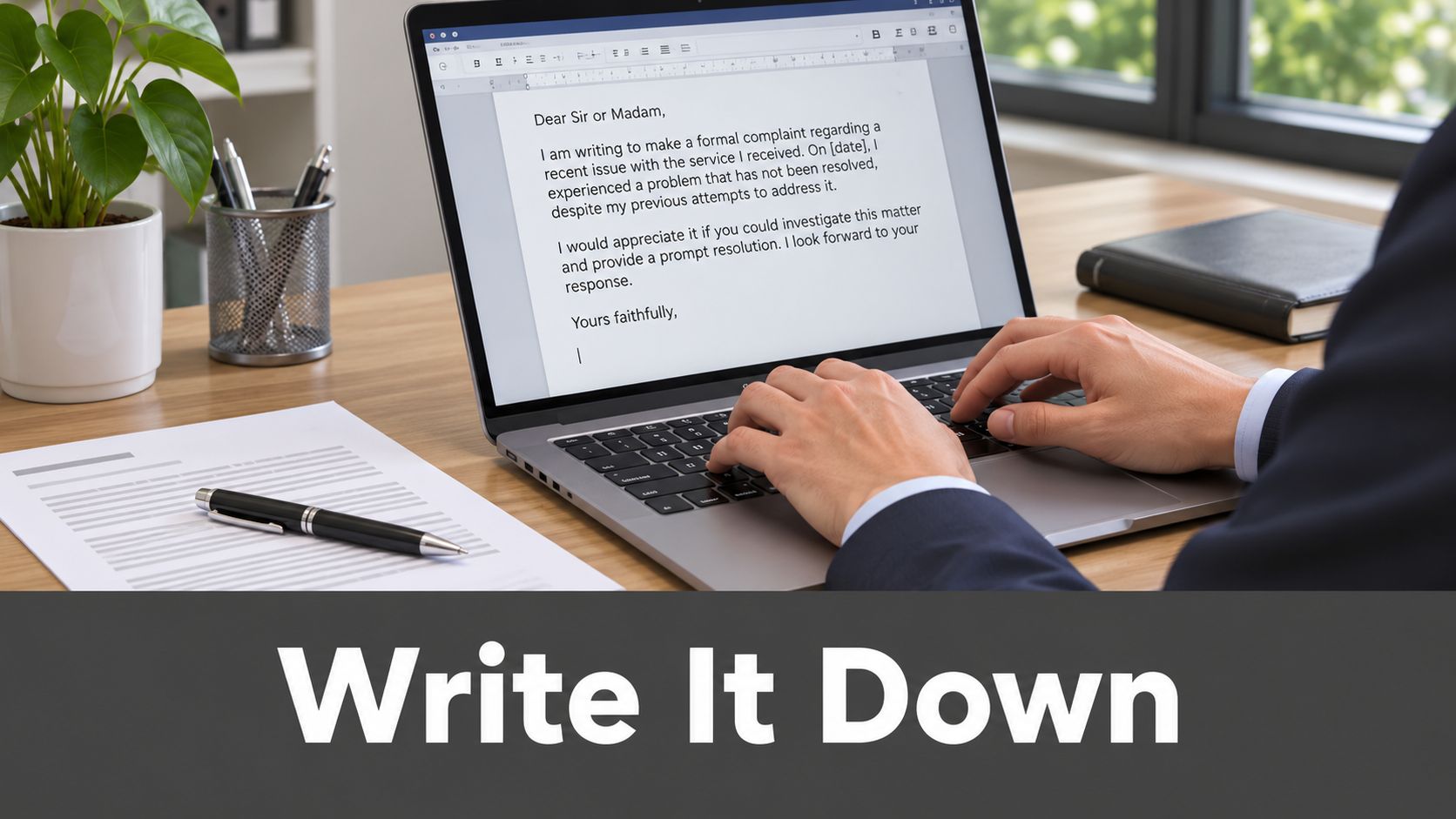
- Identify the broker and the account. Full legal name, the firm, the exact account type, and the names of anyone at the firm you've already contacted. The SEC's guidance on what a complaint should contain lists these as the core identifiers, along with the specific dates of transactions or conversations and the security name or ticker symbol.
- Build a transaction table. One row per disputed trade: date, security, quantity, price, representative, and whether you authorized it. Say an investor finds forty options trades in one month that she never approved. Listed in prose, that's a vague grievance. In a forty-row table, it becomes a dated, countable claim with a total.
- Quantify the damages from that table. Show the arithmetic: purchase cost, current value, and the difference. A number you can defend line by line is worth more than an estimate you can't.
- Tell the story in chronological order, then state the remedy. What you wanted, what happened, what you asked for, what you got. Then say plainly what you want now, such as reversal of the trades or reimbursement of the loss.
- Attach copies, never originals. Include a short index so the reader can find exhibit C without hunting.
- Send it to the firm and ask for a written response by a date you name. Put that date in the letter itself.
- File with the chosen regulator. The SEC through its portal for federal securities matters, or FINRA's Complaint Program for FINRA-registered brokers and firms.
- Record the file number. The SEC assigns one after receiving a complaint, and you should use it in every later message so your correspondence stays in one file.
Keep the tone flat. Dates, documents, amounts. Anger weakens a complaint; specificity strengthens it.
What Happens After You File and How Long It Takes
You send the complaint on a Tuesday. Friday comes, and the inbox is still empty. That quiet can feel like progress. It is the regulator working its own queue. A complaint and a claim for money are two tracks with two clocks. The recovery clock keeps running while you wait for a reply.
The queue is large. FINRA reported 24,899 investor complaints submitted directly to it in 2025, more than double the 11,908 reported for 2024, according to FINRA's complaint statistics. The SEC closed 31,472 investor complaint, question and contact files in fiscal year 2025, per its investor complaints data. A stack that size does not produce a status note for every filer. Checking for one does not slow the deadline on the money claim.
The two filings work like two kitchen timers started the same morning. One times the regulator's review. The other times how long you have to ask a forum for money. Only the second timer can expire while the first stays silent.
| Stage | Typical timing | What to expect |
|---|---|---|
| Firm response to written complaint | Within 30 days, if requested | A written answer, or silence that you can document |
| Respondent answer to FINRA arbitration | Generally 45 days after the statement of claim | The firm or broker responds with its defenses |
| Arbitration through settlement | About one year | A negotiated resolution |
| Arbitration through a hearing | About 16 months | A decision after the hearing |
| Payment of a monetary award | Generally within 30 days of the award | The responsible firm or broker pays |
Those procedure rows follow FINRA's explanation of the arbitration process. A claimant files a statement of claim, the written demand that starts the money case, and pays the applicable filing fee. The respondent, the firm or broker, generally has 45 days to answer with its defenses. Awards are generally issued within 30 days of the close of the proceeding, and a firm ordered to pay must generally do so within 30 days.
The Six-Year Window Is Not a Safe Harbor
FINRA Rule 12206 generally makes a customer arbitration claim ineligible once six years have passed from the event giving rise to the claim, as FINRA's filing FAQ explains. Ineligible means the forum can refuse to hear the claim. That six-year line does not replace shorter statutes of limitations, the court deadlines a respondent can still raise as a defense.
Whether a FINRA filing pauses a court deadline depends on the rules of that forum and the law that applies. Filing alone does not settle the question. A regulatory complaint sits on the other track. It may prompt a review. It does not open the damages case, and it does not stop the shorter deadline on its own.
A fuller walk-through of the FINRA arbitration process lays out those steps before you pick a forum.
Clients work directly with a securities attorney who knows the ins and outs of their case.
Avoid Costly Mistakes and Take the Next Step
You email a regulator on a Tuesday and feel the problem is finally moving. That feeling is expensive. A regulatory complaint and a claim for your money run on separate clocks. An SEC, FINRA, or state-regulator complaint can document suspected misconduct and trigger a review. It does not recover the losses, and it does not pause the deadlines still running on a damages claim.
The other errors cluster around paperwork and delay.
- Filing only with a regulator and assuming the deadlines are paused. The recovery clock keeps running while the agency reads your letter.
- Omitting the remedy. A complaint that describes wrongdoing but never asks for a specific amount gives the reader nothing to act on.
- Sending originals. Keep them. Send copies.
- Letting electronic evidence disappear. Save texts and emails to a folder you control before a phone upgrade or a closed account wipes them.
- Waiting while disputed trades sit unanswered. Object in writing the day you spot the trade, and keep a copy of that objection.
FINRA's 2025 figures, reported in FINRA's dispute resolution statistics, show 1,643 customer arbitration filings, and of the 240 customer claimant cases decided, damages were awarded in 28% (67 cases). That award rate covers a mixed set of cases. It is not a prediction for yours. Case type, proof, settlement posture, and how damages are calculated move the result more than any average does.
Write down the date you first learned of each disputed trade. Measure limitation periods from that date, using this overview of the statute of limitations in securities fraud cases as a starting point. Then gather the records, build the transaction table, and send the written complaint to the firm before you send anything else.
If the losses are large, or the account involved unsuitable recommendations, unauthorized trading, or an older investor, have a securities attorney look at the dates and the forum before you file. Kons Law offers a free, no-obligation consultation to learn your rights after investment losses.
A complaint documents misconduct. Only a timely claim can recover money.
Kons Law represents investors nationwide in FINRA arbitration and court actions, with more than 18 years of practice and over $50 million recovered across 700+ matters, including claims for unauthorized trading, churning, and unsuitable recommendations. If you have found trades you never approved, or a broker's explanation that does not match your statements, a free, no-obligation consultation will show which deadlines apply and which forum fits. Visit Kons Law to start that conversation while the record is still fresh.
