
You're sitting in a branch office or a conference room, and the pitch has already turned from conversation into momentum. The product changes names, but the pattern doesn't. A broker leans on a “limited window,” keeps nudging you toward a signature page, and makes it sound reckless to leave without acting today.
That's the core problem with high pressure sales tactics in investing. They're not just annoying. They're designed to shrink your judgment window until you stop comparing, stop questioning, and stop asking for the documents that would expose the deal.
When the Friendly Broker Becomes the Hardest Sell
The first sign is usually charm. The broker is warm, attentive, and unusually available, especially when there's a product on the table that pays more than your plain-vanilla account ever would. Then the tone changes. The “helpful” voice becomes insistent, the rate sheet is said to expire, and every question seems to be answered with another push toward signing.
A retiree hears that an annuity is the safest place for savings. A couple is told a private placement is only open for a short time. A prospect gets a lunch, a handshake, and three follow-up calls before the brochure even reaches the kitchen table. That sequence is no accident. It is pressure used to keep you from slowing down long enough to check the facts.
Practical rule: If the seller gets more urgent every time you ask for documents, the urgency is the product, not the opportunity.
The investor's job is to recognize the pattern early. The broker's job is to close before the buyer fully understands the downside. That's why the pressure feels personal. It's built to create obedience, not clarity.
| Tactic | What the Investor Sees | Rule Likely Violated |
|---|---|---|
| Repeated follow-up calls | “Just checking in” turns into pressure to decide now | Suitability, truthful dealing |
| Refusing written materials | Brochures are delayed, but the signature page is ready | Disclosure duties |
| Deadline language | “This rate won't last” or “the window closes today” | Fair dealing, misrepresentation |
| Social pressure | “I'd hate for you to miss this” or “you're overthinking it” | Best-interest obligations |
What High Pressure Sales Tactics Really Mean in Financial Services
In finance, high pressure sales tactics are not just aggressive selling. They're a method for forcing a recommendation through before the customer can evaluate risk, liquidity, fees, and alternatives. That matters because a bad stock pitch can hurt you. A bad annuity, private placement, or structured product can trap money for years.
The pressure usually comes through three levers. First is time, when the broker pushes deadlines, rate locks, seasonal urgency, or “last chance” offers. Second is emotion, where fear of loss, fear of retirement shortfall, guilt, or flattery takes the place of analysis. Third is information control, which means the broker withholds disclosures, glosses over surrender charges, or refuses to send the materials home.

The core problem is simple. Investment products compound over time, and so do mistakes. A customer who is rushed today may not see the damage until years later, when the surrender period, fee stack, or concentration risk finally shows up.
High-pressure selling is also not a personality trait. It's a sales method. Independent sales guidance describes it as pushing a buyer toward a quick decision through fear, urgency, guilt, or emotional manipulation, and recommends a real pause before larger purchases. That's the right instinct. In financial services, pressure is dangerous precisely because the customer can't fully reverse the mistake once the deal is done. The earlier investor guidance about a 24-hour pause for purchases over $500 and getting three quotes is one version of that same discipline, and it reflects the same common-sense defense against impulse decisions. Prospeo's analysis of high-pressure selling
Common Tactics Brokers and Advisors Use to Close the Deal
The script changes by product, but the mechanics don't. A broker sells a non-traded REIT as “like a CD but better,” then downplays illiquidity. A structured note is pitched during a volatile week as if recent market stress proves the need to buy now. A variable annuity is described as a “pension” to an older investor who is really being handed a long lockup with layered restrictions.
The pressure language changes, the target stays the same
Fabricated urgency is common around bonus rates, limited allocations, or “special” terms that are extended after the investor signs up. That pattern is especially ugly in private placements, BDCs, oil and gas partnerships, and other alternative investments, because the pitch often relies on trust before the documents are ever read. The seller knows many investors won't discover the mismatch until the first statement arrives.
Another favorite move is the relationship play. A broker uses a personal connection, a golf buddy routine, or a “I'm doing you a favor” tone to skip the normal review process. That tactic works because it lowers resistance. It also makes the investor less likely to ask for the offering memo, the fee schedule, or the exit terms.
A recommendation that survives inspection doesn't need theatrics. It needs disclosure, time, and documents.
Here are the patterns that show up again and again in misconduct cases:
- “This is basically guaranteed.” That kind of overpromise is how speculative products get dressed up as safe income.
- “You don't need to read all of that.” That is information control, plain and simple.
- “You'll miss the window if you wait.” That is manufactured urgency, especially when the same window reappears later.
- “Don't bother your spouse or kids yet.” That keeps the buyer isolated.
- “We can talk details after you sign.” That is backwards, and brokers who say it know exactly why.
The investor should treat any attempt to hurry product selection as a warning, not a feature. The more complicated the product, the less excuse there is for speed.
Red Flags You Can Spot in Real Time
Most investors don't need a law degree to know something is off. They need a pause button. The loudest warning signs are obvious, repeated calls, buy-now language, refusal to leave written materials, and a hard sell that gets sharper every time you ask a question. Those are classic markers of pressure, and they're hard to justify after the fact.
The subtler red flags matter just as much. A broker who dodges the question of liquidity is telling you the exit may be ugly. A salesperson who discourages you from talking to family is trying to cut off the people most likely to slow the deal down. A meeting held off-firm premises, or a follow-up conducted from a personal cell phone instead of firm email, should make you suspicious because it weakens the paper trail.
If you're in the room and the pitch is getting tight, use direct questions:
- Can you send the prospectus and fee schedule today?
- What happens if I need this money in five years?
- What is the exact reason this must be decided now?
- Will you put that promise in an email?
- What are the surrender charges, restrictions, or penalties?
The test is simple. Legitimate urgency can be named, explained, and written down. Manufactured urgency collapses the second you ask for it in email. That's why you should always ask for the deal documents before you answer the clock.
If you want a plain-language example of how this kind of sales pressure is often used in boiler-room settings, review the background on a boiler room scam.
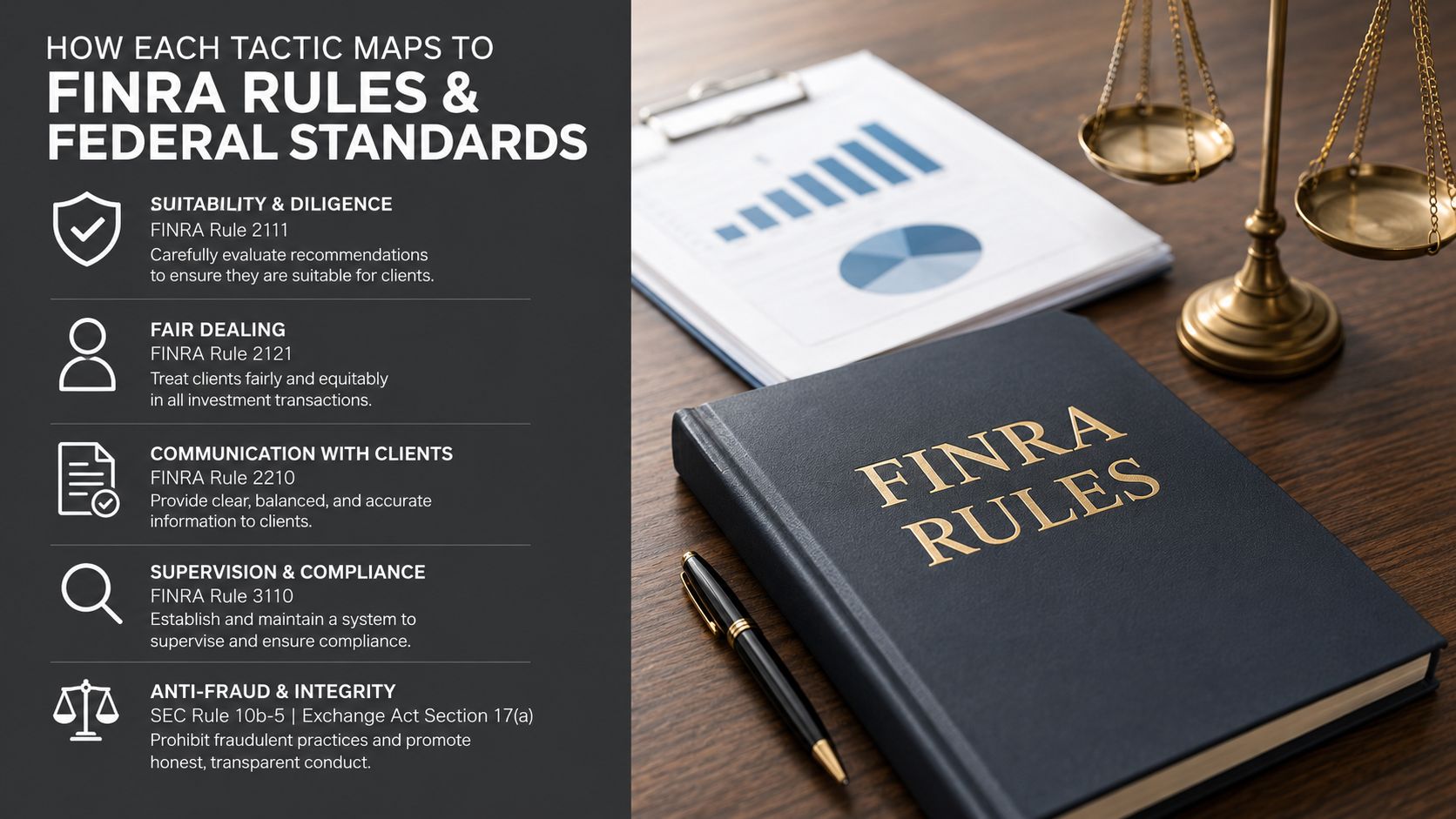
How Each Tactic Maps to FINRA Rules and Federal Standards
The law doesn't care that the pitch felt smooth. It cares whether the recommendation fit the customer, whether the firm supervised the rep, and whether the sales claims were truthful. That is where pressure tactics become litigation facts.
A rushed recommendation often points straight at FINRA Rule 2111, because suitability requires a broker to have a reasonable basis for the recommendation and to account for the customer's profile. If the broker never gave the investor time to compare alternatives, read the documents, or ask about liquidity, that pressure helps show the recommendation was not made on a sound basis. Reg BI raises the bar further for retail customers, because the recommendation has to be in the customer's best interest, not just profitable for the salesperson.
The legal hook behind the sales behavior
Pressure also matters under FINRA Rule 4511 when a firm fails to keep and supervise the records that would show how the sale was handled. If the broker was using personal texts, off-firm calls, or side conversations to push the deal, that can become a supervision issue as well as a disclosure issue. And if the pitch included false statements about safety, income, or access to funds, Section 10b-5 is where material misrepresentations come into play.
For older investors, the problem can get worse. State financial elder abuse laws and age-sensitive suitability standards can sharpen the analysis when the broker targeted a senior with a product that locked up money or replaced a stable income stream with something speculative. That's why the meeting notes, the timing, and the language of the pitch matter so much.
The law does not reward the smooth talker. It rewards the investor who can prove what was said, when it was said, and what the advisor failed to disclose.
A useful way to frame the case is this. The seller's pressure is evidence that the process was engineered to outrun the investor's judgment. That is exactly the kind of fact pattern a securities lawyer looks for when building a FINRA arbitration claim. For a broader overview of arbitration standards, review the firm's discussion of FINRA suitability rules.
Evidence to Preserve Before the Broker Realizes You Are Questioning the Sale
Once you start pushing back, the paper trail matters more than your memory. Firms and brokers can dispute the conversation, soften the timeline, or claim you understood the risk all along. Don't give them that opening.
Start with the documents you control. Download every monthly statement. Save every email and text message with the advisor. Photograph or scan the original offering documents, signature pages, and any account forms you signed. Write down the meeting dates, the names of everyone present, and the order in which the pitch happened while it's still fresh.
Also, identify where the evidence may already live outside your inbox. Recorded line calls, branch surveillance video, internal approval emails, and prior complaint history can matter later, even if you never see them now. Those items often surface only through arbitration subpoenas, so your job is to preserve what you can before the firm gets a chance to sanitize the record.
A compliance tool can help you understand how formal acknowledgment trails are supposed to work. For that reason, it's worth reviewing BoloSign's compliance features from Closer Innovation Labs Corp., especially if you want to see how firms are supposed to document acknowledgments and approvals in a cleaner process.
Preserve this now, not later
- Statements: Keep every account statement and confirmation.
- Messages: Save texts, chats, voicemails, and emails.
- Documents: Keep brochures, prospectuses, notes, and signed pages.
- Timeline: Write the sequence of the pitch from first contact to signature.
- Witnesses: List anyone who heard the recommendation or saw the documents.
For account records, it also helps to understand how statements are used and what they show. A practical primer is the firm's page on brokerage statements. The key point is this. The sooner you preserve the record, the harder it becomes for the other side to rewrite the story.
Your Recovery Options and Why a Securities Attorney Should Be the First Call
The worst mistake investors make is waiting for someone else to solve the problem. A regulator complaint may be appropriate, but it doesn't freeze deadlines. A class action may exist, but it rarely recovers the full loss for an individual investor. A direct lawsuit may be available in some cases, but it needs careful sequencing and evidence management.
The four real paths are straightforward. First, a FINRA arbitration claim against the broker and firm. Second, a securities class action if the same product was sold across a broad group. Third, a referral to a regulator such as FINRA, the SEC, or a state attorney general. Fourth, direct civil litigation for fraud, elder abuse, or related claims where the facts support it.
Why the first call should be to a securities lawyer
A lawyer experienced in brokerage disputes can do things a regulator intake form will not. That includes issuing a demand letter, preserving evidence through subpoenas, and sorting out whether the claim belongs in arbitration, court, or both. It also means the case gets evaluated on contingency in practice, instead of being lost in a complaint queue.
For a deeper look at the posture and process, review the firm's explanation of a securities arbitration attorney. The practical lesson is simple. If you wait for a regulator to act first, you may lose your negotiating power. If you wait too long to gather proof, the firm gets the upper hand.
Do not assume the loss is unrecoverable because the investment was signed. Many of the strongest cases start with a signed document and a bad sales record.
You should expect a real case review to focus on the product, the statements, the communications, and the timeline. That is where pressure tactics turn into damages analysis. Once the facts are lined up, the path forward becomes much clearer.
Clear Next Steps to Recover What You Lost
- Call now. If you want a free consultation to discuss the investment loss recovery process in more detail, call Kons Law Firm at (860) 920-5181 for a FREE, NO OBLIGATION consultation.
- Gather your record. Pull statements, emails, texts, prospectuses, and signed account forms into one folder.
- Write the timeline. List the first call, the pitch meeting, the deadline talk, and the day you signed.
- Identify other witnesses. Spouses, relatives, and co-investors may have heard the same sales pitch.
- Do not sign anything new. No release, amendment, or rollover document should go out without legal review.
Contingency-fee representation is standard in this area, and the initial call costs nothing. Pressure tactics are not a personal failure. They're a sales method, and the law gives you tools to fight back.
If you're facing losses from a rushed annuity, private placement, REIT, or other pressured investment, Kons Law can help you sort out the next move fast and without a sales pitch. Visit Kons Law to get a focused review of your claim and learn whether FINRA arbitration or another recovery path fits your case.
