You open a statement and the numbers don't make sense. Maybe money moved without your approval. Maybe your advisor kept pressing an investment that no longer fits what you were told, and the losses keep growing while the explanations stay vague.
That's the point where a lot of New York investors start searching for a fraud lawyer New York and run into a messy result. Some pages talk about criminal defense. Others talk about securities recovery. Those are not the same job, and picking the wrong one can waste time when timing and evidence matter most.
New York's fraud environment helps explain why these searches keep happening. In 2025, the New York Attorney General said its top complaint category was Retail Sales with 4,809 complaints, followed by Internet complaints with 4,595 and Credit, Banking, and Mortgages with 4,235. Those three categories alone totaled 13,639 complaints, or roughly 41.6% of the top-10 complaint volume listed in the report, and the office's consumer-fraud infrastructure had already secured more than $1.8 billion in relief for consumers between 2011 and 2014, while the Consumer Assistance Program resolved over 17,000 complaints in that same period. That's not a picture of rare, isolated harm, it's a recurring enforcement environment in a massive market. New York Attorney General complaint report
For investors, the practical question isn't just whether fraud happened. It's whether the facts support a recovery claim, where that claim belongs, and how quickly you need to move. If you're trying to recover money after unauthorized trading, misrepresentation, churning, or unsuitable advice, the legal path looks very different from a criminal-defense case.
When New York Investors Need Legal Help
A lot of people wait too long because they assume losses are just market losses. That's a mistake when the account history shows trades you didn't authorize, the recommendation ignored your risk tolerance, or the product was described one way and sold another. In investor cases, the paper trail matters more than the sales pitch.
New York regulators keep showing why these disputes keep landing on lawyers' desks. The New York State Department of Financial Services reported 44,998 suspected fraud reports in 2023, up from 38,554 in 2022, and said suspected no-fault fraud reports accounted for 75% of all fraud reports received that year. The same report also identified 16,365 reported New York insureds whose garaging or driving location was misrepresented in 2023, producing $38,304,698 in reported premium lost. Those figures matter because they show fraud disputes often involve measurable financial harm, not vague suspicion. DFS annual report
What to do when the statement doesn't match reality
Start by separating market loss from misconduct. A bad quarter is not the same thing as unauthorized trading, and an aggressive sales pitch is not the same thing as a legally actionable omission. What makes these cases viable is usually a mismatch between what you were told, what the account records show, and what your written profile said you wanted.
Practical rule: if the story changes every time you ask for an explanation, preserve the documents before you press harder.
That means saving statements, confirmations, emails, text messages, voicemail notes, onboarding paperwork, and anything that shows why you invested in the first place. If you're looking for a recovery route, this guide on recovering from fraud is worth reading alongside your records, because the recovery question turns on proof, not outrage.
The cleanest next step is to ask a lawyer who handles securities matters whether the case belongs in arbitration, court, or a defense posture. That distinction controls strategy, costs, and the likely end result. Once you know which lane you're in, the rest of the process becomes much easier to manage.
The Two Tracks of Fraud Law in New York
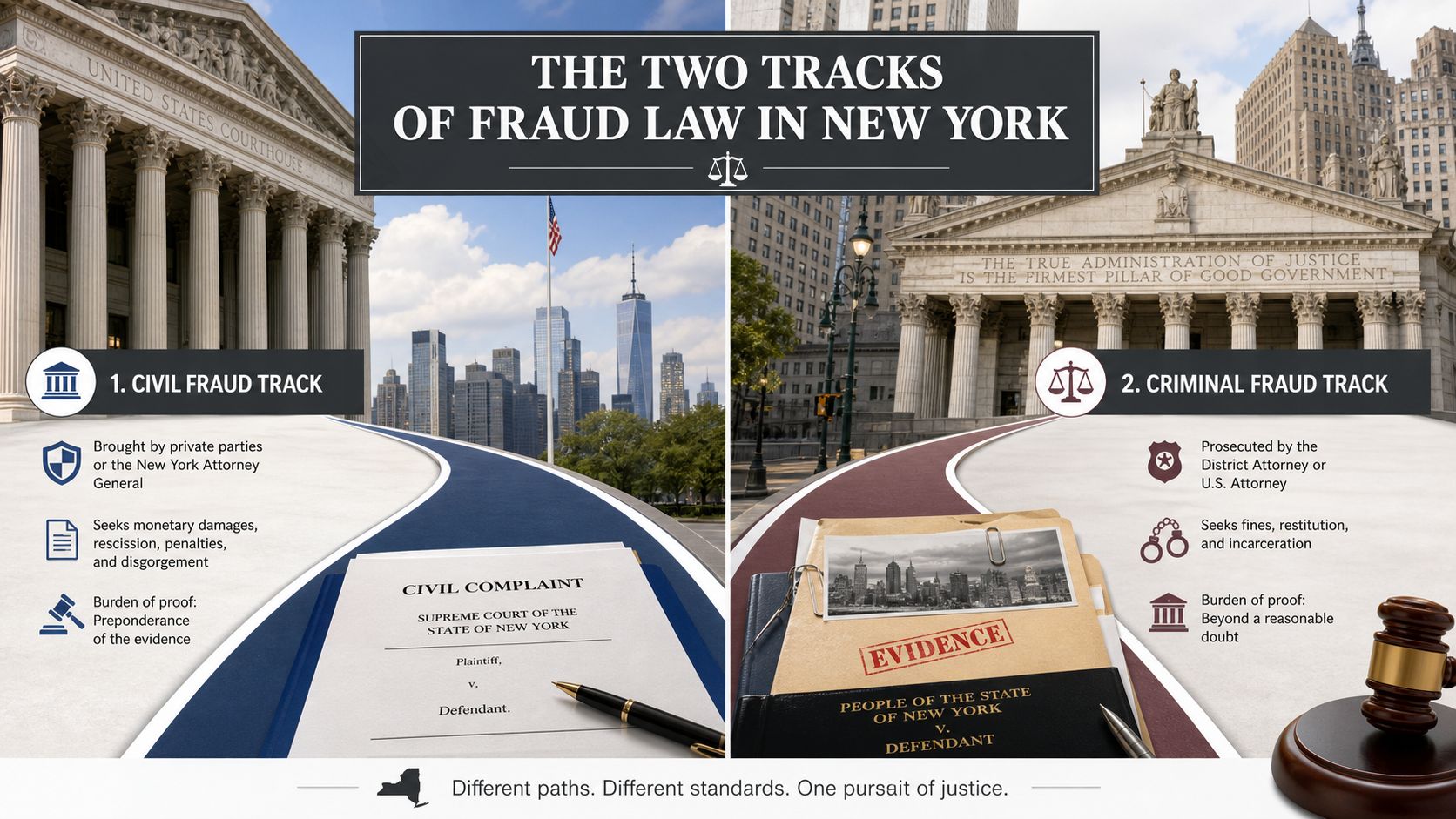
Searching for a fraud lawyer New York can mean different things. One group needs a criminal fraud defense lawyer because they're accused of deception. Another group needs a civil lawyer because they lost money and want recovery. Those are different systems with different burdens, different forums, and different goals.
Civil fraud claims and consumer fraud claims
Civil fraud claims usually require proof of a misrepresentation or material omission, knowledge of falsity, intent to induce reliance, actual reliance, and resulting harm. Consumer-fraud claims under New York General Business Law § 349 work differently, because they focus on a misleading, consumer-oriented practice and injury from that practice. That distinction matters when you're deciding whether the issue is a courtroom defense problem or a money-recovery case.
A criminal-defense page won't help you understand FINRA arbitration, suitability claims, or how to build a brokerage case from account records. That's why a general “fraud” search can be misleading. If your loss came from brokerage misconduct, the legal theory usually has more to do with the way the account was handled than with a broad accusation of fraud.
For investors comparing options, 2026 digital verification laws is a useful outside resource because it shows how proof and digital records are becoming more central in fraud-related disputes. That matters in practical terms, since screenshots, audit trails, and electronic communications often carry the case.
Why the forum choice changes the result
The forum isn't a technical footnote. It affects discovery, timing, and how the case gets resolved. A matter that belongs in FINRA arbitration can move very differently from a claim that belongs in court.
Bottom line: if the account dispute is about brokerage conduct, the right lawyer needs to know how to recover money, not just how to defend against allegations.
If you're trying to choose between those paths, this comparison of arbitration and litigation gives the clearest framework. The point is to match the claim to the process before you waste time on the wrong one.
Common Types of Fraud Claims in New York
The most useful way to think about investment fraud is by misconduct pattern, not by label. In real brokerage disputes, the facts usually fall into a recognizable category, and each category points to a different kind of proof. That's why general practice lawyers often miss cases that a securities-focused lawyer would spot right away.
The patterns that show up most often
A client may come in saying the advisor “lied,” but the documents usually show something more specific. Maybe the broker promised safety and income, then placed the money into a product with very different risks. Maybe the account was churned, with trades made mainly to generate commissions. Maybe trades were executed without permission, or the recommendations ignored the investor's age, liquidity needs, and tolerance for loss.
Here are the recurring profiles that matter most:
- Misrepresentations about risk or return: The sales pitch and the account paperwork don't match, which creates a basic reliance problem.
- Account churning: Excessive trading can point to commission-driven abuse rather than investment strategy.
- Unauthorized trading: Orders appear in the account without approval, which can shift a case from bad advice to misconduct.
- Unsuitable investments: The product may be legal, but wrong for the investor's profile and objectives.
Complex products and more serious schemes
Some cases involve products that are harder to unwind, including Ponzi schemes, unregistered securities, private placements, non-traded REITs, and other alternative investments. Those matters often require tracing transfers, reviewing offering materials, and comparing what was sold against what was disclosed. For advisers and planners who need scheduling systems in a different context, appointment scheduling for planners shows how heavily these relationships depend on recordkeeping and follow-up, which is exactly why the records matter in fraud cases too.
Practical insight: if a claim involves transfers, platform changes, or a broker who left the firm, don't assume recovery is off the table. That's often when the evidence needs to be traced most carefully.
New York investor-recovery lawyers also routinely work with forensic accountants and computer-forensics specialists to reconstruct trades and transfers, especially where the trail is scattered across platforms. Independent legal directories describing securities-fraud counsel in New York point to those exact claim categories and expert tools. Justia New York stockbroker and investment fraud directory
The right lawyer doesn't start with the word “fraud.” The right lawyer starts with the account history, the product type, and the path to proof.
Steps to Take Immediately After Suspecting Fraud
The first move is preservation, not confrontation. If you think something is wrong, the documents can disappear faster than the explanation improves. That means gathering what you already have before anyone has a chance to reframe the story.
What to secure right away
Collect your account statements, trade confirmations, onboarding forms, risk disclosures, emails, text messages, voice messages, and marketing materials. If there were notes from meetings or calls, write them down now while the timeline is still fresh. Keep everything in one place, and don't rely on the firm or the advisor to preserve it for you.
Then build a simple chronology. Mark the first recommendation, the first transfer, the first suspicious trade, the first loss statement, and the first time you asked questions. That timeline often becomes the backbone of a recovery claim.
Watch the clock
New York fraud claims are commonly described as having a six-year statute of limitations under CPLR § 213, with the clock running from discovery or when the fraud should reasonably have been discovered. That discovery rule can decide the case before anyone gets to the facts, especially where the loss surfaced late. Fraud statute of limitations in New York
If the matter involves a brokerage account, filing a FINRA complaint may be the most direct way to preserve recovery options. If the conduct looks criminal, you can also report it to the relevant authorities, but don't expect that report alone to recover your money.
Do not confront the accused person before you've preserved the records and talked to counsel. Once people know a claim is coming, they tend to clean up their paper trail.
The best early cases are the ones where the investor acted fast, stayed organized, and didn't let the other side control the narrative. Speed doesn't guarantee success, but delay often narrows the options.
How to Choose the Right Fraud Lawyer
Start with specialization. A lawyer who handles general litigation may understand the courtroom, but that doesn't mean they know brokerage statements, suitability analysis, FINRA rules, or how misconduct gets proven in an investor case. Ask directly whether the firm handles securities and investment fraud, not just “fraud” in the abstract.
Questions that separate real experience from marketing
You want to know what the firm does with investor cases. Ask how much of its work involves FINRA arbitration versus court litigation, and ask what kinds of claims they see most often. A lawyer who handles brokerage disputes regularly should be able to talk plainly about churning, unauthorized trading, misrepresentation, unsuitable recommendations, and recovery against the firm rather than only the individual broker.
Ask about the fee structure too. Contingency fees are common in investor-recovery work because they align the lawyer's incentives with yours, while hourly billing may be used in certain fraud claims depending on the posture of the case. Neither is automatically better, but you should know what you're signing before you commit.
Track record matters, but only if it's real
Don't ask for vague reassurance. Ask how many matters the lawyer has handled, what types of disputes they've seen, and how they communicate when the case gets difficult. If a firm has recovered money in investor matters before, it should be able to describe the work without padding the answer.
For one practical option in this space, Kons Law handles securities and investment recovery matters for investors through FINRA arbitration and court actions, with a contingency-fee structure and direct client communication from intake through resolution. That kind of setup matters when the case depends on tight deadlines and document-heavy proof.
Good counsel should be able to explain your case without jargon. If the first consultation sounds like a sales pitch, keep looking.
If you're searching locally, this investment fraud lawyer near me approach can help narrow the field, but the test is whether the lawyer knows the recovery path for your kind of loss.
FINRA Arbitration Versus Court Actions for Investor Recovery
Most brokerage-related investor claims in New York don't start in open court. They start in FINRA arbitration, because that's where many customer agreements send disputes. Arbitration is built for securities cases, and the people deciding them are closer to the industry than a typical jury would be.

Arbitration and litigation serve different purposes
Arbitration usually means tighter procedure, limited discovery, and no ordinary appeal path. That can be good if you want a faster forum and the dispute is centered on brokerage conduct. It can also be frustrating if you need broad document production or if the case turns on testimony from multiple participants.
Court litigation may be necessary for claims that aren't bound by arbitration agreements or where the dispute involves parties and issues outside the arbitration clause. It can also open the door to broader motion practice and formal appeals, but that comes with longer timelines and higher cost pressure. The forum choice should follow the facts, not habit.
For people trying to preserve records, messaging tools matter too. Platforms like Weeve can help teams manage conversation history, which is one reason electronic communication preservation has become so important in financial disputes.
What actually changes the strategy
Recent market guidance around complex products and digital-asset-linked fraud has made record analysis more important, not less. In practice, that means email, text, portal messages, and transfer records can carry more weight than the spoken explanation you heard from the advisor.
The best forum is the one that matches the claim and the evidence. If the case depends on broker misconduct, arbitrator familiarity with securities practice can help. If the issue is outside the account agreement or involves broader legal claims, court may be the better path.
Typical Timelines and Recovery Outcomes
Recovery is rarely instant. Some disputes settle after the first round of demand letters and document exchange. Others take longer because the other side denies everything, disputes damages, or tries to shift blame onto market conditions.
What drives timing
The biggest timing variables are evidence quality, claim complexity, and how quickly the opposing side sees risk. A clean case with clear unauthorized trading and well-organized records tends to move faster than a case involving multiple accounts, third-party transfers, or alternative investments with layered disclosures. The more people involved, the more opportunity there is for delay.
Settlement timing matters too. Cases that settle early can save legal expense and emotional strain, but early settlement sometimes comes at the cost of a lower recovery. That trade-off is real, and it should be discussed candidly instead of hidden behind optimism.
What recovery can look like
Recovery can come from settlement, arbitration award, or court judgment, and enforcement may still be needed after that. A favorable award is useful only if the other side pays or there's a way to collect. That's why post-award steps matter, especially where the loss involved a firm, advisor, or product sponsor with layered entities.
Practical rule: strong documents improve leverage long before hearing day. Weak records make even a good claim harder to settle well.
You should expect some cases to resolve quickly and others to take patience. The key is whether the claim is built on a clear misconduct pattern, a defensible damages theory, and a forum that fits the dispute. That combination usually does more for recovery than wishful timing ever does.
How Kons Law Securities Recovery Expertise Can Help
Kons Law focuses on securities and investment litigation for investors seeking recovery through FINRA arbitration and court actions. The firm brings more than 18 years of experience and has recovered over $50 million across 700-plus matters, including cases involving breach of fiduciary duty, unsuitable recommendations, churning, Ponzi schemes, and alternative investments. That kind of focused practice matters when the issue is recovery, not just whether something went wrong. Kons Law
If you're dealing with brokerage misconduct, delay can weaken a claim fast. Records go missing, account activity becomes harder to reconstruct, and the other side gets more time to shape its defense. Kons Law offers free consultations and works on a contingency-fee basis, so the discussion can stay centered on the claim and the path to recovery instead of upfront billing.
When an investor calls after suspecting fraud, the first job is to sort the case into the right track. Civil recovery and criminal enforcement serve different purposes, and most investors need a lawyer who knows how to pursue compensation, not just how to describe misconduct. Kons Law reviews the account history, the recommendation trail, and the documents that matter in FINRA arbitration or court.
That review also has to be practical. A broker dispute involving unsuitable recommendations may call for a different strategy than a case tied to Ponzi-style transfers or undisclosed conflicts. The right filing forum, the damages theory, and the paper trail all affect whether a claim can settle or win at hearing.
If you've lost money through broker misconduct, unsuitable recommendations, or another investment fraud pattern, speak with a lawyer who handles recovery cases every day. Kons Law can review your documents, explain whether your claim belongs in FINRA arbitration or court, and outline the next move. Visit our website to request a free consultation and get direct guidance on your situation.
