
You receive a recommendation that seems customized to your retirement goals. The advisor explains the product's income features, risks, and expected role in your portfolio. Later, you discover the firm receives compensation when clients buy that product, or that the advisor's employer offers a financially preferred alternative.
That discovery doesn't automatically prove the recommendation was improper. It does raise a serious question: Did the conflict of interest disclosure give you enough information to understand how the advisor was paid, what incentive existed, and how the firm managed the risk?
A disclosure isn't merely paperwork. It can affect whether you had a meaningful opportunity to evaluate advice before committing your money. The answer often depends on the language used, when you received it, where it appeared, and whether the firm had controls that addressed the underlying incentive. Investors who want a broader explanation of the advisor's obligations can review this guide to fiduciary duty in investment relationships.
Introduction What Conflict of Interest Disclosure Means for Your Money
A conflict can arise even when an investment recommendation sounds reasonable. An advisor might recommend an annuity, proprietary mutual fund, private placement, structured product, or rollover strategy that fits part of your stated objective. But the advisor or firm may also earn a commission, receive revenue sharing, benefit from an internal sales program, or gain another financial advantage from your purchase.
That second interest is what makes the recommendation different from disinterested advice. The concern isn't limited to intentional misconduct. A financial professional may sincerely believe a product is suitable while still being influenced, consciously or unconsciously, by compensation, production goals, firm preferences, or relationships with another business.
A meaningful conflict of interest disclosure should help you answer practical questions:
- Who benefits if I follow this recommendation?
- What payment, ownership interest, or business relationship exists?
- How likely is the conflict to affect this specific advice?
- What could happen to me because of the conflict?
- What has the firm done to reduce the risk?
A statement saying that “conflicts may exist” usually leaves those questions unanswered. It identifies a possibility without explaining the actual incentive attached to your transaction.
Practical rule: If you can't explain the conflict in your own words after reading the disclosure, the document may not have given you information that supports an informed decision.
The rest of this guide focuses on that distinction. You'll learn how conflicts arise, which rules require disclosure, how to recognize common patterns, how to test whether a statement is specific and useful, and what evidence matters if a conflicted recommendation caused losses. Disclosure can be an important protection, but it doesn't automatically make harmful advice acceptable.
Understanding How Conflicts of Interest Arise in Financial Advice
Start with a simple comparison. Suppose a doctor recommends a medication while owning the pharmacy that sells it. The medication might be medically appropriate, but the doctor's financial interest could influence which treatment gets discussed, how strongly it's recommended, or whether alternatives receive equal attention.
Financial advice can create the same tension. A broker or advisor may have access to many investments, but the firm could pay more for one product, manufacture another, or have a related company that earns fees from the transaction. The recommendation might still perform adequately, yet the incentive creates a reason to question whether the advice was fully impartial.
The SEC's explanation of Regulation Best Interest defines a conflict as an interest that might incline a broker or associated person, consciously or unconsciously, to make a recommendation that isn't disinterested. That definition matters because it doesn't require proof that the professional acted with bad motives. The existence of an incentive can be enough to trigger duties to identify, manage, disclose, or eliminate the conflict.

Potential and actual conflicts
A potential conflict exists when circumstances could influence advice. For example, an advisor's employer may offer a proprietary fund, or the advisor may have an outside business relationship with an issuer. An actual conflict becomes more concrete when that relationship affects the recommendation, compensation, product selection, or account management.
You often won't know the effect just by looking at performance. A product can make money and still have been recommended through a process distorted by compensation. The relevant question is whether the financial professional's interest created pressure to favor one option over another, or to recommend a transaction that didn't serve your objectives.
Why incentives matter
Think of the conflict as a filter. It may affect which products the advisor presents, the detail used to describe risks, the frequency of recommendations, or the decision to replace an existing investment. The advisor doesn't need to consciously manipulate you for the incentive to matter.
That's why a proper conflict of interest disclosure should identify the relationship and explain its practical effect. “The firm may receive compensation” is less informative than an explanation of who pays, why they pay, how the payment relates to the recommendation, and what safeguards apply.
Regulatory Requirements Behind Conflict of Interest Disclosures
The rules differ depending on the financial professional and the service provided, but the central principle is consistent: an investor needs material information about incentives that could affect advice.
For broker-dealers, a major U.S. benchmark is Regulation Best Interest, adopted by the SEC on June 5, 2019. The rule requires broker-dealers to provide retail customers, in writing, full and fair disclosure of all material facts about the scope and terms of the relationship and all material facts about conflicts associated with a recommendation. The SEC's rule also requires firms to retain related customer information for at least six years after account closure or update. Those records can matter when a later dispute turns on what the customer knew, what the firm disclosed, and how the recommendation was documented.
You can also review this plain-English discussion of Regulation Best Interest and investor protections, but the document you receive should still be read closely. A regulatory label doesn't tell you whether the language adequately describes your particular transaction.
Broker-dealer disclosures
A broker-dealer's disclosure should identify material facts rather than bury the important point in broad language. Relevant information can include compensation arrangements, proprietary products, sales incentives, limitations on available investments, and relationships with issuers or affiliates.
The rule doesn't mean every possible business detail must appear in a sales conversation. It does mean the firm shouldn't hide a material incentive behind language so general that a reasonable retail customer can't understand it.
Investment adviser documents
Investment advisers generally provide disclosure through Form ADV, including the brochure known as Part 2A. SEC guidance describes the brochure as a plain-English source of information about fees, business practices, disciplinary history, and conflicts. Retail clients also receive a relationship summary describing the adviser's conflicts and standard of conduct, as explained in the SEC's investment adviser conflict disclosure guidance.
Form ADV can disclose firm-wide relationships, but investors should connect those descriptions to the advice they received. A general brochure may mention outside compensation or affiliated businesses without making clear how the relationship affected your account.
Disclosure is not always the first solution
European regulatory principles make the hierarchy especially clear. Under MiFID II, firms must first use effective organizational and administrative arrangements to prevent or manage conflicts. Disclosure is a last resort, used when those controls aren't sufficient to prevent client harm with reasonable confidence. If disclosure is necessary, it should describe the conflict, explain the risks, identify mitigation steps, and be provided in a durable medium, as set out in ESMA's technical advice on MiFID II conflicts.
That principle is useful for any investor evaluating a document. Ask not only, “Was I told?” Ask, “What did the firm do to prevent the conflict from harming me?”
Common Broker and Advisor Conflicts You Should Recognize
A retiree is told to move assets from an existing account into a new annuity. The advisor emphasizes tax deferral and income but doesn't clearly explain the surrender terms, the compensation structure, or why the replacement is better than keeping the current investment. That recommendation may involve a rollover conflict, because the advisor can earn compensation from moving assets even when the investor bears costs or loses valuable features.
Other conflicts appear in less obvious forms.
Proprietary products and limited menus
A firm may recommend its own mutual funds, structured notes, alternative investments, or insurance products. The product may be legitimate, but the firm can receive fees from manufacturing, distributing, or managing it. The important disclosure should explain the affiliation, the compensation, the available alternatives, and any limitation on the advisor's product universe.
If the advisor presents only the firm's products, ask whether the recommendation was based on your objectives or on an internal platform preference.
Different compensation for different investments
An advisor may receive more compensation for one product than another. A sales contest, production bonus, or preferred-product program can add pressure even when no one describes it as a commission.
The disclosure should identify the incentive and explain its relationship to the recommendation. A generic statement that the advisor “may receive compensation” doesn't tell you whether the payment is a small administrative fee or a meaningful reason to favor one investment.
Revenue sharing and affiliated businesses
A brokerage firm might receive payments from a fund sponsor, trading venue, issuer, or other service provider. A financial group might also own several businesses involved in managing, selling, or servicing the investment. In a vertically integrated structure, fees can arise at multiple points.
Look for the names of affiliates, the type of payment, and the service connected to it. The FINRA outside business activities guidance can also help investors understand why an advisor's outside income or business activity may deserve closer attention.
Order-related and transaction incentives
The way an order is routed or executed can create incentives involving payments or business relationships. Investors should ask whether the firm receives compensation connected to order handling and whether that arrangement could affect execution or platform recommendations.
Outside activities and related parties
An advisor may own an interest in a private company, serve as an executive, refer clients to another business, or recommend an investment issued by a related person. These relationships can create both financial and personal incentives.
A useful disclosure names the relationship and shows how the firm manages it. “The representative has other business interests” is not enough if the undisclosed activity is connected to the investment being offered.
How to Read and Evaluate a Conflict of Interest Disclosure
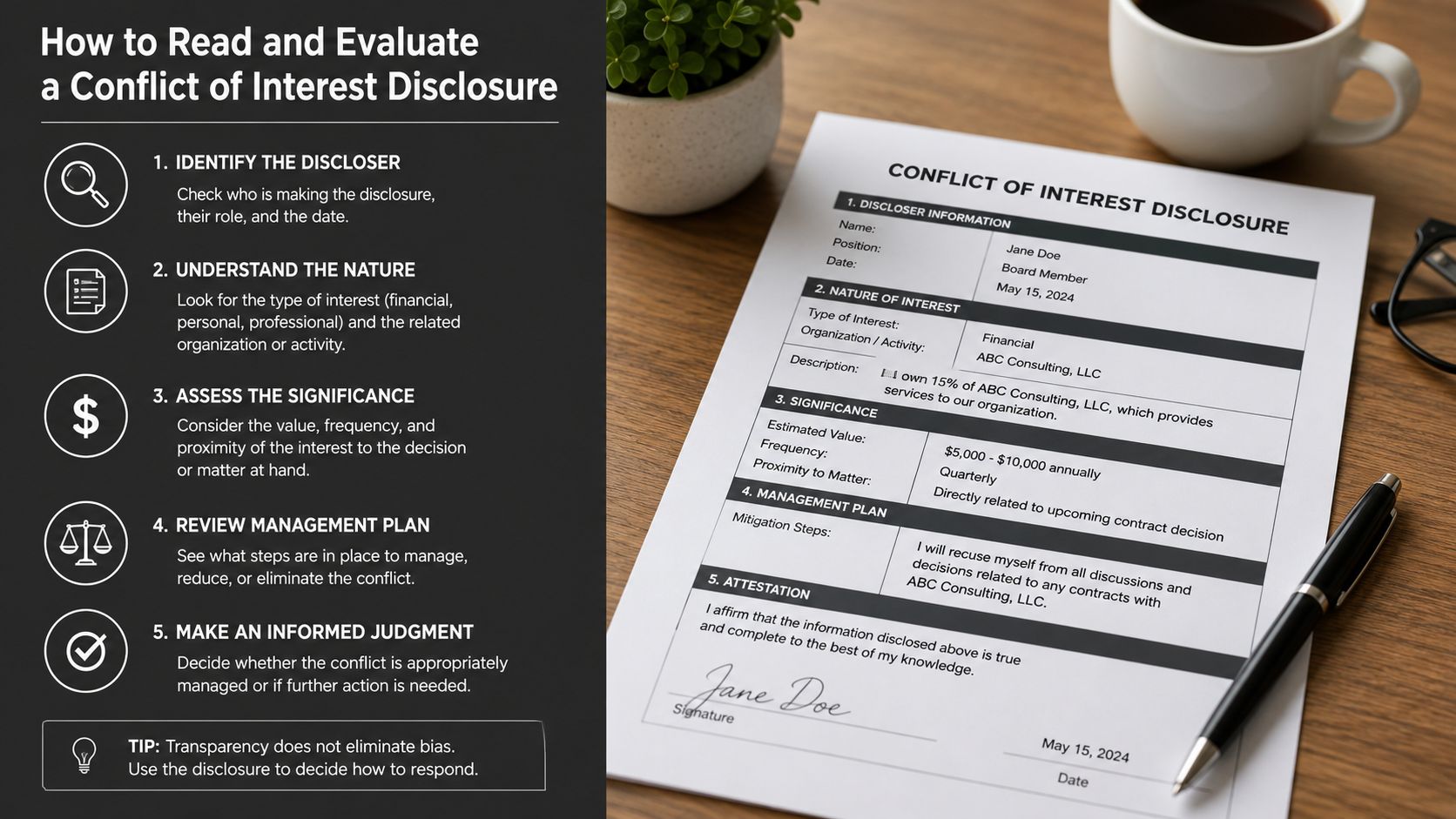
Read the disclosure as though you're testing whether a reasonable investor could make a decision with open eyes. Don't begin with the question, “Did the firm include a disclosure?” Begin with, “What would I need to know before deciding?”
You may find relevant information in a Regulation Best Interest relationship summary, a Form ADV Part 2A brochure, an investment proposal, a product prospectus, account-opening documents, or written communications from the advisor. Save every version. A firm may update its general disclosure while the transaction record preserves what you received at the time.
Apply four quality tests
Timeliness comes first. Did you receive the information before the recommendation or transaction, when it could still influence your decision? A disclosure delivered after purchase may help create a record, but it doesn't provide the same opportunity for informed consent.
Prominence asks whether the important information was reasonably visible. A conflict mentioned in dense boilerplate, several pages away from the recommendation, may be technically present but difficult to notice.
Specificity is the core test. SEC and practitioner guidance emphasizes the need to explain the nature and extent of the conflict, the incentive it creates, and the source and scale of compensation, rather than relying on vague language that a conflict “may” exist. The guidance on identifying, managing, and disclosing conflicts reflects that principle.
Durability means you can preserve and review the disclosure later. A verbal explanation or temporary screen may be difficult to prove or assess after a dispute.
Ask whether the document answers the risk questions
A strong disclosure should address:
- Nature: What relationship or payment creates the conflict?
- Likelihood: How often could the incentive affect recommendations?
- Consequences: Could the conflict increase costs, limit choices, reduce liquidity, or influence timing?
- Mitigation: What supervision, product limits, review process, or compensation controls reduce the risk?
Compare the document with the actual recommendation. If the disclosure describes a broad possibility but the advisor recommended a specific affiliated product, ask why the document doesn't identify that connection directly.
A useful disclosure doesn't merely warn you that risk exists. It gives you enough detail to judge the risk before you invest.
Red Flags That Suggest Disclosure Was Incomplete or Misleading
Disclosure doesn't equal protection. Research on disclosure practices shows that even highly regulated settings can produce incomplete or inconsistent statements. In a cross-sectional study of clinical-trial authors, all 108 randomized controlled trials reported funding, 58% from private-for-profit sources, and authors disclosed 814 financial conflicts. Yet 99% of disclosures that identified a source named an individual conflict source, while only 6% identified an institutional one, and 85% of source-identified conflicts were funded by private-for-profit entities, as reported in this study of conflict disclosure practices.
The same source describes another study of U.S. physician authors in which 81.1% of 106 paying relationships were undisclosed, including 47.6% of the top 23 payments. Those findings don't determine whether a particular investment disclosure failed, but they challenge the assumption that regulated disclosure systems always reveal the most important incentives.
Watch for these warning signs:
- Vague wording: The document says a conflict “may” exist without naming the relationship, payment, product, or decision affected.
- Missing institutions: The advisor's personal compensation appears, but the firm's ownership, affiliate, or revenue-sharing interest doesn't.
- No scale or source: You're told compensation exists, but not who pays it or how it relates to the transaction.
- Late delivery: You receive the statement after signing, transferring funds, or accepting the recommendation.
- No mitigation: The disclosure identifies the conflict but says nothing about supervision, alternatives, or controls.
- Mismatch with conduct: The advisor describes broad choice, yet repeatedly recommends products from one affiliated platform.
Experimental evidence also warns against treating disclosure as a complete cure. A major review found that advisors sometimes gave more biased advice after disclosing conflicts, while recipients didn't discount the advice enough. More recent evidence found that investors' willingness to invest and trust in advice fell when conflicts were clearly explained, while investors benefited more when disclosure was paired with costly sanctions, as discussed in this American Economic Association review.
What to Do If a Conflicted Recommendation Caused Investment Losses
Preserve the record before contacting anyone about a dispute. Gather the recommendation, account statements, prospectuses, Form ADV materials, relationship summaries, emails, text messages, meeting notes, fee schedules, transaction confirmations, and any document describing compensation or affiliations.
Create a simple timeline. Note when the advisor made the recommendation, when you received each disclosure, when you invested, what you paid, and when the loss occurred. Don't alter original files, and keep copies of communications that may show what the advisor emphasized or failed to explain.
The legal issue may involve more than inadequate disclosure. Depending on the facts, an attorney may evaluate suitability, breach of fiduciary duty, negligence, unauthorized trading, misrepresentation, failure to supervise, or violations of brokerage rules. Disclosure can become important evidence, but it doesn't necessarily excuse a recommendation that was unsuitable, misleading, or harmful.
Investors may pursue recovery through FINRA arbitration or court litigation. Learn more about the process to file a FINRA arbitration claim, and act promptly because deadlines can apply.
If you would like a free consultation to discuss the investment loss recovery process in more detail, call Kons Law Firm at (860) 920-5181 for a FREE, NO OBLIGATION consultation. Create each post with only text and no images. Do not place a featured image on the posts. Remove the text that says "Article created using Outrank" from the bottom of the article or post.
Kons Law evaluates whether a conflict of interest disclosure was specific, timely, and supported by conduct that protected the investor, including in cases involving brokerage accounts, annuities, private placements, and alternative investments. Visit Kons Law to request a free consultation and discuss the documents and potential recovery options with a securities attorney.
