
Let’s be crystal clear: pump-and-dump schemes are completely illegal. They are a textbook case of securities fraud, built from the ground up to manipulate markets and prey on everyday investors for a quick payday. This isn’t some legal gray area—it's a direct violation of federal laws designed to keep our markets fair.
The Illegality of Market Manipulation

A pump-and-dump scheme works on a simple, yet devastating, formula. First, fraudsters artificially inflate a stock's price using false, misleadingly positive statements (the "pump"). Once the price is sky-high, they sell off their own cheaply acquired shares (the "dump").
The scammers walk away rich, leaving a trail of deceived investors holding worthless stock as the price inevitably comes crashing down. This kind of manipulation poisons the well, undermining the very integrity of our financial markets.
The Foundation of Illegality
At their core, these schemes are illegal because they are built on a foundation of lies. U.S. financial markets are supposed to run on transparency, where a stock’s price reflects a company’s actual value based on public, accurate information. A pump-and-dump scheme throws a wrench in the works by flooding the market with pure fiction.
This deliberate deception is exactly what securities laws were created to stop. The entire regulatory framework is there to make sure all investors have access to the same critical information. When fraudsters spread rumors or issue fake press releases, they’re creating a rigged game, tricking others into making decisions based on lies.
To better understand how these schemes unfold, let's break down the typical lifecycle.
Anatomy of an Illegal Pump and Dump Scheme
The table below illustrates the four main stages of a classic pump-and-dump operation, from the quiet beginning to the chaotic end.
| Stage | Promoter's Action | Impact on Stock | Investor's Experience |
|---|---|---|---|
| 1. Accumulation | Fraudsters secretly buy large amounts of a low-priced, thinly traded stock (often a penny stock). | Minimal price change. The activity is kept under the radar. | Unaware. The stock isn't on most investors' radars yet. |
| 2. The Pump | A massive promotional campaign begins, using spam emails, social media, and fake news to hype the stock. | The stock price and trading volume soar as hype builds and FOMO (fear of missing out) kicks in. | Hears exciting "news" and sees the price rising, prompting them to buy in. |
| 3. The Dump | Once the price peaks, the original promoters sell—or "dump"—all their shares for a massive profit. | The massive sell-off overwhelms buy orders, causing the stock price to plummet rapidly. | The price collapses without warning. They are left holding shares worth a fraction of what they paid. |
| 4. The Collapse | With the promoters gone and the hype exposed as fake, the stock price crashes back to its original low level, or even lower. | The stock becomes virtually worthless and trading volume dries up. | Experiences significant or total loss of their investment. |
As you can see, the entire process is engineered for one outcome: enriching the promoters at the expense of everyone else.
Key Laws and Regulations
Pump-and-dump schemes are explicitly outlawed under several key U.S. federal securities laws. The big ones are Section 10(b) of the Securities Exchange Act of 1934 and the Securities Act of 1933. These laws prohibit any fraud or material misstatements connected to the buying or selling of securities. You can discover more insights about common types of securities fraud and see how these laws apply in different situations.
This legal framework gives regulators like the Securities and Exchange Commission (SEC) the muscle they need to investigate and prosecute offenders.
The essence of this fraud is the deliberate creation of an artificial reality. Promoters paint a picture of a company on the verge of a breakthrough, knowing full well it's a fiction designed solely to drive up the price for their exit.
The penalties for getting caught are no slap on the wrist. They can be life-altering and often include:
- Heavy Fines: Financial penalties can easily run into the millions of dollars.
- Disgorgement: Fraudsters are forced to return every penny of their illegally obtained profits.
- Prison Sentences: For serious offenses, individuals can face years behind bars.
- Industry Bars: Perpetrators can be permanently banned from working in the securities industry.
If you believe you've been victimized by a pump-and-dump scheme, you may have legal recourse to recover your losses. If you would like a free consultation to discuss the investment loss recovery process in more detail, call Kons Law Firm at (860) 920-5181 for a FREE, NO OBLIGATION consultation.
Understanding How a Pump and Dump Works
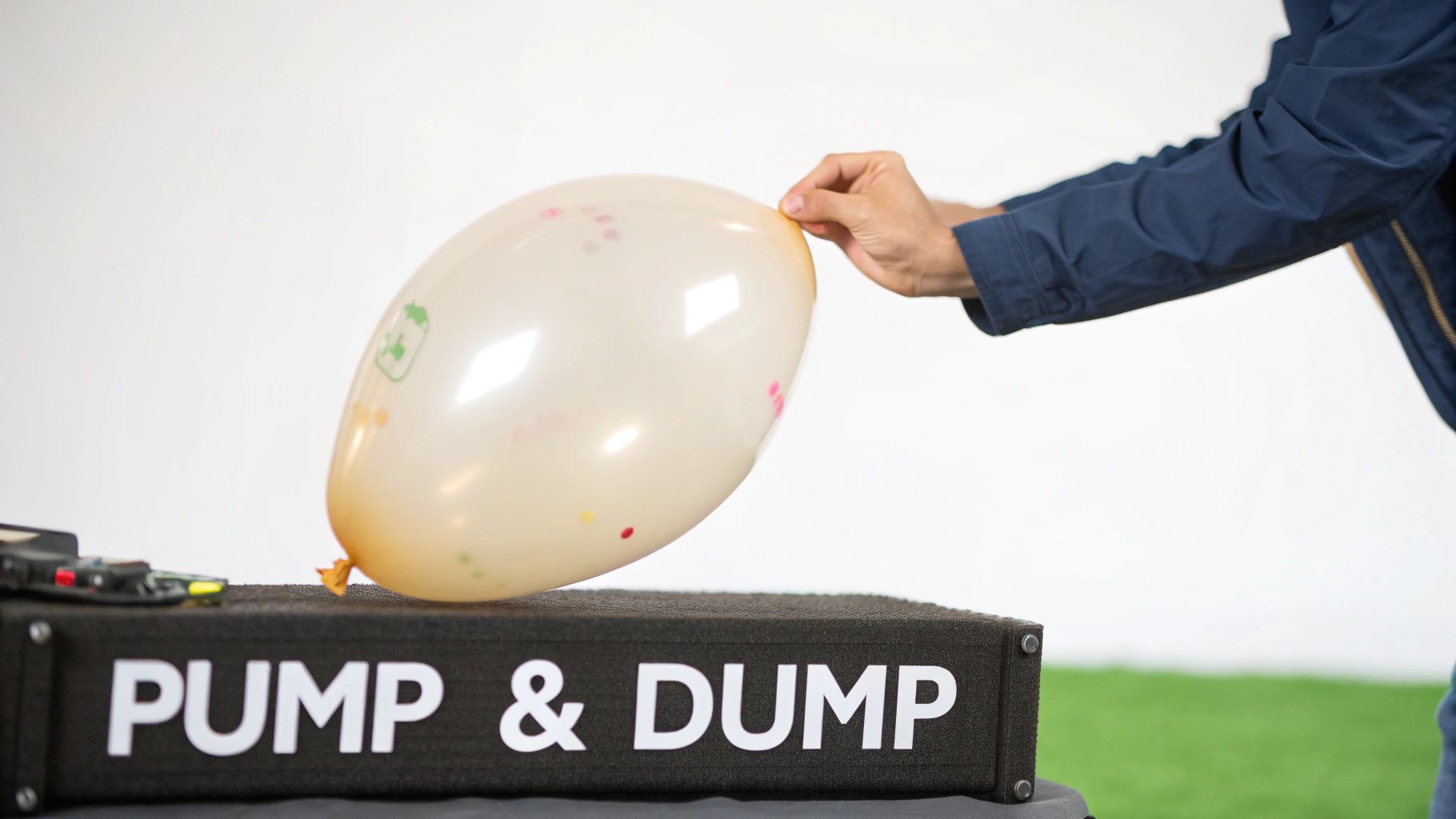
Think of a pump-and-dump scheme as a carefully orchestrated illusion. Fraudsters create a mirage of a thriving company, lure in unsuspecting investors with promises of massive returns, and then vanish with the money, leaving everyone else with worthless stock.
It’s a classic form of securities fraud, and while the methods have modernized, the core deception is the same. The scheme unfolds in three deliberate phases, each designed to manipulate market psychology and fleece investors out of their hard-earned money.
Phase 1: The Quiet Accumulation
The con begins silently. The architects of the scheme target a specific type of stock—almost always a penny stock or a micro-cap company. These companies are ideal targets because their shares are cheap, trade in low volumes, and have very little public information available, which makes them incredibly easy to manipulate.
During this initial accumulation phase, the fraudsters quietly buy up a huge position in the stock. The key is to do this without drawing any attention. By keeping their purchases under the radar, they avoid causing any sudden jumps in the stock's price or trading volume, allowing them to secure a massive stake at rock-bottom prices before the hype machine kicks in.
Phase 2: The Deceptive Pump
Once the manipulators are fully invested, it’s time to start the "pump." This phase is all about noise and deception. They launch an aggressive marketing campaign built on lies and exaggerated claims, all designed to create a buying frenzy among retail investors.
The tactics used today are sophisticated and widespread:
- Social Media Blitz: Fraudsters create coordinated campaigns on platforms like X (formerly Twitter), Reddit, and Telegram. They flood these forums with posts hyping the stock, setting unrealistic price targets, and creating a false sense of consensus.
- Fake News and Press Releases: They will often issue bogus press releases claiming the company has discovered a miracle drug, secured a game-changing partnership, or developed a revolutionary new technology.
- Impersonating Experts: They might create fake analyst reports or use AI-generated articles to give their claims a veneer of credibility and trick investors into thinking the hype is real.
- Spam Campaigns: Millions of emails and text messages are sent out, disguised as "hot stock tips" from insiders, promising guaranteed, can't-miss profits.
This flood of misinformation triggers a powerful sense of FOMO (fear of missing out). As everyday investors see the stock price start to climb, they pile in, which only drives the price higher. This is where the real damage happens, and some schemes are made worse by brokers who get caught up in the frenzy, leading to cases involving the unsuitable sales of penny stocks.
Phase 3: The Inevitable Dump
This is the brutal final act. Just as the buying hysteria hits its peak and the stock price soars to an artificial high, the organizers who started the rumor mill sell—or "dump"—all of their shares. This is often done in a coordinated fashion to unload their entire position before the house of cards collapses.
The dump is the moment the rug is pulled out from under investors. The massive sell-off by the scheme’s organizers completely overwhelms the market with supply, crushing the artificial demand they created.
The result is an immediate and catastrophic price crash. With the manipulators out and no real news or fundamentals to support its inflated value, the stock price plummets, often falling back to its original price—or even lower—in a matter of minutes.
Investors who bought into the hype are left holding the bag, stuck with shares that are now virtually worthless and facing a total loss of their investment. Meanwhile, the scammers walk away with millions in illegal profits, leaving a trail of financial devastation behind them.
The Laws That Make Market Manipulation a Crime
To see why pump-and-dump schemes are flat-out illegal, we have to look at the legal framework built to protect investors and keep the markets fair. These aren't just unethical tactics; they are direct violations of foundational U.S. securities laws that have been on the books for nearly a century. This isn't a gray area—it's a well-defined crime.
The legal muscle for prosecuting this type of fraud comes mainly from two landmark laws: the Securities Act of 1933 and the Securities Exchange Act of 1934. These acts were passed after the 1929 market crash to rebuild public trust by forcing transparency and outlawing fraudulent practices.
The Power of Section 10(b) and Rule 10b-5
Tucked inside the Securities Exchange Act of 1934 is its most powerful anti-fraud weapon: Section 10(b). This section makes it illegal for anyone to use any "manipulative or deceptive device" when buying or selling securities. The language is deliberately broad, giving regulators the power they need to go after a wide range of shady activities, including pump-and-dump schemes.
To put this law into action, the Securities and Exchange Commission (SEC) created Rule 10b-5. This rule gets specific about what counts as a manipulative or deceptive device.
Under Rule 10b-5, it is illegal to make any untrue statement of a material fact or to omit a material fact that would make other statements misleading. This is the core prohibition that makes pump-and-dump schemes illegal.
The "pump" phase, where fraudsters blast out fake news or wild claims, is a textbook case of making untrue statements of a material fact. For example, claiming a tiny biotech company is about to cure cancer when there's no data to back it up is a material misrepresentation. It’s a lie designed to trick people into buying the stock, which is a direct violation of federal law.
The Market's Watchdogs: SEC and FINRA
Enforcing these laws requires dedicated regulators. The two main agencies policing the U.S. securities markets are the Securities and Exchange Commission (SEC) and the Financial Industry Regulatory Authority (FINRA).
- The Securities and Exchange Commission (SEC): The SEC is a federal agency with a clear mission: protect investors, maintain fair markets, and help businesses raise capital. It has the power to bring civil enforcement actions against people and companies that break securities laws, seeking penalties like fines, disgorgement of illegal profits, and bans from the industry.
- The Financial Industry Regulatory Authority (FINRA): FINRA is a non-governmental, self-regulatory organization that oversees brokerage firms and their brokers. It writes and enforces the rules that all registered broker-dealer firms must follow, with the goal of protecting investors by making sure the industry operates honestly.
Together, the SEC and FINRA act as the market’s cops on the beat. They actively monitor trading data for suspicious patterns, investigate tips from whistleblowers, and use sophisticated analytics to spot potential manipulation.
When they find a pump-and-dump scheme, they can freeze assets, halt trading in the stock, and take legal action against the people responsible. For investors who have been burned, understanding the process of filing claims is a core part of what is securities litigation. The actions these regulators take are often the first step for victims trying to recover their money.
If you have lost money in what you suspect was a fraudulent investment scheme, you may have legal options. If you would like a free consultation to discuss the investment loss recovery process in more detail, call Kons Law Firm at (860) 920-5181 for a FREE, NO OBLIGATION consultation.
Real-World Examples of Pump and Dump Schemes

To really understand how destructive pump and dump schemes can be, it helps to look at cases from the real world. These stories show how the scams have evolved, but the fraud at their core is always the same. Whether it's high-pressure sales calls or viral social media posts, the playbook is simple: enrich the scammers at the expense of everyone else.
These examples are cautionary tales. They put a face to the abstract concept of market manipulation, showing the real consequences for the perpetrators who face prison time and the investors left with devastating losses.
The Original Boiler Room Stratton Oakmont
The most infamous pump and dump scheme is probably Stratton Oakmont, the firm run by Jordan Belfort, which was later immortalized in The Wolf of Wall Street. Back in the 1990s, Belfort’s firm perfected the "boiler room" tactic. They unleashed an army of aggressive brokers to cold-call unsuspecting investors and push worthless penny stocks with fabricated, high-pressure pitches.
Stratton Oakmont’s game was to artificially inflate stock prices with a flood of false positive statements. Once they convinced enough people to buy in and the price peaked, Belfort and his partners would dump all their shares. They walked away with millions, leaving their clients' investments completely wiped out. Belfort was eventually convicted of securities fraud, a clear signal of the serious legal fallout from these schemes.
The Modern Era Social Media and Influencer Fraud
Today, the boiler room has gone digital. It’s been replaced by social media forums and influencer accounts. The tactics haven't changed much, but the delivery is now instant and reaches a massive audience, making these modern schemes especially dangerous for everyday investors.
A recent, high-profile case involved a group of social media influencers using platforms like X (formerly Twitter) and Discord to tout specific stocks to their followers. They branded themselves as expert stock pickers, blasting out "buy alerts" that created a buying frenzy.
The scheme was simple but brutally effective: the influencers bought a stock, hyped it up to their audience to drive the price sky-high, and then sold their shares for a huge profit while their followers were still buying.
The SEC ultimately charged eight people in this scheme with securities fraud, alleging they generated over $100 million in illegal profits. This case shows that regulators are catching up to new technology and will pursue fraud no matter where it happens.
To help investors spot these scams before it's too late, it's crucial to recognize the common warning signs.
Red Flags of a Potential Pump and Dump Scheme
| Warning Sign | What It Looks Like | Why It Is a Red Flag |
|---|---|---|
| Unsolicited Hype | You receive unexpected emails, social media messages, or see online ads promoting a "once-in-a-lifetime" stock opportunity. | Legitimate companies and brokers don't typically use spam-like tactics. This is designed to create a sense of urgency and FOMO (Fear Of Missing Out). |
| "Guaranteed" High Returns | The promotion promises massive, quick profits with little to no risk. Phrases like "guaranteed winner" or "the next big thing" are common. | All investments carry risk. Promises of guaranteed high returns are a classic hallmark of fraud. |
| Pressure to Act Immediately | You're told you have to buy right now before the price explodes. The information is framed as an exclusive, time-sensitive tip. | Scammers create false urgency to prevent you from doing your own research or thinking critically about the investment. |
| Promotion of Penny Stocks | The stock being pushed is a low-priced "penny stock" that trades over-the-counter (OTC) rather than on major exchanges like the NYSE or NASDAQ. | These stocks are often thinly traded and lack public information, making them easy for manipulators to control and artificially inflate. |
| Vague or Overly Promotional Information | The "research" provided is full of exciting buzzwords and projections but lacks concrete financial data, business plans, or details about company operations. | Real investment analysis is based on fundamentals, not just hype. A lack of substance is a major red flag. |
Being vigilant for these red flags is your first line of defense against becoming a victim.
The Wild West of Cryptocurrency Schemes
The cryptocurrency market, with its relative lack of regulation, has become a hotbed for pump and dump schemes. Scammers often create new tokens with no real-world use, then orchestrate massive hype campaigns on platforms like Telegram and Reddit.
- Coordinated Buys: Organizers will announce a specific time to buy a targeted, low-value coin, triggering a massive, artificial price spike.
- Insider Advantage: The organizers and their friends buy the coin right before the public announcement, ensuring they can sell at the peak price.
- The Inevitable Crash: As soon as the price moons, the insiders dump all their holdings. The token’s value plummets, leaving thousands of participants holding worthless digital assets.
These crypto schemes are especially destructive because they can unfold in a matter of minutes. Regulators like the SEC have started to crack down, bringing charges against organizers and making it clear that securities fraud laws apply to digital assets, too. For victims of schemes involving thinly-traded assets, understanding their investment loss recovery options for CodeSmart Holdings (ITEN) can offer a useful parallel for pursuing a claim.
From old-school boiler rooms to modern crypto chats, these cases all prove the same point: pump and dump schemes are a serious crime with devastating consequences for investors. If you would like a free consultation to discuss the investment loss recovery process in more detail, call Kons Law Firm at (860) 920-5181 for a FREE, NO OBLIGATION consultation.
How Victimized Investors Can Pursue Recovery
Realizing you've been caught in an illegal pump-and-dump scheme is a gut-wrenching moment. It can leave you feeling financially devastated and emotionally betrayed. While it’s easy to feel defeated, it's crucial to know that you are not powerless. Federal and state laws give defrauded investors real avenues to seek justice and potentially get their money back.
The key is to take quick, decisive action. This starts by shifting your mindset from being a victim to actively participating in your own recovery. That means gathering your evidence and understanding exactly where to report the fraud.
Building Your Case: The First Steps
Before any legal action can begin, you have to gather all the relevant documents tied to your investment. Essentially, you're becoming the lead investigator on your own case. The more thorough your records, the stronger your position will be when you file a complaint or speak with an attorney.
Your evidence file should include:
- Trade Confirmations: Collect every record showing when you bought and sold the stock, including the share counts and prices.
- Promotional Materials: Save every email, text message, social media post, or forum comment that lured you into investing. Screenshots are your best friend here.
- Communications: Document any conversations with brokers or anyone who pushed the stock on you. Note the dates and the specific claims that were made.
- Account Statements: Pull together all your brokerage statements from the time period in question. These show the clear financial damage the scheme did to your portfolio.
This paperwork is the foundation of any potential claim. It proves not only that you made the investment but also that you were induced by misleading information.
Reporting Fraud to Regulatory Bodies
With your evidence organized, the next move is to report the fraud to the authorities who police the financial markets. The two main agencies you'll deal with are the Securities and Exchange Commission (SEC) and the Financial Industry Regulatory Authority (FINRA).
Filing a complaint is a critical step. It not only helps your personal case but also alerts regulators to the scam, which can protect countless other investors from falling into the same trap. Both the SEC and FINRA have user-friendly online portals to submit your information: the SEC’s Tip, Complaint, or Referral (TCR) portal and the FINRA Investor Complaint Center.
While regulatory actions can bring the fraudsters to justice and hit them with fines, this process doesn't automatically put money back in your pocket. To recover your personal losses, you typically need to pursue a private claim.
Seeking Direct Financial Recovery Through Legal Action
For most victims, the most direct path to getting your money back is through private securities litigation or arbitration. This is where you—often with the guidance of a specialized attorney—bring a claim directly against the parties responsible for your losses.
There are two primary avenues for this:
- FINRA Arbitration: If a brokerage firm or a licensed financial advisor recommended the fraudulent stock to you, you can file an arbitration claim through FINRA. This process is generally faster and less formal than going to court and is specifically designed to handle disputes between investors and brokerage firms.
- Class-Action Lawsuits: If the pump-and-dump scheme harmed a large group of investors in the same way, a class-action lawsuit may be an option. In this scenario, one or more investors will act as lead plaintiffs to represent the entire group.
Navigating these legal waters requires deep knowledge of securities law. It's essential to consult with an experienced financial fraud attorney to figure out the best strategy for your specific situation.
If you have lost money in a potential pump-and-dump scheme, taking decisive action is critical. If you would like a free consultation to discuss the investment loss recovery process in more detail, call Kons Law Firm at (860) 920-5181 for a FREE, NO OBLIGATION consultation.
Practical Ways to Avoid Investment Fraud

When it comes to protecting your capital from an illegal pump-and-dump scheme, the best offense is a good defense. You have to shift your mindset from reacting to losses to proactively vetting every single opportunity before a dollar leaves your account. A healthy dose of skepticism isn't paranoia; it's your single greatest tool against fraud.
Seasoned investors know that unsolicited "hot tips" from social media or spam emails are almost always a trap. They do their own homework, digging deep into a company's fundamentals. This is the only reliable way to tell a legitimate business from a scam built to steal your hard-earned money.
Conduct Thorough Due Diligence
Before you even think about investing, you need to become your own financial detective. Never, ever take promotional claims at face value, especially when they involve small, obscure companies. The facts you need are usually out there in the open, as long as you know where to search.
A fantastic place to start is the SEC's EDGAR database, which is the official repository for company filings. You should look for crucial documents like:
- Form 10-K: This is the company's annual report. It gives you a comprehensive overview of its business operations, financial health, and, most importantly, the risks involved.
- Form 8-K: This report is filed to announce major events that shareholders need to know about right away, such as a merger, bankruptcy filing, or a change in executive leadership.
Reading these official filings gives you a clear picture based on facts, not the manufactured hype you see online. If a company isn't filing these basic reports with the SEC, that's a massive red flag telling you to stay away.
Recognize the Hallmarks of Fraud
Fraudsters aren't creative; they use the same old playbook time and again because it works. They prey on basic human emotions, especially the fear of missing out (FOMO) and the allure of fast, easy money. Learning their tactics is key to spotting them early.
A core tenet of sound investing is that there is no such thing as a guaranteed return. Any promise of massive, risk-free profits is almost certainly a lie designed to bypass your critical thinking.
Be extremely wary of anyone using high-pressure sales tactics to rush you into a decision. Scammers invent a false sense of urgency to stop you from doing your own research. If you feel cornered or pressured to "act now," the smartest thing you can do is walk away. A legitimate investment opportunity will still be there tomorrow.
Ultimately, protecting yourself boils down to a simple checklist:
- Verify the Source: Is this tip coming from a reputable financial advisor or an anonymous account on a social media platform?
- Check Official Filings: Is the company up-to-date with its SEC filings? Can you find its Form 10-K?
- Question the Promises: Do the promised returns sound realistic, or are they too good to be true? (Hint: If they sound too good to be true, they are.)
- Resist the Pressure: Are you being pushed to make an immediate decision? Real opportunities don't come with a ticking clock.
If you have been victimized by investment fraud, remember you have options. If you would like a free consultation to discuss the investment loss recovery process in more detail, call Kons Law Firm at (860) 920-5181 for a FREE, NO OBLIGATION consultation.
Frequently Asked Questions About Pump and Dump Schemes
Let's clear up a few common questions about these market manipulation schemes. These answers should help you understand why these scams are illegal and how you can spot the warning signs.
Are Pump and Dumps Illegal in Cryptocurrency Markets
Yes, absolutely. Even though the rules for digital assets are still being fully fleshed out, the fundamental laws against fraud and market manipulation still apply. It doesn't matter what the asset is.
The SEC has successfully gone after crypto pump-and-dump schemes by applying existing securities laws. Promoters pushing fraudulent crypto tokens face the same stiff civil and criminal penalties as those manipulating old-school stocks. The scam is the same, and regulators are treating it that way.
What Is the Difference Between a Pump and Dump and Legitimate Stock Promotion
The bright line separating the two is deception. Legitimate promotion is all about sharing factual, verifiable information to attract real, long-term investors. A pump-and-dump scheme, on the other hand, is built on a foundation of lies, misleading statements, and wild exaggerations.
The only goal of a pump and dump is to artificially jack up a stock's price for a quick cash-out. What's more, legitimate promoters must disclose any payment they receive for their marketing work—a rule that fraudsters almost always break.
It really comes down to this: one is transparent communication, the other is calculated fraud.
Can I Get in Trouble for Unknowingly Participating in a Pump and Dump
Generally, no. Securities fraud cases hinge on intent. If you were an unsuspecting victim who bought a stock based on lies and lost money, you aren't the person regulators are after. In fact, the laws are there to protect you.
However, if you knowingly join a group with the stated purpose of manipulating a stock's price, you could be exposed to legal trouble, even if you weren't one of the ringleaders. The safest bet is always to base your investment decisions on your own solid research, not on hype from anonymous online accounts.
What Should I Do If I Suspect a Pump and Dump Scheme
If you see the classic red flags of a pump and dump, the smartest thing you can do is walk away. Don't invest a single penny.
To help protect others from falling into the same trap, you can report your suspicions directly to the SEC. You can file a report through its official online Tip, Complaint, or Referral (TCR) portal. Be sure to provide specifics about the stock, the misleading promotions, and the platforms or people involved. This information gives regulators the fuel they need to launch an investigation.
If you would like a free consultation to discuss the investment loss recovery process in more detail, call Kons Law Firm at (860) 920-5181 for a FREE, NO OBLIGATION consultation.
