You may already have the statements, the emails, and the sinking feeling that something was off. A wire went out without a good explanation. An account showed activity you never approved. Your advisor brushed off questions, and the firm's answers got vaguer the harder you pressed. That's not just bad service. In the right case, it's the kind of failure that points to anti-money laundering compliance breakdowns, and those breakdowns can leave investors holding the loss.
When firms miss suspicious activity, ignore weak customer verification, or let sloppy controls go unchecked, the damage doesn't stay on a spreadsheet in the compliance department. It lands in a real account, with real money, and sometimes with a fraud scheme that could have been stopped earlier. Regulators treat AML as a formal control obligation for a reason, and investors should treat it the same way. If the firm's controls failed, you may have more than a complaint. You may have a recovery claim.
When AML Failures Cost You Money
A client opens a brokerage statement and sees transfers that don't fit the pattern of the account. The advisor says there's a routine explanation, but the paper trail doesn't line up. Days later, the investor learns that the firm never asked the right questions, never escalated the red flags, and never caught what should have been obvious. That is how AML lapses turn into personal losses.
The point is simple. Anti-money laundering compliance is not a back-office formality. It is one of the systems that should stop fraud, unauthorized movement of funds, and suspicious activity before the money disappears. When it fails, the investor often pays twice, first through the loss itself and again through the delay, confusion, and document-gathering that follows.
Why investors should care
Firms often talk about AML as if it only protects the institution from regulatory scrutiny. That's too narrow. Strong controls protect customer accounts by forcing the firm to verify identities, spot unusual activity, and record what happened when something looks wrong. Weak controls let bad actors move faster and hide longer.
Practical rule: If a firm can't explain who reviewed the activity, what triggered the review, and why the account stayed open, treat that as a serious warning sign.
For investors, that matters in fraud, theft, impersonation, Ponzi-type schemes, and even advisor misconduct that rides on weak internal checks. If the firm ignored obvious problems, those failures can support claims that the broker, advisor, or firm did not meet the duties owed to you. That is where recovery starts, not with excuses from the other side.
A careful lawyer will look at whether the firm's AML controls should have flagged the conduct earlier, whether the account activity matched the customer profile, and whether the firm's own records tell a story of delay or indifference. The investor doesn't need to prove every regulatory violation at the outset. The investor needs to preserve the evidence that shows the firm's controls broke down and that the breakdown caused avoidable harm.
The Legal Framework Behind AML Compliance
The legal rules are not vague, and firms don't get to treat them like optional industry guidance. Under the U.S. Bank Secrecy Act framework summarized by GAN Integrity's AML reference, covered financial institutions must file reports for cash transactions exceeding $10,000 per day in the aggregate and maintain a formal AML program with five required components, including internal controls, independent testing, a designated compliance person, training, and a customer identification program using risk-based procedures. That's the baseline, not the ceiling.
Broker-dealers are also pulled into this structure through FINRA's AML rule set. FINRA requires a member firm's AML program to be approved in writing by a senior manager, independently tested, and supported by ongoing training for the right personnel. FINRA also requires each member firm to submit the AML Compliance Officer's contact information through the FINRA Contact System, which shows how seriously the rule treats governance and supervision. For a plain-English discussion of the broker-dealer rule itself, see this overview of NASD Rule 3310.
What those duties mean in practice
A real AML program should do more than generate paperwork. It should identify customers, check whether their activity fits the stated profile, and escalate unusual transactions fast enough to matter. If a firm opens the account, takes the documents, and then ignores the pattern of activity, the program is a shell.
The same logic applies to suspicious activity reporting. Firms are supposed to document and report conduct that suggests possible wrongdoing, not wait until the customer is already gone or the money is already layered through multiple accounts. That's why AML failures often show up together with suitability problems, unauthorized trading, and outright fraud.
For investors, the legal lesson is blunt. When the institution is covered by AML rules, it is already on notice that weak controls can produce foreseeable harm. If the firm's staff failed to follow the required process, the firm may have handed you the factual basis for a FINRA arbitration claim or, in some cases, securities litigation.
Five Essential Components of an AML Program
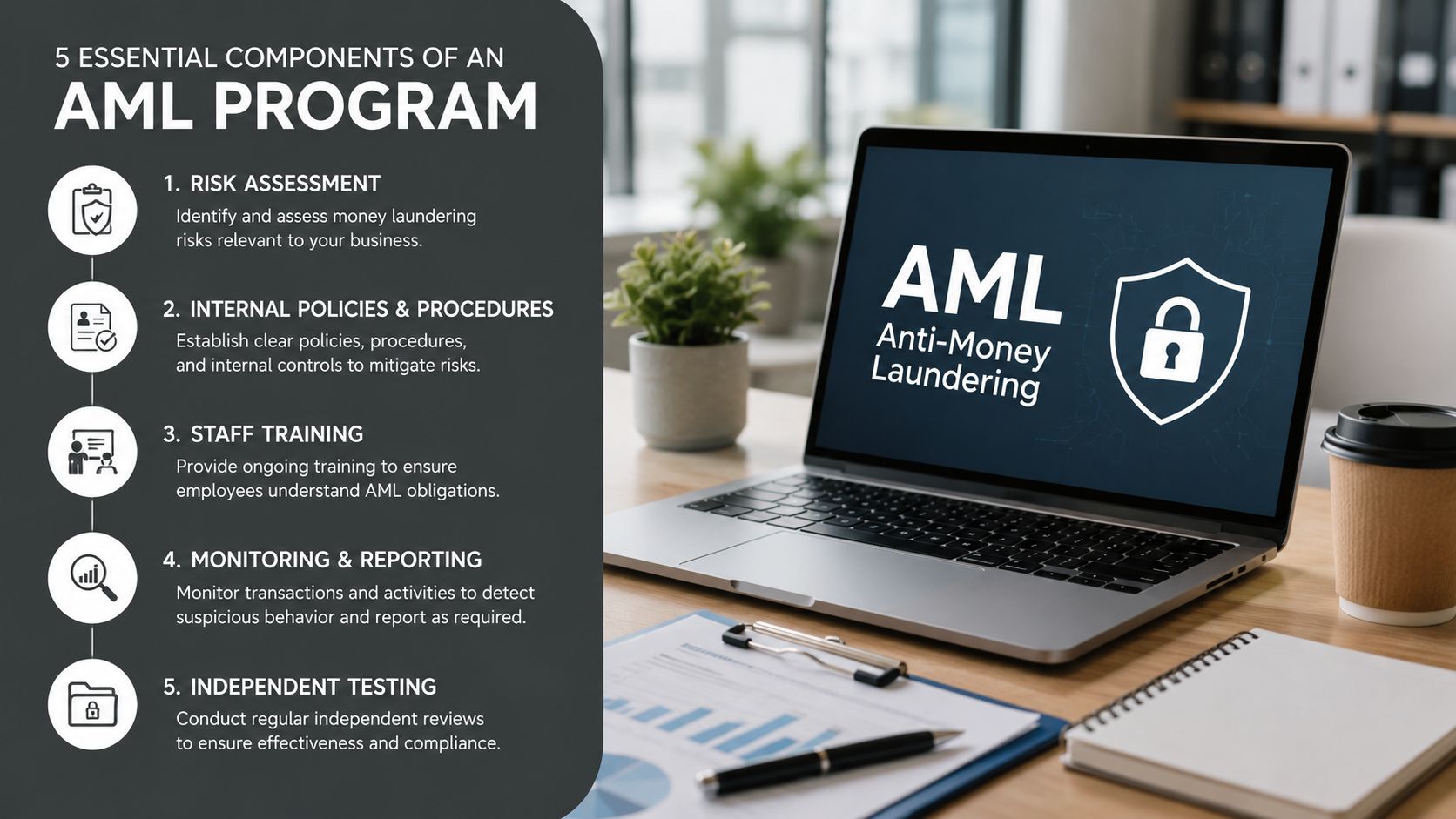
A real AML program has to work in the field, not just on paper. The five required components under the BSA framework are the controls that should stop suspicious conduct from slipping through a brokerage, advisory, or financial-services operation. When one component is weak, the whole system becomes easier to bypass, and investors are the ones who usually pay for it.
Internal controls and written procedures
This is the rulebook. It should tell staff what to flag, how to escalate it, and who makes the call when activity looks off. A firm that copies a template policy and never trains people to use it is signaling trouble, because the policy exists only to protect the firm after the fact.
Independent testing
The firm cannot audit itself through the same people who run the daily process. Independent testing should look for gaps, missed alerts, stale procedures, and unresolved exceptions. A clean report means little if nobody followed up on the problems it found, or if the firm ignored the findings once the report landed.
A designated compliance person
Someone has to own the program. FINRA's governance model makes that clear, and so do industry standards. If no one can identify the person accountable for the AML function, the firm is already in a bad place, and any investor harm that follows will be easier to trace to supervision failures.
Training and customer identification
Training should be ongoing, not a one-time slide deck. Customer identification should rely on risk-based procedures that test who the client is and whether the story makes sense. For a useful document-management angle on building those records, essential compliance documentation 2026 is a helpful reference point, and this overview of KYC documentation requirements explains what those records should contain.
Due diligence that matches the risk
Investors get hurt when firms cut corners. A good program checks beneficial ownership, compares stated purpose to actual activity, and updates the file when behavior changes. A weak one lets the account drift until the damage is done, then blames the customer for not speaking up sooner.
A firm that treats AML as a checklist usually discovers problems after the money is gone. A firm that treats it as a control function catches problems while they are still recoverable.
For investors, the question is not whether the firm had an AML policy. It is whether the five components were real, current, and enforced. If they were not, the control failure belongs in your claim file.
Red Flags That Signal AML Compliance Failures
Firms rarely announce that their AML process is broken. The warning signs show up in behavior, records, and the way staff handle questions. If the adviser gets defensive whenever you ask how a transfer was approved, that's not confidence. It's avoidance.
What broken controls look like
A firm with weak AML oversight tends to show the same patterns again and again. Transactions get approved without a meaningful explanation. Customer files stay stale even after the account behavior changes. Questions about source of funds, third-party instructions, or beneficiary ownership get answered with boilerplate rather than facts.
The most damaging red flag is silence. If suspicious activity should have been escalated but wasn't, the client may never know until much later. That delay matters because it lets the wrongdoing grow, and it makes recovery harder. For a deeper look at the reporting side of that problem, this discussion of suspicious activity reporting fits the investor's perspective better than most compliance summaries do.
Investor-facing warning signs
- Unexplained transfers or repeated wires: If the account shows movement that doesn't match your instructions or risk profile, demand the approval trail.
- Pressure to skip documentation: If a firm wants a fast close without complete customer information, it may be trying to avoid scrutiny.
- Unusual transaction patterns: Frequent movement through unrelated accounts, rapid in-and-out transfers, or activity that doesn't fit the stated purpose should trigger immediate review.
- Dismissive answers from staff: When employees discourage questions about monitoring, reporting, or internal review, they're telling you more than they intend.
The question investors should ask is not whether the firm sounded professional. It is whether the controls would have caught the conduct if someone inside the firm had been paying attention. That's the difference between a functioning system and a paper program.
If you're trying to prove a case, keep the focus on what changed, who knew it, and what the firm did next. In AML cases, the firm's reaction often matters as much as the original transaction. A fast, careful response helps the customer. A slow, evasive one can support a claim that the firm already knew the risk and chose not to act.
Enforcement Trends and Real-World Consequences
AML enforcement has stopped being a niche banking issue and become a broad supervisory expectation across financial and professional-services firms. The UK Solicitors Regulation Authority reported that 5,569 firms were within scope of the money laundering regulations by 5 April 2025, which was around two-thirds of the 9,149 firms it authorizes, showing how widely these obligations now reach beyond traditional banking SRA annual report. That scale matters because it tells you the compliance burden is no longer isolated to a few large institutions.
The cost side is just as stark. Feedzai's 2024 global report says AML compliance costs reached $213 billion worldwide in 2020, and Fenergo's 2025 research says that since the 2007 financial crash, more than $69 billion in enforcement actions has been levied against financial institutions and individuals for AML violations Feedzai report. Those numbers show two things at once, compliance is expensive, and failure is even more expensive.
What regulators are really looking for
Since the post-crisis enforcement era hardened, regulators have pushed firms toward stronger KYC, sanctions screening, and suspicious-activity detection. They are not impressed by a policy binder that sits untouched in a compliance folder. They want evidence that the firm used the controls, reviewed the alerts, and updated the risk picture when facts changed.
That is why cases involving AML problems often reveal broader misconduct. A weak monitoring system can coexist with unsuitable recommendations, unauthorized account activity, or outright fraud. The institution may say the AML problem is separate, but the investor usually experiences it as one combined failure.
For a real-world example of how laundering allegations can intersect with broader financial misconduct, The Coin Course's reporting on a major laundering probe is a reminder that these issues can reach far beyond routine account administration. The investor lesson is simple. When the compliance culture is loose, the losses rarely stay neatly contained.
That's why enforcement trends matter to recovery. The same red flags regulators punish are often the ones that help an investor show the firm ignored obvious warning signs. In arbitration or litigation, that connection can turn a bad outcome into a recoverable case.
Steps to Take When AML Lapses Harm Your Investments
Move fast, but move carefully. The first job is to freeze the facts before the firm controls the narrative. Save every statement, trade confirmation, wire record, chat, email, and voicemail that shows what happened and when.
Build the record before the firm cleans it up
Start with a timeline. List the first unusual transaction, the first unanswered question, and every time the advisor or firm gave you a different explanation. Then gather the account-opening paperwork, risk profile, and any forms that show what the firm says it knew about you.
You should also identify the specific moments where AML controls should have triggered. That can include transfers that made no sense for the account, repeated third-party instructions, or activity that clearly departed from the customer profile. If the firm's documentation is thin, that itself can help show the gap between what should have happened and what did.
Practical rule: Don't argue about every detail before you have the records. First get the statements, preserve the messages, and lock down the sequence of events.
Decide whether the facts point to recovery
AML lapses often show up alongside fraud, unauthorized trading, Ponzi schemes, or theft through account access. If the loss came from conduct the firm should have caught, your next move is to evaluate whether the broker-dealer, adviser, or custodian failed in its monitoring and supervision duties. That's where FINRA arbitration often comes in.
For a filing roadmap, this guide on how to file a FINRA complaint is useful because it shows how complaints move from suspicion to a formal claim. You don't need to master the process before calling counsel. You do need enough organized evidence to show that the problem was more than market loss or bad luck.
Avoid the mistakes that weaken claims
- Don't sign a vague release: Firms sometimes offer partial fixes in exchange for broad peace. Read carefully before you give anything up.
- Don't delay after discovery: The longer you wait, the more room the firm has to bury the trail or shift blame.
- Don't focus only on the advisor: In many cases, the supervising firm matters just as much as the individual who handled the account.
A strong recovery case is built on records, timing, and control failures. If you can show the firm had the information and didn't act, you've got something meaningful to pursue.
How Kons Law Helps Investors Recover AML-Related Losses
Kons Law handles securities and investment disputes where weak controls, fraud, and supervisory failures left investors with losses they didn't cause. The firm brings claims through FINRA arbitration and court actions, and it has more than 18 years of experience, with over $50 million recovered across 700+ matters. Those numbers matter because AML-related cases are rarely simple, and a firm that already knows how brokerage firms defend these claims can move faster on the evidence that counts.
The practical value is in the case framing. A lawyer who knows this space will look at whether the firm failed to detect suspicious activity, ignored customer due diligence problems, skipped adequate monitoring, or let records go stale while money moved through the account. The issue is not just whether someone committed fraud. It's whether the institution's controls failed in a way that let the fraud continue.
Kons Law represents investors in matters involving broker misconduct, unauthorized transactions, financial elder abuse, wire and check fraud, and related claims that often overlap with AML breakdowns. The firm also offers a contingency-fee structure and free consultations, which makes the first step accessible when the losses are already painful. If you need a direct conversation about whether your facts support a recovery claim, that's the kind of case review that should happen early, not after the paper trail gets thin.
If AML failures helped cause your losses, don't let the firm frame the story for you. Kons Law can review the account activity, preserve the claim record, and explain whether your case belongs in FINRA arbitration or court. Call now and get a direct answer about your recovery options before the documents, deadlines, and defenses start working against you.
