You log into the account on a Sunday night and the positions do not match what you remember buying. A sale went through on Tuesday. Nobody asked you first, and the confirmation is already in the portal as if the order were yours. If that is where you are, the next move is not a heated call. It is an unauthorised trading complaint built from records you still control.
I would treat the letter as evidence, not as payment. A complaint to the firm, and later to a regulator, pins down which trades you dispute and when you said so. It does not reimburse the loss, and it does not freeze the time limits on a claim. You still need a separate route if you want money back, and you need a date on every trade before you pick that route.
Which Trades Count as Unauthorised
| Situation | Likely status | Deciding document |
|---|---|---|
| Trade placed with no prior discussion or signed order | Unauthorised | Trade confirmations, order tickets and call recordings |
| Trade inside a written discretionary authority | Usually permitted | Signed discretion agreement and stated investment objectives |
| Margin sale after the account fell below maintenance requirement | Permitted by margin agreement | Margin agreement and maintenance notices |
| Trade placed after your login was compromised | Unauthorised, placed by an intruder | Login alerts, device records and password reset emails |
| Verbal approval you now dispute | Disputed, needs proof | Your notes, emails and any recording of the conversation |
Unauthorised trading means a broker placed a transaction in your account without your permission. Regulators assess it transaction by transaction, not as one vague grievance about the whole relationship. One order you never discussed can stand on its own. A later trade you did approve does not erase the earlier one.
A trade with no discussion
If there was no call, no email, and no signed ticket, the likely status is unauthorised. Confirmations, order tickets, and any call recording decide it. Do not leave the firm's later monthly statement as the only paper in the file. Your own copy, saved the week you noticed the trade, is what you will compare against their story.
Written discretion and a forced margin sale
A trade inside a signed discretionary authority is usually permitted, so long as it stays inside that writing and your stated objectives. The deciding papers are the discretion agreement and the objective language on the new-account form. If the writing is missing, or the trade ignores a limit you set, put that trade on the dispute list.
A margin liquidation is a different animal. The SEC's page on unauthorized transactions states that securities-industry self-regulatory organizations generally prohibit a broker from trading without the customer's permission or authorization, with an important exception. In a margin account, the firm may sell securities without advance approval when the account value falls below the firm's maintenance requirements. A forced sale the margin agreement allows is not automatically an unauthorised trading complaint. Read the margin agreement and the maintenance notice before you label that sale.
Compromised logins and disputed verbal approvals
A trade after someone else used your login is still unauthorised. An intruder placed it, not you. Login alerts, device records, and password-reset emails are the documents that decide it.
A verbal "yes" you now dispute sits in the middle. The status stays disputed until someone produces proof. Your notes, follow-up emails, and any recording of the conversation are what the file turns on. If the firm says a recorded line captured your approval, ask for that recording in writing.
The category keeps showing up in formal disputes. FINRA's 2024 dispute-resolution statistics recorded 119 unauthorized-trading cases served in 2024, down from 190 in 2020. Those figures are customer arbitration cases served, not every complaint and not a win rate. They show a recurring stream of claims, not a one-off headline.
Before you write the letter, answer three questions.
Was the order mine? Did I give written or recorded instructions? Does the account agreement cover this type of sale?
If the order was not yours and nothing in writing covers it, you have a complaint to document. If a margin clause or a discretion agreement covers the sale, say that in your notes so you do not mix a permitted liquidation with the trades that were not.
Account Takeovers, Seniors and Family Helpers
Was this unauthorised trading by my adviser, or was my account compromised? Both can happen, including when weak firm controls let an intruder trade, move cash, or sit inside a dormant login. The evidence and the responsible party are not the same in those two stories, so the complaint has to say which one you are describing.
The SEC's 2025 litigation release described a scheme in which hundreds of U.S. retail brokerage accounts were hacked and then used to manipulate the prices and trading volume of hundreds of NYSE, Nasdaq, and OTC securities. In that setting, arguing only that an adviser ignored your instructions misses half the file. You are also reporting a security incident.
What to keep when the login was the problem
Login and device records: Save new-device alerts and the times you signed in.
Multifactor and password mail: Keep reset emails, authenticator prompts, and texts showing a code was used.
Money movement: Note wires, address changes, and withdrawals beside the trades.
Confirmations: Download them the day you see them. Portal history can be revised.
Report the event to the firm as a security incident and as a trading dispute. Account takeover fraud often needs both frames, because a hacked login is not the same claim as an adviser who ignored a hold instruction.
Say a retiree sees a sale she never placed. Her son finds a password-reset email from the day before, sent to an address she does not use. They drop the statement, the email, and a one-page timeline into one dated folder before either of them calls the branch. That folder beats a recollection two weeks later.
For older investors, FINRA's complaint guidance points to a Securities Helpline for Seniors and recognizes that someone acting for the investor may file. A family member or caregiver can help assemble papers. Authorization, capacity, and privacy still need careful handling. Do not let a helper speak for the account unless the firm has the right paperwork, and do not paste full account numbers into a group text.
FINRA can route a matter outside its jurisdiction to another regulator. If the core problem is identity theft rather than a registered person's order, expect that handoff and keep your copies either way.
Two questions decide the route before you file. Who had access to the login? Who had authority to place orders? If the answers are "nobody I know" and "only me," lead with the takeover facts. If the answers are "my adviser traded without a discretion form I signed," lead with the missing authority.
How to Document Each Disputed Trade
A defensible file is a chronology, one order at a time. Build it before you argue about the total loss.
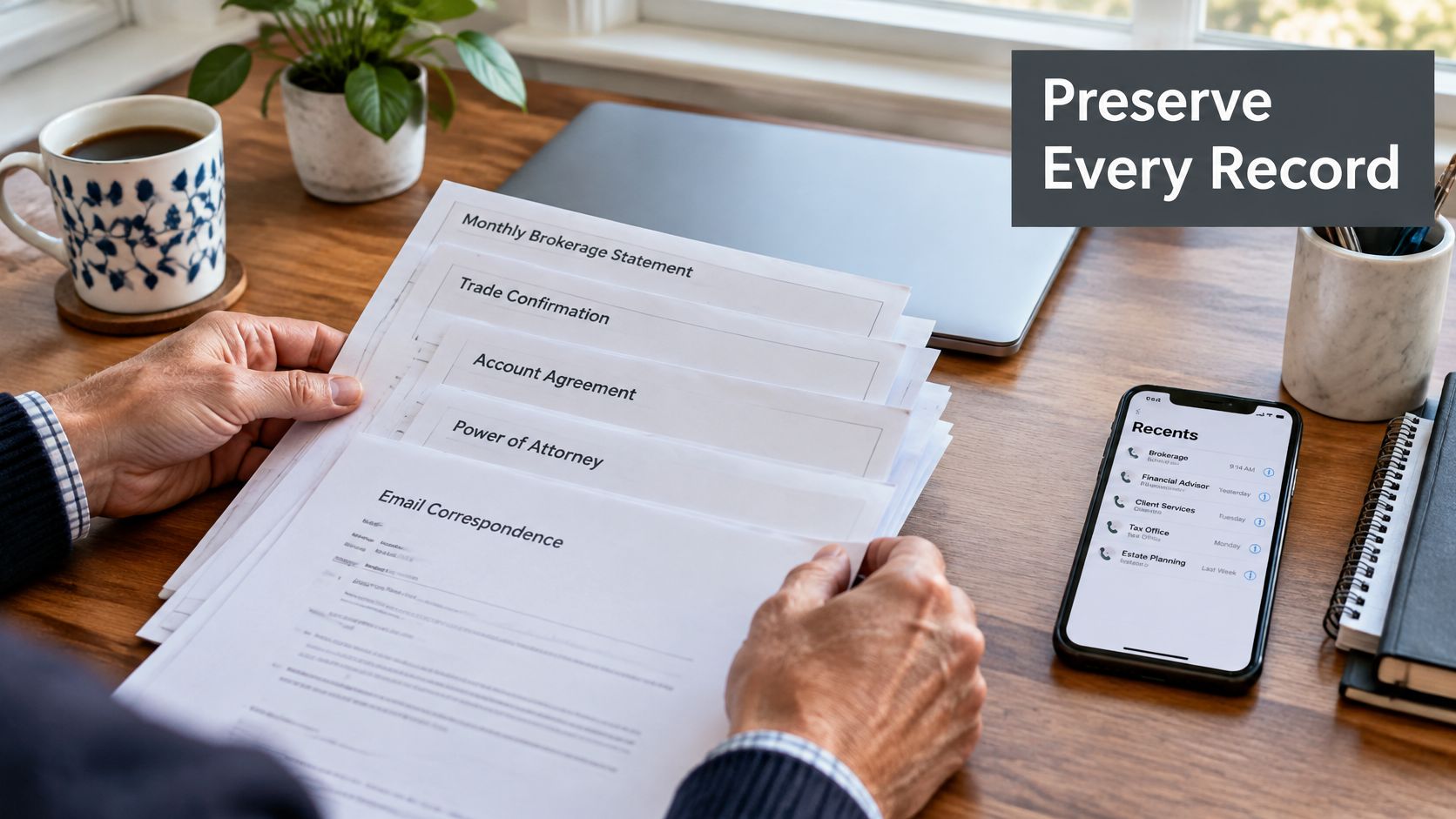
The SEC's guide to complaining about a broker warns that a written complaint may be the only evidence proving you complained about unauthorized transactions. It also stresses acting promptly, because legal deadlines can limit available remedies. An informal call does not preserve every claim, and Investor.gov treats trades you did not authorize as a warning sign that belongs in a written report to the firm and to regulators.
Five steps, in order
Preserve the raw records. Save monthly statements, trade confirmations, blotters if you have them, the account agreement, any power of attorney, emails, texts, call recordings, and later complaint letters. Do it before a portal refresh replaces what you saw. The reason is practical. If you wait, the firm's later confirmation becomes the only record, and silence is easy to dispute.
Build a trade list. For each disputed order record the date, security, buy or sell, quantity, price, account, and the claimed order source, whether phone, online, or adviser. One row per trade. A sentence that says "they traded too much" is hard to prove and easy to dodge.
Compare each trade with your instructions. Set the order next to any written authority, your stated objectives, and any recorded call. If you never gave that instruction, write that in the row. A broker statement shows what posted. It does not, by itself, prove you asked for the trade.
Quantify loss per trade. Separate principal loss, commissions, margin interest, a worse execution price, and consequential opportunity loss. A single grand total is the number a firm will argue with. A trade-by-trade model is harder to wave away, because each line points at a document.
Send a prompt written complaint. Name each unauthorized transaction and ask for a written response. If the representative does not resolve it, escalate to branch management, then compliance, then the relevant regulator. That path only works if the letter already identifies the trades.
Slips that weaken the file
People wait for the next statement and then find the online confirmations no longer match what they remember. People also roll every loss in the account into one figure, including trades they approved. Keep approved trades off the list. The complaint should cover only the orders you dispute.
Keep originals in a dated folder: Paper and PDFs, labeled by account and month.
Screenshot the portal the day you see the trade: Capture the on-screen time if you can.
Write down phone calls the same day: Date, time, name, and what was said.
Never alter a document: Do not mark up the firm's PDF. Put your notes on a separate sheet.
When that list is finished, you have the attachment the letter needs. Do not send the letter until the list exists.
How to Send the Written Complaint and Escalate It
The written complaint may be the only proof you objected. A phone call you remember clearly is not enough if the firm later says you never complained.

| Stage | Recipient | What to send |
|---|---|---|
| 1 | Your financial representative | Dated letter naming each disputed trade |
| 2 | Branch manager | Copy of the letter and a request for a written response |
| 3 | Compliance department | Same letter plus an index of your evidence |
| 4 | FINRA or the SEC | Complaint with the letter, the firm's replies and your trade list |
Start with the representative so there is a dated record in the branch file. Move up when the reply is late, vague, or "you approved it." Investor.gov and FINRA's complaint portal are the regulator step when the firm stalls. Our page on how to file a FINRA complaint covers that filing without pretending the portal writes you a check.
What goes in the letter
Identity: Your name, account number, firm, and branch.
The trades: A numbered list copied from your trade list, not a fresh set of figures you typed from memory.
The denial: A plain statement that you did not authorize those transactions.
The ask: A written response by a date you state in the letter.
Preservation: A request that the firm keep order tickets, recordings, and electronic communications for those trades.
Send it so you can prove delivery. Certified mail with a return receipt, plus an email of the same PDF, is the pair that holds up later. Some service desks still take a fax when mail and the portal both stall, and a practical note on faxing a customer service department explains how to keep a transmission record. Save every reply, including "we are looking into it."
When the firm says you approved the trades
Compare that claim with your records the same day. If you have no signed ticket and no recording you recognize, reply in writing that you dispute the authorization and attach the trade list again. Then move to the next stage on the table. Do not leave the dispute in a phone call.
Do not sign a settlement or a release while the complaint is open unless a lawyer has read it. A short release can give up a claim you have not filed yet.
The complaint stays open until escalation has produced a written answer. A verbal promise to "fix it" is not that answer.
Complaints Versus Routes That Recover Money
A complaint to FINRA or the SEC can investigate the broker and can lead to discipline. It does not, by itself, force reimbursement, and it does not stop a deadline. A written complaint to the firm creates evidence and pushes for a response. It is not a damages claim either.
| Route | What it does | Recovers money? | Watch for |
|---|---|---|---|
| Written complaint to the firm | Creates evidence and requires a response | Not by itself | Keep proof of delivery |
| FINRA complaint | Investigates the broker or firm and can lead to discipline | Not directly | Does not stop a deadline |
| FINRA arbitration | Binding claim against the broker or firm | Yes, if awarded or settled | Six years from each trade for eligibility |
| Court litigation | Lawsuit under state or federal law | Yes, subject to the court | Shorter state limits may apply |
The six-year eligibility clock
FINRA Customer Code Rule 12206 generally makes a claim ineligible for arbitration when six years have elapsed from the occurrence or event giving rise to the claim. That period does not extend or replace statutes of limitation under state or federal law. A shorter limitations period may apply, and the firm may assert it as a defense. You measure the date of each disputed trade, not the day you noticed the loss. The earliest trade can fall outside the window while later trades are still inside it.
FINRA's customer-case statistics state that most customer cases close through settlement rather than an award. A practical benchmark is a negotiated resolution, not a hearing that automatically pays you. Build the file so it works in a negotiation and, if talks fail, at a hearing.
Arbitration starts when you file a statement of claim with FINRA Dispute Resolution Services. Before you choose that route, weigh filing effort, time, the size of the loss, and whether you could collect. We bring claims against brokerage firms, financial advisors, investment advisory firms, and other third-party financial services firms to pursue recovery. That work is separate from sending a regulator a complaint.
Investors sorting a non-brokerage scam payment from a securities loss can also read fraud recovery steps for seniors. That material is about getting money back from a scammer. It is not a substitute for the arbitration clock on a brokerage trade.
The choice in front of you is narrow. Send the written complaint now, and prepare arbitration in parallel so a slow firm reply does not consume the earliest trade.
Confirm Your Deadlines Before Choosing a Route
Send the written complaint now. Then decide on arbitration before the six-year window on the earliest disputed trade closes, and sooner if a shorter state limit may apply.
Three checks decide whether you wait or file.
Earliest trade date: Find it on the trade list. That date, not the date of your letter, is the one to calendar. Put the claim filing deadline next to the firm's response date so both stay visible.
Evidence: Statements, confirmations, the account agreement, login alerts if any, and proof you mailed the complaint. If a row is missing a document, chase it this week.
Size and collectability: A small, fully documented loss can still support a demand. A large loss against a firm that can pay is a different conversation from a claim you cannot collect.
- Save and index the evidence this week. One folder, one trade list, and no edits to the firm's PDFs.
- Send the written complaint with proof of delivery. Certified mail and an email copy of the same letter.
- Calendar the firm's response date and the earliest deadline. Review both on a day you are sure to see them.
- Speak with a securities attorney before you sign any release. If you would like a free consultation to discuss the investment loss recovery process in more detail, call Kons Law Firm at (860) 920-5181 for a FREE, NO OBLIGATION consultation. Do not send confidential or sensitive information until you have talked to an attorney and entered a written agreement letter establishing the attorney-client relationship.
A complaint preserves your position. Arbitration is the route that recovers money.
Kons Law represents investors nationwide who lost money to unauthorized trading, and we pursue recovery through FINRA arbitration and court actions rather than stopping at a regulatory complaint. If your trade list is ready and the earliest order is nearing a deadline, a consultation is the practical next conversation. Visit Kons Law to see how we handle investment-loss claims and to start that review.
