Your broker called it a private opportunity. The paperwork arrived thick, the yield sounded steady, and you signed because you trusted the person selling it. Now distributions have stopped, statements show a value nobody will pay, and you're told you can't sell. That's the position many investors are in when they first search for answers about a private placement program.
What a Private Placement Program Actually Is
A retiree sits across from a registered broker who says this deal isn't available to the general public. A working professional hears the same pitch at a dinner seminar. Both are offered a security that won't trade on an exchange, won't come with a standard prospectus, and may tie up their money for years.
In plain English, a private placement program is a sale of securities by a company or fund that avoids full public registration by relying on a legal exemption. The issuer raises capital from a limited pool of investors instead of selling shares to anyone through a public offering. That structure is legal. It's also the reason you get less standardized information than you'd get with a listed stock.
Why Issuers Choose This Route
Issuers use exemptions to raise money faster and with less cost than a full registration under the Securities Act of 1933. Smaller businesses in particular may not be able to absorb the expense and delay of registering. In exchange, the law imposes conditions on who can buy, how the deal can be marketed, what must be disclosed, and how soon buyers can resell.
The modern framework comes from the SEC's adoption of Regulation D effective April 15, 1982, which combined earlier exemptions including Rule 146 and Rule 242. Regulation D isn't one product. It's a set of exemptions with different limits, solicitation rules, and investor requirements.
What Private Does and Doesn't Mean
Private doesn't mean safer. It also doesn't automatically mean riskier than every public stock. It means the normal registration process doesn't apply, so the quality of the offering documents does more work.
- Limited investor pool: Eligibility often turns on accredited status or financial sophistication.
- Lockups: You generally can't sell on demand.
- Layered fees: Placement, management, and sponsor fees can reduce what reaches the underlying business.
Practical rule: Judge the recommendation, not the label. A lawful exemption doesn't make an unsuitable sale acceptable.
Your broker's obligations get stricter, not looser, when information is harder to verify. If he recommended it, he needed a reasonable basis to believe it fit your goals, liquidity needs, and risk tolerance. That's where most disputes start.
How Regulation D Structures the Deal
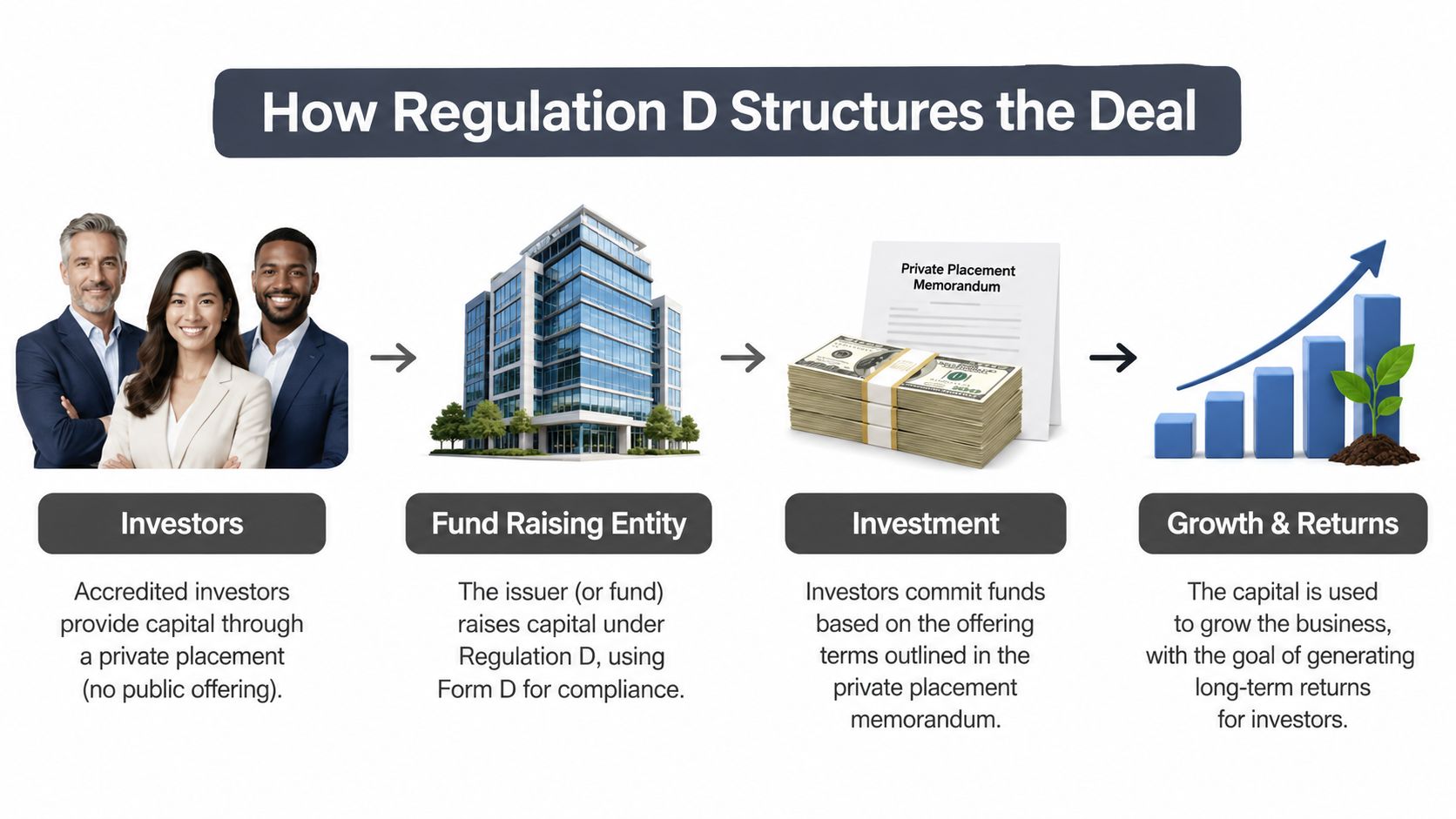
Regulation D gives issuers different paths, and the path matters because it controls who can invest and how the deal can be sold to you. Most individual investors encounter Rule 506(b) or Rule 506(c).
Rule 506(b) Versus Rule 506(c)
Under the SEC's investor bulletin on private placements, Rule 506(b) permits sales to no more than 35 non-accredited investors during any 90-calendar-day period, while Rule 506(c) permits general solicitation only when every purchaser is verified as accredited. The same source states the issuer must file Form D within 15 days after the first sale.
- Rule 506(b): An issuer may raise an unlimited amount from an unlimited number of accredited investors. It can't use general solicitation or public advertising. Non-accredited buyers, if any, must have enough financial and business knowledge to evaluate the deal.
- Rule 506(c): An issuer may advertise broadly. Every purchaser must be accredited, and the issuer must take reasonable steps to verify that status, not just take your word for it.
If non-accredited investors participate under Rule 506(b), the issuer must provide disclosure comparable in type to Regulation A information, specified financial statements, and a chance to ask questions. Ask which rule your deal used. Then check whether the marketing matched it.
Form D Is a Notice, Not an Approval
Investors often tell me the SEC must have reviewed the deal because a filing exists. It didn't. Form D contains limited information about the issuer, management, promoters, and offering terms. It's not an audit, endorsement, or finding that the investment is sound.
Compare the Form D against the private placement memorandum, subscription agreement, financial statements, fee table, and use of proceeds. Look for mismatches in names, amounts, and sales compensation. Broker-dealers also have filing duties for certain private placements they sell, and the requirements under FINRA Rule 5123 are worth checking when you reconstruct what your firm knew and when it knew it.
If a salesperson says Form D means the SEC approved the offering, stop. That statement is wrong and it's a reason to walk away.
Those documents, not the sales pitch, are where fee, conflict, and exit disputes get decided later. Keep every version you received.
The Private Placement Market by the Numbers
This isn't a niche corner of finance. SEC Regulation D statistics recorded 32,554 offerings in 2024 with approximately $2.1 trillion in capital reported as sold, rising to 34,553 offerings and about $2.4 trillion in 2025. The same dataset shows 30,315 Rule 506(b) offerings and 3,989 Rule 506(c) offerings in 2025, versus only 249 under Rule 504.
Regulation D Filings and Reported Capital Sold
| Year | Total Offerings | Approx. Capital Sold |
|---|---|---|
| 2024 | 32,554 | $2.1 trillion |
| 2025 | 34,553 | $2.4 trillion |
These figures come from initial Form D filings and reported proceeds. They measure what issuers disclosed to the SEC. They don't measure audited performance, investor returns, or whether buyers got their money back.
What the Split Tells You
Rule 506(b) dominates by count. That means most offerings still rely on the no general solicitation model, typically reaching investors through existing broker relationships. Rule 506(c), despite allowing broad advertising, remains materially smaller.
Don't draw the wrong conclusion from scale. A large market tells you private capital formation matters to the economy. It doesn't tell you your offering was fairly priced, properly supervised, or suitable for a retirement account that needs liquidity.
- Aggregate issuance: Proves activity, not quality.
- Offering count: Shows which exemption issuers prefer, not which deals performed.
- Reported capital sold: Shows money went in, not money came out.
I've seen investors reassured by trillion dollar totals right up until their own sponsor stopped reporting. Evaluate your deal on its documents, cash flows, and fees. Market size won't rescue a bad recommendation.
Registered Offerings Compared to Private Placements
A registered public offering and a private placement both raise capital. They protect you in very different ways. Understanding what you gave up helps you ask better questions before you sign, and sharper ones after a loss.
Side by Side Comparison
| Feature | Registered Offering | Private Placement |
|---|---|---|
| Disclosure document | Prospectus filed through registration | Private placement memorandum, varies by deal |
| Ongoing reporting | Periodic public reporting for reporting companies | Often limited, depends on issuer obligations |
| Marketing | Public sale through registered process | No general solicitation under 506(b), advertising allowed under 506(c) to verified accredited buyers |
| Pricing | Market price if exchange traded | No transparent market price in most cases |
| Liquidity | Generally resaleable in public markets | Restricted securities, resale limited |
| Investor eligibility | Open to general public | Often accredited or sophisticated investors only |
None of this makes a private placement automatically improper. Operating companies, real estate sponsors, and funds legitimately raise money this way every day. The exemption exists for a reason.
Where Harm Usually Happens
The legal question in most cases I review isn't whether an exemption existed. It's whether the broker understood the product, explained illiquidity and fees, and had a reasonable basis to recommend it to this specific customer.
A younger investor with other liquid assets may accept lockup risk. A retiree who needs monthly income and principal access usually can't. Same product, different answer.
Ask this directly: If I need this money back early, who buys my interest, at what price, and under what written right?
If the answer is vague, you don't have liquidity. You have a hope. Don't fund a hope with money you can't afford to lock away or lose.
Why Private Placements Are Hard to Diligence
Even an honest issuer can sell a deal that's hard to value. Many private placements lack a transparent market price, valuation information, substantial operating history, or independently audited financial statements. You're asked to trust projections for a business you can't easily compare to anything trading publicly.
That's exactly why the selling firm can't just pass along the sponsor's deck. FINRA guidance on private placements expects broker-dealers to conduct reasonable diligence on creditworthiness, business model integrity, and whether projected returns are plausible against industry benchmarks after complex fees. For retail recommendations, Regulation Best Interest requires reasonable diligence, care, and skill to understand risks and rewards and a reasonable basis to believe the recommendation is in your best interest.
Rebuild the Return Yourself
Start with the gross projection, then subtract everything.
- Sales costs: Commissions and placement fees paid to sell you the deal.
- Sponsor economics: Management fees, acquisition fees, financing costs, and carried interest.
- Exit costs: Redemption restrictions, discounts, and refinancing assumptions.
Then stress test the story. Do cash flows require full occupancy, rising commodity prices, a future refinancing, or a resale at an optimistic price? If one assumption fails, what happens to distributions?
General background on structuring that review can help, and Documind's due diligence guide is a useful primer on organizing documents and questions. For the specific records to request in these deals, use a private placement due diligence checklist before money moves, not after.
Marketing that pushes yield while minimizing speculative character, valuation uncertainty, or inability to sell should concern you. Preserve the memorandum, subscription agreement, projections, statements, emails, and notes of sales conversations. If the firm did diligence, those records help prove what it missed.
Fraud Red Flags to Watch For
Accredited only doesn't mean safe. Institutional sounding doesn't mean institutional quality. Fraudulent and unsuitable deals often use exclusivity as the sales tool.
Patterns That Should Pause a Subscription
- Yield without a credible source: The pitch emphasizes fixed, steady payouts but can't identify operating cash flow sufficient to pay them.
- Artificial urgency: You're told to wire funds quickly before an allocation disappears, with no time for independent review.
- Vague use of proceeds: Large amounts go to fees, overhead, affiliates, or unspecified working capital.
- Capital calls with no exit: The sponsor can demand more money while you have no practical right to sell or redeem.
- Invented liquidity: Someone promises a secondary market, buyback, or listing that isn't in the binding documents.
- Bad histories: Sponsors, promoters, or selling brokers have disciplinary records, prior failed deals, or undisclosed conflicts.
Watch the language. Guaranteed, insured style, principal protected, and bank backed mean nothing unless a solvent obligor has legally committed to pay you and that commitment is documented. In the worst schemes, new investor money pays old investors and statements create the illusion of performance.
Why You Can't Just Sell and Move On
Private placement securities are generally restricted securities. SEC Rule 144 materials state restricted securities acquired from an issuer or affiliate generally must be held for at least one year before resale. Other conditions can apply too, including current public information, volume limits, manner of sale limits, and a resale notice filing.
That means discovering a problem doesn't give you a clean exit. There may be no buyer at any fair price. If these patterns sound familiar, review the warning signs described in our overview of private placement fraud and compare them against your own paperwork before sending another dollar.
Don't average down into a deal you no longer trust just because the sponsor says one more capital call will save it.
How Harmed Investors Pursue Recovery
A loss alone doesn't prove a claim. A bad recommendation, material misrepresentation, omitted risk, failed diligence, or supervisory breakdown can. Your recovery path usually depends on who sold the product and what agreement you signed.
FINRA Arbitration Against the Broker-Dealer
Most claims against a brokerage firm and its registered broker go to FINRA arbitration, because customer agreements typically require it. There's no jury. Arbitrators decide the case, hear evidence, and issue an award.
Investors often prefer this forum because it's generally faster than court and the arbitrators are familiar with securities sales practices. Claims commonly allege unsuitable recommendations, violations of Regulation Best Interest, misrepresentation, failure to conduct reasonable diligence, overconcentration, and failure to supervise. The practical mechanics are explained in this guide to the FINRA arbitration process.
Your target matters. An issuer may be insolvent, while the selling broker-dealer that recommended the deal and earned commissions may have assets or insurance. We evaluate both liability and collectability from day one.
Court Actions Against Issuers and Non-FINRA Sellers
State or federal court may fit claims against an issuer, its principals, an unregistered seller, or an advisory firm that isn't subject to FINRA arbitration. Court can offer broader discovery and different claims under state law. It can also take longer and cost more to litigate.
Class actions sometimes arise when many investors were harmed by the same conduct. They can make sense for widespread, uniform misstatements. Individual arbitration or court claims usually give you more control over strategy, settlement, and presentation of your specific damages.
Timing is critical. Deadlines vary by claim and jurisdiction, and waiting can destroy otherwise strong cases. Many investor cases are handled on a contingency fee basis, meaning legal fees are tied to recovery, but you should confirm costs and terms in writing.
Damages aren't automatic. We reconstruct what you invested, what you received back, what a suitable portfolio would have done, and whether rescission or out of pocket losses fit the claim. Bring facts, not just a bad outcome.
Steps to Take This Week if You Suspect Harm
Act before records disappear and deadlines narrow. Don't confront the broker with accusations until you've secured your file.
- Stop additional funding: Don't meet new capital calls until counsel reviews the documents.
- Preserve everything: Save the memorandum, subscription agreement, projections, statements, emails, texts, and call notes.
- Identify the players: Write down the issuer, sponsor, custodian, broker, and firm of record.
- Pull the filing: Get the Form D and compare names, dates, compensation, and offering amounts to what you were told.
- Request your file: Ask for suitability records, new account forms, and communications. Do it in writing.
- Sign nothing: Don't sign a release, settlement, or tolling agreement from the issuer or firm without legal review.
Don't post details publicly. Statements you make online can be used against you later. If you would like a free consultation to discuss the investment loss recovery process in more detail, call Kons Law Firm at (860) 920-5181 for a FREE, NO OBLIGATION consultation.
If you lost money in a private placement that was pitched as safe, income producing, or suitable for your retirement needs, Kons Law can review your offering documents, broker communications, and account records to assess claims for unsuitable recommendations, misrepresentations, and failed diligence. Visit Kons Law to request a free, no obligation consultation and discuss whether FINRA arbitration or a court action fits your situation.
