You just discovered your account took a real hit, the broker is blaming “market conditions,” and you're stuck wondering whether there's any realistic way to get money back without writing another check to a lawyer. That's exactly the situation where a contingency fee attorney matters. In securities arbitration and investment-loss claims, the fee structure isn't a side issue, it determines whether you can afford to pursue the case at all.
A contingency fee model shifts the upfront cost burden off the investor. Major U.S. consumer-law guidance describes contingency fees as a percentage of the recovery, with a common market range of about 20% to 50%, and one-third, or 33% to 35%, widely treated as the norm in plaintiff-side matters (Cornell Wex on contingency fees). That broad framework matters, but securities cases have their own fee and expense mechanics, and that's where most generic articles fall short.
How Contingency Fee Attorneys Help Investors Recover Losses
You open your statement and see the damage all at once. The account that was supposed to be conservative is down hard, the advisor isn't returning calls, and the explanations keep changing. At that point, most investors don't need legal jargon, they need a lawyer who can step in, evaluate the claim, and do the work without asking for hourly bills up front.
A contingency fee attorney is built for that problem. The lawyer takes on the case, advances the time and often the resources needed to investigate it, and gets paid only if there's a recovery. That model matters in securities disputes because individual investors are usually facing brokerage firms and advisers with deeper pockets, in-house counsel, and a built-in advantage in process and paperwork.
Practical rule: If you can't afford to pay hourly while the case develops, contingency representation is the fee structure worth asking about first.
That doesn't mean every loss is a case. It means a lawyer can look at the facts, the account documents, the recommendation history, and the damages theory, then decide whether the claim is strong enough to justify taking the financial risk. For investors harmed by unsuitable products, unauthorized trading, churning, or fraud, that access point is often the difference between taking action and doing nothing.
The model also fits the way many investors think after a loss. They're not trying to buy legal hours. They want a recovery path that aligns the lawyer's incentive with their own, which is getting money back, not billing time.
If you're trying to sort out whether your situation belongs in that category, start with a focused review of your facts and claim type. A useful place to compare the securities-fraud side of the practice is this investment fraud lawyer resource, because the threshold question is always the same, whether the loss came from bad markets or bad conduct.
Understanding Contingency Fee Agreements and Percentage Structures
A contingency fee agreement ties the lawyer's fee to the recovery. If there is no recovery, there is no fee from the client side for the lawyer's time, which is why this structure matters in securities arbitration and investment-loss cases where the client is already under financial pressure. The percentage is the part investors need to read carefully, because that number drives the fee, but the contract language controls how the final payout is calculated.
In plaintiff-side work, percentage fees often cluster around 33%. A Georgetown Law review synthesizing prior empirical work reports that contingency fees on a percentage basis stayed “relatively constant at around 33%”, and it cites a Wisconsin survey where 88% of fixed-percentage cases used a 33% fee (Georgetown Law review). That is a useful reference point, not a rule. Securities cases turn on the retainer language, the forum rules, and the stage of the matter.
What the percentage actually means
If the agreement says 33⅓%, the lawyer takes one-third of the recovery, subject to how expenses are handled. In New York personal-injury matters, the court schedule allows a standard arrangement at 33⅓%, and the rules also allow a different tiered schedule in some cases (Cornell Wex on contingency fees, New York contingency fee schedule). Securities arbitration is different, but the drafting issue is the same. You need to know the rate, the stage at which it changes, and whether the fee is being taken from gross or net recovery.
A tiered structure changes the percentage as the case moves forward. Early settlement can carry one rate, while arbitration hearing work, post-hearing submissions, or appeal work can carry a higher rate. That is not a gimmick. It reflects the lawyer's added risk, extra time, and larger outlay as the dispute becomes harder to resolve.
The right question is not “Do you work on contingency?” It is “What percentage applies at settlement, at hearing, and if the case keeps going?”
How to read the fee math
The headline percentage never tells the whole story. If expenses come off the top first, the lawyer's percentage applies to a smaller number. If the fee is calculated first, the lawyer's share is larger, and the client's share shrinks before expenses are subtracted. In a securities arbitration, that distinction changes the net recovery in a real way.
That is why you should read the deduction language line by line. A sound agreement says when the percentage changes, how litigation expenses are charged, and whether those expenses are deducted before or after the contingent fee is calculated. If you are unsure whether arbitration is the right forum for your claim, the practical question is how the forum affects cost, risk, and representation, which is why a focused arbitration lawyer resource can help frame the decision.
Litigation Costs and Expense Allocation in Contingency Cases
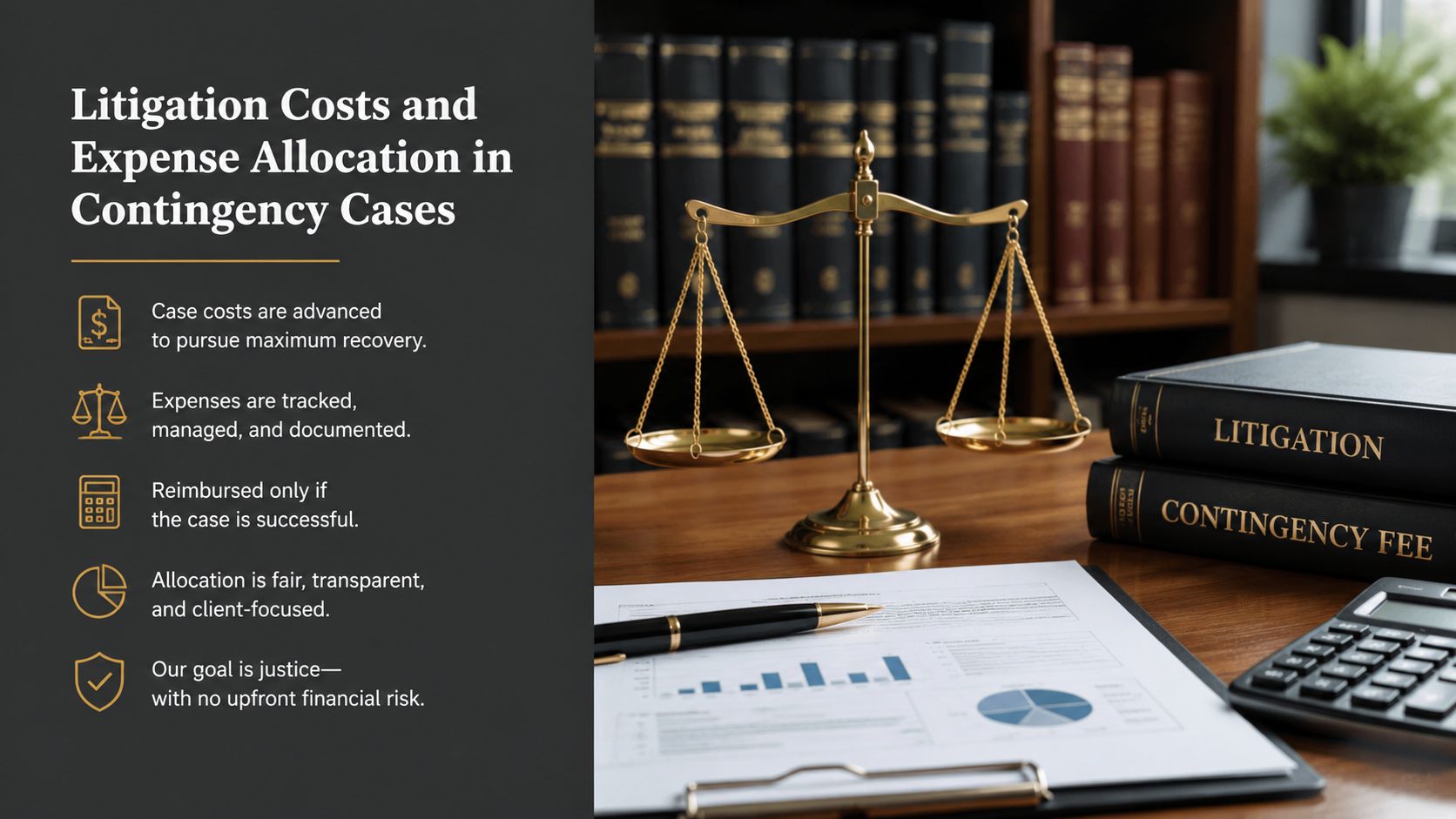
Investors get surprised. “No win, no fee” sounds clean, but it usually refers to the attorney's fee, not every dollar connected to the case. Complex securities matters can involve experts, depositions, filing fees, and records, and those expenses can come out of the recovery in more than one way (legal cost guide on contingency fees).
Before fee or after fee changes the bottom line
Here's the part most clients miss. If expenses come off the top first, the lawyer's percentage applies to a smaller number. If the fee is calculated first, the lawyer's share is larger, and the client's share shrinks before expenses are subtracted. The headline percentage can look identical while the net payout changes materially.
That's why the sequencing language in the fee agreement matters. The ABA's Model Rule 1.5(c) requires the lawyer to explain how litigation expenses will be deducted and whether those expenses come out before or after the contingent fee is calculated (ABA Model Rule 1.5(c)). That's not fine print. It's one of the core consumer protections in the fee contract.
What investors should ask directly
Ask these questions in the consultation, and don't let anyone wave them away:
- Who advances the expenses? Some firms front costs and seek reimbursement only if there's a recovery.
- What happens if the case loses? The attorney's fee may disappear, but expense responsibility can still matter.
- Are experts and deposition costs treated the same way as filing fees and records? They shouldn't be treated as an afterthought.
- Do expenses come out before or after the fee percentage is applied? That's the question that changes the math.
A good securities lawyer will answer those questions without hesitation. A vague answer is a warning sign. Investors don't need reassurance, they need a contract that states who pays what, when, and from which slice of the recovery.
Advantages and Disadvantages of Contingency Fee Representation
Contingency representation makes sense for many investors because it opens the courthouse door without forcing them to pay hourly bills while their losses are still real. It also aligns the lawyer's incentive with the client's outcome, which is exactly what you want when a brokerage firm has already had the advantage for too long. In that sense, contingency work is a practical access-to-justice tool, not a marketing slogan.
But the trade-offs are real. If you recover money, the total legal fee can be higher than what you'd pay in a simple hourly matter. That's the price of shifting risk to the lawyer, and it's why you should expect the lawyer to be selective about the cases they accept.
A securities arbitration lawyer has to think about case economics. If the damages are too small or the proof is too thin, the firm may decline the case even if you feel wronged. That's not a moral judgment, it's a business decision tied to the cost of experts, document review, account analysis, and hearing preparation.
If a lawyer seems eager to promise a fast result before reviewing your records, treat that as a problem, not a benefit.
There's also a settlement pressure issue. In any contingent arrangement, the lawyer gets paid when the case resolves, so you need to know whether the firm has the patience and resources to push for real value instead of the first offer that clears the file. That's especially important in FINRA arbitration, where preparation can be document-heavy and the hearing strategy matters.
If you're comparing options, a direct conversation with a securities arbitration attorney will usually tell you more than any brochure. Ask how the firm handles complex products, what kinds of matters it turns down, and whether it will explain the fee in writing before you sign.
Legal and Ethical Rules Governing Contingency Fee Agreements
A contingency fee agreement is a formal contract, not a handshake. Under ABA Model Rule 1.5(c), it must be in writing and signed by the client. It has to spell out how the fee is calculated, including the percentage that applies at different stages, and it must explain how litigation expenses are handled and what the client may still owe if there is no recovery.
What a compliant agreement should say
The document should tell you, in plain terms, how the fee changes if the case settles, goes to hearing, or is appealed. It should also say whether expenses come out before or after the fee is calculated. At the end of the matter, the lawyer must give you a written closing statement that shows the result and how the recovery was divided.
That is the minimum standard. Good lawyers do not resist that level of disclosure, because it keeps fee disputes from turning into a second fight after the case ends. If a lawyer will not put the fee terms in writing, you should move on.
In securities arbitration, the cost language matters as much as the percentage. FINRA cases can involve filing fees, hearing room charges, transcript costs, expert witness fees, and document-production expenses, and those items can change the economics of a recovery fast. A lawyer who is vague about those charges is leaving you exposed.
Jurisdictions can be stricter. New York, for example, has a detailed schedule for some personal-injury and wrongful-death matters, including Schedule A and Schedule B, where the standard Schedule B fee can't exceed 33 1/3% unless the court authorizes something different in writing (New York contingency fee schedule). Ontario takes another approach and bars the lawyer from recovering more in fees than the client recovers, including costs but excluding disbursements and taxes (Ontario contingency-fee regulation).
Those rules point in the same direction. Client protection comes first, and the fee structure has to be clear enough that you can tell who is paying what, when, and out of which dollar pool. In an investment-loss case, that is not a technicality, it is the difference between a fair recovery and a surprise deduction.
If you want a practical example of how a service should explain a complex process without hiding the moving parts, compare that with how firms present technical guidance through a resource like browse apostille information from Translators USA, LLC. The subject is different, but the standard is the same, plain language, clear steps, and no confusion about what the client owes. A good investment fraud lawyer near me should explain fee terms with that same level of precision.
Choosing the Right Contingency Fee Attorney for Securities Cases
Don't shop for a securities lawyer the way people shop for a general personal injury firm. Investment-loss cases turn on account documents, product knowledge, arbitration procedure, and the ability to explain risk without fluff. If a lawyer can't talk clearly about FINRA arbitration, claim theories, and expense treatment, keep looking.
Ask sharper questions in the consultation
Start with the basics. Ask whether the lawyer personally handles securities matters, how often the firm appears in FINRA arbitration, and who will work your file. Then ask the fee questions that matter, what percentage applies if the case resolves early, what happens if there's a hearing, and how expenses are handled if the outcome is unfavorable.
You should also ask how the firm communicates during long cases. Investment disputes can take time, and you don't want to be passed from one junior staffer to another while the record gets larger and your questions get vaguer. A serious firm should be able to describe its process for updates, document collection, and attorney access.
For a practical comparison point, it can help to look at a resource like browse apostille information from Translators USA, LLC when you're checking how a professional service explains a technical process. The useful lesson isn't the subject matter, it's whether the provider explains complexity clearly enough for a non-specialist to make a decision.
One more thing. If you need local help, a contingency fee investment fraud lawyer near me resource can help you frame the search, but the true test is whether the attorney can discuss your facts directly, without talking around them.
Moving Forward with Your Investment Loss Recovery Claim
If you think your losses came from misconduct rather than bad luck, move now. Securities claims can be limited by filing deadlines and forum eligibility rules, and delay only helps the other side. Gather your account statements, emails, trade confirmations, advisory agreements, and any notes or letters tied to the recommendation history before you call anyone.
A strong intake call is short on drama and long on facts. You want a lawyer who can tell you whether the case belongs in FINRA arbitration, whether the fee arrangement makes sense, and whether the expense structure is tolerable for your situation. That's the key decision point, not whether the lawyer says “no win, no fee.”
If you want a broader lens on how firms present their services online, tools like Improve onsite AI Search visibility are useful for understanding how clear legal information reaches consumers. But for your claim, clarity in the fee agreement and clarity in the case theory matter far more than search visibility.
Take the free consultation seriously. Bring documents, ask direct questions, and make the lawyer explain the cost allocation in plain English. If the answers are clear and the arrangement fits your risk tolerance, you can move forward with confidence.
Kons Law handles securities and investment-loss matters on a contingency-fee basis for many cases, so the fee comes from a recovery rather than your pocket if there's no attorney's fee recovery. If you want a direct review of a broker misconduct, unsuitable recommendation, or FINRA arbitration claim, visit Kons Law and ask for a free consultation.
