
You entrusted someone with retirement funds, college savings, or money you planned to live on. Then the account started moving in ways that didn't match what you were told. Trades appeared you don't remember approving. Risk climbed even though you asked for safety. Losses piled up, and the explanations got thinner.
That moment matters. Investors often sense that something went wrong long before they know whether they have a legal claim. The hard part is that misconduct and a recoverable case are not the same thing. Suspicion starts the conversation. Evidence decides the outcome.
Your Trust Was Broken What Comes Next
A common pattern looks like this. An investor hires an advisor after hearing reassuring words like “income,” “conservative,” or “long-term planning.” Months later, the account statement shows sharp losses, frequent trading, concentrated positions, or products the investor never fully understood. When the investor asks questions, the answers shift. The market gets blamed. Risk tolerance is suddenly described very differently than the client remembers.
That's where the legal idea of fiduciary duty becomes important. In the right relationship, the law requires a financial professional to put the client's interests first and to act with loyalty, care, good faith, and fair dealing. If that duty was broken, the law may provide a path to recovery.
Still, many investors get stuck at the same point. They know they were treated unfairly, but they don't know how to turn that experience into a claim that can survive scrutiny. That's the core issue in a breach of fiduciary duty claim. It isn't enough to feel misled. You need to show what duty existed, what conduct violated it, and how that conduct caused actual financial harm.
Investors often call only after months of frustration. By then, emails are missing, memories have faded, and account records are harder to organize. Early case evaluation usually makes a major difference in how clearly the story can be proven.
If you're trying to sort out whether your losses came from bad luck, bad judgment, or actionable wrongdoing, start by getting informed and documenting what happened. A lawyer who handles investor matters can help separate ordinary market loss from conduct that may support a claim. If you're looking for that kind of help, a financial fraud attorney can review the account history and identify what evidence matters most.
If you would like a free consultation to discuss the investment loss recovery process in more detail, call Kons Law Firm at (860) 920-5181 for a FREE, NO OBLIGATION consultation.
Understanding Fiduciary Duty in Investing
A fiduciary duty is a legal obligation to act in another person's best interest. In investing, that means more than being polite, responsive, or generally competent. It means the professional must handle the relationship with loyalty and care, not treat the client as an opportunity to generate fees or commissions.
What the duty actually requires
In securities disputes, a breach of fiduciary duty claim typically requires proof of three elements: the existence of a fiduciary duty, breach of that duty, and damages caused by the breach, as described in this discussion of fiduciary duty in securities disputes. In broker-customer relationships, whether that duty exists is context-specific, and when it does exist, the fiduciary is expected to act with loyalty, care, good faith, and fair dealing.
A useful comparison is the doctor-patient relationship. A patient doesn't expect a doctor to recommend treatment because it pays the doctor more. Investors should think about fiduciary duty in a similar way. The client's needs come first. The professional's compensation, preferences, or sales goals come second.
That doesn't mean every investment loss proves a breach. Markets fall. Strategies can underperform. Even careful professionals can be wrong. The issue is whether the advisor or broker honored the duties attached to the relationship.
Who usually owes it and when
Registered investment advisers generally operate under a framework that recognizes a fiduciary obligation. With brokers, the analysis is often more fact dependent. The nature of the account, the level of discretion, the advice given, the client's reliance, and the course of dealing can all matter.
That distinction is why investors shouldn't assume labels settle the issue. Someone may call himself a “financial consultant” or “wealth manager,” but the legal question depends on how the relationship functioned.
If you want a plain-language overview of that legal standard, this explanation of what a fiduciary duty is is a useful starting point. For readers who also deal with trust structures outside the securities setting, a practical trust guide for Australian families and professionals can help clarify how fiduciary obligations arise in trust administration more broadly.
A fiduciary relationship is about conduct, responsibility, and reliance. It is not just about the title on a business card.
The Legal Elements of a Claim

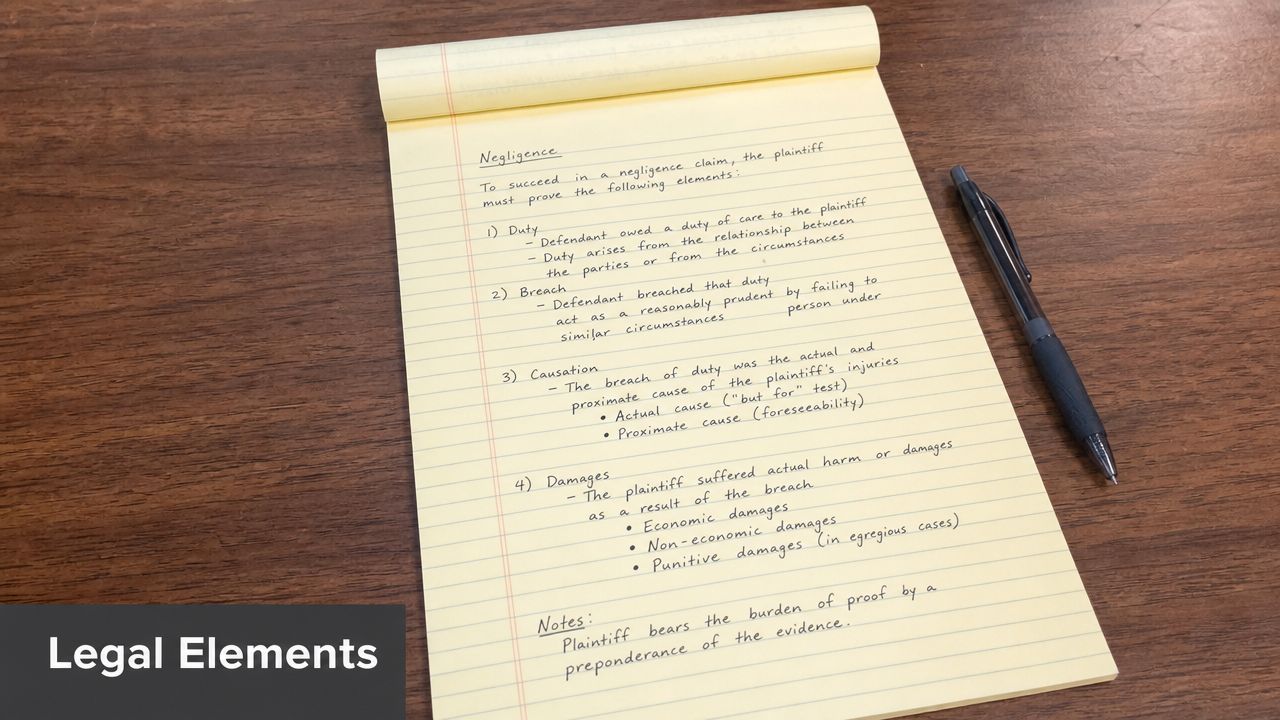
Most investors focus first on the part that feels most obvious: “my advisor did something wrong.” Legally, that's only one part of the case. A breach of fiduciary duty claim is usually built on a four-element framework: duty, breach, causation, and damages, as explained in this overview of proving a breach of fiduciary duty.
Duty and breach
Duty asks whether the relationship imposed fiduciary obligations. Account type, written agreements, communications, and the actual advisory role are important considerations. If the professional undertook to guide the account in a way that required loyalty and care, that element may be satisfied.
Breach asks what the person did wrong. That could involve steering the client into investments that served the professional's interests, failing to disclose material conflicts, ignoring instructions, or exercising authority in a way that wasn't faithful to the client's objectives.
This is the part clients often understand instinctively. They remember what they asked for and what they got instead. But intuition alone won't carry the claim. The facts must be organized and supported.
Causation and damages
The most overlooked element is causation. A proven breach does not automatically produce money damages, and that point changes the value of many cases. You must be able to connect the misconduct to a specific financial loss.
If an advisor acted improperly but the same loss would have occurred anyway, recovery becomes harder. If the account lost value because the market broadly declined, the claim needs evidence showing why the challenged conduct caused losses beyond ordinary market movement. That's where transaction history, timing, concentration, suitability analysis, and comparative performance often matter.
Damages then asks how the harm should be measured. In some matters, the losses are straightforward. In others, the analysis is more technical because the account contained mixed investments, multiple transactions, or periods where both market forces and misconduct affected results.
A concise way to think about it is this:
| Element | Core question |
|---|---|
| Duty | Did this professional owe you fiduciary obligations? |
| Breach | Did the professional violate those obligations? |
| Causation | Did that violation directly lead to your loss? |
| Damages | What financial harm can be quantified and claimed? |
For investors trying to understand how courts and arbitration panels analyze wrongdoing claims more broadly, this discussion of securities fraud elements helps frame where fiduciary duty fits within the larger picture.
The strongest cases tell a clean story. The duty is identifiable, the misconduct is specific, and the loss tracks the misconduct in a way the decision-maker can follow.
Common Examples in Securities Disputes

Investors usually don't describe their problem in legal terms. They say, “I told him I couldn't take that kind of risk,” or “I never approved those trades,” or “she kept moving money around and I couldn't tell why.” Those are often the facts that lead to a breach of fiduciary duty claim.
Unsuitable recommendations
A retiree asks for preservation of principal and reliable income. The broker recommends concentrated positions in speculative stocks, complex options, illiquid alternative investments, or products with risks the investor plainly did not want. When losses follow, the broker says the client “wanted growth.”
That kind of mismatch can support a fiduciary theory when the relationship imposed those duties. It can also overlap with a suitability claim. In practice, the same recommendation may be attacked from more than one legal angle.
The warning signs include:
- Risk level that doesn't fit your profile: The account behaves far more aggressively than your stated goals.
- Products you never really understood: The recommendation was presented as safe or routine, but the downside was substantial.
- A paper profile that looks different from your real objectives: New account forms sometimes tell a story the client never intended.
Undisclosed conflicts of interest
Conflicts don't always look dramatic. Sometimes they show up as incentive-driven recommendations. The advisor favors one fund, one product family, or one private placement because it pays more, solves a problem for the firm, or benefits a related party.
The legal problem is not merely that compensation exists. The problem is when the professional's interest distorts the advice and the client doesn't receive fair disclosure.
If the recommendation makes sense mainly for the seller, not the investor, conflict analysis should move to the top of the file.
Churning
Churning happens when trading becomes excessive in light of the account's objectives and is driven by the desire to generate commissions or fees. Clients usually spot this later than they expect. They notice constant activity, mounting transaction costs, and no coherent strategy that explains why the account is being turned over so frequently.
Review your statements with a simple question in mind: did these trades serve an investment plan, or did they mainly produce activity? If the answer is unclear, the account may need a professional review.
Unauthorized trading
Unauthorized trading is often the cleanest story for a client and the most emotionally jarring. You open the statement and see purchases or sales you never approved. Sometimes the broker claims there was a call. Sometimes the client gave limited permission that gets stretched into broad authority. Sometimes there was never consent at all.
A related issue appears in outside investments that never should have been sold through the relationship in the first place. If that's part of your situation, this explanation of selling away may help you identify another layer of misconduct.
These examples matter because they move the conversation from “something feels wrong” to “here is the conduct, here is the account evidence, and here is how the loss happened.”
Choosing Your Forum FINRA Arbitration vs Court
Once a potential claim is identified, the next decision is procedural. Where does the case go? For many investors, the answer is shaped by the account agreement long before the dispute starts. Brokerage contracts commonly require arbitration, which means FINRA arbitration is often the forum that controls claims against brokerage firms and brokers.
That doesn't mean court is irrelevant. Some disputes belong there, especially depending on the parties involved, the claims asserted, and the contracts in place. The right forum affects cost, timing, evidence gathering, privacy, and advantage.
FINRA arbitration vs court litigation at a glance
| Factor | FINRA Arbitration | Court Litigation |
|---|---|---|
| Typical access | Often required by brokerage agreements | Available when no binding arbitration clause controls or when claims fit court |
| Decision-maker | Arbitrator or panel of arbitrators | Judge or jury |
| Procedure | More streamlined | More formal and rule-driven |
| Discovery | Usually narrower | Often broader |
| Privacy | Less public than court filings | Generally public proceedings and filings |
| Appeal options | Very limited | Broader appellate review than arbitration |
| Pace | Can be more efficient in many investor disputes | Can move more slowly depending on court and motion practice |
| Cost structure | Different filing and hearing costs, often with focused process | Different court costs and litigation expenses, often shaped by broader discovery |
Trade-offs that matter in real cases
FINRA arbitration can work well when the facts are document-heavy and the investor needs an efficient path to present the case. It can also be attractive when the dispute centers on account handling, recommendations, supervision, and damages that can be shown through statements, confirmations, and communications.
Court can be preferable in some situations where the claims extend beyond a brokerage relationship, where broader discovery is strategically important, or where legal issues make motion practice more significant. But broader discovery cuts both ways. It may produce useful evidence. It may also increase cost and delay.
The key point is that forum choice isn't just administrative. It changes how the case is built. A lawyer should evaluate:
- Who the defendants are: Broker, brokerage firm, adviser, outside entity, or multiple actors.
- What contracts say: Arbitration clauses often narrow the available path.
- What evidence is needed: Some cases can be proven largely through account records. Others need broader third-party discovery.
- How fast the client needs movement: Timing affects strategic advantage, stress, and practical recovery strategy.
What works and what doesn't
What works is matching the forum to the dispute. What doesn't work is assuming one path is always better. Investors sometimes hear that arbitration is faster or that court is stronger. Both statements can be true in some matters and misleading in others.
A good forum analysis looks at the actual account, the actual defendants, and the actual proof problem. If the central issue is whether a broker mishandled a customer account, FINRA is often where the case belongs. If the dispute involves a different structure or additional parties, court may need serious consideration.
Building Your Case and Proving Damages
A lot of investors reach this point with a strong suspicion that something went wrong, but suspicion is not a legal claim. Recovery usually depends on whether the records can show three things clearly: what the fiduciary was supposed to do, how that duty was breached, and how that breach caused your losses.
That proof is built from details, not impressions.
Courts generally require more than accusations. A viable claim usually needs a clear timeline, account-level records, and evidence tying the misconduct to specific losses, as discussed in this discussion of pleading and proving fiduciary duty claims. In practice, the difference between misconduct and a recoverable case often comes down to whether the documents show a pattern a judge, panel, or opposing counsel cannot easily explain away.
Documents to gather now
Start with the records you already have access to and keep them in order:
- Account statements: Save the full monthly set. One statement rarely proves much, but a sequence can show concentration, turnover, sudden strategy changes, or mounting losses.
- Trade confirmations: These help establish what was bought or sold, when it happened, and whether the activity matched your instructions.
- New account forms and later updates: These records often become central because they show your stated risk tolerance, investment objectives, liquidity needs, and time horizon.
- Emails and text messages: Short communications often capture the clearest promises, recommendations, warnings, or omissions.
- Notes from calls or meetings: Contemporaneous notes can help fix the timeline and support your recollection.
- Prospectuses, pitch materials, and product summaries: These show what was presented at the point of sale and what risks were disclosed, or not disclosed.
- Tax records: They can help confirm realized gains, losses, distributions, and timing.
Missing records do not end a case. They do make the proof problem harder. That is one reason investors should stop relying on phone explanations once concerns arise and start preserving documents in one place.
How damages are analyzed
Damages analysis is where many claims either become persuasive or fall apart. Investors often measure harm by looking at the drop in account value. That is understandable, but legal damages are usually narrower and more disciplined.
In some cases, the measure is an out-of-pocket loss tied to a recommendation, a sale, or a series of trades. In others, the better question is what the account likely would have looked like if it had been managed in line with your actual objectives and restrictions. That comparison can matter a great deal where a conservative investor was put into speculative, concentrated, or illiquid positions.
Market declines also complicate the analysis. A fiduciary is not liable for every loss that occurred during a bad market. The claim gets stronger when the evidence separates general market movement from losses caused by unsuitable strategy, overconcentration, unauthorized trading, excessive trading, or material misstatements.
Good damages work is disciplined. Inflated numbers can hurt credibility. Weak causation can do the same.
An experienced attorney will usually review the account history, compare the conduct to the stated investment profile, and determine whether the losses can be traced to the breach in a way that is realistic to prove. That is the practical shift from “something felt wrong” to “this is a claim worth filing.”
Preserving Your Claim and Your Next Steps
A common pattern looks like this. An investor starts asking hard questions after unexpected losses, gets a few reassuring phone calls, and waits to see whether the account recovers. Months pass. Emails disappear, memories blur, and the deadline to file starts becoming as important as the misconduct itself.
Timing issues in fiduciary-duty cases are rarely simple. The filing period can change based on the state law that applies, the forum hearing the dispute, the remedy being requested, and the legal theory your lawyer pleads. Some claims may allow more time than others, as discussed in these UNC School of Government materials on breach of fiduciary duty claims. The practical point is straightforward. Waiting for perfect clarity can cost you the claim.
Preservation starts now, not after a firm finishes its internal review or a broker gives another verbal explanation. Keep account statements, new account forms, risk-tolerance documents, trade confirmations, emails, text messages, notes of calls, and any marketing materials or presentations you were shown.
Do not edit those records or try to organize them into a story before counsel reviews them. Raw documents often show timing, instructions, and inconsistencies better than a polished summary. I have seen cases improve once the original records were lined up against what the client was supposedly told.
The next step is a focused legal review. The goal is not only to identify misconduct. It is to determine whether the evidence can connect that conduct to a measurable loss and a claim that can still be filed. That is the difference between a justified suspicion and a recoverable case.
Kons Law offers free consultations for investors evaluating possible recovery options. If you want to discuss whether your losses may support a breach of fiduciary duty claim, call Kons Law Firm at (860) 920-5181 for a free, no obligation consultation.
