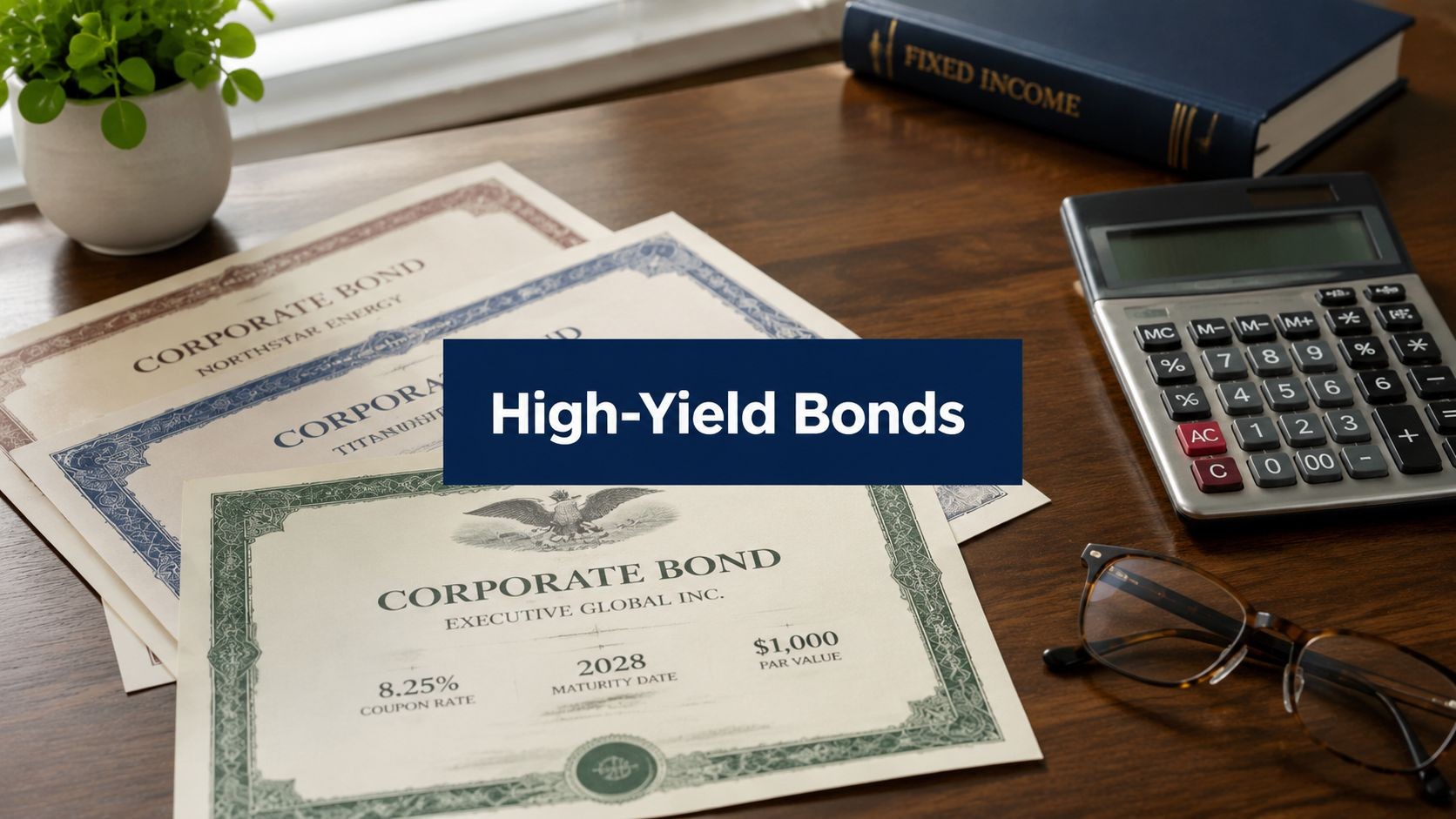
If you were told a bond investment would give you solid income without stock-market drama, and now your statements show losses you don't understand, you're not overreacting. That sales pitch often points to high-yield junk bonds, and many investors first learn what they really are only after the damage is done.
I've seen this pattern before. A retiree asks for income and preservation. The broker recommends something described as “corporate income,” “enhanced yield,” or “a bond, so it's safer than stocks.” Months later, the account is down, the issuer is in trouble, and the explanation suddenly changes from “steady income” to “well, all investing has risk.”
If that sounds familiar, act now. If you would like a free consultation to discuss the investment loss recovery process in more detail, call Kons Law Firm at (860) 920-5181 for a FREE, NO OBLIGATION consultation.
Before you decide what to do next, it helps to understand the product itself and why it so often creates legal problems when advisors sell it to the wrong client. Good investing starts with clarity, and broader strategies for financial security only work when the underlying recommendations match your risk tolerance.
The Lure and the Danger of High Yield Investing
Brokers know the phrase high yield sounds attractive. Investors hear “income.” They don't hear “significantly higher credit risk.” That gap between the sales language and the legal reality is where many disputes begin.
A junk bond is still a bond. That's what makes the pitch effective. People associate bonds with income, order, and a set maturity date. But not all bonds belong in the same conversation. A bond issued by a financially shaky company is a different animal from high-quality debt issued by a stable borrower.
Why the sales pitch works
Many investors never receive a blunt explanation. They hear:
- “It pays more than traditional bonds” and not why it pays more.
- “It's a fixed income product” and not that principal can drop sharply.
- “You'll get regular interest” and not that the issuer itself may fail.
That omission matters. In securities law, the problem often isn't just that an investment lost money. The problem is that the investor was never given a fair picture of the risk in the first place.
Investors usually don't call a securities lawyer because an investment was described accurately. They call when the recommendation and the reality don't match.
What should concern you right away
If you bought a “bond” for stability and instead got stress, you should ask three direct questions:
- Was this investment consistent with my stated goals?
- Did my advisor explain the actual credit risk in plain English?
- Was too much of my account tied to one risky credit strategy?
If the answers are fuzzy, you may be dealing with more than market disappointment. You may be dealing with an unsuitable recommendation, a misleading sales presentation, or both.
What Exactly Are High Yield Junk Bonds
If you're asking what are high yield junk bonds, start with one idea: they are corporate bonds issued by borrowers with weaker credit quality.
Think of a bond rating like a company's financial report card. The lower the grade, the less confidence the market has that the company will pay interest on time and return principal when due. That doesn't mean default is guaranteed. It means the risk is serious enough that investors demand much more compensation.
According to Britannica's explanation of junk bonds and high-yield debt, high-yield bonds are generally below investment grade, typically rated BB or lower by major rating agencies, or below Baa3/BBB-. The same source notes that investors usually receive materially higher yields, with historical spreads often running about 4% to 6% above U.S. Treasuries.
Where the line is drawn
That below Baa3/BBB- threshold is the dividing line that matters. Above it, a bond is generally considered investment grade. Below it, you've entered speculative territory.
The practical meaning is simple. The market expects more trouble from the lower-rated issuer. That trouble can include heavy debt, unstable cash flow, a weak operating history, financial strain, or financing tied to a debt-funded transaction.
A simple comparison
| Characteristic | Investment-Grade Bonds | High-Yield (Junk) Bonds |
|---|---|---|
| Credit quality | Higher | Lower |
| Typical rating range | At or above Baa3/BBB- | Below Baa3/BBB-, often BB or lower |
| Yield | Lower | Higher |
| Default risk | Lower | Higher |
| Typical issuer profile | Financially stronger borrowers | Heavily leveraged, weaker, or stressed borrowers |
| Primary appeal | Stability and income | Higher income in exchange for more risk |
Why higher yield exists
The extra yield is not a gift. It is a price. The issuer has to pay more because investors won't lend cheaply to a weaker borrower.
That's why I push back when advisors describe junk bonds as a simple income upgrade. They are not a slightly better version of conservative fixed income. They are a credit-risk product. If someone sold them to you as a safe substitute for high-quality bonds, that description was incomplete at best.
Practical rule: When an investment pays meaningfully more than safer bonds, ask what specific risk you are being paid to accept. If the answer is vague, walk away.
Why the name matters less than the risk
Some firms avoid the phrase junk bond because it sounds harsh. They prefer high yield, opportunistic credit, or income-focused corporate debt. Fine. The label doesn't control the legal analysis. The risk profile does.
What matters is whether your advisor explained, clearly, that this was below-investment-grade debt tied to a materially higher chance of issuer trouble. If that conversation never happened, the recommendation deserves scrutiny.
The High Stakes Gamble of Default Risk and Returns
A client comes in expecting bond-like stability and finds out the account was loaded with speculative debt because the yield looked attractive on a statement. That is how junk bond losses often surface. The promise of income gets attention. The credit risk gets minimized.
According to TIAA's analysis of the enduring case for high-yield bonds, the ICE BofA Merrill Lynch US Cash Pay High Yield Index returned an average of 7.77% annually from 1993 to 2017, compared with 6.38% for high-grade issues over the same period. The same report said that over rolling five-year periods between 1994 and 2017, average default rates were 4.5% for Ba-rated bonds, 14.3% for B-rated bonds, and 35.8% for Caa-C bonds.
Those numbers matter because they show the bargain clearly. Investors received more income because they accepted a materially higher chance that the borrower would fail. A broker who highlights the yield and blurs that tradeoff is not giving full advice.
What the numbers mean in practice
Default risk in junk bonds does not rise gently as credit quality worsens. It rises fast. That distinction matters in actual accounts, especially where the client asked for income, preservation, or lower volatility.
The same TIAA report also described a historical loss rate of 105 basis points and a 118-basis-point credit risk premium during that period. Put plainly, the extra yield was payment for expected credit losses. It was not a safer way to squeeze more income out of a conservative portfolio.
That is why I object when advisors present lower-rated high yield bonds as routine fixed income. They are selling a riskier credit position. For many clients, that recommendation requires a careful suitability analysis and a very clear explanation of downside exposure.
Where investors get hurt
A default is not just a bad quarter. Interest payments can stop. Bond prices can collapse. Liquidity can disappear right when the investor wants to sell.
Structured products can make that danger harder to see. Some firms place risky credit inside packaged vehicles that appear more complex than they are. If your account included one of those products, review these CLO investment risks and disputes because the legal concerns often overlap. The wrapper may change. The underlying credit danger does not.
A high yield figure should make you ask who is taking the credit risk, how severe the default risk is, and whether that risk fits your account at all.
The legal takeaway
Losses by themselves do not prove misconduct. Losses after an unsuitable recommendation, a misleading risk description, or a concentration in speculative debt can support a strong claim.
In many cases, the problem is simple. The investor was sold the upside story without a fair explanation of default risk, illiquidity, and principal loss. If that happened in your account, treat it as a possible investor protection issue, not just bad luck.
Are Junk Bonds a Suitable Investment for You

Suitability is where abstract risk turns into a legal duty. A broker doesn't get to recommend whatever pays the highest commission or sounds appealing in a client meeting. The recommendation must fit the client.
According to Investor.gov's definition of a high-yield bond or junk bond, these are corporate bonds rated below investment grade, typically below Ba3/BB-, because the issuer has materially higher expected default risk than investment-grade borrowers. That official framing matters. It confirms the product starts from a higher-risk posture.
Who usually should be cautious
In my view, junk bonds are often a poor fit for retail investors who want stability more than speculation. That includes many:
- Retirees living on portfolio income
- Investors with low risk tolerance
- People depending on principal preservation
- Clients who asked for conservative or balanced recommendations
- Households with limited ability to absorb losses
A suitable recommendation has to match your age, objectives, liquidity needs, investment experience, and tolerance for loss. If you said you wanted “safe income” and got below-investment-grade debt, that mismatch deserves a hard look.
When the recommendation deserves scrutiny
Some advisors try to defend junk bond sales by saying, “You wanted income.” That defense is weak if they skipped the second half of the sentence: income in exchange for higher default risk.
That concern appears often in other high-risk income products too. If your advisor also pushed private credit or yield-focused alternatives, you may want to review the issues that arise in BDC and private credit investment disputes.
Suitability isn't about whether an investment could ever make money. It's about whether it made sense for you before the trade was placed.
My recommendation
If you are retired, close to retirement, risk-averse, or relying on invested assets for regular living expenses, treat junk bonds as a specialized risk position, not a core safety holding. If your advisor treated them as interchangeable with conservative bonds, that was a serious problem.
And if your account statements now show losses in products you never understood, don't let the firm shift the blame by saying you signed paperwork. Signatures matter. But so do the conversations, the omissions, the account profile, and the actual recommendation process.
Red Flags of Junk Bond Mis-Selling and Broker Misconduct

Mis-selling usually doesn't look dramatic at the time. It looks polished. It sounds reassuring. The warning signs often become obvious only after the investment drops and the broker starts changing the story.
Sales language that should put you on alert
Watch for phrases like these:
- “Safe as a bond”. That statement blurs the difference between investment-grade debt and speculative debt.
- “Guaranteed income”. A broker should not present junk bond income as guaranteed.
- “Just a temporary dip”. That can minimize issuer-specific credit deterioration.
- “It's diversified because it's in fixed income”. Asset labels don't erase credit concentration.
- “This is appropriate for conservative investors”. That claim may be flatly inconsistent with the product's risk profile.
If you heard language like that, write it down now while your memory is fresh.
Conduct that often supports a claim
Misconduct isn't limited to false statements. It also includes what the broker failed to do.
- Risk omission. The advisor focused on yield and skipped a plain-English explanation of default risk.
- Concentration. Too much of the account ended up in speculative credit or correlated products.
- Profile manipulation. Your new account form was marked more aggressive than your real objectives.
- Terminology games. The broker called it “income” or “corporate debt” and avoided the term junk bond.
- Lack of due diligence. The firm recommended the product without adequately vetting the issuer or strategy.
Some firms also ignore outside activity and off-platform recommendations that expose clients to unapproved investments. If that sounds familiar, review the warning signs associated with FINRA selling away claims.
One fact pattern I take seriously
A client asks for income and safety. The advisor buys risky credit, marks the account as moderate growth, sends statements the client doesn't understand, and later points to boilerplate disclosures. That is a classic dispute pattern.
Boilerplate risk language does not erase a misleading oral sales pitch.
What to do with these red flags
Don't argue with the broker first and don't accept a casual explanation from the branch office. Preserve evidence. Take screenshots of messages. Save emails. Gather notes from meetings. A case often turns on details that seemed minor when the account was opened.
Your Path to Recovery After Junk Bond Losses
Your account drops hard. The broker says the market was rough and tells you to wait. Do not accept that answer until you know what was sold, why it was sold, and whether it ever belonged in your account.
Recovery starts with discipline. Firms defend these cases by claiming you understood the risk, approved the trades, or guessed wrong on the market. Your job is to preserve the record before that story hardens.
Step one: secure the evidence
Pull the documents now, before messages disappear and account access changes. Focus on the records that show what you wanted, what the advisor recommended, and what the firm documented.
- Account statements showing purchases, losses, and any concentration in high-yield debt or related products.
- New account forms listing your objectives, risk tolerance, liquidity needs, age, and income requirements.
- Trade confirmations and any offering materials, summaries, or disclosures you received.
- Emails, text messages, and notes showing how the bonds were described during the sales process.
- Performance reports or dashboard screenshots that may show how the firm presented the investment after purchase.
Keep the file exactly as it is. Do not sort out what you think helps or hurts. Cases are often won with routine documents that looked insignificant at the time.
Step two: write down the sales story
Prepare a timeline while your memory is still useful. Note when the broker first raised the idea, what problem the investment was supposed to solve, what promises or reassurances were made, when the losses began, and what explanation you got after the decline.
Be specific. If the advisor used words like “income,” “diversified,” “bond alternative,” or “safer than stocks,” write that down. Those word choices matter.
Step three: get a legal assessment from someone outside the firm
Do not expect the brokerage firm's complaint department to fairly judge its own conduct. It exists to reduce the firm's exposure.
A securities attorney can compare the recommendation against your profile, the account records, and the communications around the sale. That review may identify unsuitable recommendations, misstatements, excessive concentration, failure to supervise, negligence, or fiduciary breaches. Kons Law is one firm that handles investor claims involving broker and advisor misconduct.
Step four: understand where the case is usually decided
Many investor disputes against brokerage firms end up in FINRA arbitration. That is not an informal complaint process. It is a legal forum where documents, testimony, suitability evidence, and damage calculations matter.
If you want a practical overview, read this guide on how to file for FINRA arbitration.
Step five: stop making the broker's defense easier
Several mistakes weaken otherwise strong claims:
- Waiting too long, which makes documents harder to get and timelines harder to prove.
- Relying on verbal reassurances instead of preserving written communications.
- Treating the loss as a market issue only instead of examining how the product was recommended.
- Signing new paperwork without review after the problem surfaces.
- Blaming yourself too quickly when the actual issue may be misrepresentation or unsuitability.
What recovery can look like
The legal path depends on the facts, not on the broker's talking points. Some claims center on a bad recommendation. Others focus on concealment of risk, overconcentration, supervision failures, or false account profiling. In the right case, the issue is not that the bond lost value. The issue is that the investment should not have been sold to you in the first place.
If junk bond risk was downplayed, your objectives were ignored, or the product was presented as safe income, treat that as a legal problem worth investigating. You may have a claim for recovery, and you should act before evidence gets stale.
Protecting Your Portfolio and Seeking Legal Counsel
High-yield junk bonds are not automatically improper. But they are often improperly sold. That distinction matters. A risky product can exist lawfully and still be recommended unlawfully to the wrong investor in the wrong amount with the wrong explanation.
If you came here asking what are high yield junk bonds, the short answer is this: they are below-investment-grade corporate bonds that pay more because the issuer presents greater default risk. The more important answer is practical. They should never be dressed up as a conservative income substitute for investors who need stability.
If your advisor minimized the risk, overstated the safety, concentrated your account, or ignored your actual objectives, the losses are not your burden to carry in silence. Investors are entitled to honest recommendations and fair treatment.
Don't deal with this complex process alone. If you have suffered losses in high-yield bonds, call Kons Law Firm at (860) 920-5181 for a FREE, NO OBLIGATION consultation to discuss your investment loss recovery options.
If you believe a broker or advisor misrepresented junk bonds, made an unsuitable recommendation, or failed to disclose actual risks, Kons Law may be able to help you evaluate your recovery options through FINRA arbitration or other securities claims.
