
If you bought a BDC because your broker emphasized income, steady distributions, and access to private credit, but your account value dropped and the explanations now sound vague, you're not alone. Many investors only learn after the fact that a bdc investment company can carry layered risks that don't resemble a plain dividend stock, bond fund, or bank product.
Losses in a BDC don't automatically mean misconduct occurred. But they also shouldn't be brushed off as simple market bad luck, especially when the product was presented as conservative, stable, or easy to exit. The right first step is to understand what you were sold, how it was described, and whether the recommendation fit your needs, risk tolerance, and liquidity requirements.
Your BDC Investment Promised High Yields But Delivered Losses
You may be in a familiar position. The investment was pitched as an income-producing opportunity. The broker focused on yield, regular cash flow, and the appeal of lending to established middle-market businesses. Then the statements started showing losses, the share price didn't track the story you were told, or you discovered that selling wasn't simple at all.

That disconnect matters. Investors often hear the income story first and the structural risk story later. With BDCs, those risks can include indebtedness, borrower defaults, valuation uncertainty, limited liquidity, and fee drag. If the recommendation came with incomplete disclosures or a misleading comparison to safer products, the issue may be bigger than an unlucky trade.
Why investors feel blindsided
A BDC can look straightforward on the surface. You buy shares. The product pays distributions. It holds loans or investments in operating businesses. But the legal and economic reality is more complex. The manager may be using borrowed money, lending to companies that don't have easy access to traditional bank financing, and valuing some holdings without a daily public market.
That means two things can be true at once:
- The yield was real: Cash distributions may have been paid.
- The risk was understated: Principal losses, pricing gaps, and liquidity problems may still follow.
Investors usually call counsel after the sales language stops matching the account statement.
When losses may point to a claim
A bad outcome alone isn't enough. What matters is how the product was recommended and described. Warning signs include:
- Mismatch with your profile: A retiree seeking preservation of capital was placed into a high-risk income product.
- Liquidity surprise: You learned later that selling was difficult, delayed, or subject to internal processes rather than an open market.
- Risk minimization: The broker described the investment as safe, stable, bond-like, or suitable for emergency reserves.
- Concentration: Too much of your portfolio was tied to one BDC or a cluster of similar alternative income products.
Those issues often appear together. When they do, investors should take the situation seriously.
What Is a BDC Investment Company
A Business Development Company, or BDC, is a legally defined investment structure, not just an income label a broker can attach to a product. Congress created BDCs to direct capital to smaller and middle-market businesses that often borrow outside the traditional bank system.

A bdc investment company can be understood as a specialized finance vehicle that invests primarily in private or thinly traded operating companies. In practice, that usually means the BDC is making loans, taking warrants or equity positions, and relying on management's valuation judgments for assets that do not trade on a public exchange every day.
That last point matters in investor cases. If an asset does not have a transparent market price, the account statement may not show risk as quickly or as clearly as an investor expects.
The legal framework matters
The rules behind the structure affect both returns and sales practices. BDCs operate under an Investment Company Act framework that limits the kinds of companies they can invest in and pushes them toward a specific slice of the private credit market. Many also elect Regulated Investment Company, or RIC, tax treatment, which generally requires them to distribute most taxable income to shareholders. That helps explain why brokers often present them as income products.
The problem is that "income product" can hide the underlying question. What is generating that income, and what risks sit behind it?
For a fuller explanation of the product's legal design, see this overview of a business development company structure and investor risks.
Why investors buy them, and what often gets omitted
A BDC gives retail investors access to a part of the credit market they usually cannot reach directly. That access can be legitimate. It can also be sold badly.
Here is the trade-off investors need to hear at the point of sale:
| Feature | Why it appeals to investors | What a broker may gloss over |
|---|---|---|
| Income distributions | Regular cash flow can look attractive | Distributions do not protect principal |
| Private credit exposure | Access to middle-market lending | Portfolio companies may be riskier, less liquid, and harder to value |
| Closed-end structure | Manager can hold longer-term investments | Share price and underlying asset value can diverge sharply |
I have seen the same sales pattern repeatedly. A broker focuses on yield, compares the investment to dividend-paying securities, and spends little time on valuation risk, debt financing risk, liquidity limits, or borrower distress. That is not a small omission. It goes directly to suitability and full disclosure.
What a BDC actually means for an investor
A BDC is an investment in a lender and asset manager exposed to credit risk, valuation risk, and management execution risk. It is not a cash alternative. It is not necessarily conservative because it pays distributions. It is not automatically suitable for retirees, trust accounts, or investors who need ready access to principal.
Those distinctions matter because many loss cases start with a product description that was technically positive but materially incomplete.
Understanding BDC Yields and Credit Risks
The reason many investors buy a BDC is straightforward. Yield. But yield in this market is usually compensation for risk, not free income. The BDC is often earning money by lending to middle-market companies, collecting interest and fees, and using its own balance sheet structure to enhance returns.
That business model can work. It can also become fragile fast when credit quality weakens, borrowing costs rise, or borrowed capital amplifies losses.
Why the income can look so attractive
Many BDCs lend through floating-rate, senior secured loans. According to VanEck's discussion of how BDCs make money and where the risks sit, BDC balance-sheet risk is highly sensitive to their debt levels and borrower quality, and many BDCs use floating-rate loans, so rising benchmark rates can lift income but also increase default risk for borrowers.
That creates a sales pitch brokers like to use. Higher rates can mean more interest income. The problem is that the same rate environment can pressure the underlying companies that owe the money.
The three risks investors need to understand
A BDC owner is not just betting on income. The investor is exposed to several moving parts at once.
Credit risk
If portfolio companies struggle, loan payments can weaken, restructurings can happen, and valuations can fall. A BDC can still appear healthy from the outside while borrower quality is deteriorating inside the portfolio.Debt-to-equity risk
VanEck notes that statutory debt-to-equity is capped at 2:1 in the common framework discussed for U.S. BDCs. The use of borrowed capital can boost returns when assets perform well, but it also amplifies losses when values decline or credit events hit.Interest-rate risk
Floating-rate assets may support income during higher-rate periods, yet those same higher rates can stress borrowers with weaker cash flow. What helps the BDC's revenue line can hurt the borrower's ability to pay.
Yield alone isn't enough. A BDC can show attractive income and still underperform because credit losses, fees, or leverage cut into what investors actually keep.
What works and what doesn't
Investors do better when they ask hard questions before buying. They get hurt when the recommendation centers on distributions and ignores the mechanics underneath.
A useful way to assess the sales process is this:
| Sales framing | What a careful explanation should include |
|---|---|
| "High income" | Where the income comes from and what borrower stress could do to it |
| "Senior secured lending" | Security interests help, but they don't remove default risk |
| "Good in a rising-rate environment" | Rising rates can help income while simultaneously hurting borrowers |
| "Alternative to bonds" | BDCs can behave very differently from traditional fixed income |
For a closer look at how these issues often intersect with private credit risk, this discussion of BDCs and private credit exposure is useful context.
Public BDCs vs Non-Traded BDCs
Not every BDC creates the same investor experience. This distinction gets missed all the time in sales conversations, and it matters. A publicly traded BDC and a non-traded BDC can both carry the BDC label while presenting very different risks around pricing, liquidity, and transparency.
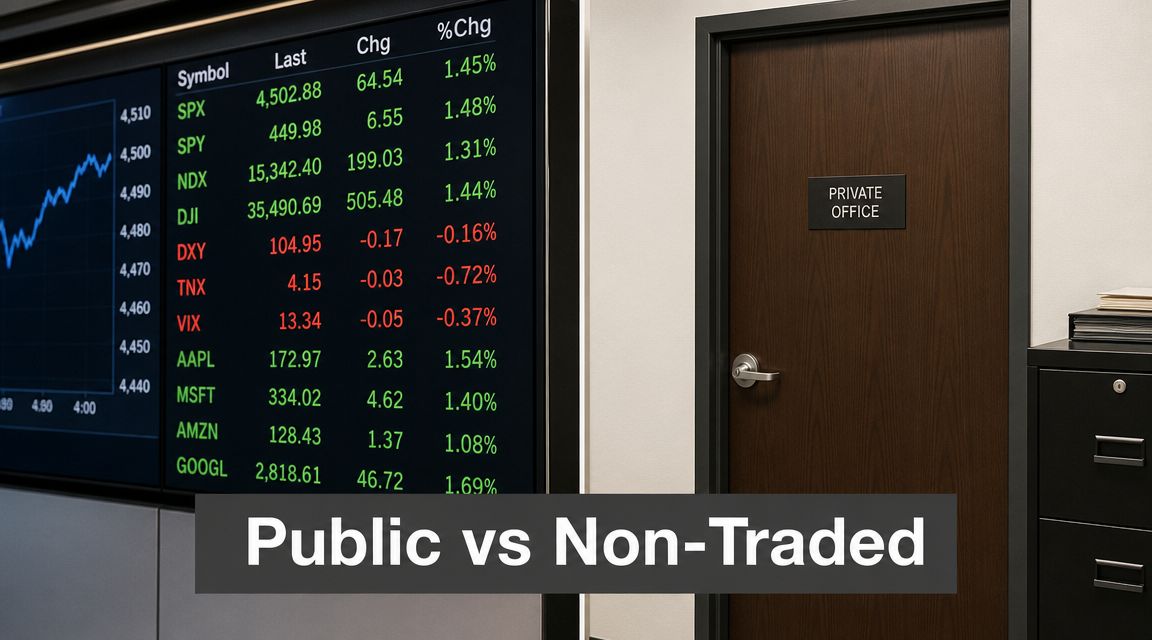
The industry has grown from approximately $127 billion in 2020 to about $451 billion in 2025, and a dramatic share of that expansion is tied to private investments, with the relevant market measure rising from roughly 17% to about 66%, according to Mayer Brown's BDC facts and stats summary. That shift is one reason investors need to pay attention to whether they own a public vehicle or a less-liquid private structure.
How the two structures differ
Here is the practical comparison investors should make.
| Type of BDC | Liquidity | Pricing | Common investor concern |
|---|---|---|---|
| Publicly traded BDC | Shares can generally be bought and sold on an exchange | Market price updates in public trading | Price volatility can be obvious and immediate |
| Non-traded BDC | Selling may be limited, delayed, or restricted | Valuation may depend on internal or infrequent methods | Investors may not appreciate how hard exit can be |
With a public BDC, you can usually see market price changes in real time. That transparency can be uncomfortable, but at least the discomfort is visible.
With a non-traded BDC, the risk often presents differently. The account statement may not immediately reflect the kind of price discovery you'd see in an exchange-traded product. Investors sometimes mistake that for stability.
Where investors get misled
The most common problem isn't that non-traded BDCs exist. The problem is how they are described. If the broker emphasizes income and downplays the limits on redemption, valuation subjectivity, or portfolio illiquidity, the client may think the product is safer than it is.
A product can look calm on a statement because the market hasn't priced it in real time, not because the risk disappeared.
For investors who suspect they were placed into this type of product without a full explanation, this resource on non-traded business development company risks helps frame the issues that often appear in disputes.
Common Red Flags of BDC Broker Misconduct
Most BDC cases don't begin with a client saying, "My broker violated securities rules." They begin with a simpler reaction: "This is not what I thought I bought." That reaction often points to the sales process.
Investor guidance associated with the BDC market warns that buyers should understand a BDC's debt, fees, and key risks, and notes that the market exceeded $434 billion in AUM as of Q4 2024, making widespread misunderstanding more consequential, as summarized by the Small Business Investor Alliance's BDC market page. In practice, the misunderstandings often follow repeat patterns.
Unsuitable recommendations
A BDC may be unsuitable if the investor needed liquidity, principal stability, or low volatility. This is especially serious when the customer is retired, dependent on the account for living expenses, or relying on the funds as a near-term reserve.
An unsuitable recommendation often sounds reasonable at first. The broker says the client wants income. The BDC pays income. The analysis stops there. It shouldn't.
Misrepresenting liquidity
This is one of the most damaging sales failures. A non-traded or private BDC can be sold as if it were easily redeemable or functionally similar to a public income investment. The investor only learns the truth later, usually when cash is needed.
Common versions include:
- "You can always get out if you need to." That may be false or materially incomplete.
- "It works like a conservative income fund." That comparison may ignore illiquidity and valuation risk.
- "The value doesn't move much." A stable reported value isn't the same as a liquid market value.
Downplaying leverage and valuation risk
Some brokers talk about portfolio companies and distributions but skip the hard part. They don't explain that borrowing can magnify losses or that portions of the portfolio may be difficult to price in stressed conditions.
That omission matters because valuation disputes often become central after losses occur. If the statement value stayed relatively flat while economic risk worsened, the investor may have made decisions based on a misleading sense of stability.
Clients often discover the true risk profile only when they try to sell, transfer, or question a decline.
Failure to disclose fees and economic drag
BDCs can involve multiple layers of cost. Even when fees are disclosed somewhere in offering materials, the practical question is whether the investor received a fair, understandable explanation before buying. If not, the recommendation may have been misleading in substance even if paperwork existed.
Overconcentration in alternative income products
A broker can turn one risky recommendation into a portfolio-level problem. An investor may be placed not only in one BDC, but in several alternatives with similar credit, liquidity, or valuation characteristics. The account appears diversified by product name. Economically, it may not be diversified at all.
If your experience fits any of these patterns, a review by counsel who handles broker misconduct claims can help determine whether the loss was tied to a sales practice violation rather than ordinary market movement.
Steps to Recover Your BDC Investment Losses
If you suspect your losses stem from the way the BDC was sold, don't wait for the broker to reconstruct the story for you. Start building your own record. Recovery cases often turn on documents, timelines, and the gap between what was promised and what was disclosed.

A BDC is a regulated closed-end investment company under the Investment Company Act of 1940, and that regulatory framework helps form the legal basis for investor claims when a broker or firm makes an unsuitable recommendation, as described in this discussion of what a BDC is and how investor claims can arise.
Step one gathers the paper trail
Start with the basic file. You want the recommendation history, not just the loss number.
Collect:
- Account statements: Monthly or quarterly statements showing purchases, valuations, distributions, and declines.
- Trade confirmations: These help identify dates, quantities, and transaction details.
- Emails and letters: Anything where the broker described safety, liquidity, expected income, or suitability.
- Notes from calls or meetings: Even informal notes can help establish what was said.
- New account forms: These are critical if the firm later claims you asked for aggressive or illiquid products.
If you have online portal screenshots showing values or redemption language, save those too.
Step two gets a real case evaluation
Many investors lose time by arguing directly with the broker who sold the product. That's rarely productive. The broker and firm already know the language they want to use. What you need is an outside review of the recommendation, disclosures, concentration, and damages.
A lawyer who handles securities disputes can evaluate questions such as:
| Question | Why it matters |
|---|---|
| Was the BDC suitable for your objectives? | Suitability is often central in investor claims |
| Were liquidity limits explained clearly? | Misstatements about exits can support a claim |
| Was the account overconcentrated? | Concentration can turn a risky product into an unreasonable recommendation |
| Did the firm supervise the sale properly? | Supervision failures may broaden liability beyond the individual broker |
Bring the documents before memories fade. The paper trail often tells the story more clearly than the salesperson does.
Step three understands the recovery path
Many investor disputes involving brokerage firms are pursued through FINRA arbitration rather than a traditional court lawsuit. That doesn't make the claim informal. It is still a legal proceeding, and the quality of the evidence matters.
A typical recovery path may involve:
- Reviewing the account and documents
- Identifying legal theories, such as unsuitable recommendations, misrepresentation, omission of material facts, overconcentration, or failure to supervise
- Filing a FINRA arbitration claim against the responsible broker and firm when appropriate
- Pursuing settlement or hearing recovery based on the facts
Not every BDC loss supports a case. Some losses are investment losses by nature. But when the recommendation was flawed from the start, the law may provide a way to seek recovery.
Take Action to Protect Your Financial Future
A bdc investment company can be legitimate, useful, and still inappropriate for a particular investor. That's the point many sales conversations leave out. The product's legal structure, income profile, indebtedness, credit exposure, and liquidity limits all matter. So does the way the broker framed them.
If you were told the investment was safe, stable, easy to sell, or well-suited for retirement assets without a full explanation of the trade-offs, your losses may deserve closer review. Investors have rights, and those rights don't disappear because a risky product was wrapped in income language.
Waiting usually helps the firm, not the customer. Gather your records, preserve your communications, and have the recommendation evaluated by counsel who understands securities claims and investor recovery.
If you'd like a free consultation to discuss the investment loss recovery process in more detail, call Kons Law at (860) 920-5181 for a FREE, NO OBLIGATION consultation.
