
You may be looking at a parent's brokerage statements and feeling that something is off, but you can't yet prove it. The account may suddenly hold variable annuities, private placements, or concentrated positions that don't fit a retired person's goals. The advisor may be telling your family that the losses are just “the market,” while your parent insists the broker is trustworthy.
That situation is common in cases involving a licensed financial professional. It also requires a different response than a case involving a caregiver, a joint bank account, or misuse of a power of attorney. When a broker or advisor is involved, the actual questions usually are whether the recommendations were suitable, whether the trades were authorized, whether the firm ignored obvious warning signs, and whether the claim belongs in FINRA arbitration rather than probate court.
A Guide to Fighting Elder Financial Abuse by Brokers and Advisors

When families search for an elder financial abuse attorney, they often find articles focused on scams, caregivers, or stolen checks. Those issues matter, but they don't answer the harder question: what do you do when the person who caused the damage is a broker, investment adviser, or brokerage firm that wrapped the abuse in account forms, suitability questionnaires, and polished explanations?
The scale of the problem is not small. The National Council on Aging states that older adults lose over $28 billion annually to financial abuse, and between June 2022 and June 2023, FinCEN received 155,415 reports related to elder financial exploitation reflecting about $27 billion in reported suspicious activity. That same evidence trail matters because cases against financial institutions often turn on account records, internal notes, transfers, and compliance reviews documented in regulated systems, as described in the National Council on Aging's elder abuse overview.
Some losses are plainly theft. Others are buried inside recommendations that were never appropriate for an older investor in the first place. If you're trying to understand the difference between ordinary losses and actionable misconduct, this overview of elder financial abuse basics is a useful starting point.
Why broker cases are different
A family-abuse case often focuses on who controlled the elder's money. A broker case usually focuses on how the money was invested, traded, supervised, and documented.
That changes everything, including:
- Where the claim is filed. Many investor disputes against brokerage firms belong in FINRA arbitration.
- What evidence matters most. Monthly statements, new account forms, emails, text messages, wire records, and internal firm responses often carry more weight than family suspicion alone.
- Who may be liable. The responsible party might be the individual advisor, the brokerage firm, an investment advisory firm, a custodian, or more than one entity.
Practical rule: If a senior's losses are tied to investment recommendations or trading activity, treat the matter as a potential securities case from day one, not just a family dispute.
Time matters. Records disappear, memories harden, and firms build defenses quickly once they know a complaint is coming.
Recognizing Red Flags of Advisor and Broker Misconduct
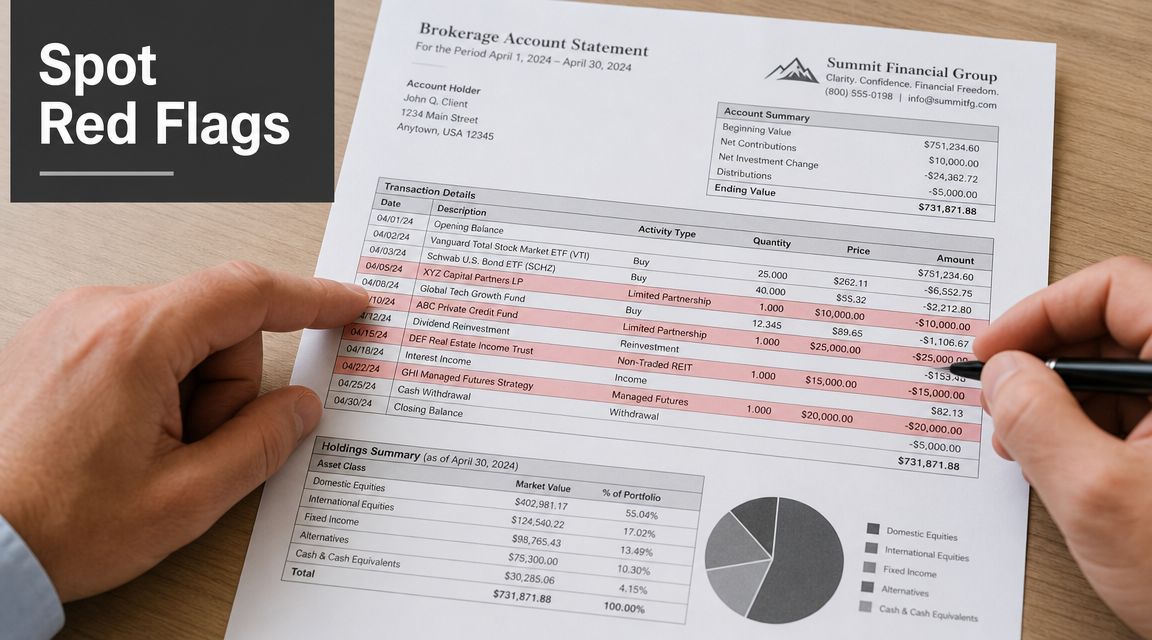
Most families expect financial abuse to look like a stolen check or a drained bank account. In broker cases, it often looks like a “strategy.” That's why many families wait too long. The paperwork appears legitimate, the products have official names, and the advisor has an answer for every concern.
A key problem is that many elder financial abuse cases are not simple theft but are framed as legitimate investment strategies. Many victims don't self-identify, family intervention can be delayed, and some claims are better framed as unsuitable recommendations, churning, or unauthorized trading rather than a traditional incapacity-based case, as discussed in this elder financial exploitation analysis.
What suspicious activity looks like in a brokerage account
Start with fit. If the account belonged to a retiree who needed income, liquidity, and preservation, ask whether the holdings match that profile.
Common warning signs include:
- Complex products in a conservative account. Variable annuities, non-traded products, structured products, options, or private placements may be unsuitable for an elderly investor who needed simplicity and access to cash.
- Frequent trading. If the account shows repeated buying and selling with no clear purpose, the broker may have been generating commissions rather than serving the client.
- Concentration risk. A senior investor's account heavily tied to one stock, one sector, or one speculative theme can signal poor supervision or unsuitable advice.
- Transactions the client cannot explain. If your parent says, “I don't remember approving that,” take it seriously.
- Defensive explanations from the advisor. Watch for language that avoids specifics, especially when the advisor blames volatility but won't address why the product was recommended.
A family that wants to organize its review can borrow ideas from this investing checklist from Finzer, especially for gathering the underlying documents before confronting anyone.
Capacity issues make these cases harder, not weaker
A signature on a form doesn't end the analysis. Seniors with cognitive decline can sign documents, repeat an advisor's explanation, and still be vulnerable to exploitation or pressure. In practice, some of the strongest cases involve a client who signed account paperwork but plainly did not understand the risk, the liquidity limits, or the trading activity.
Look for these capacity-related clues:
- Sudden strategy shifts after years of stable investing.
- New trusted contact changes or unusual communication patterns.
- Large product purchases made after health declines, bereavement, or isolation.
- Boilerplate risk tolerance forms that conflict with the client's actual age, needs, and history.
A signed suitability form is evidence. It is not the whole case.
Losses alone don't prove abuse
Not every decline in an older adult's portfolio is elder financial abuse. Markets move. Good investments can lose value. What matters is whether the professional breached duties through unsuitable recommendations, unauthorized trading, overconcentration, misrepresentations, or supervisory failures.
If the conduct points in that direction, the issue is no longer just “bad luck.” It may be broker misconduct, and families should start treating it that way. For a closer look at those patterns, review this discussion of broker misconduct claims.
Immediate Actions to Preserve Evidence and Protect Assets

Once you suspect misconduct, your job changes. You are no longer trying to win an argument with the advisor. You are trying to preserve evidence, protect the elder, and avoid mistakes that damage a later recovery claim.
A practical recovery workflow starts with identifying red flags and preserving documents, determining legal control and the true client relationship, then filing civil recovery claims or seeking protective orders and coordinating recovery. One of the biggest pitfalls is misidentifying the client, such as treating the caregiver or adult child as the client instead of the older person whose assets are at risk, as outlined in this elder abuse recovery workflow discussion.
First steps in the first days
Do these tasks before you accuse anyone:
Download every statement you can access
Save monthly statements, trade confirmations, annuity applications, account-opening documents, wire requests, beneficiary forms, and tax documents.Preserve communications
Gather emails, text messages, voicemail summaries, handwritten notes, and calendars showing meetings or calls with the advisor.Write a timeline
Record when the account changed, when the parent's health changed, when family first noticed problems, and what the advisor said when questioned.Secure online access if authorized
If the family has lawful access, change passwords and preserve login records. Don't guess at credentials or access the account without authority.
Determine who has legal authority
This point gets mishandled often. An adult child may be the person discovering the abuse, but that doesn't automatically make that person the legal decision-maker.
Check whether there is:
- A valid power of attorney
- A trustee with authority over trust assets
- A conservator or guardian
- An executor or estate representative if the elder has died
If authority is unclear, get that sorted out immediately. Firms will often refuse to share information until the proper representative is identified.
Critical point: The injured client is the elder investor or the estate, not the family member who happens to be the loudest or most organized.
Contact the firm carefully
There is a right way and a wrong way to alert a financial institution.
The wrong way is an emotional phone call accusing the broker of stealing. The right way is a measured written notice to the firm's compliance department requesting preservation of records, identifying suspicious activity, and asking for the account to be reviewed. Depending on the facts and legal authority, families may also ask the institution to place heightened review, a temporary hold, or other protective measures where appropriate.
Use a short, factual approach:
- Identify the account. Include names, account numbers, and the relationship to the elder.
- Describe the concern. State that suspicious recommendations, transfers, or trades require immediate review.
- Request preservation. Ask the firm to preserve all documents, notes, recordings, emails, texts, and supervisory materials.
- Avoid overexplaining. You don't need to prove the whole case in the first letter.
Create an outside record
Families should also consider reporting to agencies that can create a formal record, such as Adult Protective Services or the state securities regulator. These reports won't replace a recovery claim, but they can help document concern, trigger review, and support later advocacy.
Don't wait for certainty. By the time a family feels certain, the most useful records are often harder to obtain.
How to Choose the Right Elder Financial Abuse Attorney

Families often assume any elder law attorney can handle a broker abuse case. Sometimes that works for protective orders, guardianship questions, or estate issues. It often does not work for an investment-loss recovery claim against a brokerage firm or advisor.
The problem is procedural as much as substantive. Broker cases involve suitability standards, supervisory obligations, account documentation, arbitration clauses, damages models, and industry rules that general practitioners may not handle regularly.
General elder law attorney versus securities attorney
Here is the practical distinction.
| Attorney type | Usually strongest at | Usually not the best fit for |
|---|---|---|
| General elder law attorney | Capacity issues, guardianship, protective planning, probate-related disputes | Proving unsuitable recommendations, churning, unauthorized trading, or FINRA-specific claims |
| Securities litigation attorney | Brokerage misconduct, investment loss recovery, FINRA arbitration, firm liability theories | Purely family-control disputes with no investment misconduct component |
If the suspected wrongdoer is a licensed financial professional, your family should strongly consider counsel who routinely handles securities matters. This overview of choosing a financial abuse lawyer for investment-related losses highlights the difference.
Questions to ask in the consultation
Don't ask only whether the lawyer handles elder abuse. Ask whether the lawyer handles elder financial abuse by brokers and advisors.
Use direct questions:
- How much of your practice involves investor claims against brokerage firms or advisors?
- Do you handle FINRA arbitration regularly?
- Have you handled cases involving unsuitable annuities, unauthorized trading, concentration, or supervision failures?
- Who would be the likely defendants in a case like this?
- What records do you want first?
- How do you analyze damages if the account had both market losses and questionable recommendations?
- Do you expect this case to belong in arbitration, court, or both?
- How do you address signed forms when the elder may have had diminished capacity?
The right lawyer should answer clearly and specifically. If the answer stays abstract, keep looking.
What strong counsel usually does early
An experienced lawyer typically starts by pressure-testing the theory of liability. That means identifying whether the strongest claim is unsuitability, unauthorized trading, failure to supervise, negligence, breach of fiduciary duty, or theft.
They should also focus quickly on:
- Account-opening documents
- Investment objectives and risk tolerance records
- Communications and notes
- Product-specific disclosures
- The firm's supervision and escalation history
- Whether the elder had capacity concerns the firm should have recognized
The best early question is not “Can we sue?” It is “Who had duties to this investor, and what proof shows those duties were breached?”
Fee structure and practical fit
Many investment-loss cases are handled on a contingency-fee basis, which can be important for families already dealing with care costs and depleted accounts. You should still ask how expenses are handled, what happens if the claim doesn't recover money, and whether the firm expects arbitration filing costs or expert costs.
Fit matters too. Families in these cases are stressed, angry, and often embarrassed. You need a lawyer who can separate emotion from proof without minimizing what happened.
Warning signs when interviewing lawyers
Be cautious if the lawyer:
- Talks mostly about criminal prosecution when your main need is money recovery.
- Focuses only on probate remedies though the losses came from a brokerage account.
- Promises quick results before reviewing statements and account forms.
- Treats every elder loss as incapacity-based abuse instead of analyzing securities violations.
The right elder financial abuse attorney for a broker case is often a securities lawyer who understands elder vulnerability, not just an elder law lawyer who occasionally sees financial disputes.
Understanding Your Legal Recovery Options
When the suspected wrongdoer is a broker or advisor, the recovery path is usually defined by the account agreement and the industry's dispute framework. Many families are surprised to learn that the primary venue is often FINRA arbitration, not a public courtroom.
That distinction matters because many discussions of elder abuse blur family exploitation and financial-professional misconduct. For brokerage-related claims, the path is different. Brokerage firms and advisors are typically subject to FINRA rules, which often makes FINRA arbitration the primary venue for claims involving unsuitable recommendations, supervision failures, and related investment misconduct, as noted in this discussion of brokerage liability in elder abuse cases.
Comparison of Legal Recovery Paths
| Factor | FINRA Arbitration | Civil Litigation (Court) | Regulatory Complaint (SEC/State) |
|---|---|---|---|
| Typical use | Claims against brokerage firms and registered representatives | Cases that belong in court because of parties, claims, or procedural posture | Reporting misconduct to regulators |
| Main goal | Monetary recovery for the investor | Monetary recovery, injunctions, or broader civil relief depending on the case | Investigation, discipline, or enforcement |
| Privacy | Generally more private than court | Public court filings are often accessible | The complaint process is not the same as a private damages case |
| Procedure | Arbitration rules, panel process, document exchange, hearing | Formal civil procedure, motions, discovery, possible trial | Agency review, not a substitute for private representation |
| Best for | Unsuitable recommendations, unauthorized trading, churning, failure to supervise | Cases involving non-FINRA defendants or separate civil issues | Creating a record and encouraging oversight |
| Limitation | May not cover every possible defendant or remedy | Can be slower and more procedurally complex | May not return money directly to the victim |
What usually works best in broker cases
For most investor claims involving a brokerage account, FINRA arbitration is the practical center of the case. It is built to resolve disputes between customers and industry members, and it often allows counsel to present the account history, product issues, supervision failures, and damages in a focused forum.
Court can still matter. A case may involve parallel issues such as emergency relief, estate administration, trust disputes, or claims against non-broker parties. But when the losses stem from recommendations and trades in a brokerage account, families should expect arbitration to be part of the discussion.
If you're trying to decide whether a lawsuit is even available, this explanation of claims against a financial advisor helps frame the issue.
Regulatory complaints help, but they are not the recovery case
Families sometimes assume a complaint to the SEC or a state regulator will recover the money. Sometimes regulators do act, and their involvement can be useful. But a regulatory complaint is usually not the same thing as a private recovery claim.
Use it for what it is:
- A way to alert regulators
- A way to create another record of the misconduct
- A way to increase pressure on the institution
Don't use it as a substitute for a damages case. If the goal is getting money back, the legal claim still needs its own strategy, evidence, and forum.
The strongest cases line up the forum with the facts. They don't force every dispute into probate court or treat every bad investment as a regulator-only problem.
Frequently Asked Questions About Financial Abuse Claims
What if my parent refuses to believe the advisor did anything wrong
That happens often. Seniors may trust the advisor, feel embarrassed, or fear losing independence. A claim can still be viable if the documents, transactions, and communications show unsuitable recommendations, unauthorized activity, or exploitation of diminished capacity. Start with records, not arguments.
What if my parent signed everything
Signed forms matter, but they don't automatically defeat the claim. The key questions are whether the products fit the investor, whether the risks were explained, whether the trading was authorized, and whether the firm ignored vulnerability markers or capacity concerns.
What if the advisor left the firm
The case may still exist. In many matters, the firm's supervision, account approval, or failure to act is central. The responsible entity is not always just the individual advisor.
Is there any formal compensation pathway outside a lawsuit or arbitration
Yes, in some circumstances. The federal system has expanded recognition of older adults as a distinct victim class. The Elder Abuse Prevention and Prosecution Act was signed into law on October 18, 2017, and in FY 2021 and FY 2022, 23,710 people age 60 and older applied for compensation benefits, while 2,062 compensation claims related to elder abuse or neglect were paid by VOCA-funded organizations, according to the Department of Justice elder justice data. Those programs won't replace a securities recovery claim, but they can matter in the overall strategy.
How fast should we act
Quickly. The longer a family waits, the easier it becomes for the firm to frame the events as ordinary investment losses and the harder it may be to gather clean evidence. Early action is especially important when the elder is still being influenced by the advisor or when assets remain exposed.
If you'd like a free consultation to discuss the investment loss recovery process in more detail, contact Kons Law. Kons Law is a nationwide securities and investment litigation firm focused on recovering money for investors through FINRA arbitration and court actions. Call Kons Law Firm at (860) 920-5181 for a FREE, NO OBLIGATION consultation.
